The first thing Daniel Carter noticed was the way his son stopped smiling.
It happened so quietly that most people in the plaza missed it. One minute, eight-year-old Noah was pushing himself across the smooth concrete on his scratched blue skateboard, arms loose, knees bent the way Daniel had shown him. The next minute, the board shot away from him, rolled across the open square, and bumped against the polished black sneaker of Travis Cain, the most famous martial arts champion in the city.
Noah froze in the middle of the plaza with one knee scraped, one shoelace untied, and fear spreading across his small face. He knew who Travis Cain was. Every kid in Mason Falls knew him. Travis had billboards above the freeway, a gym downtown with his name in silver letters, and videos online where he threw grown men to the mat while smiling at the camera.
Daniel knew him too, though not in the way the crowd did. He knew the type. Loud confidence. Camera-ready toughness. A man who had mistaken attention for respect until he could no longer tell the difference.
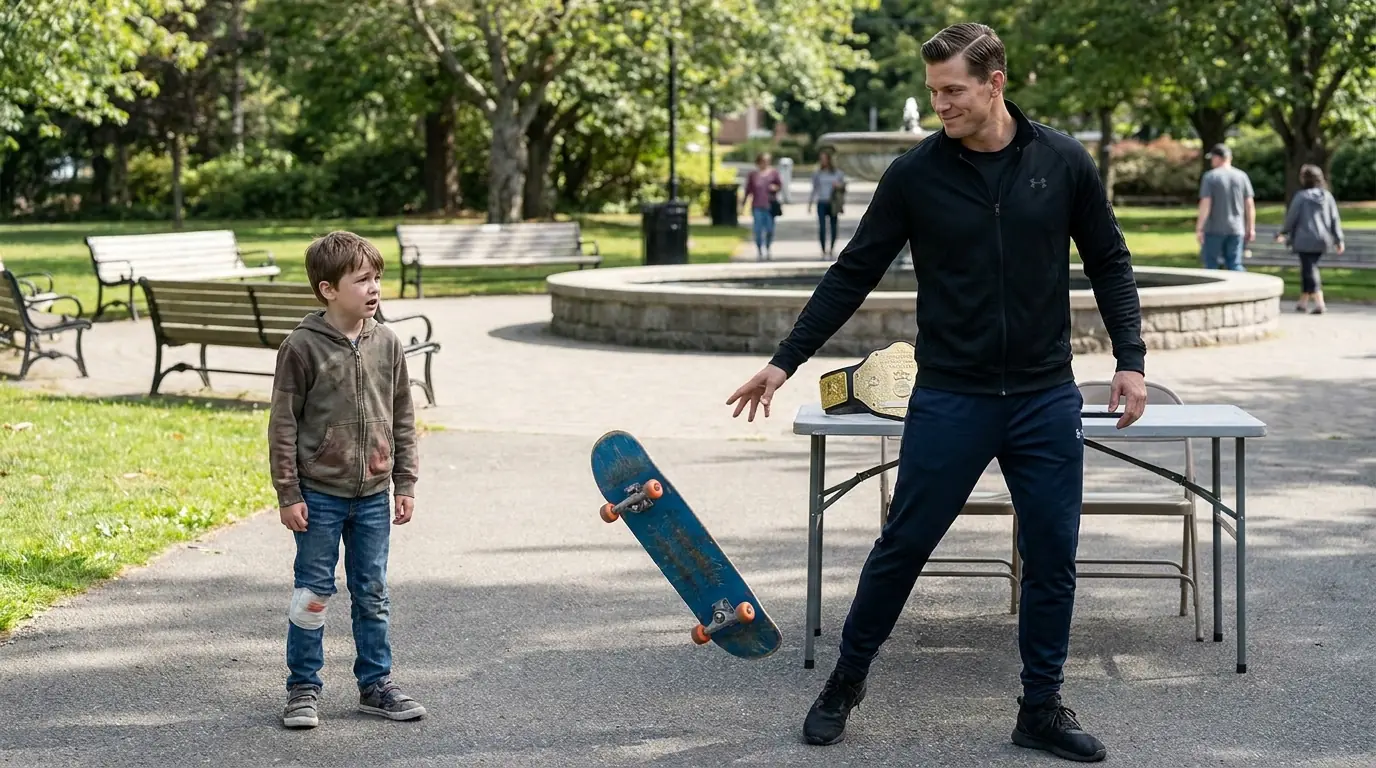
The late afternoon sun hung low over the downtown plaza, turning the glass storefronts gold and throwing long shadows across the benches. Food trucks lined the curb. Parents pushed strollers. Teenagers sat on the edge of the fountain, pretending not to watch the group that had gathered around Travis and his crew. Someone had brought a small portable camera rig. Another man held a microphone with the logo of a local sports channel printed on it.
It was supposed to be an ordinary Tuesday for Daniel and Noah. After school, Noah had asked if they could stop at the plaza for twenty minutes before going home. He wanted to practice turning without falling. Daniel had looked at his son’s hopeful face, thought about the laundry waiting in the apartment and the chicken thawing in the sink, and said yes.
Noah had lost his mother two years earlier. Since then, Daniel had learned that grief did not always look like crying. Sometimes it looked like a child asking the same bedtime question three times. Sometimes it looked like a lunchbox coming home untouched. Sometimes it looked like a boy clinging to small routines because routines made the world feel less likely to disappear.
So Daniel said yes to the plaza. He said yes to scraped knees. He said yes to the skateboard even though Noah was still wobbly, because falling and getting back up was something Daniel wanted him to learn before the world taught it the hard way.
“Go get it, buddy,” Daniel called gently.
Noah took one step toward the board, then stopped when Travis Cain lifted it with one hand.
The crowd around Travis shifted. A few people turned their phones from selfie mode to recording mode. Travis was tall, broad-shouldered, and built like a man who had spent half his life in mirrors. His black training jacket was unzipped enough to show the white logo of Cain Combat Academy across his chest. A championship belt sat on a folding table nearby as if it had its own security detail.
“Well, well,” Travis said, loud enough for the microphones to catch. “Look what rolled into my foot.”
Noah swallowed. “I’m sorry, sir. That’s mine.”
Travis looked down at him and smiled, but it wasn’t the kind of smile that made a child feel safe. It was the kind that made adults look away because they knew something mean was coming and did not want to be responsible for stopping it.
“This yours?” Travis asked, turning the skateboard over. “You sure? Because it doesn’t look like you know what to do with it.”
A few people laughed.
Noah’s ears turned red. “I’m learning.”
“Learning?” Travis repeated. “Kid, I watched you fall three times in five minutes. At some point, that stops being learning and starts being evidence.”
The laughter grew louder. Noah glanced back toward Daniel. That look hit Daniel harder than any insult ever could have. It was not just embarrassment. It was betrayal, the shock a child feels when he realizes adults can be cruel for fun.
Daniel started walking.
He was thirty-seven years old, though the lines around his eyes made people sometimes guess older. He wore faded jeans, a gray T-shirt, and work boots with dust in the seams. His hair was cut short, his beard trimmed because Noah liked when he looked “dad neat,” and his hands carried small scars that did not match the quiet life he had built. Nothing about him invited attention. That was deliberate.
For years, Daniel Carter had been very good at becoming invisible.
He had once served in special operations, though no one in the plaza knew that. He had been part of missions that were never discussed in public, in places whose names sounded unreal when spoken over dinner tables. He had moved through rooms where one wrong breath could end a life. He had learned a dozen ways to stop a man and a thousand reasons not to.
When he came home, he had tried to leave that world behind. Then his wife Emily got sick, and the whole meaning of strength changed. Strength became holding a plastic hospital cup to her lips. Strength became reading Noah bedtime stories with one hand while signing insurance forms with the other. Strength became burying the woman he loved and still getting up the next morning to pack a dinosaur lunchbox.
After Emily died, Daniel wanted no more violence. He wanted no more noise. He wanted to raise his son in peace and teach him that being gentle was not the same as being weak.
He reached Noah and placed a hand on his shoulder.
“Give him the board back,” Daniel said.
His voice was calm. Not cold, not threatening. Just calm.
Travis looked Daniel up and down, taking in the worn jeans, the tired eyes, the quiet posture. He clearly saw nothing worth fearing. That was his first mistake.
“Is this your dad?” Travis asked Noah, still grinning.
Noah nodded.
Travis turned toward the camera. “Everybody relax. Dad’s here to save the day.”
Somebody laughed too hard. Somebody else muttered, “Come on, man, he’s just a kid,” but not loud enough to matter.
Daniel held out his hand. “The skateboard.”
Travis tilted his head. “You always this serious?”
“When someone humiliates my son, yes.”
The air changed then. People could feel it even if they did not know why. Daniel had not raised his voice, but something in the sentence landed cleanly. It drew a line without needing to describe it.
Travis’s smile tightened.
“Oh, so now I humiliated him?” he said. “I was teaching him. You know, father to father, since somebody clearly forgot. Kids need to toughen up. World doesn’t care about feelings.”
“Noah apologized,” Daniel said. “You had a chance to be decent.”
Travis stepped closer. The cameras followed. That was the problem with men like Travis. They could not leave a stage once they had one.
“You hear that?” Travis said to the crowd. “Mr. Single Dad over here is giving me a lecture on decency.”
Noah flinched at the words single dad, as if the crowd had suddenly been allowed into the most painful room in his life.
Daniel felt his son move closer against his leg.
“Last time,” Daniel said. “Give him the board.”
Travis lowered the skateboard but did not hand it over. Instead, he tossed it lightly onto the concrete behind him, just far enough that Noah would have to walk past him to get it.
“There,” Travis said. “Fetch.”
The plaza went very still.
Daniel looked at the skateboard. Then he looked at Travis. His face did not change, but something in his eyes did. Travis saw it for half a second and mistook it for anger.
It was not anger.
It was assessment.
Daniel had promised himself after leaving the service that he would not be that man anymore unless there was no other choice. He had kept that promise through rude drivers, drunk strangers, impatient bosses, and men who liked to test quiet people. He had kept it because Noah needed a father, not a weapon.
But there are lines a decent man does not cross. A frightened child was one of them.
“Noah,” Daniel said softly, “stand behind me.”
Noah obeyed.
Travis grinned wider, playing to the phones. “Oh, this is getting dramatic. What are you going to do, dad? Teach me a lesson?”
“I’m asking you to walk away,” Daniel said.
“That sounds like fear.”
“It’s mercy.”
A murmur passed through the crowd.
Travis’s face hardened. His ego had been fed all afternoon by admiration. He could not let one tired-looking father take control of the moment. Not in front of cameras. Not in front of students. Not in front of the followers who would see the clip later and judge whether the champion still looked untouchable.
So he shoved Daniel.
It was not a playful push. His palm struck Daniel’s chest hard enough that several people gasped. Noah made a small sound behind him.
Daniel barely moved.
That was Travis’s second mistake. He had expected Daniel to stumble backward, maybe raise his hands, maybe look embarrassed. Instead, Daniel stood exactly where he had been, as steady as a post sunk into concrete.
The confusion on Travis’s face lasted only a heartbeat. Pride filled the space where caution should have gone.
“Back up,” Travis snapped. “Before you embarrass yourself.”
“You already did that,” Daniel said.
Travis lunged.
Later, people would argue about what exactly happened. Some swore Travis threw a punch. Others said he went for a collar grab, the kind of quick domination move he used in online demonstrations. The clearest video came from a teenager near the fountain, and even that recording made the movement look almost too simple to understand.
Daniel stepped slightly off the line. His left hand caught Travis’s wrist. His right hand guided the champion’s shoulder as if opening a door. Travis’s own momentum carried him forward, and Daniel turned with it, dropping his weight just enough to remove Travis’s balance without damaging him.
In less than three seconds, Travis Cain was face down on the plaza concrete with one arm controlled, one cheek against the ground, and Daniel kneeling beside him with the calm expression of a man tying a shoe.
No punch. No kick. No rage.
Just control.