Two security officers walked him out. Less than 10 minutes later, the elevator doors opened and a billionaire came running. And when he saw Nolan reaching for an old pickup, his face went white. The morning began at 7:40 with frost on the windshield of a Ford pickup that had crossed more than 200,000 miles of state highways.
Nolan Avery drove it into the financial district past towers that threw the sunrise back at the street in long orange bars. The valet lane in front of Sterling Crown held a Bentley and a Range Rover with dealer plates still in the window. Nolan parked across the street instead on the fourth level of a public deck where nobody would look twice at a cracked tailgate. He was 20 minutes early exactly as planned.
In the backpack were a dented laptop, a folder of drawings printed at 4 in the morning, and an aluminum case the size of a paperback book. It held the final prototype, which had taken 9 months and most of a line of credit. There was no suit, no watch, no assistant, no car service, only a man who had spent most of the night in a rented shop running the same test 11 times, who had eaten half a sandwich over the sink at 5, and who had left his daughter a note about lunch money in the drawer. He crossed at the light with the case under his arm.
A valet in a gray vest stepped forward and scanned him the way people scan a receipt for an error, then asked kindly whether he was looking for the delivery entrance. The kindness somehow made it land harder. Nolan smiled and said the main lobby was fine, and the young man nodded and stepped back, and the moment passed so lightly that neither of them would have called it anything. It took 3 seconds for a stranger to decide what kind of man Nolan Avery was.
It would not be the last time that morning. Inside, the lobby ran 40 feet to the ceiling. Pale stone on every wall, a water feature sliding down a slab of granite near the elevators with a sound engineered to be calming. Nolan stopped in the middle of the floor and looked up, admiring it the way a carpenter admires another man's joinery.
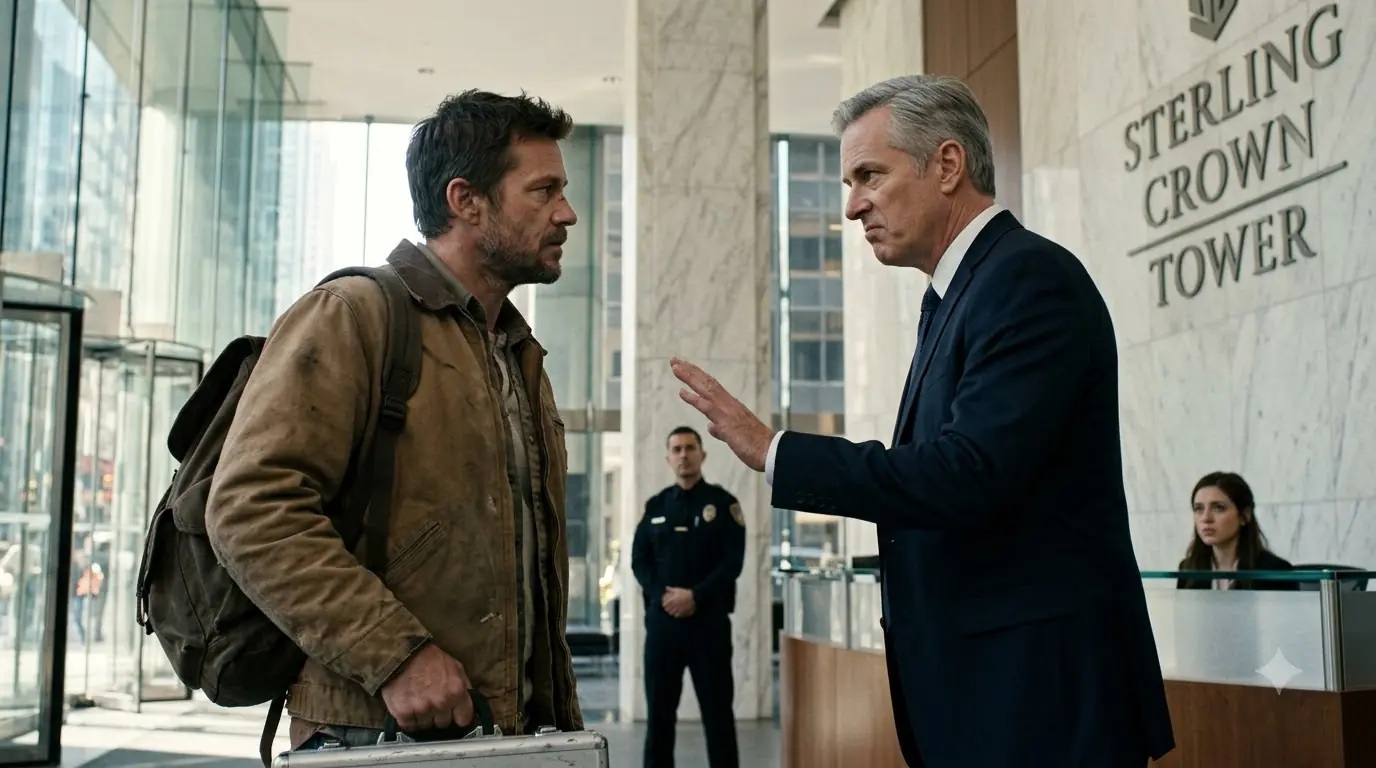
Behind the reception desk, Tessa Monroe was running a finger down the morning's appointment list. She noticed the work jacket, and her first thought was not suspicion, but curiosity, because he was not moving like someone who was lost. She drew a breath to greet him. That was the exact second Preston Wexler came around the corner from the elevator bank with a tablet in his hand.
Preston had managed this building for 6 years, and he described his job to anyone who asked as the management of impressions. A delegation of investors was due at 8:15. A limousine confirmed, water glasses already squared in a conference room on the 12th floor. He saw the jacket before he saw the face.
He saw the boots, the frayed cuff, the scuffed case, and his mind finished the picture before his feet finished crossing the floor. He stopped a comfortable distance away and said pleasantly that contractors checked in at the service entrance around the side on Bellamy Street. Nolan turned and said his name was Nolan Avery and that he had an 8:00 appointment. Preston asked who the appointment was with.
Nolan said two words, "Graham Sterling." The water kept running. Somewhere near the elevators, a phone chimed and a man laughed into it. Preston looked at the dust in the creases of those boots and the oil stain near the pocket and he came within half a breath of laughing out loud.
He did not because laughing would have been unprofessional and Preston was never unprofessional. He simply let the silence sit there long enough to make its point. Then he asked in the tone of a man coaxing somebody off a ledge whether Nolan had an invitation. Nolan took out his phone and turned the screen around.
It was a confirmation sent 11 days earlier from the office of the chief executive listing the date, the time, and the floor. Preston glanced at it for under two seconds. He read the name of the executive assistant who had sent it, and in his mind, that name became the problem rather than the proof because anybody could forward a message. He said he could not accept a phone as verification.
Nolan said that was reasonable and asked him to call the 58th floor. It was a simple request, the kind that takes 11 seconds and ends the conversation one way or the other. Preston did not make the call. He asked instead where Nolan had parked.
And when Nolan told him the public deck, something settled in Preston's face like a verdict. People with appointments upstairs did not park in public decks. They did not carry their own equipment. Preston believed this the way other men believe in gravity.
He stepped closer and lowered his voice because the first guests were already clustered near the side tables and he did not want them turning around. He said he did not know what Nolan was trying to accomplish, but that people who held meetings with Graham Sterling did not show up looking like this. Nolan did not flinch and did not raise his voice. He asked mildly what exactly this looked like.
Preston did not answer with words. He let his eyes travel down to the jacket and the boots and come back up. And the gesture was so small and so complete that an answer would have been redundant. Tessa leaned forward anyway.
She said carefully that perhaps they should check the morning list because two names on it had not been matched to a face yet. Preston did not look at her. He said he had it handled. The phrase landed on her like a hand closing a door and she sat back down and she would think about that moment for a long time afterward.
Outside a black limousine slid to the curb. Preston's jaw tightened because he had four minutes before 14 people in very good coats walked through that door and found a man in work boots standing in the middle of his lobby. He raised one hand without turning his head, and two security officers started across the floor. They were not brutal men.
One of them, a broad-shouldered father of three named Curtis, had worked that desk for 9 years and had never once put his hands on anybody. He came because his supervisor had signaled and because he assumed the manager knew something he did not. Nolan watched them approach and did not move toward the elevators or raise his voice. He took out his phone and called Dean Holloway whose direct line he had been given for exactly this kind of snag.
The call rang four times and went to voicemail because 58 floors above him Dean Holloway had set his phone face down beside a folder of signature pages. Nolan hung up without leaving a message. To Preston, that unanswered call was the final confirmation. A man with a real appointment makes one call and the problem dissolves.
A man with nothing calls a number nobody answers and then pretends it means nothing. Preston felt the clean satisfaction of having been right, which is the most dangerous feeling available to anyone who has not actually checked. He said Nolan could leave on his own or security would assist him. Nolan looked at his watch.
7:52. He thought about the 9 months, about the three companies whose offers were still sitting unanswered, and about his daughter who had asked the night before whether this was the one that finally fixed things. He put the phone in his pocket and said one word. Okay.
To Preston, that single syllable proved everything because guilty men go quiet. But anyone close enough to see Nolan's face would have noticed he was not embarrassed and not beaten. He was calculating something the way a man calculates a load before he lifts it. 58 floors up, the air was a different temperature, and the carpet swallowed every footstep.
The boardroom of Sterling Dynamics ran the length of the north face, a single slab of walnut down the middle. 19 chairs, a wall of glass showing the river and the two bridges and the low industrial sprawl beyond. Four outside attorneys had arrived at 7:15 and arranged their folders into a landscape of tabs and flags. Two members of the investment committee had flown in the night before from the coast.
A carafe of coffee stood untouched beside a tray of pastries. Nobody would eat. Everything that could be prepared had been prepared twice. The agreement on the table was worth $420 million and had taken 11 months to build.
Sterling Dynamics was not buying a company or a factory. It was buying the exclusive license to a thermal recovery system that captured and recirculated waste heat inside a specific class of industrial line, the kind that ran hot for 20 hours a day across three continents. Independent testing had put the energy reduction at just under 30% on a live line. And the engineers who ran that test had checked their instruments twice because the number looked wrong.
In an industry that fought over 2%, 30% was not an improvement. It was a different century. Graham Sterling sat at the head of the table in a charcoal suit with no tie and had not touched the agenda in front of him. He was 61.
He had not given a media interview in 4 years, and the people who negotiate against him described his patience as a kind of trap. He had read everything available about Nolan Avery, which was almost nothing. No corporate website, no conference appearances, one technical paper under a company name that no longer existed. He looked at the empty chair halfway down the table.
7:55. Camille Prescott, vice president of strategy, closed her laptop and asked whether Avery had checked in. Dean Holloway picked up his phone, saw nothing, and set it back down. Camille said what several people had been thinking for 2 weeks, which was that she still did not understand why one independent engineer had been allowed to dictate four separate clauses in an agreement this size.
She had watched the lobby feed once in March out of curiosity and seen a man in a canvas jacket carrying a hard case and assumed he was there to service the air handling units. She had not said that out loud to anybody. She was not proud of it. Dean answered the way lawyers answer with consequences instead of reason.
Two other industry groups had offered Avery more money, one of them nearly $60 million more, and he had refused both without a counter offer. A third was still circling and had sent revised terms as recently as Thursday. The patents were held personally filed under a sole inventor with no investors and no board. If Nolan Avery walked out of this building unsatisfied, there was no lever anywhere to pull him back because the man wanted nothing that Sterling Dynamics could threaten to take away.
The room absorbed that in silence. Down at street level, the revolving door turned and put Nolan out into the cold. The limousine had emptied and its passengers came up the steps in a loose formation of dark coats. Two of them glanced at the man being escorted out and looked away with the efficiency of people who have decided something is not their business.
Preston stood just inside the glass with his hands folded and said loudly enough to carry that Nolan should not use Mr. Sterling's name again to get into this building. Nolan stopped on the second step and turned around. He was not angry which was somehow worse. He said Preston should hope there would not be a next time.
Then he walked away and the door sealed the lobby back into its own quiet. Behind the desk, Tessa Monroe opened the appointment list again. And halfway through the executive entry, she found a line that read 8:00 58th floor with a single name beside it. She read it three times, then looked up at the empty sidewalk.
Across the street, Nolan set the aluminum case on the hood of the pickup. He was not thinking about Preston Wexler. He was thinking about a clause on page 31 and whether a company whose building worked this way could be trusted to keep it. Then his phone rang.
The screen said Graham Sterling. Nolan looked at it through four rings. Upstairs, Graham stood at the window with the phone to his ear and the room behind him gone completely quiet. On the sixth ring, Nolan answered.
Graham asked where he was, perfectly even in the voice of a man assuming a traffic problem. Nolan looked back across the street at the gold band of sunlight climbing the glass and said he was outside. Graham said he would send someone down to the door to meet him. Nolan said that would not be necessary because he had already been removed from the building by one of Graham's people.
The silence that followed lasted long enough for Camille Prescott to look up from her notes. Graham asked him to say that again and Nolan did in the same flat tone without a single adjective. He had given his name at the desk. He had stated the time of the meeting, offered the written confirmation, and asked twice for somebody to call upstairs, and the manager had declined and called security instead.
Then he added the only sentence that morning that carried any edge at all. He said it seemed he did not meet the standard for guests in Graham's building. Graham Sterling set the phone down on the conference table without ending the call, and he was moving before anybody understood that he had decided anything. His chair rolled backward and struck the credenza.
Dean Holloway was on his feet half a second later because Dean had spent 19 years reading rooms for the first sign of catastrophe and had just watched $420 million stand up and walk toward a door. Camille followed and she had worked for him 9 years and had never once seen him move like that. Two assistants came out of the anteroom with no idea what was happening and fell into step behind them. The attorneys stayed where they were, and one of them asked quietly whether somebody should close the folder of signature pages.
The elevator dropped 58 floors in under a minute. When it opened, the sound of the water feature rushed in, and the first thing Graham saw through the wall of glass was a man in a faded work jacket on the far sidewalk waiting for the light so he could cross back toward a parking deck. Graham came out at a pace that was not quite a run and was not anything else either. His coat was open.
He had left his phone upstairs on the table. He crossed the floor in a straight line, past the side tables, past the water, past the investors Preston Wexler had spent all morning preparing to receive. Preston saw him coming and did not understand. For one absurd half second, he believed there was a fire or a medical emergency or an evacuation order he had somehow missed.
He stepped forward with his hand half raised, already assembling the words that would show the operations manager was on top of whatever this was. Graham Sterling went past him as though he were a column. Preston turned and watched the charcoal suit recede toward the doors and then saw the general counsel and the vice president of strategy come out of the same elevator at nearly a jog and the first cold edge of something entered his chest. Across the lobby, Tessa Monroe stood up behind her desk.
Graham went out onto the sidewalk and into the noise of the street. The light had changed. Nolan already had his hand on the door handle of the pickup and his keys out. Graham called his name across four lanes of traffic loud with none of the control he was famous for.
Half the lobby turned around. A woman from the delegation lowered her coffee. Nolan stopped, hand on the handle, and looked back across the street at a 61-year-old billionaire standing without a coat in 40-degree air, breathing hard, having run through his own building. The walk signal turned.
Graham crossed and did not slow down when he reached the other side. He stopped 2 feet away, put out his hand, took Nolan's in both of his the way men do at funerals, and said he was sorry. Not the corporate version, not the version with conditions built into it. Four words: in a parking deck entrance with a bus going past behind the glass across the street, Preston Wexler watched the chief executive of Sterling Dynamics apologize on a public sidewalk to the man he had personally removed 11 minutes earlier.
And the arithmetic of his entire morning came apart. Nolan did not smile. He did not look toward the building and he did not say any of the things a man would be entitled to say with an audience watching through 40 feet of glass. He said that Graham was not the person who needed to apologize.
It was offered without heat as a correction of fact, and it did something no accusation could have done. Graham Sterling let go of his hand, turned his head, and looked back across the street at the lobby of the tower that carried his name. He stood that way for 3 seconds. Then he said they should go inside.
The revolving door turned, and the lobby that had emptied Nolan Avery onto the street 20 minutes earlier took him back in beside its owner. Preston was already moving toward them. He had assembled a face, a posture, and the first half of a sentence, and he deployed all three at once. He said, "Mr. Avery, it seemed there had been something of a misunderstanding this morning.
He said it warmly. He even added the small self-deprecating tilt of the head he used with tenants who complained about the elevators. It was in its way a professional performance. Nolan looked at him and said there had not been any misunderstanding at all.
The warmth stayed on Preston's face a second longer than it should have, like a light left on in an empty room. Nolan laid it out plainly because the facts did not require volume. He had given his full name. He had named the person he was meeting.
He had offered written confirmation of the time and the floor. He had asked twice for somebody to pick up a telephone and spend 11 seconds checking. Preston had decided before any of that the answer did not need checking. Preston tried the only door he had left.
He said that building protocols required visual verification of credentials, that there had been three separate incidents that year involving individuals attempting to reach the executive floors, and that his responsibility was to the safety of the tenants. It was not a bad defense. It had the shape of a reasonable thing. Graham Sterling listened to all of it without interrupting, hands in his pockets, and when it was finished, he did not respond to any of it.
He turned instead toward the reception desk and asked Tessa Monroe to come over. She came and her hands were not entirely steady and she stood where she could see both men. Graham asked whether the gentleman had given his name when he entered. She said yes.
He asked whether the gentleman had asked them to check the appointment list. She said yes twice. He asked whether the gentleman had raised his voice, refused an instruction or caused any disturbance of any kind. She said no.
Then he asked the question Preston had not prepared for. He asked whether she had tried to check that list herself. Tessa's eyes went to Preston and came back. She said she had and that she had been told it was handled.
The water kept running. The investors by the side tables had stopped pretending not to listen. Preston opened his mouth and found nothing in it. Graham nodded once slowly the way a man nods when something he suspected has been confirmed in front of witnesses.
He did not fire him and he did not raise his voice. He said four words which were my office this afternoon and then he walked Nolan Avery toward the executive elevator. Dean Holloway fell in on Nolan's left and said nothing at all which was the smartest thing anybody from the company did that morning. Upstairs, the boardroom was already standing.
19 people, four outside attorneys, two committee members who had flown 3,000 miles, all of them on their feet before Nolan entered. Because Dean had sent two words from the elevator, and because everyone understood by then what had almost happened, Nolan came in with dust on his boots and set the aluminum case on the walnut, and the sound it made was the loudest thing in the room. Camille Prescott extended her hand and called him Mr. Avery. He shook it and said that Nolan was fine.
Somebody pulled out the chair with the water glass in front of it. On the wall screen, in white letters on a dark field, sat a single line of text that had been there since 7:15 that morning. It read, "Avery Thermal Systems, exclusive licensing agreement." In the 14 minutes that followed, every person at that table learned the technical shape of what the company was buying, which was 11 years of one man's work held under his own name, built in a leased shop with a second mortgage and a used lathe.
But the question nobody in the room could answer yet was not about the technology. It was why Graham Sterling, who had not personally come down to a lobby in 9 years, had just run through one. The agenda called for signatures at 9:30. At 9:30, Nolan Avery did not pick up the pen.
He sat with his hands folded on the walnut and said that before anything was signed, he wanted to talk about page 31. The attorneys found it in unison, a sound like a wave hitting a beach. Graham asked the question the whole room was holding, which was whether what had happened downstairs had changed his mind. Nolan said no.
Then he said something that rearranged the morning for every person listening. He said this was not about him being insulted. An insult, he said, was a small thing and he had absorbed a great many of them without it ever costing anyone $420 million. Then he told them about Ohio.
14 months earlier, before Sterling Dynamics had ever contacted him, he had taken a short contract as an outside consultant at a plant in a town northeast of Dayton. It was ordinary work, a thermal audit on an aging line, the kind of job he had taken a dozen times to keep the lights on in the shop. The plant was owned through two layers of holding companies by Sterling Dynamics. He had been there 11 days.
On the third day, he met a maintenance technician named Walt Brennan, 63 years old, 29 years on that line. A man who knew every pump and valve in the building the way a farmer knows weather. Walt could hear a bearing going bad through a concrete wall and had taught himself the control system out of a manual on his own time. In 11 days, Nolan watched local management walk past him without acknowledgement, routed questions about his own equipment to a contractor from out of state and referred to him in a meeting while he stood in the room as one of the floor guys.
Walt never said a word about it. Nolan told the boardroom he had gone back to his motel on the ninth night and done the math on his own system and the math had frightened him. A 30% cut in energy consumption on a line like that does not only reduce a utility bill, it changes the operating model and it makes a certain number of maintenance positions look on a spreadsheet like a rounding error. The fastest way to harvest that value was to take the savings, modernize the line, and let men like Walt Brennan go in the restructuring that always follows.
Sitting on that bed, he understood that he had invented a very efficient way to make a certain kind of person disappear. So he wrote a clause page 31 section 4 subsection 2 language that had taken his attorney and Dean Holloway 9 weeks to agree on. Any facility implementing the technology under this license was contractually required to retain its existing technical and maintenance workforce through the conversion period and retrain them on the new system rather than replace them with outside specialists. Not a statement of intent, not a memorandum of understanding, a condition of the license with audit rights, reporting obligations, and a termination trigger attached to it.
That clause, he said, was why he had refused two offers worth more money than this one. The first company rejected it outright within a week. The second offered him $58 million more and asked politely that the language be softened into a non-binding commitment, which he understood perfectly because non-binding means no. Sterling Dynamics was the only one of the three that said yes, and it said yes in 11 days, faster than any of its lawyers had wanted.
He had chosen this company for exactly one reason, and it was not the valuation, and it was not the market access. It was that clause. Then he brought the room all the way back around to the lobby. He said he had spent 11 months trusting that a company willing to sign page 31 was a company that meant it, and that at 7:52 that morning, standing on the sidewalk outside its headquarters, he had received a very fast and very clear demonstration of how that company treats a man in a work jacket when there is no contract in the room.
He was not accusing anyone at the table. One manager is not a company, but he asked them to understand why at 9:30 he was not reaching for the pen. Nobody spoke for a while. Then Graham Sterling pushed his chair back from the head of the table and said there was something he had never told anyone in that room and that Nolan had earned it.
In the spring of 1984, he had been 22 years old, working third shift as a maintenance technician at a bearing plant outside Erie, Pennsylvania, making $9.20 an hour and sleeping 4 hours a night. He spent 3 years in those coveralls. He learned everything he knew about machines in that building and everything he knew about people in the 11 feet of hallway between the shop floor and the front office where the carpet started. He told them about a morning in his second year when the plant's owner brought buyers through on a tour.
Graham had been called up from the floor to explain a retrofit he designed himself on his own time, a modification that took 40 minutes a day off a changeover. He came up the stairs in work clothes with grease in the creases of his knuckles. The plant manager met him at the top of those stairs and sent him back down in front of the buyers and said somebody from engineering would handle it. Graham stood on that stairwell a while before he went back to work.
He was 61 years old and could still describe the pattern of the linoleum. He had built Sterling Dynamics over 30 years for a hundred reasons and one of them which had never appeared in a letter to investors was that he wanted to own the building so nobody could ever again decide at the top of a staircase who was allowed to come up. When his phone rang at 7:58 that morning and he heard a man tell him without anger that he did not meet the standard for guests in Graham Sterling's building, what he felt was not the panic of a transaction coming apart. He told them the transaction had not entered his mind until he was already in the elevator.
Preston Wexler had spent years believing he was protecting the image of Graham Sterling, screening out the work boots and the frayed cuffs and understanding all of it as loyalty. What he had actually done at 7:51 on a Tuesday morning was take the one thing Graham Sterling hated most in the world and perform it flawlessly in Graham Sterling's own lobby on the one man in the city who had refused $58 million to protect people exactly like the young technician Graham had once been. Nolan sat quietly through all of it. When Graham finished, he said he would still like to discuss page 31, but that he would like to do it after lunch.
And then for the first time that day, he smiled. Graham Sterling did not terminate Preston Wexler that afternoon. And the reason he gave Dean Holloway was that a company which fires a man on the strength of one bad morning is not a company with standards. It is a company with a temper.
What he ordered instead was a full review by human resources covering every documented interaction between the building's operations manager and non-tenant visitors over the preceding 3 years. He asked for the lobby footage, the access logs, and the visitor denial records. And he asked for something nobody expected, a list of every employee who had worked under Preston Wexler and since left the company. The lobby cameras had no audio and did not need any.
The footage ran 11 minutes and 40 seconds from the moment Nolan came through the door. It showed him stopping in the middle of the floor to look up at the ceiling. It showed Preston crossing at speed, the approach, the glance down at the boots and back up. The two seconds he spent on the phone screen.
From a second angle, it showed Tessa Monroe leaning forward with her hand already on the appointment list and a palm rising to stop her without a turn of the head. And it showed a man in a work jacket walking out between two uniformed officers with his back straight. Tessa gave her account that same afternoon in a small room on the ninth floor with a human resources director and a recorder on the table. She was frightened and said so and gave it anyway.
Then she said it would be dishonest to describe that morning as an isolated event. She had worked that desk 3 years. There was a pattern. Everyone who worked the lobby knew about the pattern and nobody had ever written any of it down because there had never been anywhere to send it.
The director asked for examples. Tessa had been thinking about this for 6 hours and she gave four. In February, a courier arrived with a temperature controlled case of surgical reagents for the practice on the 11th floor with a delivery window of 15 minutes. And Preston sent him around to Bellamy Street where the freight elevator was down for inspection and the material was out of specification by the time it arrived.
In August, a technician called at 6:00 in the morning for a failed compressor was left on the sidewalk for 35 minutes in weather that reached 94 degrees. In October, a woman came to interview with a tenant firm in a suit that was visibly old, and Preston asked her within hearing of two other people whether she was certain she had the right address. And then there was Ramona Castayanos, who had cleaned that lobby and the first 11 floors for 16 years, longer than Preston had held his job. Tessa had personally heard him while walking prospective tenants across the floor, gesture toward Ramona, and call part of the background staff.
Not cruelly—that was the detail Tessa kept returning to. He had said it the way a man describes a potted plant, and Ramona had kept working, and the tour had moved on, and nobody had said anything, including Tessa, which was the part she could not get out of her head. Preston understood by then that something larger than a single complaint was moving toward him, and he did what people do when they feel the ground going. He wrote a four-page account of the morning and sent it to three executives.
He described a security assessment of an unverified individual conducted in accordance with building protocol following three prior access attempts that year. He called his decision proportionate. And then in the third paragraph of page two, he made the only genuinely unforgivable move of his career. He wrote that the reception staff on duty had failed to follow the standard verification procedure and that the incident reflected a training deficiency at the desk.
Graham Sterling read that memo at 4:15 with the lobby footage paused on the screen beside him. He ran it back 11 seconds and let it play again. Just the one shot from above the elevator bank. A woman half out of her chair with her hand on the list to stop her.
He watched it twice. He said nothing to Dean Holloway who was sitting across from him and nothing about it to anybody else that day. He simply closed the laptop. Dean, who had worked for him 19 years, understood that the matter was finished and that whatever came next was no longer a question of investigation.
Preston was called to the 58th floor at 10 the following morning. He had not slept. He had prepared on index cards, a structure built around three points, protocol, precedent, and his six-year record of tenant satisfaction scores. He wore his best suit, a navy two button that had cost him more than a month of rent when he bought it, and he spent 4 minutes in the elevator adjusting the knot of his tie.
He had never been on the 58th floor. When the doors opened, he found that the carpet was a different color. And for some reason, that detail unsettled him more than anything else that happened that day. There were six people in the boardroom.
Graham Sterling at the head of the table, Dean Holloway, Camille Prescott, the human resources director with a folder in front of her, Tessa Monroe, who did not look up when he came in, and at the far end in the same canvas jacket, a man with his hands folded on the walnut. Preston had not known that Nolan Avery would be there. He registered the boots first, the same boots under a 400-pound table in the executive boardroom of Sterling Dynamics, and whatever order his index cards had been in stopped being relevant. He went to Nolan first and apologized in the dialect he had been trained in for his entire working life.
He said that if his actions had created an impression that Mr. Avery was not welcome in the building, he deeply regretted that outcome. He said it had never been his intention to make anybody feel uncomfortable. He said that with the benefit of hindsight, the situation could have been managed with greater sensitivity. Every clause was built so the harm lived inside somebody else's feelings and the actor disappeared entirely.
In most conference rooms, that kind of sentence works. Nolan interrupted him once gently and it was 11 words. He said Preston had not made him feel unwelcome. He had removed him.
Preston stopped. He stood at the end of the table waiting for somebody to help him and nobody did. Graham asked him to sit down and he sat. The human resources director opened her folder and over the next 20 minutes the findings were read aloud in a calm procedural voice.
The courier, the technician on the sidewalk, the applicant in the old suit, the custodian described as background, the footage, and a pattern of denials that broke down along lines nobody in that room was willing to call anything other than what they were. When it ended, Graham asked him one question. He asked whether if Nolan Avery had walked into that lobby wearing a $5,000 suit with a car service and an assistant, any of this would have happened. Preston started to answer.
He got as far as explaining that the verification protocol applied uniformly to all unscheduled arrivals. And then he heard himself and he stopped in the middle of the sentence because he had just realized he had no idea whether the thing he was saying was true. The room was quiet for 8 seconds. Graham said that this was the answer and that nothing else needed establishing.
Preston turned to Nolan then because Nolan held the leverage and because men in Preston's position have always understood where leverage lives. He asked almost under his breath what Mr. Avery wanted him to do. Nolan looked at him a long moment and there was no triumph in it. He said it was not his decision, that he was not an employee of this company and had no intention of becoming one, and that he had never asked for anybody to lose a job.
Then he said the only thing he said to Preston Wexler that could be called personal. He said what he wanted was for the next man in work boots to get as far as the desk. Graham Sterling ended Preston's employment at the close of that meeting, and he was precise about the grounds because precision was the entire point. It was not because Preston had insulted an important man.
If the review had turned up a single incident involving a single visitor with no leverage and no contract and no $420 million behind him, the outcome would have been identical. The standard of this company could not be that a person has to matter before they are treated decently because a standard that works that way is not a standard. It is a calculation. Preston left the building at 11:40 with a cardboard box and he went out through the main doors.
By then, it was Wednesday. The signature pages had been sitting in Dean Holloway's folder for 26 hours, and Nolan Avery still had not signed. The attorneys had begun making the particular small talk lawyers make while quietly panicking. Camille asked Dean twice whether he had any read on it, and Dean said no.
Graham said nothing at all, ordered sandwiches, and waited because he had understood from the beginning that this was a man who could not be hurried and did not need managing. At 1:30 that afternoon, Nolan came back into the boardroom and said he wanted to add one more thing before he signed. Graham asked what it was. Nolan said page 31 protected the people already inside the plants and it was a good clause and it would hold through the 7-year conversion period, but it did nothing for the people who would be inside those plants in year 9 or year 14 and nothing for the young technician in Erie or Dayton who would walk into a facility running on a system nobody had taught him.
He wanted a training fund attached. 2% of the annual licensing payment held separately, administered jointly, dedicated to certification programs for plant technicians at any facility running the system. With the curriculum open to workers from outside the company, Dean Holloway did the arithmetic in his head and arrived at a number with seven figures in it every year for 15 years. He looked at Graham Sterling, who did not look back.
Graham asked Nolan one question, which was whether the fund would be open to technicians from competing manufacturers. Nolan said yes, because a man who loses his job to a machine does not care who owns the machine. Outside counsel spent 2 hours on the language, Camille Prescott named it the Brennan Fund after hearing the story twice, and at 4:20, Nolan signed his name 11 times with a borrowed pen. What the deal did for him was not transformation.
It was the closing of a set of wounds that had been open for 4 years. It paid off the note on the shop, which had been secured against his house. It funded his daughter's college account in one transfer in full, so that a conversation he had been dreading for 3 years simply stopped existing. It meant he could decline work.
It meant the next 11 years of development on the next idea would not be financed at 19%. He did not buy a house on the water. He did not buy a watch. At 5:15, he came down through the lobby with the case under his arm and the same jacket on his back, the water feature still running.
The valet in the gray vest was at the door, and he had spent two days hearing about who the man in the work jacket was, and he stepped forward at once and offered to bring Mr. Avery's vehicle around for him. Nolan looked across the street at the fourth level of the public deck, where a 12-year-old pickup sat with a cracked tailgate. He thanked him and said he could walk, and he did. The system went into its first sterling plant in April, the one northeast of Dayton, which Nolan had requested specifically and which nobody argued about.
The conversion took 5 months. Of the 91 technical and maintenance staff employed there, when the agreement was signed, 89 were still employed a year later, and the two who were not had retired. Walt Brennan, 64 by then, spent 11 weeks in certification training with a group of men half his age, finished second in the class, and became the plant's lead systems technician, which came with a raise of $9,000 and a desk he never used because he preferred the floor. He wrote Nolan a letter.
Nolan pinned it above the lathe. By the following spring, the technology was running in three Sterling facilities and in commissioning at a fourth, and the Brennan Fund had certified 406 technicians in 18 months, 81 of whom worked for other companies. Tessa Monroe was promoted to director of guest services at Sterling Crown that summer, and the first thing she did with the authority was rewrite the lobby protocol. The new procedure ran two pages, and the operative sentence was in the first paragraph.
No employee of this building may determine a person's right to enter on the basis of their clothing, their vehicle, or their appearance. Every arrival gets checked against the list. Every single one. Preston Wexler did not collapse because that is not usually how it goes.
He found another position 4 months later with a property management firm running two mid-rise buildings in a suburban corridor 18 miles out. The lobbies had drop ceilings, the parking was free, and the tenants were dentists and insurance brokers. He was good at the work because he had always been good at the work. What he had to adjust to was something else.
In that corridor, the name Wexler meant nothing to anybody. Nobody straightened up when he gave it. And for the first time in 38 years, he had to be somebody on the strength of how he treated the next person through the door. On a cold morning 14 months after all of it, Nolan Avery came back through the revolving doors of Sterling Crown Tower for an 11:00 on the 58th floor.
He wore the same boots, resoled once in a canvas jacket with a new tear at the left elbow, and he carried a hard case under his arm, and he had parked across the street in the public deck out of habit rather than necessity. The lobby looked exactly as it had on the first morning, the stone, the water, the 40 feet of ceiling. Behind the desk stood a young man he had never seen before. Three weeks into the job, he looked up as Nolan crossed the floor.
The young man did not look at the boots. He smiled, said good morning, and asked how he could help. Nolan said he had an appointment. The young man asked for his name, found it on the list in under 5 seconds, printed a badge, told him the executive elevators were on the left, and wished him a good meeting.
That was all of it. Four sentences, 11 seconds, no hesitation anywhere in them. Nobody asked whether he belonged in that building. Nolan took the badge, said thank you, and walked toward the elevators with the morning light coming in sideways across the stone behind him.