The morning sun poured through the tall display windows of Whitmore & Vale, one of the city's oldest and most prestigious tailor shops. Soft classical music drifted through the showroom. Rows of perfectly tailored suits lined the polished walnut walls. Every jacket had been hand-finished with meticulous care. Every tie had been carefully arranged beneath warm lighting.
The shop had built its reputation dressing judges, senators, business leaders, and generations of the city's wealthiest families. Appointments were often booked months in advance. Many customers returned year after year. They trusted only Whitmore & Vale for the suits they wore during the most important moments of their lives. The air carried the faint scent of fine wool and cedar.
Just after ten o'clock, the brass bell above the entrance chimed softly. An elderly man stepped quietly inside. He looked completely out of place among the luxury surroundings. His wool coat had been patched at both elbows with neat, careful stitches. His trousers showed signs of multiple mends, yet everything about him remained clean and dignified.
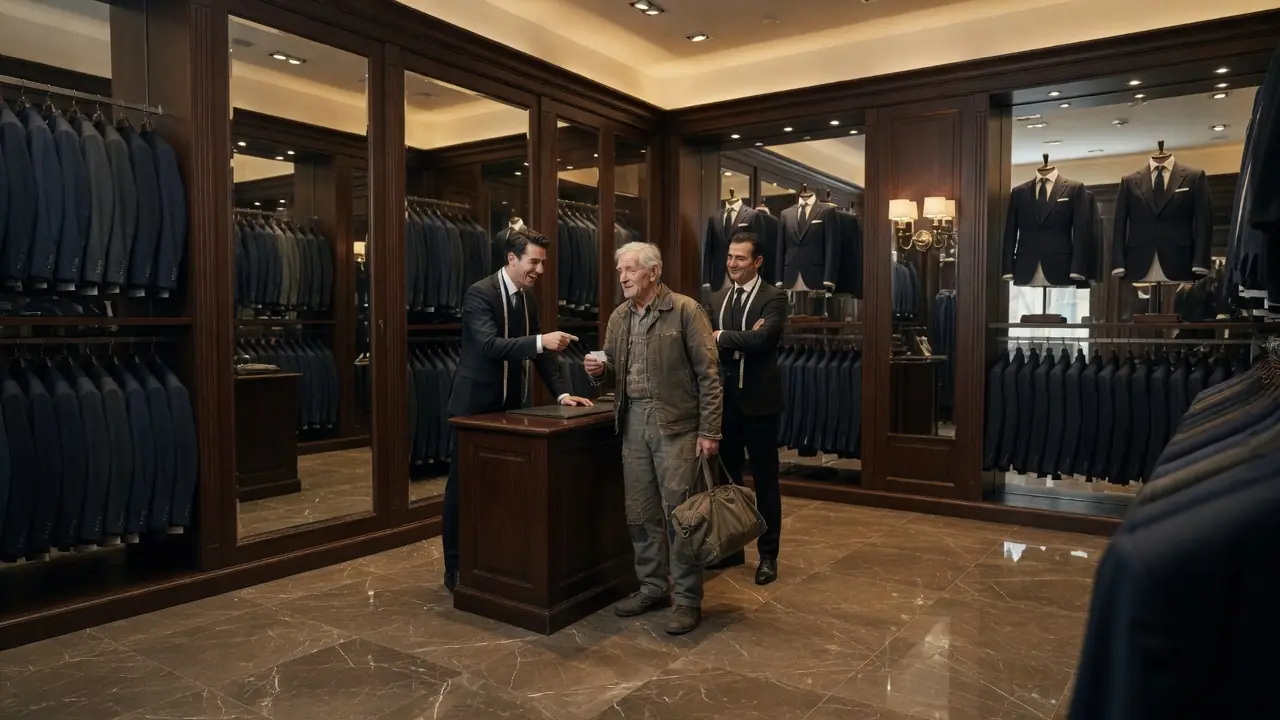
He carried a faded brown envelope in one hand and an old flat cap in the other. His silver hair was neatly combed. For a moment, he paused near the entrance, taking in the elegant showroom. Then he walked calmly toward the reception counter. His old shoes, though cracked with age, had been polished that morning.
The receptionist looked up briefly. Then she looked back down at her appointment book. A young salesman noticed the newcomer and quietly nudged another tailor standing nearby. "Looks like someone wandered into the wrong shop," he whispered. The second tailor smiled without replying.
The old man reached the counter and offered a warm smile. "Good morning." The receptionist answered politely but with clear detachment. "I'd like to order a custom navy-blue suit," the old man said. Her fingers stopped moving across the book. She stared at him for a long second.
She continued explaining the details. The price depended on the fabric, hand stitching, lining, and finishing touches. "I understand that too," he said. Another tailor slowly walked over, pretending to organize fabric samples while listening closely. The salesman folded his arms across his chest.
"Do you have an appointment, sir?" the salesman asked. "No." "We normally work by appointment." "I don't mind waiting," the old man replied. The salesman smiled politely, though sarcasm colored his tone. "There are several department stores nearby if you're looking for something more affordable."
The old man met his gaze steadily. "I'm looking for a custom navy-blue suit." Another employee laughed quietly. "You know, some of our buttons cost more than most off-the-rack suits." Several people chuckled. The receptionist tried not to smile. The old man remained perfectly calm.
He neither defended himself nor appeared embarrassed. He simply stood quietly with both hands resting on the counter. The salesman continued. "Sir, custom tailoring probably isn't necessary. I think you'll find something much more suitable somewhere else." The old man tilted his head slightly.
"My son asked me to meet him here." That only encouraged more smiles. "Oh?" the salesman replied with mock interest. "And does your son know what our prices are?" "Yes." "Did he tell you how expensive our suits are?" "He did."
"And he still sent you here?" "Yes." The salesman shrugged. "Well, I suppose he'll be disappointed." Another tailor added, "Unless he's buying you one button at a time." This time the laughter became impossible to hide. The old man waited patiently until the room grew quiet again.
Then he reached into his coat pocket. Instead of taking out money, he removed a simple white business card and placed it gently on the marble counter. "I'll wait." The receptionist glanced at the card without much interest. Before she could read it carefully, the bell above the entrance rang again.
A black luxury sedan had just stopped outside. Its driver hurried around to open the rear passenger door. A man in his early forties stepped out wearing a perfectly tailored charcoal suit. Several employees recognized him immediately. "Mr. Bennett," one whispered urgently.
The manager himself hurried from his office with a welcoming smile. "Good morning, Mr. Bennett. We've prepared everything for your fitting." But Michael Bennett barely acknowledged him. The moment he entered the showroom, his eyes searched the room until they found the elderly man standing quietly at the counter.
His expression softened instantly. "Dad." Without hesitation, he crossed the room and embraced the old man warmly. "I'm so sorry I'm late. I got caught in a board meeting." The old man smiled. "I've only been here a few minutes."
The showroom became completely silent. The manager looked from Michael to the old man, then toward the receptionist still holding the business card. She finally lowered her eyes to read it. Her face immediately lost its color. The card simply read: Harold Bennett.
No title. No company. Just a name. She looked back at Michael Bennett, one of Whitmore & Vale's oldest and most respected clients. He was the chief executive of Bennett Industrial Holdings. His company had ordered custom suits from the shop for more than fifteen years.
The realization struck everyone at once. The elderly man they had just mocked was his father. The salesman swallowed hard. The laughter disappeared as though it had never existed. The manager stepped forward immediately. "Mr. Bennett, I sincerely apologize."
Michael looked at him calmly. "For what?" The manager hesitated. "For the misunderstanding." Michael slowly turned toward his father. "Dad, were they respectful?" The old man smiled gently. "They seemed very concerned about whether I could afford the buttons."
No one spoke. The silence felt heavier than any shouting could have. Michael looked slowly around the showroom. "So my father's clothes were enough for everyone here to decide what kind of person he was." The salesman attempted to explain. "Sir, we only assumed..."
Michael interrupted him. "Exactly. You assumed." The room remained silent. Michael continued speaking with quiet intensity. "My father spent forty-three years repairing railroad equipment. He worked twelve-hour shifts. He missed birthdays and holidays so I could have opportunities he never did."
He glanced toward the old coat hanging loosely over his father's shoulders. "That coat helped pay my college tuition. The shoes you're laughing at walked thousands of miles so I could become the man standing here today." The receptionist lowered her head. The tailor who had joked about the buttons no longer knew where to look.
Michael kept going, his voice steady but filled with emotion. "My father has never owned a custom suit. He never bought expensive clothes. Not because he couldn't. Because he always believed someone else needed the money more." The old man quietly touched the envelope he had been carrying.
Michael noticed. "Did you bring Mom's picture?" His father nodded. "I wanted her with me." The room grew even quieter. Michael looked toward the employees. "My mother passed away eight months ago. Before she died, she asked Dad to buy himself one beautiful navy-blue suit. He promised her he finally would."
The elderly man carefully opened the envelope. Inside was a slightly faded photograph of himself and his wife taken nearly forty years earlier. She was smiling warmly. He wore an old navy-blue jacket in the image. "She always said blue suited me," Harold said, his voice soft enough that everyone leaned closer to hear.
"I told her one day I'd let a real tailor make me one." The manager closed his eyes briefly. Every word made the earlier laughter feel crueler. He stepped forward again. "Mr. Bennett, I owe you a sincere apology." The old man looked at him kindly. "You don't owe it to me because my son walked through that door. You owe it because I walked through it first."
No one could answer. The manager nodded slowly. "You're right. I am truly sorry." One by one, every employee apologized. The receptionist spoke first, her voice trembling. The salesman followed, then the tailors. No one was forced. No one was interrupted. The old man listened patiently to each of them.
When they finished, Michael asked quietly, "Dad, would you like to find another tailor?" The old man looked around the showroom. Then he smiled. "Your mother also taught me something else." Michael smiled faintly. "What was that?" "Don't let someone else's mistake decide the kind of person you'll be."
He turned toward the manager. "I came here for a navy-blue suit. If you'll still make it, I'd be honored to wear one." The senior tailor stepped forward himself carrying a measuring tape. "It would be an honor for us, sir." This time there was no laughter. Only quiet professionalism.
Measurements were taken with renewed care. Shoulders. Chest. Sleeves. Waist. The tailor discussed fabrics, lapel styles, linings, cuffs, and buttons with the attention every customer deserved from the beginning. When asked which lining he preferred, the old man smiled toward the photograph inside the envelope. "Navy blue. Inside and out."
"My wife always said if you're going to choose blue, don't be afraid of choosing all of it." The team worked diligently. They brought out multiple fabric swatches for Harold to feel. Discussions about thread strength and button durability lasted longer than usual. Every detail reflected a new level of respect.
To add depth to the moment, the manager personally shared the shop's long history while they worked. He recounted how Whitmore & Vale had dressed leaders during historic events decades ago. Yet he admitted that moments like this reminded them that true legacy came from treating every person with dignity. Harold listened with genuine interest, asking thoughtful questions about the craft.
Meanwhile, Michael stayed close, occasionally sharing light memories to ease the lingering tension. He told a story about his father repairing train engines late into the night so the family could afford books for school. The employees hung on every word. The atmosphere in the showroom had shifted completely from mockery to admiration.
Two weeks later, Harold Bennett returned for his final fitting. The same employees greeted him warmly the moment he entered. Not because they now knew who he was through his son. But because they had finally learned how every guest should have been welcomed from the beginning. The senior tailor adjusted the shoulders with precise pins.
Harold stepped out wearing the finished navy-blue suit. The showroom fell silent once again. The suit fit perfectly. His shoulders stood a little straighter. His eyes seemed brighter. He stood before the mirror holding his wife's photograph in one hand. "What do you think, Emily?" he whispered.
For a long moment, no one spoke. Then Michael smiled through tears. "I think she'd tell you you've never looked more handsome." Harold smiled at his reflection. "I think she would." The moment carried profound emotion. Several employees wiped their eyes discreetly.
Months later, every new employee joining Whitmore & Vale heard the story of the elderly man in the patched coat who came asking for a navy-blue suit. The tale became part of the shop's training. It served as a powerful reminder. Fine tailoring begins with measuring cloth. True professionalism begins by never measuring a person's worth before you know their story.
To expand the narrative further, the story continued to ripple outward in unexpected ways. One afternoon, a prominent judge who had been a longtime client overheard the full account from the manager. Moved by Harold's dignity and Michael's defense of his father, the judge requested a private meeting with the old man. They spoke for hours about resilience, family, and the quiet strength found in everyday labor.
Harold shared detailed memories of his forty-three years on the railroads. He described freezing winter nights fixing tracks under harsh lights. He recalled scorching summers where the metal burned his hands. Through it all, he and Emily had built a life centered on love and sacrifice. The judge later commissioned a special suit for Harold as a gesture of respect.
Back at the shop, the sales team underwent subtle but meaningful changes. The young salesman who had been quickest to judge began volunteering at a local community center. He helped older residents with basic tailoring repairs. His experiences there deepened his empathy. Other tailors started noticing small acts of kindness among themselves, like offering coffee to walk-in customers regardless of appearance.
Michael, meanwhile, took his father on a special trip to the old railroad yards where Harold had worked. They walked the familiar grounds together. Harold pointed out specific engines he had repaired. He recounted stories of close calls during storms and moments of camaraderie with fellow workers. Michael recorded some of the tales on his phone, preserving them for future generations.
As seasons passed, Harold wore his navy-blue suit with quiet pride. He attended a community event honoring longtime railroad veterans. Wearing the suit made him feel connected to Emily's wish. At the event, he met younger workers facing similar struggles. He offered them advice drawn from decades of experience, encouraging them to invest in their children's futures just as he had.
The tailor shop itself experienced a quiet renaissance. Word of the incident spread among loyal clients. Many praised the staff for how they had handled the aftermath. Business grew, not just from wealthier customers but from people who appreciated the renewed emphasis on human dignity. Whitmore & Vale even launched a small scholarship program for aspiring tailors from working-class backgrounds.
One dramatic afternoon, a sudden crisis tested the shop's transformation. A fire broke out in a nearby warehouse. Several employees rushed to help evacuate people. Among those saved was an elderly woman who reminded Harold of his late wife. The team worked together seamlessly, showing the same care they now extended to every customer.
Harold visited the shop regularly after that. He became a beloved figure. Employees sought his wisdom on life matters beyond suits. He shared stories of perseverance, love, and the importance of seeing beyond outward appearances. Each visit reinforced the lesson that had changed everything that fateful morning.
The legacy endured. New apprentices learned the story during their first week. They practiced not only stitching and measuring but also greeting every person with genuine respect. The brass bell above the door continued to chime. Each time it rang, the staff remembered Harold Bennett and the powerful reminder he had brought through those patched doors.
In time, the tale of the old man and the navy-blue suit became more than shop lore. It turned into a story told at family dinners across the city. It inspired essays in local schools. It reminded everyone that true value often hides in the most unassuming packages. And in the heart of the prestigious showroom, a simple framed photograph now hung discreetly near the reception counter.
It showed Harold in his finished suit, holding Emily's picture. Below it, a small plaque read: "Measure the person first." The words served as a daily guide. They ensured that no one else would ever face the same initial judgment. The sun continued to pour through the tall windows each morning. The classical music played on. Yet the spirit inside Whitmore & Vale had been forever elevated by one elderly man's quiet dignity and his son's unwavering love.