Clara Bellamy had crossed more than eight hundred miles believing that when the train stopped in Bitter Creek, Wyoming, a man named Elias Boone would be waiting beneath the station awning with a brass button fastened to his hatband. She had imagined that moment so many times during the journey from St. Louis that she knew exactly what she intended to say first: nothing clever, nothing romantic, only, “Mr. Boone, I believe this belongs to you,” while showing him the matching button he had mailed in his third letter. Instead, when Clara stepped down from the passenger car with one gloved hand gripping the railing and her carpetbag pressed against her side, the stationmaster looked at the envelope bearing Elias’s name and went pale. “Ma’am,” he said quietly, “Elias Boone has been dead almost four weeks.”
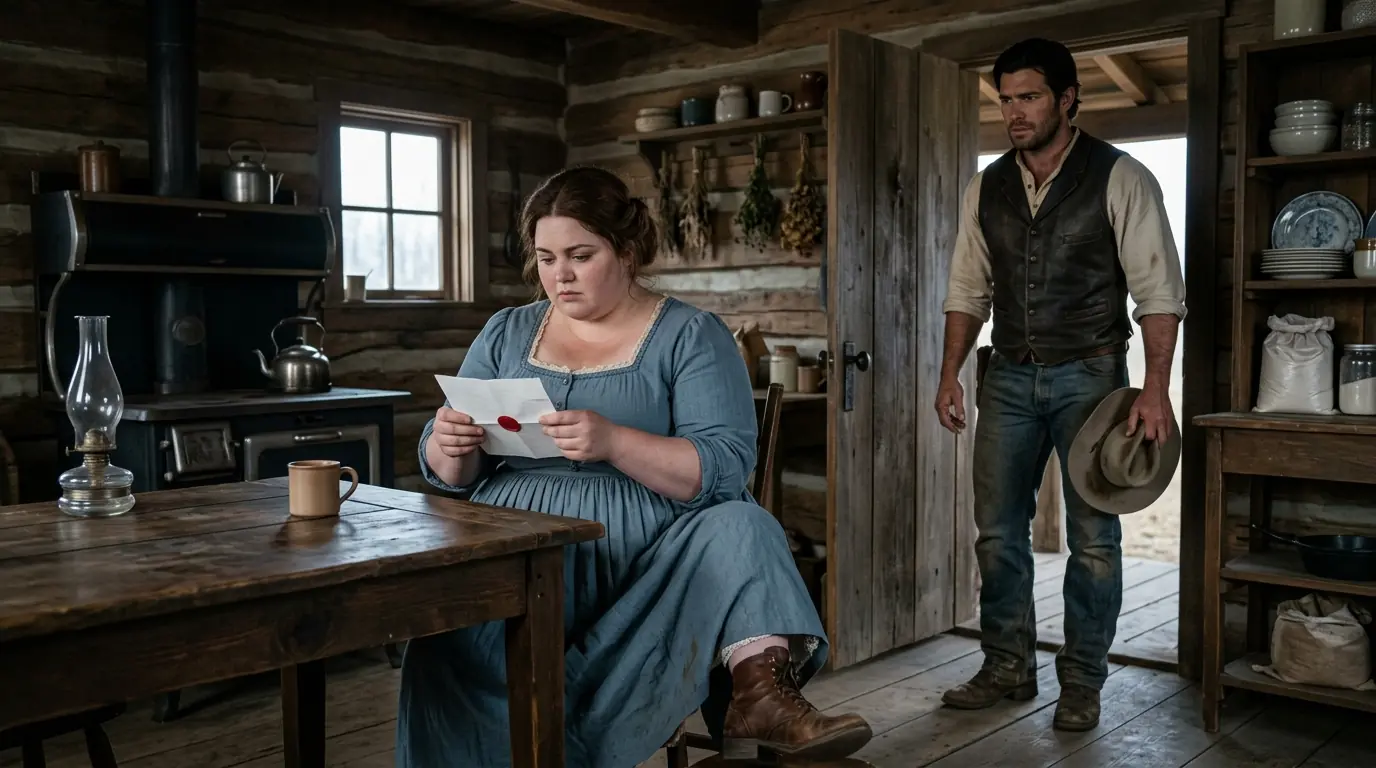
For several seconds Clara heard nothing except steam hissing beneath the locomotive. She was thirty-three years old, nearly four hundred pounds, broad through the shoulders and waist, with a round face framed by dark auburn hair pinned beneath a travel hat that had begun losing its shape somewhere in Nebraska, and she had spent enough of her life being watched that she usually knew when strangers were staring before she ever looked at them. That morning, however, she did not notice the women near the baggage cart until one whispered, “Lucky he died before seeing how big she was,” and another answered, “Imagine ordering a bride and getting four hundred pounds of one.” Their laughter reached Clara with perfect clarity.
She tightened her hand around Elias’s final letter. Cruelty was familiar enough that she knew the usual choices: pretend not to hear, make a joke first, or turn around and give people the satisfaction of knowing the words landed. Clara chose none of them. She looked at the stationmaster and asked, “How?”
He removed his cap. “Creek crossing north of the Ward place. Spring runoff took a wagon. Elias got another man to the bank before the current carried him under.”
“That was four weeks ago?”
“Yes, ma’am.”
“I received this two weeks ago.”
“Mail delays.”
Clara looked down at the envelope. Elias had written that the valley was beginning to green and that he hoped she would not judge Wyoming by the first muddy road she saw, because “the place improves once you stop expecting civilization.” She had laughed when she read it on the train. Now the paper felt impossibly heavy.
“Where is he buried?”
The stationmaster pointed toward a rise beyond town. “Churchyard.”
“I want to visit before tomorrow’s eastbound train.”
One of the women behind Clara made another noise that might have become a laugh.
Then the locomotive shrieked.
A whistle blast tore across the platform as steam exploded along the wheels. Horses tied near the freight wagon jumped, but one bay gelding panicked completely, rearing hard enough to snap its lead rope before coming down sideways.
A cowboy had one boot in the stirrup.
He never got the other over the saddle.
The bay lunged.
The cowboy crashed against the ground, his right foot trapped as the frightened animal bolted down the edge of the platform dragging him behind it.
People screamed.
Men moved out of the way.
Clara dropped her carpetbag.
Growing up above her father’s freight stable had taught her two things about frightened horses. The first was that a terrified animal did not become sensible because a human shouted louder. The second was that if you could turn a horse’s head far enough without pulling it backward, you could sometimes convert a straight run into a circle.
Clara ran.
Her skirts made speed difficult, and someone yelled at her to stop, but she reached the bay before it reached the timber stacks near the freight shed. She caught the bridle near the bit with both hands and pulled the horse’s head toward its left shoulder.
The gelding fought her.
Hard.
Clara’s boots slid across the dirt.
The horse took another stride.
Then another.
Clara held.
Her glove tore across one palm.
The bay’s straight run bent into an arc.
Then a tighter arc.
Clara moved with it, breathing hard, using her weight instead of fighting against it.
Around once.
Twice.
The animal’s momentum broke.
It stopped with its sides heaving.
Clara kept one hand on the bridle and spoke quietly near its cheek until the whites around its eyes began disappearing.
Behind her, the cowboy tore his boot free from the stirrup and rolled onto his back.
“Mr. Ward!” the stationmaster shouted.
The platform changed.
Two men hurried toward the fallen cowboy.
Clara knew the name.
Everybody who had written to anyone within a hundred miles of Bitter Creek knew it.
Caleb Ward owned more land in that valley than some counties farther east. Ward Ranch ran cattle across thousands of acres, controlled several valuable water crossings, and employed enough hands during roundup that local merchants treated payday there like a seasonal event.
Caleb pushed himself upright.
He was forty, tall, broad through the chest, dark-haired, and bleeding lightly from one temple where the ground had caught him. He ignored the men trying to inspect him and looked instead at Clara.
Then his gaze dropped toward her torn glove.
A small brass button had been sewn inside her left cuff.
Caleb became completely still.
“Where did you get that?”
Clara looked down.
“Elias Boone sent it.”
Caleb slowly removed his hat.
Fastened into the leather hatband sat an identical button.
The laughter near the baggage cart died.
Clara stared.
Caleb touched the button with one finger. “Elias gave me this before the creek crossing.”
Her throat tightened.
“He told you about me?”
“He told me about a woman in St. Louis who could balance a freight ledger faster than most store clerks, calm a frightened team, and endure more foolishness from strangers than any decent person should have to.”
Clara glanced toward the women.
They looked away.
Caleb continued. “He asked me to meet your train if something happened before you arrived.”
Clara swallowed. “Something did.”
“Yes.”
For a moment neither spoke.
Then one of the women near the baggage cart muttered, “Now she’ll expect the richest rancher in the valley to take responsibility for her.”
Clara turned.
“No.”
The word carried farther than she intended.
She faced Caleb again.
“I do not want charity.”
Caleb’s expression did not change.
“Good.”
“Give me honest work or help me purchase tomorrow’s eastbound ticket.”
He studied her.
Not her body.
Her face.
That distinction was so unusual Clara noticed it immediately.
Finally Caleb picked up her carpetbag.
“My ranch books are six weeks behind. A cattle buyer arrives Friday.”
“That is four days.”
“I know.”
“What kind of books?”
“Payroll, feed, stock movement, two supplier accounts, purchase ledgers, and everything Elias was keeping when he died.”
Clara held out her hand.
Caleb stopped.
“You said work.”
“Yes.”
“Then tell me the wage before you put my bag in your wagon.”
Something like approval moved through his expression.
“I paid Elias eighteen dollars a week plus room and meals.”
“Same work?”
“Same pay.”
Clara nodded.
“Four days.”
“If you put the books in order.”
“I will.”
Caleb lifted the carpetbag into his wagon.
Then he did not climb up.
Instead he looked toward the hills beyond Bitter Creek.
“There’s something you should know before we leave.”
Clara’s stomach tightened.
“What?”
“My foreman and most of the senior crew signed a notice this morning.”
“What notice?”
Caleb’s jaw hardened.
“They nailed it across the main gate.”
Clara waited.
“They say they won’t work under a mail-order bride.”
For a moment even the station noises seemed quieter.
Clara looked toward the road east.
Tomorrow’s train could take her back to St. Louis.
There would be humiliation there too, but familiar humiliation came with rooms she knew, streets she understood, and employment she could probably recover.
Then she looked at Caleb.
“Do they think I’m going to be their foreman?”
“No.”
“Accountant?”
“They don’t know what work you’ll do.”
“Then why are they angry?”
Caleb looked toward the wagon.
“That is what I intend to find out.”
Clara climbed aboard.
The women on the platform watched.
She did not look at them again.
The Ward Ranch lay almost twelve miles north of Bitter Creek, spread across rolling grassland broken by cottonwood creek bottoms and low ridges where snow remained in shadow despite spring sunlight. Clara saw cattle before she saw buildings, then fences, then barns, then the large two-story ranch house standing beneath a line of old trees.
The gate appeared last.
A broad plank had been nailed across it.
Black paint covered the front.
NO MAIL-ORDER WOMAN GIVES ORDERS TO WARD MEN.
Clara read it once.
Caleb stopped the wagon.
Two ranch hands stood near the bunkhouse pretending not to watch.
Clara asked, “Did Elias give orders?”
“Sometimes.”
“Were they angry about that?”
“No.”
“Who runs the ranch when you’re gone?”
“My foreman, Mason Pike.”
“Where is he?”
Caleb pointed.
A lean man in his late forties stood near the barn with a gray vest, pale hat, and the relaxed posture of someone accustomed to being obeyed before finishing a sentence.
Mason approached.
His eyes went immediately to Clara.
Then stayed there too long.
“Ward.”
Caleb climbed down.
“Mason.”
“You brought her anyway.”
“Yes.”
Mason looked toward Clara.
“This ain’t personal, ma’am.”
Clara almost laughed.
“People usually say that immediately before making something personal.”
Several hands nearby smirked.
Mason ignored them.
“We signed on to work cattle, not answer to some eastern woman who thinks a marriage letter makes her part owner.”
“I am not married.”
“No.”
Mason’s eyes moved over her body.
“That part’s become obvious.”
The laughter was quieter than at the station.
Caleb’s expression changed.
Clara spoke first.