Look up, sir. The voice came from somewhere down by his elbow, urgent in a way that did not match the gentle Tuesday afternoon, and Arthur Mercer, who had spent the last 30 years training himself to ignore voices on the street, did the opposite of what 30 years had taught him. He looked up. He had time just barely to register the slow tilting of the enormous oak that stood at the corner of Sycamore and Lynden, the way the whole canopy of it leaned almost gracefully toward the sidewalk where he was standing. 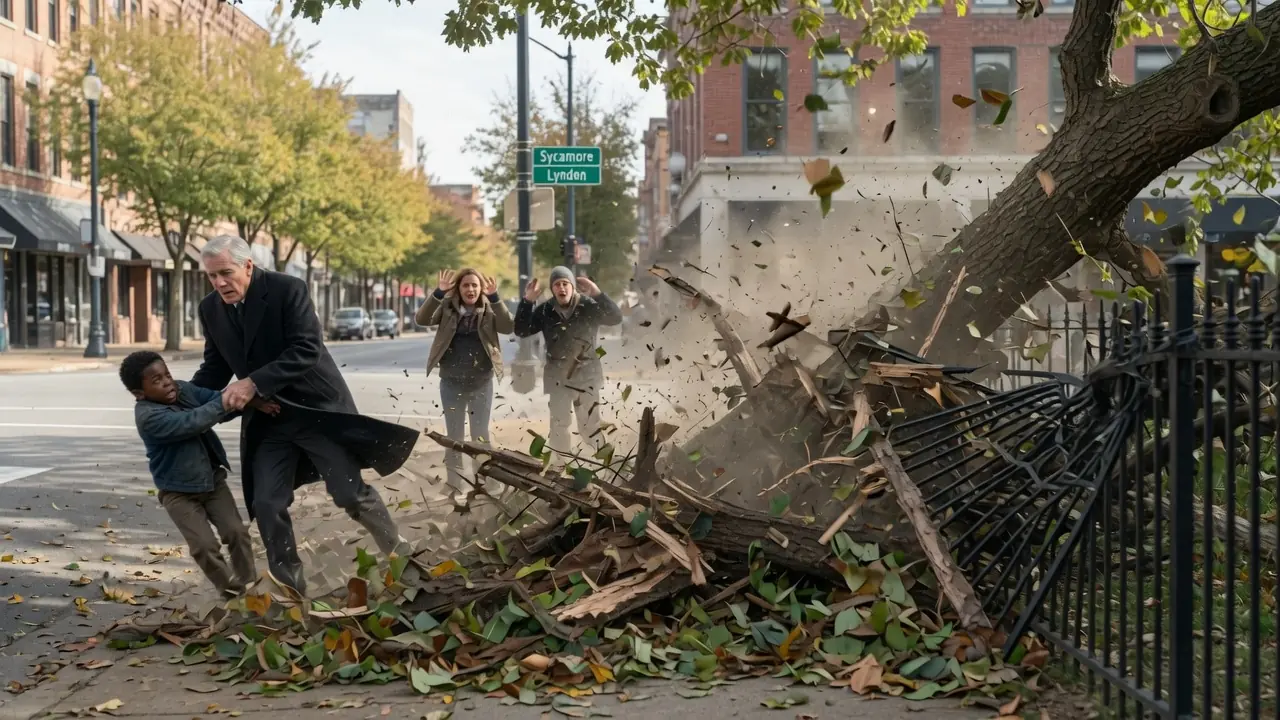
The strange dry crack from somewhere inside the trunk that sounded less like wood breaking than like a long bone giving up. Then a hand closed around his wrist and pulled him backward with a strength that astonished him given how small the hand was, and Arthur stumbled three steps back into the iron fence of the brownstone behind him, just as the oak came down across the sidewalk with a noise that did not belong to any quiet afternoon in Lynden Heights, and never had. The branch that would have struck him passed through the air where his head had been one and a half seconds earlier.
He felt the displacement of it against his face. He smelled the cold green sap of broken wood and the dust of old bark, and underneath both of those things, the faint sweetness of small white flowers from a window box that had also been crushed. For a long moment, nobody moved. The street which had been making its ordinary Tuesday sounds a moment before went very quiet in the particular way streets go quiet when something has happened that the people on them are still deciding how to react to.
A woman across the way had stopped with her grocery bag halfway raised. A delivery man on a bicycle had put one foot down and was looking. Somewhere a car alarm was beginning to wake up. Arthur looked down. The hand was still around his wrist. The hand belonged to a boy.
The boy was perhaps eight, perhaps a little younger, dressed in a jacket that had once been blue and was now the color of pavement after rain. And the boy was not looking at the tree. The boy was looking at Arthur's face with the kind of careful attention that very young children give to wounded birds. You're not hurt, the boy said. It was not a question. It was a statement made by someone who had already checked.
No, Arthur said. His own voice surprised him by being steady. He did not by long habit allow his voice to do anything in public that he had not first given it permission to do. No, I am not hurt. Your hand is shaking. Arthur looked at his hand. It was in fact shaking.
He had not noticed. He noticed now. He folded the hand carefully against his chest the way a man folds a thing he does not want other people to see. And he turned his attention back to the boy. You saved my life, Arthur said. The boy did not answer.
He let go of Arthur's wrist with the same careful attention he had used to take hold of it, and he stepped back half a step, and he looked at the fallen oak with an expression Arthur could not read. It was not the expression of a child who had done something brave. It was the expression of a child confirming something he had already known was going to happen. How did you know? Arthur asked.
It was leaning wrong, the boy said. It has been leaning wrong all week. I told the man with the broom on Monday. He said he would tell somebody. Nobody came. Then I saw the crack on Sunday and I told the lady at the flower shop. She said it was not her tree. So I waited.
You waited for the day it would fall. I did not know it would be today, but I knew it would be one of the days and I knew it would be in the morning because the wind comes up in the morning here. I was watching it when you came around the corner. Arthur stared at the boy.
The boy was thin in the particular way that children get thin when they have been thin for a long time. His shoes did not match. One was a sneaker. One was a black canvas thing that might have been a girl's at one point in its life. His hair had been cut by someone who was not a barber and had not been cut recently. What is your name? Arthur asked.
Ren, the boy said. Ren Callaway. Sirens were starting in the distance now. Someone had finally called. The fire trucks arrived first. Two of them, the larger one easing onto the curb at the far end of the block, the smaller one stopping at an angle that allowed three men in heavy coats to step down and assess the tree without having to walk around anything.
A patrol car came up Lynden from the south, another from the north. Within 4 minutes, the corner of Sycamore and Lynden had been transformed from a quiet residential intersection into the kind of small, organized emergency that Arthur Mercer had watched on television all his life and had never imagined himself standing in the middle of. A paramedic crouched in front of him with the patient professional warmth that paramedics have learned to wear like a second uniform.
Sir, are you all right? Did anything hit you? Can you turn your head for me? I am all right, Arthur said. Truly, the boy pulled me back before it came down. The paramedic looked at the boy. The paramedic had the kind of face that did not change expression unless the change was useful, and the change at that moment was very small, but it was there.
He reached into his pocket and produced a small foil wrapped granola bar and held it out to the boy without saying anything. The boy looked at the bar. The boy looked at the paramedic. The boy took the bar with a careful two-handed grip of a child accepting something he was not yet sure he was allowed to keep. Thank you, sir, Ren said.
You're welcome, the paramedic said. He turned back to Arthur. Sir, I'd like to take your blood pressure if you'll allow me. You've had a shock. People your age, the shock can do more than the falling tree would have. Will you sit on the step here for a moment? Arthur sat on the step.
The brownstone behind him belonged to a family he had nodded to in passing for the better part of a decade without ever learning their names, which was, he understood with sudden uncomfortable clarity, a fact about him rather than a fact about them. The paramedic wrapped the cuff around his arm. The cuff inflated. The numbers, when the paramedic read them aloud, were higher than Arthur had been told they should be, but not high enough to require anything beyond a polite suggestion that he sit a while longer and drink water if water was available.
A police officer had stepped up by then. She was perhaps 40 with the kind of calm that comes from being calm for a living. Sir, my name is Officer Ray. Can you tell me what happened? Arthur told her. He told it the way he had spent his whole career learning to tell things, which was to say accurately and in the order they had occurred and without embellishment.
He told her about the voice at his elbow. He told her about the hand on his wrist. He told her when she asked that the tree had been leaning and that the boy had said it had been leaning all week. Officer Ray turned her attention to Ren. She crouched the way the paramedic had crouched on one knee, bringing her face level with his rather than above it.
I live with my aunt, he said finally. She works at the laundromat on Pearl. She is at work right now. What is her name? Bernadette. Bernadette what? A small hesitation. Bernadette Callaway.
And where do you live with your aunt Bernadette Ren? Apartment 4 above the laundromat. There is a door on the side of the building. You go up the stairs. Officer Ray wrote this down. Arthur watching her face understood that she did not entirely believe it.
He understood also that she was not going to say so in front of the child. She finished writing and she stood up and she looked at Arthur with an expression that contained a question she was not going to ask in front of the boy either. Sir, she said, would you mind staying for a few more minutes? I'd like to make a couple of calls before we wrap this up.
Of course, Arthur said. She walked a small distance away. Arthur watched her dial. He could not hear what she said, but he watched her face, and her face told him everything he had already begun to suspect. He turned to the boy. The boy was sitting on the step beside him now, the granola bar held carefully in his lap, unopened.
You can eat that, you know, Arthur said quietly. The boy looked at the granola bar. I was going to save it for later. How much later? Tonight maybe or tomorrow morning. Arthur was quiet for a moment.
He had spent the morning before any of this on his way to a meeting at his attorney's office about the disposition of an estate that had grown over the course of 40 years of careful work into something he had never quite figured out what to do with. He had been irritated walking to that meeting by a number of small things. The lateness of his usual taxi, the fact that the man who delivered his newspaper had once again left it on the wrong side of the door.
The cost of a particular consultancy he had been billed for in the quarter. He did not believe the consultancy had done any actual work. He had been, in short, the kind of irritated that a comfortable man becomes when nothing in his life is actually wrong and he has run out of larger things to be irritated about. He looked at the boy. The boy was rationing a granola bar.
Ren, Arthur said, when did you last eat something that was not given to you in the last hour? The boy looked at him sideways. It was the look of a child trying to assess whether the question was a trap. Yesterday. Yesterday. When?
There is a place on Hadley where they put the bread out at night when they close. If you get there early before the man comes with the cart, you can take some. I got there early yesterday. Yesterday morning or yesterday evening? Evening.
Arthur did the arithmetic. Somewhere around 20 hours, give or take, possibly more. The boy had been awake at least since dawn, judging by the state of his shoes and the small scrape on his knee that had not yet scabbed over. And the aunt? Arthur said carefully.
Bernadette at the laundromat. Does she feed you when she comes home? The boy was quiet. Ren, there is no aunt Bernadette, the boy said. He did not look up when he said it. He said it to the granola bar in his lap.
I thought as much. Are you going to tell the lady? Arthur considered the question. He considered Officer Ray, who was still on the phone a few yards away, and who was, he could see now from the angle of her shoulders, getting answers she had expected to get. He considered the boy, who had pulled him backward by the wrist 14 minutes ago with a strength a malnourished 8-year-old should not have possessed, but had clearly summoned from somewhere.
He considered the fact that a child who told a careful and well-rehearsed lie about a laundromat aunt was a child who had learned the cost of telling the truth to the wrong adult. I am not going to tell the lady, Arthur said. But the lady will find out. The lady is on the telephone now finding out. So we have, I think, perhaps two more minutes in which you can tell me the things you would rather she did not hear first.
The boy looked at him for the first time since the question about the aunt. His eyes were a peculiar color, somewhere between gray and green, like the color of a river in a season that could not decide whether to be winter or spring. Why? The boy asked. Why? What? Why do you want to know first?
Arthur thought about this. He was, as a rule, an honest man in the small ways and in some of the larger ones. He had built his life and his fortune on a particular kind of honesty, which was the honesty of saying what he meant and meaning what he said in rooms where most people did neither. It had cost him things over the years.
It had also bought him things. On the whole, he believed it had been a good trade. Because in about 2 minutes, he said, a woman in a uniform is going to start making decisions about your life and those decisions are going to be made on the basis of whatever information she has at that moment. The information she has at that moment is going to be incomplete.
I would like, if you will let me, to make sure it is less incomplete than it would otherwise be because the decisions she makes are going to matter. Ren, they are going to matter for a long time. The boy looked at the granola bar. He looked at Arthur. He looked back at the granola bar.
My mom died when I was five, he said. My dad before that, I do not really remember him. I lived with my grandmother until she died, too. That was last winter. After that, I was at a place with other kids for a while, but I left.
You left? They were not nice. Not nice how? Arthur asked. The boy did not answer right away. He turned the granola bar over in his lap. He turned it over again. Arthur watched him do this, and he understood that some questions were too large for an 8-year-old to answer in the four minutes he had been given to answer them, and that the polite thing to do was to stop asking and to wait for the answers to come on their own time, if they ever came.
You do not have to tell me now, Arthur said. You do not have to tell me ever. I'm only asking because I would rather know than not know, but the not knowing is also all right. The boy nodded once. The nod was very small. How long have you been on the street, Ren?
Since March. It was now October. Arthur did the arithmetic again. 7 months. Seven months of a child living the way Arthur had just learned this child had been living. He thought about the previous winter, the one that had taken the grandmother.
He thought about the spring that had followed when this boy had been 7 years old and sleeping. He did not yet know where. He thought about the summer when men like Arthur had complained about the heat from the windows of cars whose air conditioning had been set to the temperatures their wives preferred. He felt a thing move in his chest that he did not have a name for.
He had felt it before in his life twice that he could remember clearly. Once when he was 19 and had read a particular paragraph in a particular book. Once when he was 34 and had watched a woman he loved very much walk away from him for reasons that had turned out to be the right ones. He had not felt it in a long time.
He had begun to think somewhere in the last decade that he might not feel it again. He was on the whole glad to find that he had been wrong. Officer Ray was walking back. Arthur had perhaps 20 seconds. Ren, when she comes back, she's going to ask you to come with her.
She will be kind about it. She will not be unkind, but she will ask, and when she asks, the answer is going to be yes because you are 8 years old and the law does not give you any other answer to give. Do you understand? Yes. I am going to ask her something.
I'm going to ask her to wait for one telephone call before any decisions are made. If she agrees and she may not, I'm going to make the telephone call in front of you. I'm going to call a woman named Estelle. Estelle is the closest thing I have to a sister. She has spent 30 years of her life doing work that involves children in the situation you are now in.
She will know what is possible and what is not possible. I'm not going to promise you anything that I cannot deliver. I'm only going to tell you what I am about to try. The boy looked at him for a long moment. Why? Because you pulled me out of the way of a tree.
That was not a big thing. It was a thing the size of my life, Ren. To me, it was the largest thing that has happened on a Tuesday morning in 30 years. The boy did not say anything to that. Arthur could see, however, that the boy was thinking about it.
Officer Ray arrived. She did not crouch this time. She had Arthur understood moved into a different mode. The mode in which the conversation was no longer with the child, but with the adults around the child. She looked at Arthur first.
Sir, may I speak with you for a moment over by the truck. Of course, Ren, stay here, please. I will be back in 2 minutes. He stood. His knees were unsteadier than he had expected them to be, and he was reminded that he was 67 years old and that the body of a 67-year-old man does not absorb a near miss with a falling tree the way the body of a 30-year-old man does.
He walked with Officer Ray to the side of the fire truck. Sir, she said low, there is no Aunt Bernadette. There is no apartment above the laundromat on Pearl. The laundromat on Pearl was closed for renovation 8 months ago. The boy was reported missing from a state placement in March.
He has been listed as a runaway since. I have a duty here that I am about to perform. But before I do, I wanted to tell you because you were standing here when it mattered that he is not in any trouble for what he told me. He is 8.
Officer Ray, sir, my name is Arthur Mercer. I would like to ask you for 10 minutes. Officer Ray looked at him. She was, Arthur understood, doing a number of small calculations at considerable speed. She was assessing his coat, which was a good one.
She was assessing the way he had spoken his own name, which had been the way of a man who was used to his name being known in certain rooms, and was aware that it was probably not known in this one. She was assessing the boy on the step, who was still holding the unopened granola bar. She was assessing her own intuitions, which were, Arthur guessed, the most reliable instrument she had been issued by the department she worked for.
10 minutes for what, Mr. Mercer? For one telephone call to a woman named Estelle Whitford. She has run a licensed therapeutic foster placement in this state for 31 years. She is on the board of two organizations whose names you will recognize if I say them.
I would like to call her in front of the boy on speakerphone if you prefer and ask her one question which is whether she can take a phone call from your department in the next hour and whether if the department finds it appropriate she would be willing to receive Ren as an emergency placement tonight. I'm not asking you to release him to me.
I'm not asking you to bend any procedure. I'm asking you for 10 minutes. She did not answer right away. She looked at the boy on the step. She looked back at Arthur. Why? Because the boy ran from the last placement.
And because boys who run from placements run again from the next one if the next one is the same kind of place. And because the woman I am about to call is not that kind of place. She is the other kind. The kind people do not run from.
I have known her for 40 years. I have watched her do this work for 31 of those years. I am not a man who promises things lightly. Officer Ray, I am offering you a phone call. She was quiet for a moment longer. Then she said,
Make the call, speaker. I want to hear it. If she says what you say she will say, I will pass her contact to my supervisor, and the supervisor will make the next decision. That is the most I can promise you, Mr. Mercer. I cannot promise you the supervisor will agree.
I am not asking you to promise me anything the supervisor decides. Thank you. He walked back to the step. He sat down beside the boy. Officer Ray stood at a respectful distance, close enough to hear far enough not to crowd.
Ren, I am going to make the call now. Estelle is going to answer on the second ring or the third. She always does. She is a small woman with a loud voice. She's going to ask me questions and I am going to answer them honestly.
You can listen. You can also not listen. Either is all right. He took out his phone. He found Estelle in his contacts. He set the phone to speaker. He pressed call.
She answered on the second ring. Arthur. Estelle. It is the middle of the day on a Tuesday. Arthur, you do not call me in the middle of the day on a Tuesday unless something has happened. What has happened?
A tree fell on Sycamore and Lynden a little while ago. It would have fallen on me, but a boy pulled me out of the way. The boy is 8 years old. He has been on the street since March.
He has been talking to me for the last 20 minutes. He is sitting beside me right now. He can hear you. There's also a police officer standing nearby. She can also hear you. Her name is Officer Ray. A pause.
It was a short pause by anyone else's standards. By Estelle's it was a paragraph. Hello, Ren. Hello, Officer Ray. Hello, ma'am. The boy said. His voice was very small.
Ma'am, said Officer Ray. Arthur, what are you asking me? I am asking you whether you have a bed tonight. I'm asking you whether if the department finds it appropriate you would be willing to receive Ren as an emergency placement.
I'm not asking you to do anything you would not otherwise do. I'm only asking the question. Another pause. I have a bed. I have had a bed open since Sunday. I was going to call the agency tomorrow.
Officer Ray, I would be glad to speak with your supervisor whenever your supervisor would like to speak with me. My number is the number Arthur has just called from. My license is current. My references are current.
My home study was renewed in June. Officer Ray had taken out a small notebook. She was writing. Ren Estelle said, are you still there, sweetheart? Yes, ma'am. You do not have to decide anything right now.
The grown-ups are going to do the deciding part. But I wanted to say one thing to you while I have you on the telephone, which is that my house is quiet, and there is a yard with a fence, and there is a dog named Pepper who is too old to do much but sleep, and there is a room at the back that has been empty for a while.
That is what is on the table. The rest we will figure out. The boy did not answer. He was looking at the phone in Arthur's hand as though it were a thing he had read about in a book and had not quite believed in. Thank you, Estelle, Arthur said.
Call me back, Arthur. The line went dead. Officer Ray closed her notebook. She did not say anything for a moment. She was looking at the boy on the step and then at Arthur and then at the fallen oak, which the men in heavy coats had begun to cut into manageable sections with a chainsaw that filled the corner of Sycamore and Lynden with a noise that made conversation briefly impossible.
When the chainsaw stopped, she said, Mr. Mercer, I'm going to make a call to my supervisor. I'm going to recommend that we contact Miss Whitford and that we expedite the emergency placement. I'm also going to recommend because it is going to come up that you not be present at the placement tonight.
Not because of anything you have done because the boy has just been through a thing and because the people who will be making the decision about where he goes next will be more comfortable if they can see that the decision was made by them and not by you. Do you understand? I understand.
Arthur said, I would not have asked to be present. I will not be present. I thought as much. I am telling you anyway because I have learned over the years that men in good coats sometimes need to be told. That is fair.
She walked a few steps away. She made her call. Arthur turned to the boy. The boy was still holding the granola bar. He had not opened it. Ren? Yes, sir. Two things.
The first is that you are not going to go back to the place you ran from. Officer Ray is making sure of that. The second is that the woman you just spoke with on the telephone is, in my honest opinion, the best person I know.
I am not going to tell you everything will be perfect because I do not know what perfect would mean to you and I am not going to pretend to. I'm going to tell you that her house has been a place where children have been able to sleep for 31 years and that the children who have slept there have on the whole come out the other side as people who could sleep in other places afterwards.
That is the most I can say. The boy looked at the granola bar. Then he looked up at Arthur. Are you going to come and see me? The question landed in Arthur's chest the way the branch had not.
He took a careful breath. If you would like me to, yes. If you would not like me to, no. The choice is going to be yours, Ren. Estelle will not let me come if you do not want me to come.
That is one of the things about Estelle. She's going to ask you in a few days when you have had a chance to rest and eat and look around whether you would like to see me. And she is going to take seriously whatever you answer. So you do not have to answer now.
You can answer when she asks. Okay. You can also change your mind. People change their minds. It is allowed. Okay. Officer Ray came back.
She crouched in front of the boy again. The mode had shifted once more. The mode now was gentle. Ren, my supervisor is sending someone from the agency to meet us. She will come in a different car.
She is a nice lady. Her name is Ms. Park. She is going to take you to Miss Whitford's house tonight. Miss Whitford is expecting you. There is a dog named Pepper. There is a room with a bed.
You are going to eat dinner there, and you are going to sleep in the bed. And tomorrow, some grown-ups are going to talk to each other about what happens next. That part is not your job. Your job tonight is to eat and to sleep.
Is that all right? Yes, ma'am. Is there anything you need from anywhere before we go? The boy thought about this. There is a bag, he said. Behind the dumpster at the back of the church on Hadley. It has my things in it.
Then we will go and get the bag. Officer Ray said. I will drive you, Mr. Mercer. You will not be coming with us. I understand.
She stood. She helped the boy to his feet, not by lifting him, but by holding out her hand and waiting for him to take it, which he did. He looked at Arthur. Sir, yes, Ren.
Thank you for the telephone call. Arthur did not trust his voice for a moment. He waited until he did. Thank you for the wrist, Ren. The boy made a sound that might have been a laugh if it had been allowed to grow into one.
It did not quite get there, but Arthur heard the shape of it, and he understood that the shape of a laugh was a thing he was going to remember for a long time. Officer Ray led the boy to her patrol car. She opened the back door, but she did not put him in the back.
She opened the front passenger door instead and helped him climb up and she buckled the seat belt around him with the careful attention of a woman who had Arthur suspected children of her own at home. She walked around to the driver's side. She got in.
She looked at Arthur once through the windshield before she pulled away. He raised one hand. She raised one back. The patrol car pulled away. Arthur stood on the corner of Sycamore and Lynden for a long time after it was gone.
The men with the chainsaw started up again. The car alarm down the block, which had been wailing intermittently since the tree had come down, finally exhausted itself and went quiet. The woman with the grocery bag had long since gone inside.
He realized after some minutes that he was still holding his phone in his hand. He looked at it. He pressed Estelle's name again. She answered on the second ring. I have not gotten any calls from any department yet.
Arthur, you will. I am calling about something else. All right. How much money would your house need to never have to worry about money again? A long pause this time. A real one.
Arthur, I am asking honestly. Estelle, I have been looking for a thing to do with what I have. I have found this morning what the thing is. Come and see me on Saturday.
We will talk about it then. Not on a Tuesday. Not on the telephone. All right, Arthur. Yes, he is going to be all right, the boy. Not perfect, but all right. I want you to know that before Saturday.
Thank you, Estelle. The line went dead. Arthur did not go to his attorney's office that afternoon. He called from the corner of Sycamore and Lynden and told the receptionist, a woman named Doris, who had been answering that telephone for 22 years and had never once been rude to anyone on the other end of it, that he would not be coming in today and that he would explain on Thursday.
Doris, who had heard a great many men her age cancel a great many meetings on a great many Tuesday afternoons, did not press him. She said only that she hoped he was well, and that she would put him in the book for Thursday at 10:00. He walked home instead.
It was by the route he chose, almost 2 miles, and he had not walked 2 miles in one go in perhaps 4 years. His knees told him about it. His left hip told him about it. He listened to what they said. He did not, by long habit, allow them to change his mind.
He walked because he needed the time. He walked because the inside of a taxi or the inside of his own apartment would have been at that moment smaller than what was happening inside his chest needed in order to fit. He walked because he had been for a long time the kind of man who solved most problems by sitting down with a yellow pad.
And he understood that the thing happening to him now was not the kind of thing a yellow pad was going to solve. He thought as he walked about a great many things. He thought about his wife who had not been his wife for 33 years. Helena.
They had divorced in their mid-30s for reasons that had been at the time the right ones and had remained in the long view the right ones, but had left him without the family he had assumed at 25 he was going to have by 40. They had not had children. They had talked about children.
They had postponed children. Then they had postponed each other. Then Helena had gone to a fellowship in Edinburgh and had not come back. And he had not asked her to come back.
And that had been that. He thought about his brother Edward, who had died of a heart attack at 58 on a treadmill in a hotel gymnasium in Houston. He thought about Edward's wife Margaret, who had remarried and moved to Phoenix, and who sent him a Christmas card every year that said the same six words in slightly different handwriting depending on how rushed she had been.
He thought about Edward's children, who were now adults with children of their own, and who he saw at funerals. He thought about the work. He thought about the firm he had built starting in the back room of a borrowed office in 1979 and the way it had become over the decades the kind of firm that did not need him to be in the building for the building to keep running.
He thought about the foundation he had started in 2003, because his accountant had suggested he ought to, and because he had not at the time known what else to do with money that was accumulating faster than he could find uses for it. He thought about the foundation's most recent annual report, which had been, when he read it, the report of an organization that did good work, but did not particularly know him.
He had been, he understood now, a stranger at his own foundation for some years. He thought about the boy. He thought about the boy a great deal. He thought about a child who had watched a tree lean for a week and had told two adults about it and had been ignored by both and who had then stationed himself near the tree to do for strangers what the adults had not been willing to do for the street.
He thought about what it took to be 8 years old and to have decided in the absence of anyone deciding it for you that the job of looking out for other people was your job. He thought about the small careful way the boy had held the granola bar.
He arrived at his building a little after 4:00. The doorman, a man named Reuben, who had been there longer than Arthur had, opened the door for him and made some small remark about the weather and then looked at Arthur's face more closely and said, Mr. Mercer, are you all right, sir?
I had a near miss with a tree this morning, Reuben. My God, sir, should you not be at a hospital? A paramedic looked at me. I'm all right. I'm only tired, sir.
I am going to bring you a glass of water upstairs. Thank you, Reuben. That is kind. He went up to his apartment. It was on the eighth floor.
It had a view of the park that he had paid a great deal of money for and had over the years looked at less and less. The apartment was clean because a woman named Enz came twice a week and made it so. And it was quiet because there was no one in it but him.
And it was, he understood suddenly, and with some force, the apartment of a man who had not had a real conversation inside its walls in possibly 9 months. He sat down on the sofa. He did not turn on the television. He did not pour himself a drink.
He sat in the very particular quiet of his own apartment at 4:00 in the afternoon, and he thought about a small boy who was at that exact moment riding in the passenger seat of a patrol car with a backpack from behind a dumpster on his lap on his way to a house with a yard and a fence and a dog named Pepper, he thought for the first time in a long time that he might have been wrong about a great many things.
Reuben came up with the water. Arthur drank it. Reuben withdrew. The apartment was quiet again. After a while, Arthur picked up his phone.
He scrolled past Estelle's name. He scrolled past his attorney's name. He scrolled until he found the name of a woman he had not called in 11 years. He pressed call.
Helena answered on the fourth ring. Arthur. Helena. There was a silence on the line of the kind that exists only between two people who have not spoken in a long time and who have in the time they have not spoken neither stopped loving each other nor figured out what to do with the fact.
You sound strange, she said. Are you all right? A tree almost fell on me this morning. A boy pulled me out of the way. The boy is 8 years old. He has been on the street since March.
I have spent the last several hours arranging for him to go somewhere safer than the street. And I have spent the last hour sitting in my apartment thinking about what I am going to do with the rest of what I have. And I have, after some thinking, arrived at the conclusion that one of the things I would like to do with the rest of what I have is to call you and tell you that I am sorry.
A pause. Arthur. I am not asking for anything, Helena. I'm not asking to see you. I'm not asking to write letters. I am calling because I should have called 30 years ago when I realized I had been wrong and I did not because I had decided at the time that the dignified thing to do was to leave you alone.
And I have in the last hour come to the conclusion that the dignified thing and the right thing were not the same thing and that I owed you the call. Helena was quiet for a long time. He could hear very faintly the sound of a kettle somewhere in the background of her life in Edinburgh, where it was 9:00 at night, and where she had, he knew, because he had once asked an acquaintance and then felt ashamed about asking, married a man named Ian in 1996 and had been married to him ever since.
Arthur, she said finally. Her voice was not cold. It was not warm either. It was the voice of a woman who had spent 33 years working out what she would say if Arthur Mercer ever called her and who had now discovered that the thing she had worked out was no longer quite right because the man on the telephone was no longer quite the man she had been preparing the speech for.
I do not know what to do with this telephone call. She said you do not have to do anything with it. I do not want anything from it. I wanted you to have it. That is all.
You said a boy pulled you out of the way of a tree. Yes. Tell me about the boy. So he told her. He told her about the corner of Sycamore and Lynden.
He told her about the voice at his elbow. He told her about the granola bar and the dumpster behind the church on Hadley and the way the boy had said since March. He told her about Estelle, whom Helena had met perhaps four times during their marriage and had liked very much.
He told her because she asked about the call to Estelle and about the conversation that had followed about the house and about the money. When he was finished, Helena was quiet for a long time. Arthur, she said, do you remember the conversation we had in the kitchen on Cumberland Street in 1989?
I remember every conversation I had with you in any kitchen in any year, Helena. That is a lovely thing to say, and I do not entirely believe it, but I will take it. The conversation I am thinking of is the one where I asked you whether you wanted children, and you told me that you did, and I told you that I did, and we agreed that we would, and then we did not.
We did not because you said we should wait until the firm was steadier. And I said, All right. And then we waited until I was 37 and you were 41. And by then, I had stopped asking and you had stopped saying anything.
Do you remember that part? I remember that part. I have thought in 33 years about that part more than is healthy. I have made my peace with it mostly. Ian and I did not have children either for reasons that were our own and not yours.
I am telling you this because I want you to hear what I am about to say next without thinking I am saying it to hurt you. I am not. Are you ready? I am ready.
You are 67 years old, Arthur. You have by your own description in this telephone call just decided to do something about a boy who is 8. That is not nothing. That is in fact the largest thing I have heard you describe wanting to do in any of the years I have known you.
I want you to do it carefully. I want you to do it slowly. I want you to do it in a way that is for him and not for you. Do you understand the difference? I do. I am not certain you do.
I'm going to say it again in a different way. There is a temptation, Arthur, for men in your position to find a child like this one and to put him on a shelf inside the rest of their life as though he were the missing piece that completes the picture. He is not a missing piece. He is a person.
He has his own picture. Your job, if you have a job at all in his picture, is to be one figure in the background of it holding the lantern while he walks. Not the lantern, not the road, not the destination, the hand that holds the lantern.
Do you understand now? Arthur sat on his sofa in his quiet apartment on the eighth floor and he closed his eyes and he understood that he had called the right person. Yes, he said. Now I do. Good.
Then I am glad you called. Helena, yes. Are you happy? A pause, a short one. Yes, Arthur I am. Are you?
I have not been. I think I might be about to be for the first time in a long while. Then I am glad about that too. Call me on Saturday after you have seen Estelle. Tell me what she says. I would like to know.
I will. Goodbye Arthur. Goodbye Helena. The line went dead. He sat for a long while on the sofa. The room was darker than it had been when he sat down. He had not noticed the light going.
He stood up eventually. He went to the window. He looked at the park. He did not, of course, see the boy from the window. The boy was 4 miles away in a kitchen in a house in a part of the city Arthur had only been to twice, eating a bowl of soup that Estelle had made from a recipe her own mother had taught her, with a dog named Pepper asleep on the floor beside his chair.
But Arthur standing at the window felt for the first time since he had been roughly 30 years old that he knew where in the world the next part of his life was going to take place. Arthur did not see Ren for 9 days. He had been prepared after the conversation with Helena to wait considerably longer.
He had been prepared, if necessary, to wait forever, in the sense that he had understood from Helena's voice on the telephone that the waiting was part of the thing, and that a man who could not wait was a man who had not understood what the boy was for, which was to say not for anything. He spent those nine days doing several things.
He went to his attorney's office on Thursday morning as promised. He sat across from Marcus Hanson, who had been his attorney for 28 years, and he explained what had happened on Tuesday and what he intended to do about it. Marcus listened the way Marcus always listened, which was without interruption and with one pen tapping very softly against the edge of a yellow pad.
When Arthur was finished, Marcus said, Arthur, before we discuss the structure, I want to ask you one question, and I want you to answer it honestly. Are you doing this because the boy saved your life? Or are you doing this because you have realized on the occasion of your life having been saved that you would have done it anyway if you had known the boy existed?
Arthur thought about this. The second one. The first is the occasion. The second is the reason. Good answer. We can work with that. Tell me what you want.
He told him. He wanted a trust established for Estelle's house sized so that the house would never have to take a child it could not afford to take and never have to refuse a child for reasons of money. He wanted a second trust established for Ren specifically to take effect if and only if Ren chose at the age of 18 or any age thereafter to make use of it with terms that allowed Ren to decline it entirely if he wished and walk away owing no one anything.
He wanted a third instrument established that he did not yet have a name for, but that he described to Marcus as a way for the foundation to begin doing the kind of work the foundation had not until now been doing. He wanted Marcus to start drafting all three.
Marcus said, Arthur, this is going to take some months. I am aware. Start anyway. He spent a portion of each day on the telephone with people he had not called in some time.
He called his niece in Phoenix who was 41 and worked in pediatric occupational therapy and who had the last time he had seen her told him about a program in her hospital that worked with children who had been removed from their homes. He had said at the time that it sounded important. He had not at the time asked her any follow-up questions.
He asked them. Now the conversation lasted an hour and 40 minutes and at the end of it his niece was quiet for a long time and then said, Uncle Arthur, are you all right? And he said, I am Cassie better than I have been.
I will explain in time. He called Doris at his attorney's office and asked her to come to lunch with him on Friday. He had known Doris for 22 years and had never had lunch with her once. She accepted with the careful neutrality of a woman who had decided long ago that whatever the men in good coats wanted to do with their time was their business.
At lunch he asked her about her children of whom he had heard her speak only in passing over the years. And he listened to the answers with the attention he had failed for 22 years to give them. When the lunch was over, she said, Mr. Mercer, I am not sure what this lunch was about, but it was a nicer lunch than I had expected when I accepted it.
And he said, Doris, I'm 67 years old and I have only just figured out that I have been failing for some decades to ask the right questions of people who deserved them. I'm trying to repair some of that. Thank you for coming.
She looked at him for a moment and then she said, Well, all right then, Mr. Mercer. And she did not say anything more, but Arthur saw as she walked away from the table that her shoulders sat a little differently than they had when she sat down.
He did not call Estelle. He had said he would come on Saturday. He came on Saturday. Estelle's house was in a neighborhood that Arthur had been through perhaps three times in his life and never on foot.
It was a yellow house with a white porch and a fence around a yard with grass that had been allowed to grow a little wild on purpose because Estelle had once told him children needed places where the grass was tall enough to be interesting. The dog Pepper was on the porch when Arthur came up the walk, lying in a square of sunlight with the particular boneless commitment of an old dog who had decided that nothing on this porch was going to require him to stand up again ever.
Estelle opened the door before he reached it. She was 71. She had been a small woman when Arthur had met her at 31, and she had become over 40 years somehow smaller and more solid at the same time, like a stone that had been weathered by long use into the exact shape of itself.
Arthur. Estelle, he is in the back. He is reading. He does not know you are coming today. I did not tell him because I did not want him to spend the morning waiting. He has spent enough mornings waiting in his life so far.
That was wise. I am going to walk you to the kitchen. You are going to sit at the table. I'm going to go and tell him that you have come and that he can come and say hello if he wants to and that he does not have to if he does not want to.
Then we will see what he chooses. Yes. She walked him to the kitchen. The kitchen was a small one with a window that looked out onto the yard. There was a teapot on the stove.
There were drawings taped to the refrigerator that Arthur, looking at them, understood to be Ren's. The drawings were not the drawings of a child who had been drawing all his life. They were the drawings of a child who had perhaps not been given paper in some time and was making up for it.
Arthur sat down at the table. Estelle went down a hallway. He waited. He did not look at his phone. He did not look at his watch. He looked at the drawings on the refrigerator and at the window and at the dog on the porch through the screen of the back door, and he understood with a clarity that surprised him that there was no part of him at this moment that needed anything to happen any faster than it was about to happen.
After perhaps 4 minutes, he heard small footsteps in the hallway. The boy came into the kitchen. He was wearing a clean shirt that was a size too big for him and a pair of jeans that had been rolled at the cuffs. His hair had been cut by someone who knew how to cut hair.
He looked, Arthur thought, like a child. Not like a child who had been on the street since March. Like a child. Hello, sir. Ren said.
Hello, Ren. The boy looked at him for a moment. Then he crossed the kitchen and he sat down in the chair across from Arthur. And he folded his hands very carefully on the table. The way a child folds his hands when he has been told perhaps recently that this is what a person does at a kitchen table when there is a guest.
Estelle told me you might come on a Saturday. She told me I might come on a Saturday, too. I'm glad it turned out to be today. Me too, sir. A pause, not an awkward one.
Ren, yes, sir. How are you? The boy thought about this. He thought about it for what Arthur would later remember as a very long time, though it was probably only 6 or 7 seconds. I am okay, sir, he said.
I think I'm going to be more than okay, but I am okay for now. Arthur did not this time try to keep anything off his face. He let what was there be there. That is the best answer to that question I have ever heard, Ren.
The boy almost smiled. The smile, like the laugh on the corner of Sycamore and Lynden, did not quite finish itself, but it got further than the laugh had. Arthur saw it get further. Estelle came in behind them with the teapot.
She set it on the table. She brought three mugs. She poured for all three of them, including the boy whose mug was mostly milk with a small splash of tea to make it the color of the grown-up drinks. She sat down.
All right, she said. Now we talk. They talked for 2 hours. They talked about what Ren was reading, which was a book about a boy who had a fox for a friend, and which Ren had read twice already in the nine days he had been at Estelle's house because he had not until then had a book that was his to read more than once.
They talked about Pepper, who was, according to Ren, 14 years old and afraid of the vacuum cleaner and not afraid of thunder, which Ren had decided made Pepper a sensible dog. They talked about the school Estelle had begun the conversations to enroll him in, which was four blocks away, and had a music room with a piano in it that the children were allowed to touch.
They talked about Ren's mother, whose name had been Sarah, and who had liked to sing in the kitchen while she made pancakes on the weekends, and whose voice Ren remembered better than her face, which Arthur understood, having sat with Eli in another life that had not been his, was the way of these things. They did not talk about the tree.
They did not talk about the wrist. They did not talk about the conversation Arthur had had with Marcus on Thursday or the trust that was being drafted in his name. Those things were not for this Saturday.
Those things would be for other Saturdays, doled out at the pace of an 8-year-old's understanding with a hand on the lantern and not on the road. When it was time for Arthur to go, Ren walked him to the porch. Pepper opened one eye, considered standing up, and decided against it.
The afternoon light was coming sideways through the maple at the corner of the yard, turning the lawn a color that Arthur, who did not have words for most colors anymore because he had not needed them, thought might be the color of honey if honey had a sound. Sir, Ren said. Yes.
Estelle says you are coming back next Saturday if you would like me to. I would like you to if you would like to come. I would like to come, Ren. The boy nodded once.
He did not hug Arthur. Arthur had not expected him to. Hugs were for later if they were forever. The boy held out one small hand instead, the way a child holds out a hand when he has been told perhaps recently that this is what a person does on a porch when a guest is leaving.
Arthur took the hand. He held it for a moment. He let it go. Goodbye, Ren. Goodbye, sir.
Arthur walked down the porch steps and out through the gate of the fence around the yard with the long grass. He turned at the gate. The boy was still on the porch. He raised one hand. Arthur raised one back.
He walked to his car which was parked at the curb and he got in and he sat for a moment with the keys in his hand and he did not start the engine. He thought about a great many things. He thought about the corner of Sycamore and Lynden where a tree had fallen on a Tuesday morning 11 days earlier and had missed him by a foot and a half because a child had pulled him backward by the wrist.
He thought about the granola bar the boy had not eaten until Officer Ray in the front seat of the patrol car had quietly told him he could. He thought about Estelle, who had answered her telephone on the second ring, as she always did, and who was at this moment in her kitchen washing three mugs that two adults and a child had drunk tea out of.
He thought about Helena in Edinburgh, who had told him on a telephone the previous Tuesday evening to be the hand on the lantern and not the lantern, and who had thereby saved him from the version of this story that would have been about Arthur and not about Ren.
He thought about the years he had spent being irritated about small things in a life that had been, by any honest accounting, extraordinarily fortunate. He thought about the doormen and the receptionists and the nieces he had failed to ask the right questions of, and the brother who had died on a treadmill in Houston, and the wife he had lost because he had postponed and postponed and postponed.
He thought about the boy on the porch with his hands still raised, who had been on the street since March, and who had in his nine days at Estelle's house read a book twice and made friends with an old dog and worn a clean shirt that was a size too big for him because Estelle had not yet had time to take him to buy one in his own size, and who had said when Arthur had asked him how he was. I am okay, sir. I think I am going to be more than okay, but I am okay for now.
Arthur Mercer, who had built a life on the kind of honesty that involved saying what he meant in rooms where most people did neither, said out loud to no one in the quiet of his car at the curb in front of a yellow house with a white porch in a neighborhood he had only ever been to three times in his life. So am I. He started the engine.
He drove home.was standing.