Ethan Carter did not think of himself as brave that afternoon. He was only twelve years old, sitting on a wooden bench in a quiet city park while yellow leaves drifted across the grass around his sneakers. His green hoodie was zipped halfway, and his lunchbox rested on his knees. He had come to the park after school because his mother was working late, and the bench near the old oak tree had become his favorite place to wait.
The park was calm in the way autumn parks often were, gentle but a little lonely. Parents pushed strollers along the path, joggers passed with quiet footsteps, and pigeons gathered near the fountain looking for crumbs. Ethan opened his lunchbox slowly, already thinking about the apple slices his mother had packed. He was hungry, but not desperate, and that difference would matter more than he knew.
Beside him sat a girl he had not noticed at first. She was small, maybe nine years old, with two loose braids and a gray sweater stained with dirt and old grass. Her jeans were torn at both knees, and her shoes looked too thin for the cooling weather. She kept her hands folded tightly in her lap, trying very hard not to stare at his food.
Ethan saw her eyes move toward his lunchbox, then quickly away. She looked embarrassed, as if even wanting food was something she should hide. Her face was pale under the smudges on her cheeks, and her lips pressed together whenever her stomach made a small sound. Ethan had heard that sound once during a long school trip when he forgot breakfast, but hers sounded deeper and sadder.
He looked down at his sandwich. It was turkey and cheese, cut in half by his mother because she knew he liked clean edges. There were grapes in a plastic container, a small cookie, and a folded napkin with a tiny smiley face drawn in blue pen. Ethan suddenly felt the weight of the food differently. It no longer felt like his lunch; it felt like a decision.
He turned slightly toward the girl. “Are you waiting for someone?” he asked. She looked up quickly, startled by his voice. Her eyes were brown, wide, and tired in a way that made her seem older than nine. She shook her head once, then looked back down at her hands.
“My name is Ethan,” he said, trying not to sound too loud. The girl’s fingers twisted around the hem of her sweater. “Sophie,” she whispered. Her voice was so soft that the wind almost carried it away. Ethan nodded like that was all he needed to know.
He opened the sandwich container and picked up one half. Then he hesitated, glanced at her face, and realized one half might not be enough. Still, he did not want to embarrass her by offering too much too suddenly. So he held out half the sandwich gently, keeping his hand steady.
“Here,” Ethan said kindly. “You can have half.”
Sophie stared at the sandwich like she did not understand what it was. Then tears filled her eyes so fast Ethan almost pulled his hand back, afraid he had done something wrong. Her lips trembled, but she did not reach for the food. She looked around the park as if someone might scold her for accepting it.
Ethan placed the sandwich on the lunchbox lid and pushed it closer. “It’s okay,” he said softly. “You need it too. I’m okay. Eat.” Sophie looked at him for a long moment. Then she picked up the sandwich with both hands as if it might disappear.
She took one small bite first. Then another. She tried to eat politely, slowly, but hunger betrayed her, and soon she was swallowing with quiet urgency. Ethan looked away for a few seconds so she would not feel watched. He opened the container of grapes and placed it between them without saying anything.
Sophie noticed the grapes and froze. “I can’t take more,” she whispered. Ethan shrugged gently. “They’re for sharing.” She wiped her cheek with the back of her hand. “Nobody shares with me,” she said, not angrily, just as if stating a fact she had learned too young.
Across the walking path, Daniel Whitmore had stopped beside a tree. He wore a dark suit, a long coat, and glasses he had lowered without realizing it. He had been walking through the park after a meeting, trying to clear his head before returning to his office downtown. At first, he had noticed only the boy in the green hoodie and the girl with the tired face.
Then he saw the sandwich.
Daniel stood very still as Ethan pushed the food closer to Sophie. He watched the girl’s trembling hands, the boy’s careful kindness, and the way neither child understood that anyone important was watching. That was what moved him most. Ethan was not performing goodness. He was simply giving what he had.
Daniel had spent the entire morning in a conference room discussing charity budgets, public image, and community outreach. People had used large words like impact, visibility, and strategic giving. He had nodded through all of it, but something about it had felt empty. Now, standing in the park, he saw more truth in half a sandwich than he had heard in three hours of polished speeches.
Ethan opened the cookie next. He broke it unevenly, frowned at the smaller piece, and handed Sophie the larger one. She noticed and tried to give it back. Ethan shook his head. “You look like you need the bigger half today,” he said.
Sophie held the cookie close to her chest for a second before eating it. That small gesture pierced Daniel’s heart. He had a daughter once, a little girl named Lily, who used to save cookies in her coat pocket for later. She had passed away five years earlier after an illness that took her before Daniel could understand how to live without her.
Since Lily’s death, Daniel had become very good at business and very poor at feeling alive. He donated money, sat on boards, signed checks, and attended charity dinners, but he rarely looked directly at the people those checks were meant to help. Grief had made him efficient because efficiency was easier than tenderness. But Ethan’s simple kindness cracked something open.
On the bench, Sophie slowly relaxed. Her shoulders lowered, and color began to return to her face. Ethan asked her if she went to the school across the street, and she nodded. He asked what grade she was in, and she said fourth. He told her he was in seventh and that middle school smelled like old pencils and cafeteria pizza.
Sophie almost smiled. It was small, but Ethan saw it and grinned like he had won something. “See?” he said. “You can still laugh.” Sophie looked down, shy now. “I forgot,” she whispered.
Ethan did not know what to say to that. He was only twelve, and some sentences were too heavy for a child to carry properly. So he did the only thing he could think of. He slid the apple slices toward her too.
Daniel stepped closer, then stopped again. He did not want to frighten them. Children who had learned hunger often learned fear alongside it, and Daniel knew enough to approach carefully. He removed his glasses, wiped them with a folded cloth, and put them back on.
Finally, he walked toward the bench slowly. Ethan noticed him first and sat up straighter. Sophie pulled her hands into her lap, as if afraid the food would be taken away. Daniel felt ashamed that his suit alone could make a hungry child shrink.
“I’m sorry to interrupt,” Daniel said gently. “I saw what you did.” Ethan looked nervous. “Was I not supposed to share food here?” Daniel’s face softened. “No, son. You were absolutely supposed to share it.”
Ethan relaxed slightly. Sophie kept her eyes lowered. Daniel crouched a little so he would not tower over them. “My name is Daniel Whitmore,” he said. “I work with a foundation nearby, and I think I may be able to help.”
Sophie’s face tightened. “I didn’t ask for anything,” she said quickly. Daniel nodded. “I know. That is why I believe you.” Ethan looked between them, confused but protective. “She was just hungry,” he said.
Daniel swallowed hard. “Yes,” he said. “And no child should have to hide that.”
For the first time, Sophie looked directly at him. Her eyes were frightened, but there was a question inside them too. Daniel spoke carefully, keeping his voice calm. “Is there an adult taking care of you today?” Sophie glanced toward the path, then back at her shoes. She shook her head.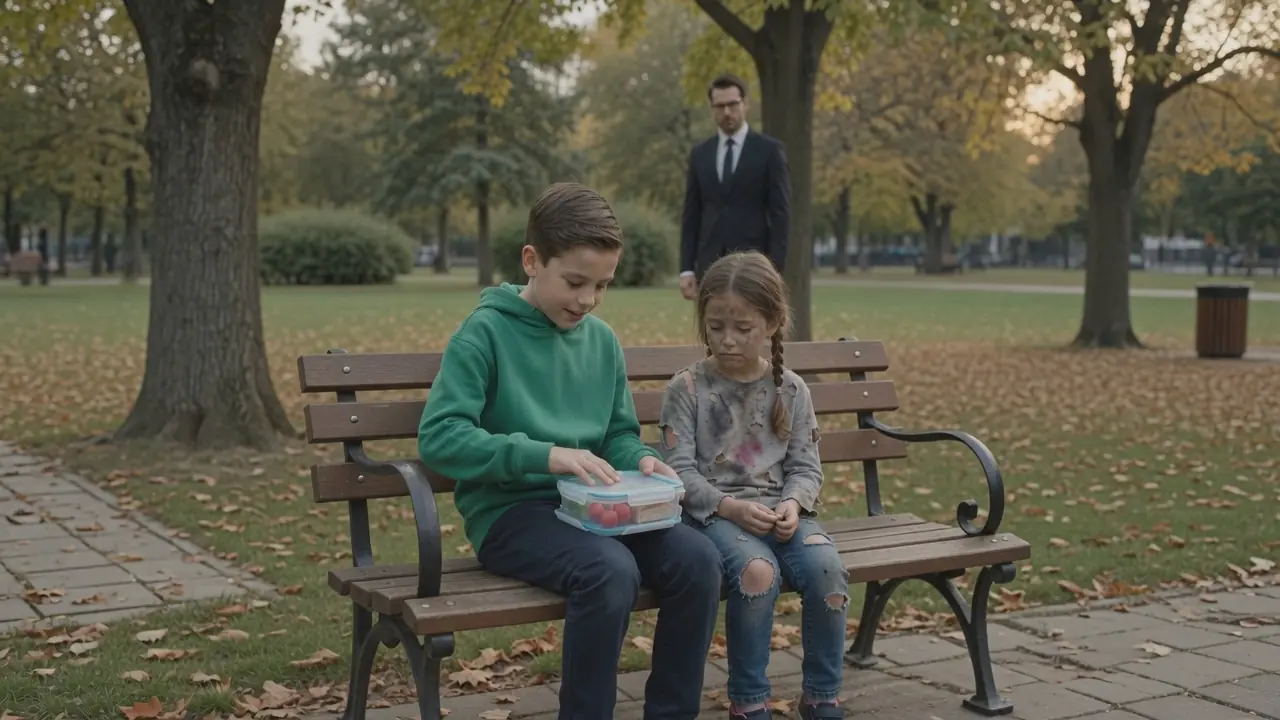
Ethan frowned. “Where do you live?”
Sophie’s hands twisted again. “Sometimes with my aunt,” she said. “Sometimes not.” Her voice grew smaller. “She gets mad when there isn’t enough food.” Ethan looked down at his lunchbox, suddenly understanding that sharing lunch was not enough to fix what Sophie was facing.
Daniel felt an old pain rise in him, sharp and familiar. Lily had always believed adults could solve things if they truly wanted to. Daniel used to believe that too. Somewhere along the way, after losing her, he had stopped wanting to solve anything that required his heart.
But this moment would not let him remain distant.
Daniel took a card from his coat pocket and handed it to Ethan first, not Sophie, because Ethan seemed less frightened. “There is a family support center three blocks from here,” he said. “It is safe, and they help children with food, shelter, and family services. I can call them right now, but only if Sophie agrees.”
Sophie stared at the card. “Will they make trouble?”
“They will try to keep you safe,” Daniel said. “That may feel like trouble at first, but it is not punishment.” His voice trembled slightly, surprising him. “You have done nothing wrong.”
Sophie’s eyes filled again. “I’m just hungry,” she whispered.
Ethan reached into his lunchbox and found the napkin with the smiley face. He handed it to her without thinking. “You can keep this too,” he said. Sophie looked at the little drawing and gave the first real smile he had seen from her. It was tiny, but it changed her whole face.
Daniel turned away for half a second so they would not see his eyes grow wet. Then he called the support center. He spoke quietly, explaining where they were and what Sophie had said. The woman on the phone responded with practiced concern and promised to send a child welfare specialist and a counselor immediately.
While they waited, Daniel bought warm drinks from a nearby cart. Hot chocolate for Ethan and Sophie, coffee for himself. Sophie held the cup with both hands, letting the warmth seep into her fingers. Ethan blew on his drink and told her about his science teacher, who had once accidentally dropped a frog model into a trash can.
Sophie laughed softly this time. Daniel heard it and felt something inside him ache with gratitude. Children should laugh easily, he thought. Not like laughter was something they had to remember how to do.
Within twenty minutes, a woman named Marissa arrived from the support center. She wore a blue coat and spoke to Sophie with gentle patience. She did not rush her, did not grab her arm, did not ask questions in a way that made the child feel guilty. She simply sat on the bench beside her and listened.
Ethan stayed close until his mother arrived from work, breathless and worried because he had texted her where he was. Her name was Rachel Carter, and when Ethan explained what happened, she put one hand over her mouth. Then she hugged him tightly, pressing her cheek against his hair.
“I’m proud of you,” Rachel whispered.
Ethan looked embarrassed. “I just gave her lunch.”
Rachel looked at Sophie, who was now speaking quietly with Marissa. “Sometimes ‘just lunch’ is not just lunch,” she said. Daniel heard her and nodded because he had been thinking the same thing.
Before Sophie left with Marissa, she walked back to Ethan. She held the napkin with the smiley face folded carefully in one hand. “Thank you,” she said. Ethan shrugged, trying to act normal. “Maybe tomorrow I’ll bring extra.”
Sophie smiled again. “Maybe I’ll be at school tomorrow.”
Daniel watched the two children look at each other. It was not a grand goodbye, not a perfect ending, not a miracle wrapped in music. It was something better. It was the first small step away from being invisible.
That night, Daniel could not sleep. He sat alone in his large apartment overlooking the city, thinking about Ethan’s lunchbox and Sophie’s trembling hands. On his desk sat framed photographs of Lily, her gap-toothed smile frozen in time. He picked up one photo and touched the glass.
“You would have liked that boy,” he whispered.
The next morning, Daniel called an emergency meeting at the Whitmore Foundation. His staff expected another discussion about grants and yearly planning. Instead, Daniel placed a simple lunchbox on the table. Inside were a sandwich, grapes, a cookie, and a folded napkin with a smiley face drawn in blue ink.
No one spoke.
Daniel looked around the room. “Yesterday, I watched a twelve-year-old do with half a lunch what we have spent months overcomplicating.” His voice was steady, but his eyes were different from usual. “We are starting a school lunch and emergency support program today.”
One board member shifted uncomfortably. “Daniel, something like that needs planning.”
“It has needed planning for years,” Daniel replied. “Today it needs action.”
The program began with three schools, including Ethan and Sophie’s. It provided free meals without public embarrassment, weekend food bags, emergency clothing, and direct connections to family support services. Daniel insisted that every child receive help quietly and respectfully. No child should have to announce hunger to receive food.
Sophie’s situation did not fix itself overnight. Real life rarely worked that way. But she was placed with a caring foster family while her aunt received investigation and support. She returned to school within a week, cleaner, safer, still shy, but no longer looking like she was trying to disappear.
Ethan brought extra lunch anyway.
At first Sophie refused to take it because the school now had food for her. Ethan looked offended. “It’s not because you need it,” he said. “It’s because we’re friends.” Sophie considered that, then accepted half a cookie.
Their friendship grew quietly. Ethan helped Sophie with math because fractions made more sense when explained with sandwich halves. Sophie helped Ethan draw trees because he admitted all his trees looked like broccoli. They sat together at lunch, and slowly other students joined them.
Daniel visited the school two months later to see the program in action. He tried to stay in the background, but Ethan spotted him near the cafeteria doors. “Mr. Whitmore!” he called. Sophie looked up too, and this time she did not lower her eyes.
Daniel walked over, smiling. “How are you both?”
Ethan lifted his lunch tray proudly. “They have better grapes now.” Sophie nodded seriously. “And hot soup on Fridays.” Daniel laughed, and the sound surprised him because it came easily. For the first time in years, he felt joy without guilt.
Sophie reached into her backpack and pulled out a folded piece of paper. She handed it to him with shy determination. Daniel opened it carefully. Inside was a drawing of the park bench, Ethan in his green hoodie, Sophie holding half a sandwich, and a man in a suit standing under a tree.
At the bottom, in careful handwriting, she had written: “Kindness sees people.”
Daniel had to sit down.
He read the sentence again and again. Ethan leaned over and said, “She worked really hard on that.” Sophie blushed. Daniel folded the drawing carefully, as if it were worth more than any contract he had ever signed. “I’ll keep this in my office,” he said.
Years later, people would talk about the Whitmore Lunch Bridge Program as if it had begun in a boardroom. They would mention statistics, funding models, school partnerships, and community outcomes. They would praise Daniel Whitmore for his leadership. Daniel would always correct them.
“It began on a park bench,” he would say.
Ethan grew older, but he never forgot that afternoon. He remembered the leaves moving across the grass, Sophie’s trembling hands, and the strange man in a suit who looked like he had been woken from a long sleep. He remembered feeling nervous and doing the kind thing anyway. His mother told him that was what character meant.
Sophie remembered it even more clearly. She remembered being hungry and ashamed. She remembered trying not to stare at someone else’s food. She remembered Ethan pushing half a sandwich toward her as if sharing were the most natural thing in the world.
That half sandwich did not solve her whole life, but it opened the first door. Behind that door were people, safety, food, school, friendship, and the beginning of trust. Sophie learned slowly that help did not always come with humiliation attached. Sometimes it came with grapes, a cookie, and a boy who said, “You need it too.”
As for Daniel, he kept Sophie’s drawing on the wall of his office. It hung beside expensive awards and framed newspaper articles, but it was the only thing visitors always noticed. When they asked about it, he told them the story. Not to make himself look generous, but to remind himself why generosity mattered.
He had once believed grief had taken the best part of him. But in the park that day, two children had handed part of it back. Ethan gave away half his lunch. Sophie accepted kindness even though fear told her not to. And Daniel finally understood that helping people was not about distance, strategy, or polished words.
It was about seeing them.
On some autumn afternoons, Daniel still returned to that same park. He would stand near the old oak tree and watch families pass, students laugh, and leaves scatter across the bench where everything began. Sometimes he saw Ethan and Sophie walking home from school together, older now, talking easily. They never knew how often he silently thanked them.
One small lunch had changed the air in the park.
One child’s kindness had reached another child’s hunger.
And one man watching from a distance had finally remembered what his heart was for.