The boy came through the fence at a dead sprint. No shoes, blood on his feet, soot on his face. 61 lbs of terror cutting through 800 bikers like a blade through smoke. He stopped in the clearing, chest heaving, and pointed one trembling hand at the sky. Every engine went quiet.
A column of black smoke was rising above the tree line, thick enough to blot out the sun. "My mom's in there. " He screamed. "My mom's in the fire. " 800 riders looked at that smoke. Then they looked at the boy. And the president of the Iron Thunder MC recognized the face.
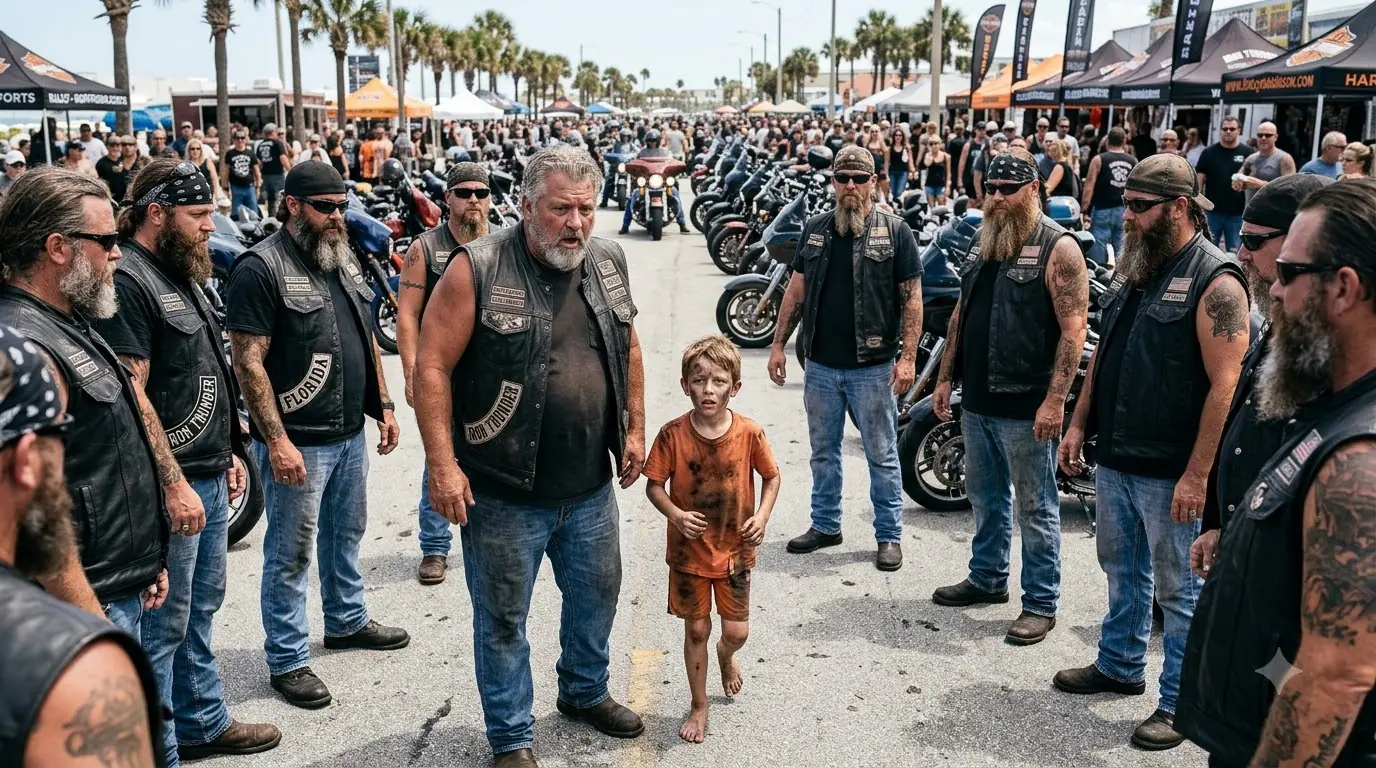
Because the last time he'd seen those green eyes, they belonged to a dead man he'd called brother. The annual Iron Thunder rally had been shaking Daytona Beach for 3 days straight by the time Saturday afternoon settled over the fairgrounds like a warm oil-scented blanket. 800 motorcycles lined the lot in rows so precise they looked military. Chrome catching the Florida sun and throwing it back in blinding daggers of light. The air tasted like exhaust, grilled meat, and the salt coming off the Atlantic 2 miles east.
Speakers the size of refrigerators pumped Southern rock across the field, and the bass was deep enough to feel in your teeth. Colton Merritt stood near the main stage with a bottle of water in one hand and a schedule sheet in the other, watching his club, his family, do what they did best. Fill a space with noise and brotherhood and the particular kind of joy that only comes when 800 people share the same heartbeat. He was 52 years old. He had been riding since he was 15.
He had founded the Iron Thunder Motorcycle Club in a garage in Ormond Beach in 1989 with four men, two of whom were now dead and one of whom was sitting 20 ft away in a lawn chair nursing a bad knee and a worse attitude. That was Earl Weston, 64, who had told Colton that morning that the porta-johns were insufficient and the brisket was dry. Colton had nodded at both complaints because Earl was right about most things and arguing with him was like arguing with weather. The rally was a charity event, always had been. Toy drives in December, school supply runs in August, and every July, the big one.
Three days of riding, music, food, and enough donated money to keep the Volusia County Children's Home running for another year. 800 riders from 11 states. Vendors selling leather goods and custom parts. A bounce house for the kids that no one over 200 lb was supposed to enter. A rule that had already been broken twice by men who should have known better.
It was a good day. It was the kind of day Colton had spent 33 years building toward. Proof that a motorcycle club could be something more than the evening news said it was. He did not know that in approximately 4 minutes, a 7-year-old boy would change every calculation he had ever made about what brotherhood meant. Reed Callaway had been running for 11 minutes.
He had started running from the front porch of a rented duplex on Palmetto Street, six blocks south of the fairgrounds, when he saw the smoke. Not the thin white kind that comes from a grill or a cigarette, the black kind. The kind that moves like something alive, rolling upward in a column so thick it blocked out a piece of the sky. The kind that smells like melting plastic and burning wood and something worse underneath. Something that a 7-year-old boy should never have to identify, but that Reed knew with the certainty of a child who has already lost one parent was the smell of everything he had left disappearing.
His mother was inside. Shelby Callaway had been asleep on the couch when Reed left for the backyard to throw a tennis ball against the fence. A game he played alone most afternoons because the neighbor kids were at camp and his mother needed rest. Her back had been bad for 3 days, worse than usual, and the pills the clinic gave her made her sleep so deeply that sometimes Reed would stand next to the couch and count her breaths just to make sure they were still coming. He had been in the backyard when he smelled it.
Then he heard the smoke detector. Not the sharp, insistent beep of a test, but the continuous scream that meant it was real. He ran to the back door and the handle was hot. Not warm. Hot.
The kind of hot that teaches you something about fire in a single touch. A lesson that burns itself into the palm and stays there. He could see the smoke curling under the door like fingers reaching for him. He ran to the front. The living room window showed orange light behind the curtains, moving, pulsing, alive.
He screamed for his mother. He screamed until his voice cracked and his throat felt scraped raw and still she did not appear at the window, did not open the door, did not call his name. Reed did the only thing a seven-year-old boy with no phone, no neighbors in sight, and a mother who would not wake up could do. He ran toward the loudest sound he could hear. The rally was six blocks north.
He had passed it with his mother two days ago, had seen the motorcycles and the flags and the big men with beards and leather vests, and his mother had said, "Your daddy would have been there. " In the quiet voice she used when she was remembering something that hurt too much to say out loud. He ran barefoot because he had been in the backyard without shoes. The asphalt was hot enough to blister. Mid-July in Florida, the pavement holding the sun's heat like a grudge. But Reed did not feel it.
He felt nothing except the animal terror of a child who understands, in the way children understand things they cannot articulate, that time is a resource he is spending with every step, and he does not know how much is left. He reached the fairgrounds at 2:47 p.m. He did not go to the gate. He did not stop at the ticket booth. He went under the chain-link fence where it sagged near the south entrance, tearing his shirt on a bent wire, and he ran into the crowd of 800 bikers, a boy weighing 61 lb entering a sea of leather and denim and engine noise.
And he screamed. The scream cut through the music. It cut through the laughter and the conversations and the idling engines. It was the kind of sound that bypasses the ears and goes straight to the spine. The primal unmistakable cry of a child in genuine terror.
800 heads turned. Reed stood in the middle of the clearing near the main stage, chest heaving, face streaked with tears and soot. His right palm an angry red from the door handle, his feet bleeding on the packed dirt. He raised one thin arm and pointed at the sky behind him. South, toward Palmetto Street, where a column of black smoke was rising above the tree line like a dark pillar holding up the clouds.
"My mom's in there," he screamed. "Please, my mom's in the fire. " 800 people looked up, and every single one of them froze. The freeze lasted 3 seconds. 3 seconds in which 800 men and women stared at the column of smoke climbing the Florida sky and processed what they were seeing. 3 seconds in which the music kept playing because the sound guy hadn't caught up to what was happening.
3 seconds in which Reed Calloway stood barefoot and bleeding in the middle of a crowd that could have swallowed him whole, pointing at the sky with a trembling hand. Colton Merritt broke the freeze. He crossed the distance between the stage and the boy in four strides. Long ground-eating steps that scattered people like water parting around a stone. He dropped to one knee in front of Reed and put both hands on the boy's shoulders.
And the size difference was almost absurd. This man built like a diesel engine holding a child who weighed less than his riding gear. "Son. " His voice was low, steady, the voice he used when things were falling apart and someone needed to believe they weren't. Where's the fire? Tell me exactly.
Palmetto Street, Reed gasped, the blue house, the duplex. My mom won't wake up. She takes pills for her back and she won't wake up and the door was hot and I couldn't How long ago? I don't know. I ran.
I ran the whole way. Colton looked up at Hank Brennan, who was already standing 3 ft away with his phone in his hand, face the color of old cement. Call 911 now. Palmetto Street duplex. He said the blue one.
Colton turned to the crowd and stood up and when he spoke his voice carried the way it always did, not loud, but absolute. I need 20 riders. Trucks if you've got them. We've got a structure fire six blocks south with someone trapped inside. Move now.
The rally broke like a wave hitting rocks. 20 riders became 40, 40 became 60. Engines fired in a staggered roar that shook the ground and the first bikes were pulling out of the lot before Colton had finished speaking because these were men and women who had spent their lives responding to the sound of something that needed doing. Earl Weston did not move. He sat in his lawn chair and watched Colton pick up the boy, just lifted him, one arm under his knees and one behind his back.
The way you carry a child who has used up everything he has and something in Earl's face changed. It was subtle, a tightening around the eyes, a slight movement of the jaw, the kind of expression that on a younger man might have been surprised, but on Earl Weston at 64 was recognition. Colton, Earl said quietly. Colton stopped. That boy.
Earl's voice was careful, measured, the way it got when he was about to say something that would leave a mark. Look at him. Colton looked down at the child in his arms, sandy brown hair, green eyes, a cowlick that wouldn't stay flat, the scatter of freckles across the nose. The recognition hit him like a fist to the sternum. He knew this face.
He had seen it 20 years younger, grinning from the passenger seat of a pickup truck on the way to a poker run in Flagler Beach. He had seen it across a campfire at a dozen rallies, laughing at jokes that weren't funny enough to deserve the laughter they got. He had seen it in a hospital room, gray and still, with a tube in the throat and monitors drawing flat lines. Daniel Callaway's son, Roadhouse's boy. "Oh God," Colton whispered.
Hank heard it. Hank, who had ridden next to Daniel Callaway for 11 years, who had been the one to identify the body after the accident on I-95, who had stood at the funeral and promised Shelby Callaway, promised her with his hand on her shoulder and tears cutting tracks through the road dust on his face, that the club would take care of her and the boy. That was 3 years ago. Hank could not remember the last time he had driven to Palmetto Street. He could not remember the last time anyone from Iron Thunder had checked on Shelby Callaway or her son.
The promise had been real when he made it. It had been real for the first 3 months, when meals appeared on the porch and envelopes of cash showed up in the mailbox, and riders stopped by on Sundays to mow the lawn and ask if she needed anything. Then the meals slowed. The envelopes stopped. The Sunday visits became monthly, then quarterly, then not at all.
Not because anyone decided to stop, because life is a current and it carries you away from the things you swore you'd hold on to. And by the time you notice, the distance is too great to swim back. Colton carried Reed to his truck, a black Ford F-250 that had seen better decades, and set him in the passenger seat. The boy was shaking, not crying anymore, past crying. The tremors were deep, involuntary, the body's response to sustained terror.
"Reed. " Colton said the name and it tasted like a debt. "I'm going to get your mom. Do you understand me? " "I'm going to get her. " "You know my name. " Reed said. His voice was small, hollowed out. "Yes, son.
I know your name. " Colton started the engine. "Your daddy was my brother. " Reed looked at him with those green eyes, Daniel's eyes, and said the thing that would keep Colton awake for the next 6 months. "Then where were you? " Colton had no answer. He put the truck in gear and drove south toward a column of smoke that was getting darker by the second. And in his chest, something that had been locked away for 3 years cracked open and began to bleed.
They could hear the sirens before they reached Palmetto Street, one fire truck coming from the east. Colton's riders had arrived first. Bikes lined the curb for half a block, and men were already in the yard, and the sight of the house stopped Colton's breath. The left side of the duplex was fully engulfed. Flames were coming through the roof, rolling out of the upstairs windows in orange sheets that turned the afternoon air into something you could taste, acrid, chemical, wrong.
The right side, where Shelby lived, was filling with smoke but hadn't caught yet. The fire had started in the vacant unit next door, an electrical fault in wiring that the landlord had been warned about twice and fixed zero times. Hank Brennan was at the front door of Shelby's unit. He had kicked it open. Smoke poured out like water from a broken dam, thick and low, filling the porch and rolling down the steps.
"She's on the couch. " Hank shouted. "I can see her, but I can't get to her. The smoke's too thick. I can't breathe. " Colton was out of the truck before it fully stopped. He pulled his shirt over his nose and mouth, a gesture so inadequate it was almost symbolic and went through the door.
The interior of Shelby Callaway's living room was a study in what smoke does to a space before fire arrives. The air was layered, breathable near the floor for perhaps 18 in, then a dense rolling ceiling of gray-black smoke that dropped lower with every second. The temperature was wrong, not the blast furnace heat of direct flame, but a pervasive pressing warmth that soaked through clothing and skin and told you in a language older than words that you were in a place where the physics of survival were actively turning against you. Colton dropped low, hands and knees. The carpet was damp.