Sergeant Darnell Brooks had spent thirty years learning how dangerous a quiet police station could be.
Noise was easy to understand. Noise was officers shouting over radios, suspects arguing at booking, patrol cars coughing to life in the alley, phones ringing through the front desk while someone somewhere asked for a supervisor. Noise announced itself. Silence was different. Silence was what happened after somebody important asked a question nobody wanted answered.
At four twenty-seven on a gray Thursday afternoon, the front desk area of Chicago’s Twenty-Second Precinct went quiet in exactly that way.
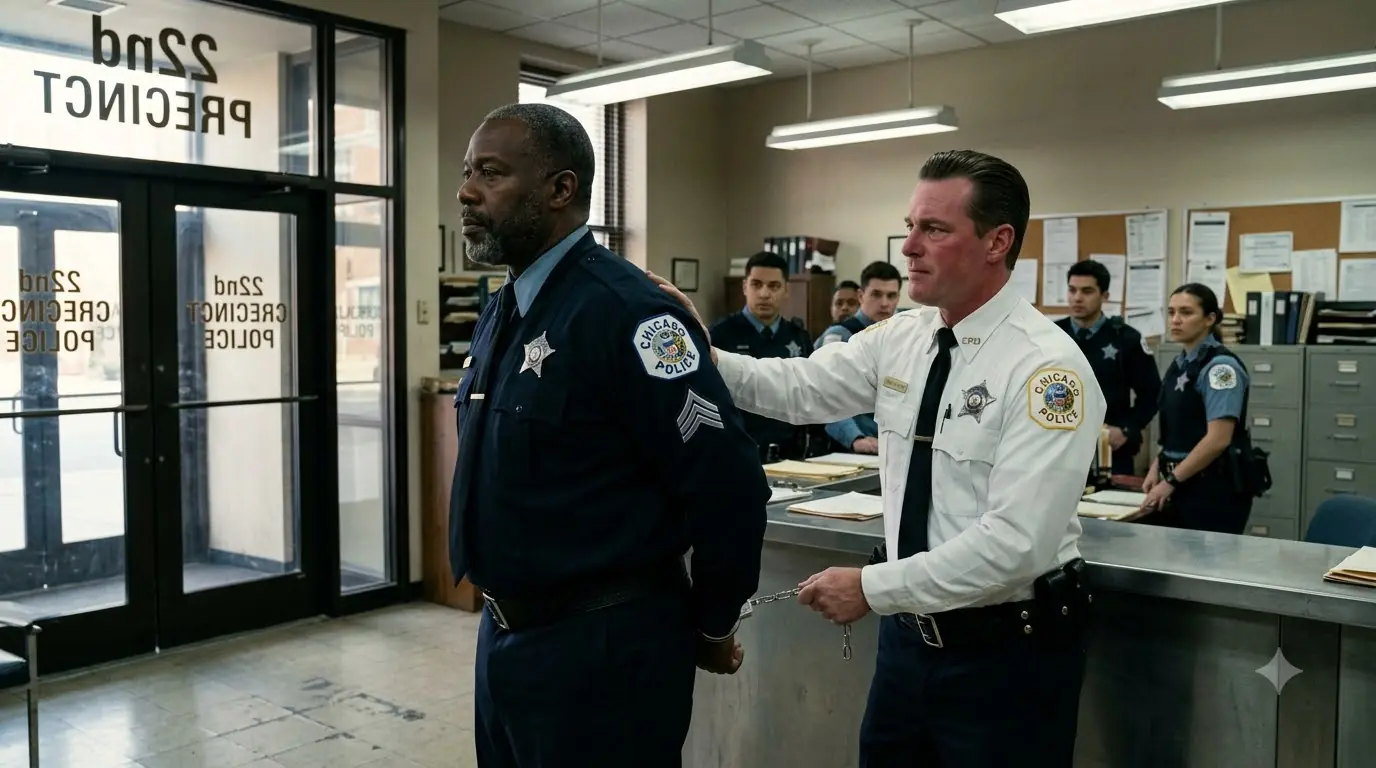
Darnell stood beside the steel counter with both wrists cuffed behind him. Late sunlight pushed through the glass entrance doors, laying pale rectangles across the tile. Filing cabinets lined the wall behind the desk, and several officers who had been talking only seconds earlier now watched without pretending otherwise. Lieutenant Patrick Grady stood close enough for Darnell to smell mint gum and aftershave. Grady’s face was flushed red, his slick brown hair still neat, his jaw tight with the satisfaction of a man who believed he had finally trapped someone beneath him.
“Evidence locker, Brooks,” Grady said, giving the cuffs an unnecessary tug. “You’re done.”
Darnell looked at him steadily. He was fifty-two, broad without being bulky, with a short gray beard and the calm face of a man who had survived enough bad supervisors to stop being impressed by rank. He did not pull against the cuffs. He did not raise his voice. If anything, the corner of his mouth almost moved.
“You have no idea who sent me,” he said.
Two younger officers near the report desk exchanged smirks. One lowered his head to hide it. Grady did not bother hiding his.
“Sure,” he said. “Everybody’s got a friend at headquarters once the cuffs go on.”
Darnell said nothing.
That bothered Grady more than an argument would have.
For six weeks, Darnell had been assigned to the Twenty-Second under a temporary staffing order that looked ordinary enough on paper. Most officers knew him as a veteran sergeant transferred from the South Side after budget reshuffling. They knew he had a reputation for writing clean reports and refusing shortcuts. They knew he asked irritatingly specific questions about property logs. What they did not know was that Commissioner Helen Ward had selected him personally for a quiet internal review after the Office of Professional Standards noticed a pattern no one could explain away.
Cash seized during narcotics arrests was coming up short. Firearms were being signed into evidence and later appearing under different case numbers. Body-camera files were vanishing from the archive after complaints were filed. Small discrepancies, taken separately, could be blamed on sloppy paperwork. Taken together, they suggested somebody inside the precinct had learned to make the system leak without setting off alarms.
Helen did not trust a task force yet. Task forces made noise. She needed someone who could sit inside the building, work normal shifts, watch habits, and understand the difference between incompetence and design.
Darnell Brooks had been her first choice.
He had known Helen for fifteen years, though neither of them would have called the relationship friendship in public. They had met when she was still a deputy chief and Darnell was a patrol sergeant testifying about officers who had falsified overtime. Three people had warned him to stay quiet. He testified anyway. Helen remembered that.
When she called him six weeks earlier, she did not flatter him.
“I need someone who knows what a dirty locker looks like before the inventory says it’s dirty,” she told him.
“What’s the catch?” Darnell asked.
“The catch is the building may know you’re looking before you know who’s watching.”
Darnell had accepted before the call ended.
Now, cuffed in the lobby while Grady declared victory, he realized the warning had arrived late but accurately.
The glass doors swung open.
Every officer in the room turned.
Commissioner Helen Ward entered wearing a navy pantsuit beneath a dark coat, silver bob catching the last of the afternoon light. She was sixty-two, composed, unsmiling, and followed by two command-level officers from headquarters. She did not hurry. She did not need to.
The room changed simply because she was in it.
Officers straightened. A desk officer stood so quickly his chair rolled backward into a filing cabinet. Grady’s face lost some of its color, but not all of it. He still seemed to believe this could be explained.
Helen walked directly to him.
“Take the cuffs off my detective.”
No one moved for half a second.
Grady blinked. “Commissioner, he stole—”
“I sent him.”
Helen’s voice remained level. “Your badge. On the desk.”
The color drained from Grady’s face completely.
For the first time that afternoon, Darnell watched fear replace anger.
“Ma’am, I can explain.”
Helen looked at him with the same expression she might have given a report that failed basic arithmetic. “Then you’ll have plenty of time to do it somewhere you are not supervising officers.”
Grady’s hand shook when he unclipped his badge and set it on the steel counter.