Don't worry, I'm here now. Mom? The rain came down like bullets on the Montana highway that night. 15 Harley-Davidsons roared through the darkness, their headlights cutting through the storm like knives. The sound of their engines was thunder itself, deep, primal, unstoppable.
At the head of the pack rode a man who looked like he'd been carved from granite and violence. 6'3", 250 lb of muscle and scars. Silver hair pulled back in a long ponytail that whipped in the wind. A beard that had gone from black to gray over decades of hard living. On his back, the leather cut bore three words that made strong men step aside, Hells Angels.
President. Montana. His name was Wyatt Brennan. But on the streets, in the bars, in the dark places where the law didn't reach, they called him Reaper. The convoy didn't slow as it approached Billings, didn't stop at red lights, didn't care about the speed limit, or the rules that govern normal people.
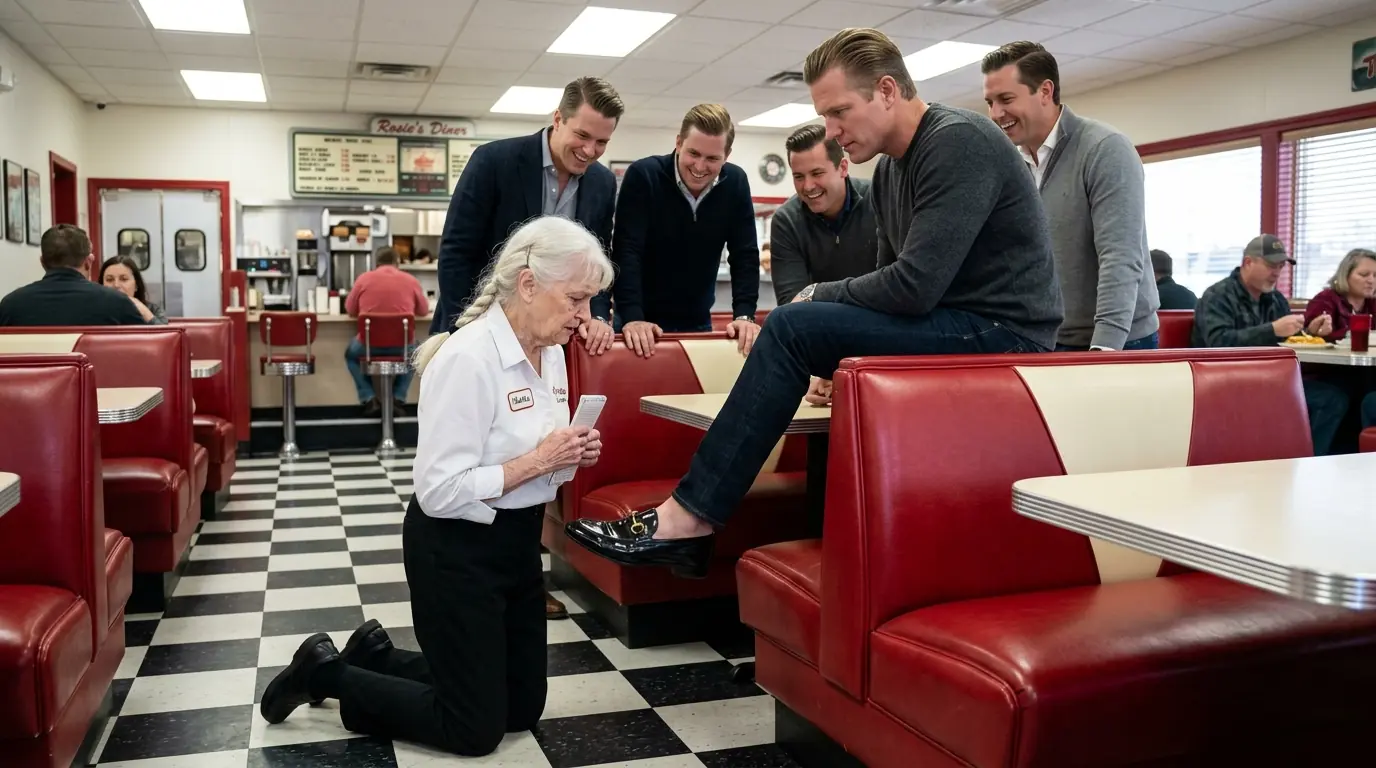
Because tonight wasn't about rules. Tonight was about blood. They pulled up outside a small diner on the edge of town. The neon sign flickered in the rain. Rosie's Diner.
Established 1989. The kind of place that served coffee in thick ceramic mugs, and where the waitresses knew your name. Wyatt killed his engine. The silence that followed was somehow louder than the roar that came before. He dismounted slowly.
His boots, thick black leather, worn from a thousand miles, hit the wet pavement with purpose. Behind him, 14 other men did the same. No words, no signals. They moved like a pack of wolves who'd hunted together for years. Wyatt pulled open the diner door.
Inside, the lights were off. Tables overturned. Chairs scattered like someone had fought. And there, in the center of the checkered floor, lay a woman. She was small, fragile-looking.
White hair pulled back in a braid that had come loose. Blood trickling from a cut on her forehead, mixing with the tears on her weathered cheeks. Wyatt crossed the room in three strides, dropped to his knees beside her. His massive hands, hands that had broken bones, hands that had built motorcycles, hands that hadn't touched his mother in 37 years, reached out and cradled her head. "Mom," he whispered, his voice cracked.
"Mom, I'm here. I'm so sorry I came late. " Martha Brennan's eyes fluttered open. Blue, faded like old denim, but still sharp. She looked up at her son, and despite the pain, despite everything, she smiled. "Wyatt," she breathed.
"You You came home. " "I did, Mom. I'm here now. " "The boy," she whispered. "The Aldridge boy. He said He said I deserved it because of what I did to his father. " Wyatt's jaw clenched. The muscles in his neck went taut as steel cables.
When he spoke, his voice was quiet, dangerously quiet. "What's his name, Mom? " "Preston. " "Preston Aldridge. " Wyatt looked up at his men. 14 faces stared back at him, waiting. "Find him," Wyatt said. "Bring him to me. " Morning in Billings, Montana came quiet and cold.
Martha Brennan woke at 5:15, same as she had every day for the past 35 years. Her alarm didn't ring. She never needed it anymore. Her body just knew. She sat up slowly in the narrow bed of her single-wide trailer.
Her joints protested. 78 years old, and every one of those years lived in her bones now. She rubbed her knees, wincing, then reached for the pill bottle on her nightstand. Not the painkillers the doctor prescribed. Those made her foggy, and she needed to be sharp for work.
The other bottle, the one she kept hidden behind the lamp. She unscrewed the cap and stared at the label, chemotherapy pills. Stage four lung cancer. Four to six months, the oncologist had said. Maybe less.
That was three months ago. Martha dry swallowed one pill, then put the bottle away. She didn't tell anyone about the cancer. Not Rosie, who'd worked beside her for three decades. Not the regulars who came in for coffee and called her by name.
Not the son she hadn't seen in 37 years. Especially not him. She stood, pulled on her waitress uniform, white blouse, black slacks, sensible shoes with rubber soles. The blouse had been washed so many times the fabric felt like paper. The name tag was crooked.
"Martha. " She straightened it in the mirror. The trailer was small, one bedroom, a kitchenette she never used because she ate at the diner, a bathroom with a shower that dripped. But the walls, those she'd filled with memories. Photographs in mismatched frames, her wedding day, 1975. She'd been 25.
Her husband, James Brennan, had been 28, broad-shouldered in his dress uniform. They married three weeks before he shipped out. She wore her grandmother's dress and carried wildflowers. Another photo, James holding a baby. Their son, Wyatt.
Born 1971. Even as an infant, he'd had those eyes, blue and fierce, and searching for something the world couldn't quite give him. More photos followed the years. Wyatt at six, gap-toothed and grinning, holding up a fish he'd caught. Wyatt at 10, serious now, standing beside his father in matching flannel shirts.
Wyatt at 15, leather jacket, motorcycle in the background, eyes that had gone from searching to angry. And then, nothing. No photos of Wyatt after 18. Just an empty space on the wall where the story stopped. Martha's hand went to the silver necklace she wore.
A simple chain with a single letter W. Wyatt had made it for her in shop class when he was 12. Soldered the letter himself, gave it to her for Mother's Day wrapped in newspaper. "So you never forget me, Mom," he'd said. As if she ever could.
She touched the necklace now the way she did every morning, and whispered the same prayer she'd whispered for 37 years. Keep him safe, wherever he is. Then she grabbed her purse and walked out into the Montana cold. Rosie's Diner sat on the corner of Fifth and Main like it had been there since God invented breakfast. Red vinyl booths, black and white checkered floors, a long counter with chrome-trimmed stools that spun if you pushed them.
The jukebox in the corner still played actual records, Elvis, Patsy Cline, Johnny Cash. The kind of music that reminded you what America used to sound like. Above the counter hung a photograph, Rosie and Martha, 1989 opening day. Two young women with their whole lives ahead of them, arms around each other, grinning like they just conquered the world. 35 years later, Rosie still ran the place.
She was 72 now, silver-haired and sharp-tongued, with hands that could flip pancakes and tell you to go to hell in the same motion. Martha arrived at 5:45, let herself in through the back door. The diner smelled like coffee and bacon grease and history. "Morning, Martha," Rosie called from the kitchen. "Morning. " "You look tired. " "I'm fine. " "That's what you always say. " Rosie emerged, wiping her hands on her apron.
She studied Martha's face. "You taking your medicine? " "Every day. " "The good stuff, or the stuff that makes you feel like hell? " Martha smiled. "The stuff that keeps me standing. " Rosie shook her head, but didn't push. She knew better. 35 years of friendship had taught her when to talk and when to let silence do the work.
They moved through the morning routine like a choreographed dance. Martha filled the coffee pots. Rosie prepped the griddle. By 6:00, the first customers were walking through the door. Old man Patterson, retired railroad worker, same booth every day for 20 years.
Two eggs over easy, white toast, black coffee. Mrs. Chen, no, not Chen. Mrs. Sullivan, Irish, red-haired gone white.
Oatmeal with brown sugar and a cup of tea. By 7:00, the diner was full. The sound of conversations, clinking silverware, the occasional laugh. This was Martha's world, small, simple, safe. She poured coffee and took orders and smiled at people who'd known her since her hair was dark and her husband was alive.
She moved between the tables with practiced efficiency, her body remembering the rhythm even when her mind got tired. "Martha, honey, can I get a warm-up? " called a voice from booth three. She turned, a regular, Frank something, retired veteran, always polite. "Of course, Frank. " She filled his cup. He nodded his thanks.
"You doing okay, Martha? You look a little pale. " "I'm fine. Just didn't sleep well. " "Well, you take care of yourself, you hear? This town needs you. " She smiled, moved on to the next table, the next customer, the next moment of her shrinking life. By 9:30, the breakfast rush had ended.
Martha leaned against the counter, catching her breath. Her chest felt tight. The cough she'd been fighting for weeks threatened to surface. Rosie appeared beside her with a glass of water. "Drink. " Martha drank.
"You should see the doctor again," Rosie said quietly. "I saw him last month. " "And what did he say? " Martha set down the glass. "He said I'm old. Bodies get old. " "Bull. You're hiding something. " Martha met her friend's eyes.
For a moment, she almost told her. Almost said the words, "I'm dying. Four to six months. Maybe less. " But then the bell above the door chimed, and everything changed. Four men walked into Rosie's Diner at 9:47 on a Tuesday morning.
The first thing you noticed was the money. Designer clothes, expensive watches, shoes that cost more than most people's rent. They moved with the lazy arrogance of men who'd never been told no in their entire lives. The second thing you noticed was the smell. Cologne, expensive, yes, but too much of it.
Like they were trying to cover up something rotten underneath. The leader was tall, early 40s, blond hair slicked back, square jaw, the kind of handsome that came from good genes and better dentists. His name was Preston Aldridge, though Martha didn't know that yet. Behind him came his friends, Garrett, Lance, Brendan. Interchangeable rich boys with interchangeable smirks.
They took the largest booth without asking, sprawled across the red vinyl like they owned it. Martha approached with menus and her professional smile. Good morning, gentlemen. Coffee to start? Preston looked up at her.
His eyes, blue, cold, assessing, traveled from her face down to her name tag and back up again. Brennan's, ma'am, he said slowly. Martha Brennan. Something in his tone made her skin prickle. Yes, sir.
Have we met? No. His smile didn't reach his eyes, but I knew your name. My father used to talk about you. Your father, Harrison Aldridge.
You remember him? The name hit Martha like a fist to the stomach. Harrison Aldridge. Oh, she remembered. 25 years ago, 3 years after James died, Harrison had been a widower then, wealthy, persistent.
He'd come into the diner every week, asked her out every week, sent flowers, gifts, love letters written in someone else's handwriting. She'd turned him down every time. I'm sorry, she told him finally. I can't. My heart, it died with my husband.
I don't have anything left to give. Harrison had looked at her with something between love and hatred. You think that makes you noble? He'd said, staying faithful to a dead man. It makes you a fool, Martha, a lonely, stubborn fool.
He never came back to the diner after that. Now, 25 years later, his son sat in her booth smiling that same smile. I remember your father, Martha said carefully. I'm sorry for your loss. I heard he passed.
Eight months ago. Preston's voice was flat. Left me everything. $65 million, the business, the house, everything. That's That's wonderful for you. Is it?
He leaned back. You know what he told me before he died? He said the biggest mistake of his life was loving a woman who didn't love him back. A woman who thought she was too good for him, a waitress who spent her whole life serving other people because she was too scared to live her own life. Martha's hand tightened on the notepad.