Elijah Monroe had not eaten in almost two days, but the first thing he did when he saw the old man struggling with two grocery bags on the corner of 8th and Marshall was step forward and say, “Let me carry that for you, sir.”
No one around them slowed down. No one looked. In a city like Cleveland, in a neighborhood like this one, a small Black boy speaking to a white-haired stranger was the kind of moment people walked past on purpose. But Elijah did not know that the man in the long gray coat was worth more money than every house on that block combined. He only knew that the man was tired. He only knew that one of the bags was about to tear. He only knew that helping someone, even when you had nothing, was the one thing his mother had told him before she died that he should never stop doing.
That single decision, made in the cold November light, would change both their lives in ways neither of them could have imagined.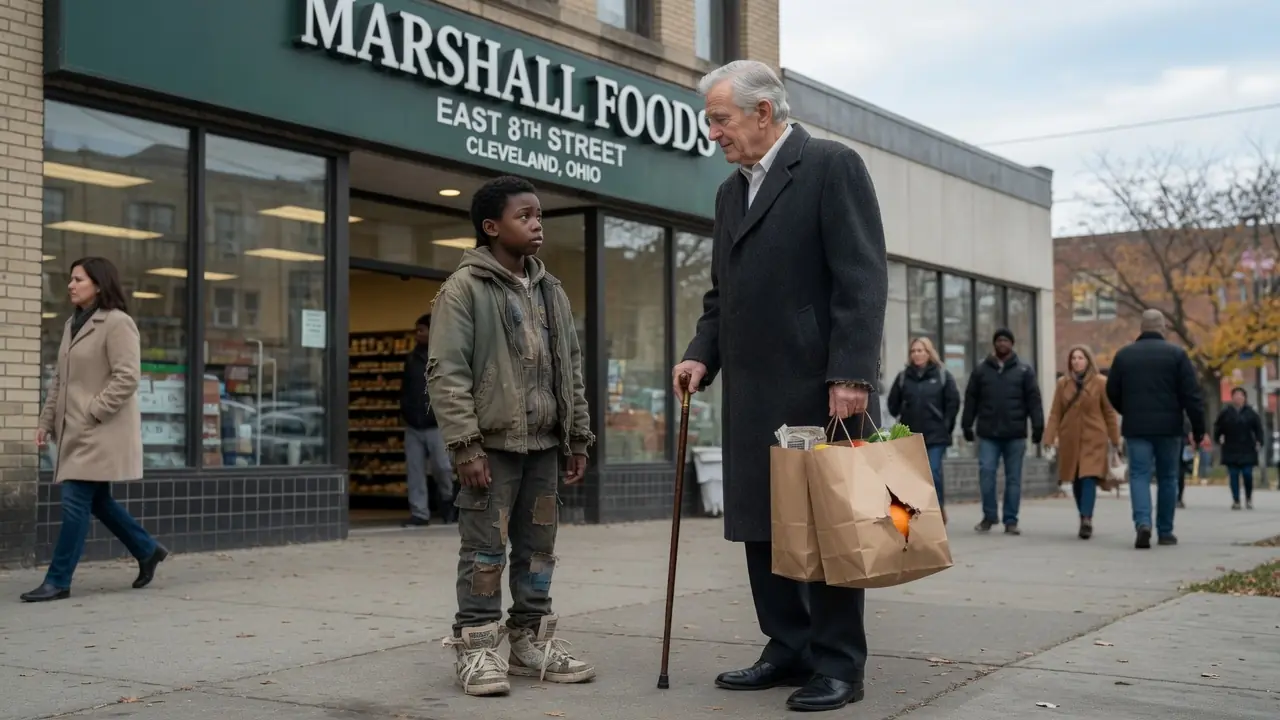
East Cleveland in late November had a way of looking gray even when the sun was out. The wind came off Lake Erie and cut through everything. It rattled loose metal on street signs and pushed empty plastic bags down the gutters in long, lazy somersaults. Elijah Monroe stood across the street from Marshall Foods, hands buried in the sleeves of a jacket that had once belonged to a cousin. His sneakers were two sizes too big, stuffed at the toes with folded newspaper so they would not slide off when he ran.
He had been on his own for almost three weeks. His grandmother, who had taken him in after his mother passed, had been moved to a care facility after a fall. The social worker had said there would be a placement, a foster home, a plan. The days had stretched and no one had come. So Elijah had stopped sleeping at the apartment. He was afraid that if he stayed too long in one place, someone in a suit would arrive and take him somewhere he did not know.
He carried his life in a backpack with one broken strap. Inside was a notebook, a stub of pencil, a small photograph of his mother holding him as a baby, and a single peppermint candy he was saving for a moment he could not yet imagine.
The man who finally stepped out of Marshall Foods that afternoon did not look like a man who needed help. He was tall, slightly stooped, with silver hair cut short and neat, and a long charcoal-gray wool coat that was clearly expensive but old. In his right hand was a dark wooden cane with a warm brass handle. In the crook of his left arm were two paper grocery bags, too full. The bottom of one was already darkening with a damp spot where something inside had begun to leak.
His name was Harold Whittaker. He was seventy-eight years old. He had walked into the small family-run grocery the way he walked into a thousand other small stores over fifty years—quietly, paying in cash, asking for nothing special.
Elijah saw the bag begin to tear before Harold did. He saw the soft paper give way along the seam. He saw the old man shift his weight, plant the cane, and try to adjust his grip. And he saw in that small careful motion something that had nothing to do with money or coats or canes. He saw a person who was tired. He saw a person who was going to drop the bag in about three more steps.
Elijah crossed the street.
“Sir,” he said, stepping up beside Harold with both hands already half raised, careful the way you approach a cat you do not want to startle. “Sir, your bag, it is about to tear. Let me carry that for you.”
Harold turned his head. His eyes were a clear watery blue. He looked down at the bag. The split at the bottom had widened, and a single orange was now pressed against the paper, ready to roll out into the street.
“Well,” Harold said, his voice low and dry like a page turning, “I suppose you are right about that.”
Elijah very gently reached up and slid both of his thin arms under the bottom of the failing bag. The paper rustled. The orange shifted but did not fall. He lifted, and the weight of the groceries pressed into his chest. For a moment he was reminded of how little he had eaten, how the hunger sat in his ribs like a quiet animal, but he did not let his face change.
He took the whole bag carefully into his own arms, leaving Harold with only the second one.
“Where are you headed, sir?” Elijah asked, adjusting the bag in his arms so the bottom would not give out the rest of the way. “I can walk with you, just so it does not fall.”
Harold considered the boy for a long moment. There was a stillness to him that some people mistook for coldness, but it was not coldness. It was the stillness of a man who had learned, painfully and slowly, to look at things twice before deciding what they were.
“I am parked,” Harold said slowly, “about six blocks from here, near the lake. It is a long walk for a small person carrying a heavy bag.”
“I do not mind, sir,” Elijah said.
They walked.
The wind off the lake pushed against them in long, cold gusts. They did not speak much at first. Harold had never been a man who filled silence for the sake of filling it, and Elijah was concentrating on the bag, on keeping his arm steady, on not letting the orange roll out the bottom.
They passed a closed barbershop with a hand-painted sign in the window. They passed a laundromat where the light spilled warm and yellow onto the sidewalk and the air smelled of soap and dryer sheets.
After the third block, Harold spoke.
“What is your name, young man?”
“Elijah, sir. Elijah Monroe.”
“Elijah.” Harold rolled the name slowly. “That is a strong name, a prophet’s name.”
“My mother picked it,” Elijah said. His voice did not change much, but Harold heard the small dip in it, the careful way the boy used the past tense.
“She chose well,” Harold said.
He let the silence sit for a few more steps, then asked gently, “And what does your mother do, Elijah?”
Elijah’s arms tightened a little around the bag. He looked straight ahead at the sidewalk and said, “She passed, sir. Almost a year ago now.”
Harold did not say “I am sorry” in the quick hollow way that closed a door. He simply nodded slowly and said, “Then she is still picking your name every time you say it.”
And Elijah, who had not cried in front of anyone in a very long time because crying in front of people was a luxury he could not afford, felt something hot move behind his eyes and pressed his lips together hard and did not let it out.
They kept walking.
The cane tapped a slow, even rhythm on the concrete. Somewhere far away, a freight train let out a long, low note that seemed to belong to the gray sky itself. And Elijah, carrying a stranger’s groceries through a neighborhood that had taught him to expect nothing, felt for the first time in weeks that he was not entirely alone in the world.
Harold did not ask about the father. He did not ask where Elijah lived or who was waiting for him at home. He had learned, over a long life, that questions could feel like accusations when they came too fast, and that the most important things a person needed to tell you would arrive in their own time if you let them.
So he walked and he listened to the soft scrape of the boy’s oversized sneakers on the sidewalk, and he made a small, quiet calculation in his head: The boy was hungry. The boy was alone. The boy was carrying a stranger’s groceries for the simple reason that the bag was about to break and he had nothing to gain from it.
“Elijah,” Harold said after another block, “do you live near here?”
“Sort of, sir,” Elijah said. “Sort of” was a phrase he had learned to use for many things in the past year.
“And is anyone expecting you for supper?”
The question was so gentle that Elijah almost did not feel the edge of it. He looked up at Harold, at the long gray coat, at the silver hair, at the patient blue eyes, and he understood that the old man already knew the answer.
“No, sir,” Elijah said. “Not really.”
Harold nodded once. He did not stop walking. He simply absorbed the answer the way the ground absorbs rain, and he kept moving.
Two blocks ahead in a small gravel parking lot beside a closed bait shop, Elijah could see a long dark car waiting. The kind of car he had only ever seen in movies. A man in a dark suit and a wool driver’s cap was standing beside it.
Elijah’s steps slowed without him meaning them to.
“That is just Marcus,” Harold said quietly. “He drives me. He has been driving me for twenty-two years. He is a good man. He will not bother you.”
“Yes, sir,” Elijah said, but his arms had tightened around the bag again.
Marcus saw them coming from half a block away. He straightened but did not move toward them. He had worked for Harold long enough to know that the old man rarely arrived back at the car alone.
“Marcus,” Harold said as they reached the gravel lot, “this is Elijah Monroe. He has been kind enough to keep my groceries from rolling into the street.”
Marcus tipped his cap. “Mr. Monroe,” he said with complete seriousness, “thank you for your help.”
Elijah did not know what to do with being called Mr. Monroe. No one had ever called him that. He nodded carefully and said, “Yes, sir.”
Marcus reached for the torn bag. Elijah for a half second did not want to give it up. The bag had been his job, his reason for walking, the small important thing he had been entrusted with. But Marcus’s hands were patient and his eyes were kind, and Elijah let the bag slide gently into the driver’s arms.
“Thank you, Elijah,” Harold said.
He reached into the inside pocket of his long gray coat. Elijah saw the movement and felt his stomach tighten. He knew what came next. He had imagined it the entire walk. He had almost allowed himself to hope for it. Now that the moment had arrived, he found, to his own surprise, that he did not want it. He did not want this old man who had spoken to him kindly to reach into a pocket and hand him a folded bill and turn the whole afternoon into a transaction.
He took a small step back.
“I did not do it for money, sir,” he said. His voice was quiet but very clear. “I did it because the bag was about to break.”
Harold’s hand paused inside his coat. He looked at the boy for a long moment, and something moved across his face that was not quite a smile, but was close to one. He withdrew his hand from the coat. It was empty.
“I know you did not,” Harold said. “I was reaching for something else.”
He produced instead a small white business card, printed on heavy paper. He held it out between two gloved fingers.
“This has my name on it and a telephone number. The number rings to a woman named Dorothy who has worked for me for thirty years. If you ever find yourself in a difficult situation, Elijah, and you need a person to call, you may call that number. You do not have to explain anything. You only have to say this is Elijah and I met Mr. Whittaker outside Marshall Foods. Dorothy will know what to do.”
Elijah took the card. His fingers were cold and clumsy. The paper felt impossibly smooth. He looked down at it. Printed in plain black letters was a name: Harold J. Whittaker. Below it, a phone number, nothing else.
He did not know, holding that card in his red-knuckled hand on a gravel lot in East Cleveland on a cold Tuesday afternoon, that the name Harold J. Whittaker had appeared on the front of business magazines for the better part of forty years. He did not know that the company Harold had founded in a rented garage in 1971 had grown into one of the largest privately held companies in the Midwest. He only knew that the old man had given him a card with a name and a number on it and had told him he could call.
“Thank you, sir,” Elijah said.
He slipped the card very carefully into the inside pocket of his too-big jacket, the pocket closest to his heart, the same pocket where he kept the photograph of his mother.
Harold and Marcus exchanged a look over the boy’s head that lasted no more than a second. Marcus gave the smallest nod.
“Elijah,” Harold said. “Before we say goodbye, I would like to ask you something and I would like you to feel free to say no. I’m going to have supper in about an hour at a small restaurant not far from here. The owner is a friend of mine. The food is simple and very good. I would be glad of the company if you would join me. You are not obligated. Marcus can take you wherever you need to go with no supper at all if that is what you prefer. I only wanted to ask.”
Elijah stood very still in the gravel lot. The wind off the lake was pushing at the back of his neck and his stomach, which had been quiet for hours by sheer force of practice, gave a small treacherous turn at the word “supper.”
He thought about the peppermint candy in his backpack. He thought about his mother who had taught him to be careful with strangers and who had also taught him that some strangers were not strangers at all but neighbors he had not yet met.
He looked up at Harold’s face. He looked at the patient blue eyes, the silver hair, the brown leather gloves folded calmly around the brass handle of the cane.
“Yes, sir,” Elijah said. His voice was small but steady. “I would like that. Thank you, sir.”
Harold nodded once as if a small important agreement had been settled and gestured toward the open door of the car.
Elijah hesitated at the threshold the way a person hesitates at the edge of deep water, and then he climbed in.
The seat was wider than his grandmother’s couch. The leather was warm. There was a soft hum somewhere under the floor that he realized after a moment was a heater. He had never been inside a car like this. He sat very still, his backpack on his lap, and tried not to touch anything he did not need to touch.
Harold settled in beside him with the slow, careful movements of a man whose joints had stopped forgiving him a decade ago.
Marcus closed the door, walked around to the front, and slid into the driver’s seat. The car pulled out of the gravel lot and turned onto the wide street that ran along the lake. And Elijah watched through the window as East Cleveland slid past him in a way it never had before.
“Marcus,” Harold said, “the place on Larchmere, please. Tell Anna we will be two for supper and that one of us is a young man with a very honest face.”
“Yes, sir,” Marcus said. He glanced once into the rearview mirror, met Elijah’s eyes, and gave him a small reassuring smile.
The drive took about fifteen minutes. They left the gray streets near the lake and moved south through neighborhoods that Elijah had only ever seen from city buses. He watched the houses grow larger, the trees thicker, the sidewalks cleaner. He did not say anything. Harold did not push him to say anything.
Larchmere Boulevard was a long, tree-lined street of small shops and old brick buildings. The restaurant was tucked between an antique bookstore and a tailor’s. Its name, painted in modest gold letters on the front window, was Anna’s.
The restaurant was small and warm and smelled of bread. That was the first thing Elijah noticed when Marcus held the door open for him and the bell above the door gave its soft, friendly chime. The smell of bread, the kind that has been baking slowly for hours, the kind that wraps itself around you the moment you step inside a place and makes your shoulders come down from your ears without your permission.
A woman in her sixties came out from a swinging door at the back wiping her hands on a clean white towel. She was short and round and had her gray hair pulled back into a low bun. When she saw Harold standing inside the door, she made a small sound of pleasure that came from somewhere deep in her chest and crossed the room with her arms already opening.
“Harold,” she said, taking both of his hands in hers. “It has been three weeks. Three weeks, Harold.”
“I know, Anna. Forgive me. The doctors have been keeping me on a short rope lately.”
“The doctors should mind their own business,” Anna said firmly, but she was smiling. And then she turned and looked down at Elijah, who was standing half a step behind Harold with his backpack clutched in front of him like a small shield.
Anna’s face did not change in any sudden way. She did not gasp or coo. She simply lowered herself slowly until her face was level with his and she said with the same warm directness she had used with Harold, “And you must be the young man with the honest face. I am Anna. This is my restaurant. You are very welcome here.”
“Thank you, ma’am,” Elijah said. “I am Elijah.”
“Elijah.” She repeated it slowly, as if the name deserved its proper weight. “A beautiful name. Are you hungry, Elijah?”
He hesitated. He had been taught not to admit to hunger in front of people who did not know him because hunger admitted out loud was a thing that made adults uncomfortable. But Anna’s face was patient and Harold was standing quietly behind him and the smell of the bread was so strong and so good that he could feel it in his throat.
“Yes, ma’am,” he said. “I think I am.”
“Good,” Anna said and stood. “Then we have already done the most important part.”
She led them to a table near the front window where the late afternoon light came in soft and gold through the glass and she pulled out a chair for Elijah with the same formal courtesy she would have shown a senator. He sat. The chair was solid and warm.
Anna disappeared back through the swinging door and a moment later a young woman in a long apron brought a basket of bread to the table, still warm from the oven with a small dish of butter and another of olive oil.
Harold settled himself across from Elijah with a quiet sigh. He set his cane against the side of the table where it would not fall. He took off his gloves and folded them neatly. Then he reached for the bread basket and tore a piece for himself slowly and pushed the basket gently toward the middle of the table where Elijah could reach it.
“Eat as much as you like,” Harold said. “Anna will keep bringing it as long as we keep eating it. That is how she is.”
Elijah reached for a piece of bread. His hand was shaking just slightly in the way hands shake when a body has been waiting too long for something and finally allows itself to believe the thing is real. He tore the bread carefully the way he would have torn a page he did not want to damage. He dipped a small corner of it in the olive oil. He put it in his mouth.
The bread tasted like a memory he did not know he had. He chewed slowly. He did not cry. He had decided somewhere on the drive over that he was not going to cry in front of Harold, but his eyes stung and he kept them down on the white tablecloth and he ate.
Harold did not watch him eat. That was the kindness Elijah noticed first and the one he would remember for the rest of his life. Harold simply tore his own piece of bread, dipped it in his own oil, and turned his face slightly toward the window so that Elijah could eat in peace. He spoke now and then about small, easy things. The weather. The way the trees on Larchmere had lost their leaves later than usual this year.
Anna brought soup. She brought a plate of roasted chicken with potatoes and green beans cooked in butter. She brought a small glass of milk for Elijah and a cup of black coffee for Harold and refilled the bread basket twice without being asked.
Halfway through the chicken, Elijah set his fork down. He had eaten more in the last twenty minutes than he had eaten in the last three days combined and his stomach, which had grown used to being empty, was protesting the sudden bounty in small, uncertain ways. He folded his hands in his lap. He looked at the plate. He looked at Harold.
“Sir,” he said, “may I ask you something?”
“You may ask me anything,” Harold said.
Elijah took a small breath.
“Why are you doing this?”
Harold did not answer right away. He set his own fork down. He picked up his coffee, took a slow sip, and set the cup back into its saucer with the careful precision of a man who had spent a long life around fragile things. He looked at Elijah across the white tablecloth, and the late afternoon light through the window caught the silver of his hair and made it look for a moment almost gold.
“That is a good question,” Harold said. “It deserves an honest answer.”
He paused.
“When I was about your age, Elijah, I lived in a town in western Pennsylvania that does not exist anymore. The mill closed, and then the town closed. My father had been gone for a long time by then, and my mother was a seamstress who took in mending. We did not have much. There were days when I went to school hungry, and there were days when I came home from school hungrier still, because my mother had given me the only piece of bread in the house for my lunch and had eaten nothing herself.”
He stopped. He took another sip of coffee. Elijah did not move.
“One afternoon,” Harold went on, “I was walking home from school in the cold, and I passed a small grocery on the corner of our street, and I saw an old woman drop a sack of apples on the sidewalk outside. The sack had split. The apples rolled everywhere. She was bent over trying to pick them up, and she could not quite manage it because her back was not what it used to be. I was nine years old. I was hungry enough that the smell of those apples on the cold sidewalk almost made me dizzy. And I had a choice, the way you had a choice this afternoon outside Marshall Foods. I could have picked up one of those apples and put it in my pocket and walked away, and she would not have known, and no one in the world would have blamed me if they had known.”
He looked at Elijah very steadily.
“I did not do that,” Harold said. “I picked up every one of those apples, and I put them back in her arms, and I walked her to her door. And when we got to her door, she invited me in and she gave me a bowl of stew that I can still taste if I close my eyes.”
He paused.
“Her name was Mrs. Kowalski. She fed me supper twice a week for the next four years. She is the reason I am sitting here tonight.”
Elijah was very still.
“You did for me today,” Harold said quietly, “what I did for her a long time ago. So, I am doing for you what she did for me.”
Elijah looked down at the white tablecloth for a long time. The story had landed in him in a place that did not yet have words for what it was feeling. He thought about the apples rolling on a cold Pennsylvania sidewalk seventy years ago. He thought about a small boy with empty pockets choosing to give back what no one would have known he had taken. He thought about his own mother who had said to him once, sitting on the edge of his bed when he was seven and feverish, “The only way the world gets better, baby, is when people decide to be the better part of it.”
“Sir,” he said, and his voice was very small, “I do not know how to say thank you for this.”
“You do not have to,” Harold said. “You already did outside the store.”
They finished their meal slowly. Anna brought a small dish of vanilla ice cream for Elijah without asking, and Harold did not protest. The light through the window deepened from gold into the soft blue that comes just before evening.
When the meal was over, Harold settled the bill with Anna in a way that Elijah did not see, because Harold had a particular skill for handling money in a manner that did not make a charity case.
Anna walked them to the door. She bent down to Elijah’s height again and she said, “You come back anytime, Elijah, with Harold or without. You tell whoever is at the door that Anna is expecting you and there will always be a plate.”
“Yes, ma’am,” Elijah said. “Thank you, ma’am.”
Outside, the air had grown colder, but it did not bite the way it had earlier in the afternoon. Marcus was waiting beside the car.
Harold paused on the sidewalk before getting in. He turned to Elijah.
“I’m going to ask you one more thing tonight, Elijah, and again you are free to say no.” He looked at the boy carefully. “Marcus and I are going to drive back across the city now. The house I live in has more rooms than any one old man needs. There is a small guest room on the first floor with a bed that has clean sheets on it and a bathroom of its own and a door that locks from the inside. There is a woman named Dorothy, the one whose number is on the card I gave you, who lives in a cottage on the property and looks after the house. She is a grandmother eight times over and she is kinder than I am, which is saying something. I would like to offer you that room for tonight, for as many nights as you need while we figure out together what comes next. You would not be a guest who has to earn his keep. You would be a young man under my roof and you would be safe there.”
He paused.
“You may say no, Elijah. Marcus will take you anywhere you ask him to take you. I will not be hurt and I will not be offended. But I am seventy-eight years old and I have learned that some offers, when they come, should be made plainly. So, I am making it plainly.”
Elijah stood on the sidewalk outside Anna’s restaurant in his too-big jacket and his too-big sneakers and he looked up at the old man in the long gray coat and he thought about the card in his pocket and the photograph of his mother in the same pocket and the bed with clean sheets that he had not slept in for three weeks and the door that locked from the inside.
He thought about his grandmother in the care facility who he had not been allowed to see and the social worker who had not come. He thought about the cold of the sidewalk and the long hungry nights and the small careful animal of hope he had been trying not to crush in his hand all afternoon.
“Yes, sir,” he said. “Thank you, sir. I would like that.”
The drive back across the city took longer than the drive to the restaurant because Harold’s house was not in the city at all. It was east of it, past the suburbs Elijah had only ever seen on highway signs, on a quiet road lined with old trees that had been standing there since long before any of them had been born.
Elijah watched the street lights give way to porch lights and the porch lights give way to long stretches of dark countryside where the only light was the moon on the bare November fields. He did not say anything for most of the drive. Harold did not push him to, either.
Marcus drove with the same steady patience he had shown all evening and once, when Elijah’s eyes began to grow heavy in the warm leather seat, Marcus adjusted the heater a small degree higher without being asked.
The house, when they reached it, was not the kind of house Elijah had imagined a rich man would live in. It was a long low farmhouse made of pale stone with a slate roof and warm yellow light coming from the windows on the lower floor. There was a wreath on the door made of dried wheat and a single red ribbon.
Dorothy was already waiting in the front hall when they came inside. She was exactly as Harold had described her—a small woman with iron-gray hair and a face that had been kind for so long that the kindness had settled into the lines of it permanently.
She did not make a fuss over Elijah. She simply said, “Welcome, young man. The guest room is made up. Are you tired?”
And Elijah, who had not realized until that moment how tired he was, nodded.
That was the beginning.
The story did not end that night because real stories rarely do. It went on through the winter and into the spring. Harold’s lawyers quietly and carefully helped Elijah’s grandmother get the medical care she needed and helped Elijah become her legal ward with Harold and Dorothy named as guardians in the event she could not return.
Elijah went back to school, a different school, where he was allowed to be quiet and was not asked questions he could not answer. He kept the small white business card in the inside pocket of a new jacket that fit him properly, and he kept the photograph of his mother in the same pocket, and he kept the peppermint candy, too, because he had decided that the moment he had been saving it for was the moment he no longer needed to save it.
The story of how they met did not become a viral video. There were no security cameras on the corner of 8th and Marshall that afternoon, and no one in the city of Cleveland had any idea that one of the wealthiest men in the Midwest had bought groceries at a family-run store and let a hungry child carry his bag. The story stayed where it began, between the two of them, the way the most important stories often do.
Harold did not write about it. Elijah did not tell anyone at his new school. Only Marcus and Anna and Dorothy knew, and they were the kind of people who knew how to keep a thing that was not theirs to tell.
Years passed. Harold lived longer than his doctors had told him he would, the way stubborn men sometimes do when they have found a reason to stay. He saw Elijah graduate from high school. He saw him accepted into a university on a scholarship that Harold had arranged without ever letting Elijah know it had been arranged. He did not see him graduate from college because he died quietly in his sleep in the small stone farmhouse the winter before, with Dorothy holding his hand and Elijah sitting in the chair beside the bed reading aloud from a book Harold had given him years earlier.
In Harold’s will, there was a letter for Elijah. It was short.
It said: “I want you to remember three things. The first is that your mother chose your name. The second is that you carried my groceries when no one else would. The third is that the world gets better only when people decide to be the better part of it, and you, Elijah Monroe, were the better part of mine.”
Elijah is forty-three years old now. He runs a foundation in Cleveland that finds children who are sleeping where they should not be sleeping and offers them a door that locks from the inside and a bed with clean sheets. He named the foundation after a woman in Pennsylvania he never met. He calls it Kowalski House.
Some kindnesses begin with a boy stepping forward on a cold corner and saying, “Let me carry that for you, sir.”
And some lives are saved not by wealth or power, but by an old man who remembered what it felt like to be hungry and chose to open a door instead of closing one.
The bag that did not tear carried more than groceries.
It carried two people across a divide that most of the world had decided was too wide to cross.
And on the other side, they found each other.