Owen Mercer was running late when he saw the elderly woman fall on the crowded downtown sidewalk. Apples rolled across the pavement, a loaf of bread slid near the curb, and her worn purse landed in a muddy puddle beside her trembling hand. People walked around her as if she were an inconvenience blocking their path. Some glanced once and looked away, but Owen stopped his delivery van immediately.
He was thirty-six years old, a single father, and every minute of his day mattered. His daughter Hazel was waiting after school, his rent was overdue, and the van’s engine had been making a sound he could not afford to diagnose. Still, when he saw the woman kneeling helplessly on the pavement, something inside him would not let him keep driving. He grabbed the small first-aid kit from the passenger seat and ran toward her.
“Please don’t trouble yourself,” the woman whispered, her voice shaking with embarrassment. “People usually just walk past.” Owen knelt beside her and picked up the apples one by one, wiping each with a napkin from his pocket. “Then they’re wrong,” he said gently. “Nobody should be left like this.”
Her name was Margaret Langston, though Owen did not know then that the name belonged to one of the wealthiest families in the city. To him, she was simply an exhausted elderly woman with wet sleeves, shaking hands, and eyes that looked as if they had been ignored for too long. He gathered her groceries, cleaned her scraped arm, and helped her sit on a nearby bench. Then he bought her tea and a sandwich from the cafe across the street.
Margaret tried to refuse the food, but Owen only smiled and placed it carefully in front of her. He told her he had a daughter named Hazel, and that Hazel would scold him if she knew he let someone sit hungry. Margaret laughed softly at that, though tears filled her eyes. For the first time all afternoon, she looked less invisible.
Across the street, a black luxury car sat near the curb with tinted windows. Inside, Victor Langston watched the entire scene without moving. He had spent months searching for his mother after she left the family estate following a painful argument. Now he had finally found her, and the man helping her was not asking questions, not looking for reward, and not treating her kindness like a performance.
“Find out who that man is,” Victor said quietly to his assistant. His eyes remained on Owen as the single father gently folded Margaret’s soaked purse in a paper napkin and handed it back to her. Victor had spent his life surrounded by polished manners and expensive charity dinners. But what he saw on that sidewalk looked more honest than anything he had seen in years.
Margaret ate slowly, still embarrassed by how hungry she was. Owen did not stare or make her feel ashamed. He simply sat beside her, speaking softly about ordinary things: his daughter’s school, the price of groceries, the traffic, and how hard it was to keep going when life kept adding weight. Margaret listened as if every word mattered.
Before leaving, Owen slipped twenty dollars into the grocery bag. It was part of the money he had set aside for gas, and losing it would make his week harder. But Margaret’s hands had trembled when she tried to pick up her bread, and he knew hunger when he saw it. “Take this,” he said. “Please.”
Margaret looked at the bill and shook her head. “You have a child,” she said. Owen smiled sadly. “That’s why I know what it means when someone needs help.” She held his hand for a moment, her eyes shining. “You helped me before knowing I had anything to give.”
Owen did not understand the weight of that sentence. He only nodded, wished her safety, and hurried back to his van. By the time he reached Hazel’s school, he was twelve minutes late, and Hazel stood under the awning with her backpack hugged tightly against her chest. She gave him her serious little frown, but it disappeared when he lifted her into a hug.
That night, Owen cooked pasta with half a jar of sauce and pretended not to notice how close they were to running out of groceries. Hazel told him about a spelling test, a boy who had cried at recess, and a teacher who had praised her drawing. Owen listened with tired eyes but full attention. No matter how bad the bills became, Hazel never had to compete for his love.
After she went to sleep, Owen sat at the kitchen table with a stack of envelopes. Rent, insurance, utility bill, school lunch balance, van repair estimate. The numbers looked impossible. He rubbed both hands over his face and whispered, “Just one more week.”
The next morning began with burnt toast and Hazel singing badly while brushing her hair. Owen packed her lunch, checked the time, and tried not to think about the red overdue notice on the refrigerator. Then a firm knock sounded at the front door. Owen frowned, because nobody visited his small rental house at that hour.
When he opened the door, he saw a man in a tailored dark suit standing beside a long black luxury car. Two assistants waited behind him, and the driver stood near the rear door. The man looked powerful without trying to look powerful, the way some people carry wealth like weather around them. “Mr. Mercer?” he asked.
Owen tightened his grip on the door. “Yes.” The man extended his hand. “Victor Langston.” Owen’s heart skipped because he knew that name from news articles, business headlines, and billboards across the city. Victor Langston owned companies, towers, shipping routes, and hotels, and he was standing on Owen’s cracked front step.
“I think there must be a mistake,” Owen said. Victor shook his head. “No mistake.” His voice softened. “You helped my mother yesterday.” Owen’s expression changed instantly. “Margaret?”
Victor nodded. “Margaret Langston.” Owen stepped back slowly, stunned. The elderly woman with the soaked purse and shaking hands was the mother of one of the richest men in the country.
Victor asked to speak inside, and Owen let him in after a moment of hesitation. The living room was small, with Hazel’s drawings taped to the wall and laundry folded on one chair. Victor looked around without judgment, then sat carefully on the edge of the couch. Owen remained standing, still unsure whether this visit was gratitude or trouble.
“My mother left our estate several months ago,” Victor explained. “We had an argument, and she wanted to prove she could live without our money or protection.” He looked down, regret visible in his face. “I thought she was being stubborn. I did not understand she was lonely.”
Owen said nothing. He had learned that sometimes people confessed more when given silence. Victor continued, explaining that Margaret refused help, moved through shelters, and avoided every attempt to bring her home. The previous evening, she finally called him, but not to ask for herself.
“She called to tell me about you,” Victor said. Owen looked away, uncomfortable. “I didn’t do much.” Victor leaned forward. “That is exactly what kind people always say.” He opened a leather folder and placed it on the coffee table.
Inside was an employment offer. Owen stared at the first page, not understanding at first because the salary figure seemed unreal. Senior logistics coordinator. Full benefits. Education support for Hazel. Paid training. Stable hours. A signing bonus large enough to erase every overdue bill on his refrigerator.
Owen’s hands began to tremble. “Why would you offer this to me?” he asked. Victor looked toward Hazel’s drawings on the wall. “Because my mother said you treated her with dignity when everyone else treated her like a problem.” He paused. “And because I checked your record. You have worked logistics for years, raised a daughter alone, and still stopped to help someone who could give you nothing.”
Owen sat down slowly. His chest tightened in a way that made speaking difficult. For years, he had pushed through exhaustion without expecting rescue. He had told himself that being a good father meant surviving quietly. Now, in one impossible morning, someone was offering him a door he had never believed would open.
“I don’t want charity,” Owen said. Victor nodded. “Good. This is not charity.” He tapped the folder once. “It is an opportunity. You will work, train, and earn every dollar. I am only making sure a decent man gets the chance he should have had sooner.”
Hazel came into the hallway holding her backpack, her eyes wide. “Daddy?” Owen wiped his face quickly and smiled at her. “Everything’s okay.” Victor stood and greeted her politely, speaking to her with the same respect he had shown Owen.
“Are you the rich man?” Hazel asked. Owen closed his eyes in embarrassment, but Victor laughed. “Some people say that.” Hazel studied him seriously. “Then can you fix our van?” Owen almost choked. Victor smiled at her. “I think we can start there.”
Within two weeks, Owen began training at Langston Freight Systems. He arrived early every morning, wearing the best shirt he owned, determined not to waste the chance. The work was difficult, but he understood routes, timing, drivers, inventory, and the pressure of delivery better than many people with degrees. He had lived the bottom of the system, and that made him excellent at improving it.
Hazel adjusted too. The company’s family support program helped with after-school care, and for the first time, Owen could pick her up without racing across town in panic. They moved into a safer apartment with better heating and a kitchen table that did not wobble. Owen paid every overdue bill and kept the receipts in a drawer as proof that the nightmare had ended.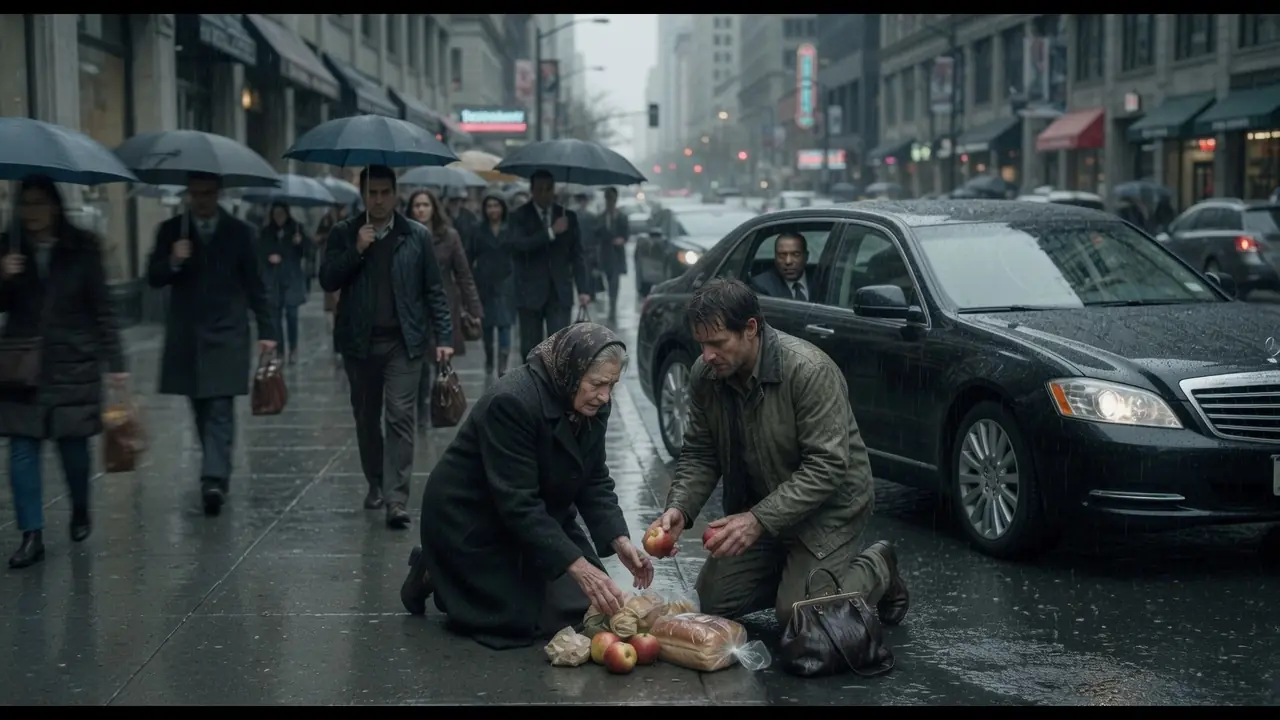
Margaret became part of their lives slowly. At first, she visited with Victor, bringing books for Hazel and homemade cookies that looked imperfect but tasted wonderful. Then she came alone, sitting at the kitchen table and helping Hazel with reading homework. Hazel began calling her Grandma Margaret before anyone officially gave her permission.
Owen and Victor also changed each other. Victor had money and power, but Owen had a way of seeing people inside systems. He explained how delivery drivers were overworked, how warehouse schedules punished single parents, and how small changes could protect good workers from breaking. Victor listened, and for the first time in years, Owen felt his experience had value beyond survival.
Six months later, Langston Freight launched a new family stability program for hourly employees. It included emergency childcare, transportation assistance, meal support during overtime weeks, and a hardship fund that did not bury workers in paperwork. Victor credited Owen for the idea at a company meeting. Owen stood in the back, uncomfortable with applause but proud all the same.
Margaret cried when she heard about it. “You turned one sandwich into a thousand meals,” she told Owen. He shook his head. “No, ma’am. I just helped someone on a sidewalk.” Margaret smiled. “That is how everything begins.”
One year after the day they met, Victor invited Owen and Hazel to a community event downtown. The same sidewalk had been cleaned, repaved, and lined with planters. Langston Foundation had opened a small outreach center nearby for seniors facing housing insecurity. Margaret insisted the first bench outside be placed exactly where Owen had helped her.
At the ribbon-cutting, Owen tried to stand in the crowd, but Hazel dragged him forward. Victor spoke briefly about dignity, family, and the people society fails to see. Then Margaret stepped to the microphone with both hands trembling slightly. This time, her trembling did not come from hunger or shame.
“A year ago, I fell on this sidewalk,” she said. “Many people passed me.” Her eyes found Owen. “One man stopped.” The crowd turned toward him, and Owen lowered his head, overwhelmed. Margaret continued, “He did not know my name. He did not know my son. He did not know I could ever repay him. That is why his kindness was real.”
Hazel slipped her small hand into Owen’s. He squeezed it gently, fighting tears. He thought of the overdue bills, the broken van, the nights he skipped dinner, and the fear that Hazel’s childhood would be shaped by lack. Then he looked at Margaret, standing strong in front of a crowd, no longer forgotten.
After the ceremony, Hazel asked Margaret why she had pretended to be poor. Margaret thought carefully before answering. “I was not pretending, sweetheart. I was lost.” Hazel frowned. “But you had money.” Margaret smiled sadly. “Money does not always mean a person knows where home is.”
That sentence stayed with Owen. He realized he had once thought money would solve everything. It solved many things, of course: bills, safety, food, heat, medicine, time. But the deeper change had come from being seen, trusted, and given room to become more than his struggle.
Years later, Owen became director of logistics outreach at Langston Freight. He built programs for single parents, returning veterans, and workers who needed training but could not afford to stop earning. He hired people others overlooked because he knew overlooked people often carried the strongest discipline. Every applicant who came in nervous reminded him of himself.
Hazel grew up watching her father help others the way he had once been helped. She learned that kindness was not weakness, and dignity was not reserved for people with clean shoes and full wallets. When she was old enough, she volunteered at the outreach center beside Margaret. She told people, “My dad says you never know which small act will change a whole life.”
Owen kept the twenty-dollar receipt from the cafe in a frame on his desk. It was faded, bent, and ordinary. Visitors often asked why a successful director framed such a small receipt. Owen would smile and say, “Because that was the day I became rich before I had money.”
And that was the truth. He had been rich in character when his bank account was nearly empty. He had been rich in compassion when his own life was heavy. He had been rich in the one thing Victor Langston could not buy and Margaret Langston could never forget.
The world often tells struggling people to save themselves first. Owen believed there were moments when helping someone else reminded you that you were still human, still strong, and still capable of giving light even while standing in the dark. He never forgot the woman on the sidewalk, the black car across the street, or the morning everything changed. But most of all, he never forgot that kindness given without expectation can return in ways no one could ever plan.