Walter Ellison almost missed the folded napkin when he swept the counter after closing.
That was the first thing that stayed with him from that night.
The second was how the little girl had stood just inside the door of the Riverside Diner, rain dripping from her sleeves onto the worn linoleum, staring at the pie case like it contained something holy.
The third was the promise she made in a voice so small it barely reached across the empty booths. 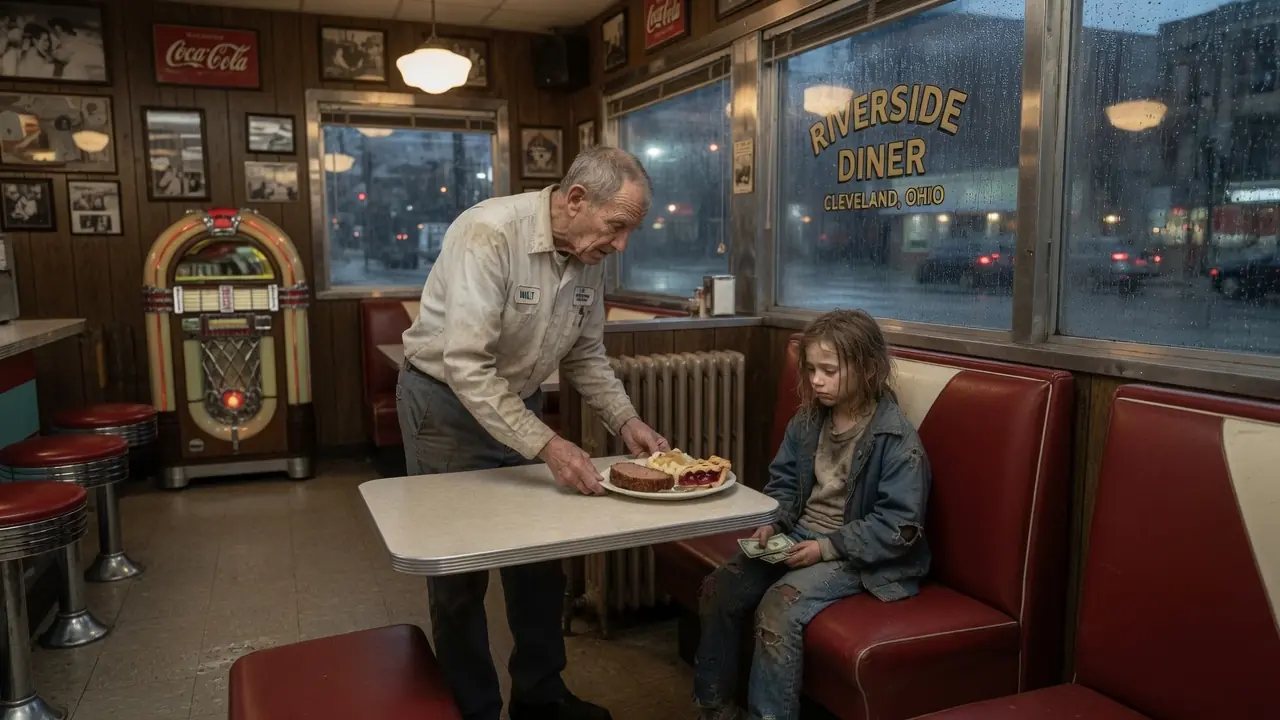
It was a Thursday in late October, the kind of night when the rain came sideways off Lake Erie and found every crack in the old building. The neon sign outside buzzed and flickered, casting a tired red glow across the wet street. Inside, the air smelled of burnt coffee, grilled onions, and the lemon cleaner Walter used on the tables every night. The jukebox in the corner had been unplugged for years, but the low hum of the refrigerator and the occasional tick of the cooling grill kept the place from feeling completely dead.
Walter was sixty-three, thin in the way men get when they have stood on their feet for thirty-five years. His white shirt was yellowed at the collar despite every washing, and the name tag pinned above his heart read simply WALT in letters that had started to peel. He had buried his wife twelve years earlier and had no children of his own. The diner had become both his job and the only thing that still expected him to show up every morning.
He was about to lock the front door when he saw her.
She couldn’t have been more than eight. Her jacket was too thin for the weather, and one shoe had a hole near the toe that she tried to hide by standing with that foot slightly behind the other. She didn’t come all the way in at first. She just stood there, small and uncertain, until the wind pushed the door open again and the bell above it gave a single tired ring.
“You all right, kid?” Walter asked, keeping his voice low so he wouldn’t startle her.
She nodded without looking at him. Her eyes stayed on the glass case where the last slices of cherry pie sat under a plastic dome.
“Hungry?” he tried again.
This time she glanced up. Her face was pale from the cold, and there were dark smudges under her eyes that no child that age should have. She didn’t answer. Instead she reached into her pocket and pulled out two crumpled dollar bills and some change, counting it carefully on her palm as if the numbers might change if she looked long enough.
Walter came around the end of the counter. He moved slowly, the way he always did with people who looked ready to run.
“What’s your name?” he asked.
“Mia.”
“That’s a nice name. You got a last name to go with it?”
She hesitated. “Thompson.”
He nodded like that was all the information he needed. “Well, Mia Thompson, the kitchen’s closed, but I haven’t eaten my dinner yet. Meatloaf and mashed potatoes. Too much food for one person anyway. You want to help me finish it?”
She stared at him as if he had offered her something dangerous.
“I don’t take charity,” she said, the words sounding rehearsed, like something her mother had taught her to say.
“It’s not charity,” Walter said. “It’s leftovers. And I hate eating alone.”
He went back into the kitchen, plated the meatloaf that was supposed to be his dinner, added an extra scoop of potatoes, and cut a big slice of cherry pie. He poured a glass of milk and carried everything to the booth nearest the old radiator that still worked. The vinyl seat was cracked, but it was the warmest spot in the room.
Mia slid into the booth without taking off her jacket. She ate slowly at first, as if she expected someone to take the plate away. Then hunger won and she ate faster, careful not to make noise. Walter sat across from her in the booth that faced the street and pretended to read the newspaper he had already read twice that day.
When she finished the meatloaf, he pushed the pie toward her.
“I can’t pay for pie,” she said.
“Pie’s on the house tonight. Cook burned one earlier and we had to cut around it. Shame to waste it.”
She looked at him for a long moment, then picked up the fork.
They sat in silence while the rain hammered the big front windows. Outside, a semi truck hissed past on the wet road. Inside, the only sounds were the scrape of her fork and the soft tick of the wall clock above the register.
When the pie was gone, Mia wiped her mouth with the paper napkin and stared at the blank side of it for a while. Then she asked, “Do you have a pencil?”
Walter found one behind the counter, the kind with the diner’s name printed on it in fading blue letters. She took it and began to draw on the napkin. Her tongue stuck out a little from the corner of her mouth while she concentrated. After a few minutes she pushed the napkin across the table.
It was a simple drawing done in careful lines: the long counter, the booths, a stick-figure man with a name tag standing behind the register, and a smaller stick-figure girl sitting in a booth. Above them she had drawn a big yellow sun even though it was night outside. At the bottom, in letters that slanted uphill, she had written:
*For Walt. Thank you. Mia.*
And then, smaller, almost an afterthought: *One day I’m going to come back with a car so big it blocks the street and I’m going to make sure this place never closes.*
Walter looked at the drawing for a long time. Something tight and old moved in his chest.
“That’s a fine picture,” he said quietly.
She shrugged like it was nothing, but her cheeks had gone pink.
“I have to go,” she said. “My mom’s waiting in the car. She’s not feeling good.”
Walter nodded. He didn’t ask where the car was parked or why they were out so late on a school night. Some questions didn’t need answers when a child looked that tired. He packed the rest of the pie into a small cardboard box, added two dinner rolls and a couple of apples from the basket by the register, and handed it to her.
“For your mom,” he said.
Mia took the box with both hands. For a second she looked like she might cry, but she swallowed it down the way children do when they have already learned that tears don’t change anything.
“One day,” she said again, “I’m going to pay you back. I promise.”
Walter smiled. “You don’t owe me anything, kid.”
She shook her head, the same way the girl in another story had once shaken hers on a different rainy street.
“Yes I do,” she said. “And when I come back, it’s going to be in a big car. You’ll see.”
Then she slipped out the door and disappeared into the rain.
Walter stood at the window for a long time after she was gone, the napkin drawing still in his hand. He folded it carefully and put it in the breast pocket of his shirt, right over his heart.
Fifteen years passed.
The Riverside Diner changed around him the way old buildings do when no one has the money to stop time. The new management company that bought the building put in new menus with words like “artisanal” and raised the prices. Regulars stopped coming as often. The vinyl on the booths was patched with silver duct tape in three places now. The neon sign outside had lost half its letters and just read RIVE SIDE DIN R most nights.
Walter was seventy-eight. His knees hurt every morning and his back hurt every night, but he still came in four days a week because the small paycheck and the routine were the only things holding the shape of his days together. The new manager had started talking about selling the building to developers who wanted to put up luxury apartments. There were already papers on the desk in the back office with numbers that made Walter’s stomach turn.
One rainy Thursday evening in November, the same kind of rain that had fallen the night Mia first walked in, Walter was the last one left. He had sent the young cook home early because business had been slow. The lights were half off, the way he liked them when he closed. He was wiping the counter for the third time when he heard the soft chime of the bell above the door.
He looked up.
A woman stood just inside, shaking rain from a dark wool coat. She was in her early twenties, tall, with light brown hair pulled back neatly. Everything about her looked expensive but not flashy—the kind of quiet money that didn’t need to announce itself. She scanned the empty diner until her eyes found him behind the counter.
For a moment neither of them moved.
Then she took one step forward and the light from the remaining fixtures caught her face fully.
Walter felt the air leave his lungs.
The eyes were the same.
“Mia?” he said, the name coming out rough.
She smiled, and it was the same small, careful smile from fifteen years earlier, only older now and carrying things he couldn’t name.
“You still remember,” she said. Her voice cracked on the last word.
He came around the counter without thinking, the rag still in his hand. She met him halfway and hugged him before he could decide whether that was allowed. She was taller than him now. Her coat smelled faintly of rain and something clean and expensive.
When she pulled back, her eyes were wet.
“I told you I’d come back,” she said.
Walter looked past her through the big front windows. Parked at the curb was a dark SUV, sleek and new, its headlights still on, wipers moving steadily. It was big enough to block half the street if she had wanted it to.
“You kept your promise about the car,” he said, trying to make his voice steady.
Mia laughed, the sound half sob. “I kept a lot of promises.”
She told him everything while they sat in the same booth by the radiator. Her mother had been sick that night—pneumonia that had turned dangerous because they couldn’t afford a doctor. They had been living in the car for three weeks. The meal Walter gave Mia had been the first real food either of them had eaten in days. Her mother recovered, barely. They found a shelter, then a small apartment. Her mother worked two jobs and went to night school until she got her nursing license. She died five years ago from complications that had started during those hard years.
Before she passed, she made Mia promise to find the man at the diner who had fed a scared little girl on a rainy night and never asked for anything in return.
“I started a company after college,” Mia said. “Real estate, but the kind that buys old buildings and keeps them alive instead of tearing them down. And I started a foundation in my mother’s name. We help small businesses that are about to disappear. Diners. Hardware stores. Laundromats. Places that hold neighborhoods together.”
She reached into her bag and pulled out a thick folder.
“I bought the building,” she said simply. “The developers were going to tear it down next month. They won’t now. And I paid off the medical debt the manager had been holding over your head. You don’t have to work here anymore unless you want to. But if you want to stay, the diner is yours. Or we can run it together. Whatever you decide.”
Walter stared at the papers. His hands, which had steadied thousands of plates over the decades, shook.
“I gave you meatloaf,” he said. “That’s all.”
Mia’s eyes filled again.
“You gave me proof that someone still saw us,” she said. “That was enough to keep my mother alive long enough to raise me. And it was enough to make me want to spend the rest of my life making sure other people get seen too.”
They sat with that for a while. The rain kept falling. The old radiator clanked and hissed.
Then the bell above the door rang again.
An elderly man stepped inside, shaking water from a worn fedora. He was in his late seventies, maybe early eighties, with a lined face and careful eyes. He had been coming to the diner every single morning for the last eighteen years. Same stool at the far end of the counter. Same order: two eggs over easy, wheat toast, black coffee. He never said much. Most people called him Mr. Thompson. Walter had always called him Arthur.
Arthur stopped when he saw them. His gaze went from Walter to Mia and back again. Something in his expression shifted, like a man who had been waiting a very long time for a lock to finally turn.
Mia looked at him, polite but curious.
Arthur took off his hat slowly. His hands were not steady.
“Forgive me,” he said, voice rough. “But your name… Mia Thompson?”
She nodded.
Arthur closed his eyes for a second, as if the words had physically struck him.
“My daughter’s name was Elena Thompson,” he said. “She would have been about your mother’s age.”
The diner went very quiet. Even the rain seemed to soften against the windows.
Mia went still in the way people do when the ground under them is about to move.
“My mother’s name was Elena,” she whispered.
Arthur made a sound that was not quite a word. He reached into his coat with trembling fingers and pulled out an old photograph protected in a plastic sleeve. A teenage girl with light brown hair and the same eyes smiled out from a faded color snapshot. She was standing in front of a Christmas tree, one hand resting on her stomach in a way that suggested she already knew a secret.
Mia took one look and made the same sound her grandfather had made.
Walter felt the pieces slide into place with the slow, inevitable weight of something that had been waiting fifteen years to be understood.
Years ago, right after he started at the diner, a scared pregnant girl had come in late one night. She had no money and nowhere to go. He had given her the last of the meatloaf and enough cash for a bus ticket to her aunt’s house in another state. She had never told him her name. He had never asked.
That girl had been Elena Thompson.
And the child she carried had grown up to be the young woman sitting across from him now.
Arthur looked at Walter with eyes that had been searching for decades.
“You fed her,” he said. It wasn’t a question.
Walter nodded once.
“I fed her,” he said. “And then I fed her daughter. And I never knew.”
Arthur sat down heavily on the nearest stool. His shoulders shook. Mia moved without thinking, crossing the space between them and putting her arms around the old man who had been a stranger until thirty seconds earlier.
For a long time the only sounds in the diner were the rain and two people crying quietly against each other.
Walter stayed where he was, giving them the moment. His hand went to his shirt pocket by habit. The old napkin was still there, folded small, the ink faded but the drawing still clear if you knew what you were looking at.
When Mia finally looked up, she reached out and took his hand, pulling him into the circle the way someone pulls family closer on a cold night.
“You’re part of this,” she said, voice thick. “You always were.”
Arthur nodded, wiping his face with a handkerchief that had seen better decades.
“My daughter thought we didn’t want her,” he said. “Her stepmother… there were lies. I looked for Elena for twenty years. I started coming here every morning because someone told me they had seen a pregnant girl near this corner once. I kept coming because it was the only place that still felt like she might walk through the door.”
He looked at Walter.
“You kept her alive long enough to have this one,” he said. “And then you kept this one alive long enough to find me.”
Walter had no words. He simply sat with them while the rain continued and the old radiator kept up its steady, faithful noise.
Three weeks later the diner reopened under new ownership.
The sign outside had been restored to full neon brightness: THE RIVERSIDE DINER. The vinyl booths had been re-covered in the original shade of red. The menu went back to meatloaf and cherry pie and eggs over easy. A small brass plaque was mounted on the wall beside the booth nearest the radiator. It read:
*No meal is too small when someone is hungry for kindness.*
Walter still worked four days a week, though Mia and Arthur both told him he didn’t have to. Arthur came every morning at seven. Mia came every Thursday evening, sometimes with papers for the foundation, sometimes just to sit in the booth and drink coffee while Walter told her stories about the old regulars who had passed through over the decades.
On the nights when the rain came sideways off the lake again, Walter would sometimes stand at the big front window after closing and look at the dark SUV parked at the curb. He would touch the faded napkin he still carried in his pocket and remember the little girl who had promised a car so big it would block the street.
She had kept that promise.
And in keeping it, she had brought back something far bigger than any car could carry.
A family that had been waiting decades to find itself again.
And a place that would now stand for as long as any of them needed it to.