The morning the black Porsche disappeared beneath my carport, I was standing barefoot on the back steps with a mug of coffee in one hand and my twelve-year-old daughter's forgotten lunchbox in the other. The first crack sounded like a rifle shot, sharp enough to stop every conversation in the yard next door. Then the roof dipped in the middle, the front beam twisted, and nearly two tons of German engineering dropped under a storm of timber, roofing panels, and splintered cedar. By the time the dust cleared, the Porsche looked as if a building had stepped on it.
For three full seconds nobody moved. Then my neighbor, Denise Calder, screamed my name so loudly that people came out of houses half a block away. Her brother-in-law, Grant, shoved through the crowd toward the wreckage while Denise's twenty-three-year-old son Mason stood with both hands on his head, staring at what had been his favorite car. I remember taking one slow sip of coffee because I already knew exactly what they were going to say next.
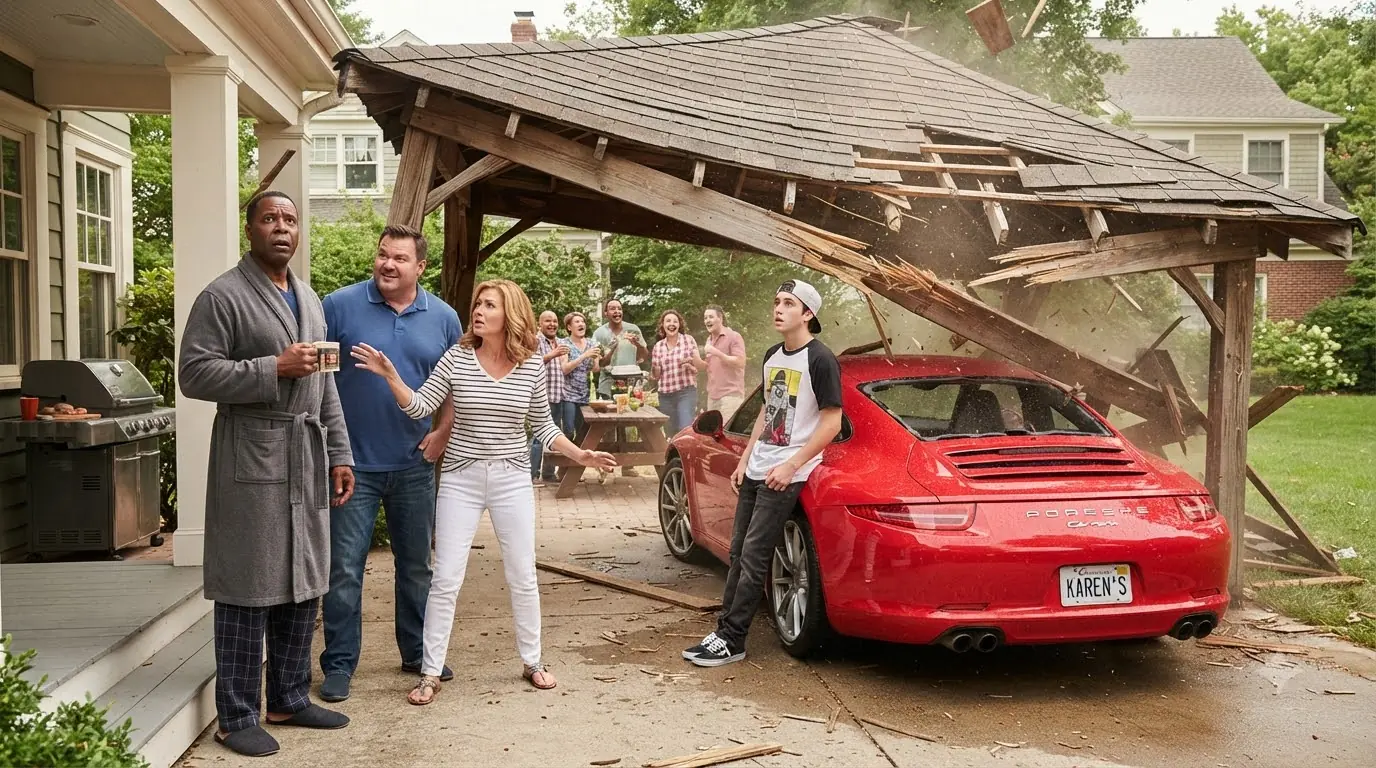
"You did this," Denise shouted. She pointed at me as if she had just caught me holding a chainsaw. "You knew he was parking there. You weakened it on purpose." Grant took over before I could answer, telling everyone that I had threatened their family for months and finally snapped. Mason just stared at the crushed Porsche, pale enough that his freckles had disappeared.
I set the lunchbox on the step and looked at Denise. "I told you not to park there," I said. "I told all of you. In writing." That should have ended the argument, but people like Denise never heard a boundary as information. They heard it as a challenge.
My name is Daniel Harper. At the time I was forty-five years old, a widower, and the owner of a modest electrical contracting business in a suburb outside Cincinnati. The house had belonged to my father before it belonged to me, and the detached carport beside the garage was one of the last projects we built together before his stroke took away the use of his right hand. He designed the timber frame himself, cursed every uneven post, and made me redo one roof joint three times because "good enough" was a phrase he considered offensive.
The carport had stood for nineteen years without a problem. It was never meant for strangers, party guests, or people who believed the word private applied only to other people's property. It existed because my father hated scraping frost off work trucks in winter, and after he died I kept his old Ford beneath it until the transmission finally gave out. When my wife, Sarah, got sick, I sold the truck and used the space mostly for lumber, ladders, and occasionally my own van.
Sarah died two years before the Porsche collapsed. Ovarian cancer took eighteen months, most of our savings, and a version of me I never got back. Our daughter, Grace, was ten when we buried her mother and old enough to understand the loss but too young to know what to do with it. For a while, the two of us moved through the house like tenants in a museum, careful around objects because everything seemed to belong to someone who was no longer there.
The Calder family moved in three houses down during that same terrible year. Denise was forty-eight, recently divorced, loud in the way some people become when they confuse confidence with ownership. Her adult son Mason drifted between jobs and spent more time discussing business ideas than working at any of them. Grant, Denise's older sister's husband, owned a small chain of luxury used-car lots and liked to talk as if every conversation were a sales pitch he had already won.
At first they were only annoying. Their relatives parked across driveways during cookouts. They left trash beside other people's cans after parties. Mason used the end of my driveway to turn his car around because, as he once explained, his lowered suspension "couldn't handle the angle" of his mother's curb. I let most of it go because grief had stripped me of the energy required for neighborhood wars.
Then the parking under my carport began. The first time, I came home from a service call and found Grant's Mercedes beneath it while half a dozen cars crowded the Calder driveway. I walked over and asked him to move it. He laughed, clapped me on the shoulder, and said, "Relax, Dan. We're neighbors. It's shade, not Fort Knox." I moved his hand off my shoulder and told him the carport was on my property.
The second time was Mason's pickup. The third was Denise's sister's SUV. By the fifth time, I stopped asking politely and sent Denise a written notice with a copy of the property survey. I highlighted the boundary line in yellow and wrote in plain language that nobody from her household or her guests had permission to park, store items, or enter beneath the carport.
Denise brought the letter back to me the next afternoon. She held it between two fingers like something dirty. "Do you really have nothing better to do?" she asked. I told her I had plenty to do, which was why I did not want to keep telling adults to move their cars. She said I was making the street hostile.
"No," I told her. "I'm making my driveway private." She rolled her eyes and asked whether Sarah had always found me this difficult. That was the first time she used my dead wife's name in an argument. I closed the door before anger made me say something I would regret.
A week later my PRIVATE PROPERTY sign disappeared. I replaced it with a larger one bolted to the fence. Two days after that, somebody bent it backward until the metal creased. Grace found it when she came home from school and asked why the neighbors hated us. I told her they did not hate us. They simply did not like being told no.
The carport became dangerous after a series of late-summer storms. One corner footing shifted slightly when runoff washed soil away from the rear post. I noticed a gap where the base plate met the concrete and called a structural carpenter named Luis Moreno, a man I had worked with on commercial jobs for more than a decade. He inspected the frame, took measurements, and told me the structure was not about to fall down, but the rear footing needed to be reset before I put any heavy vehicle beneath it.
Luis gave me a written estimate and marked the weak corner with orange spray paint. I placed two traffic cones across the carport entrance and taped a laminated notice to the front post: UNSAFE FOR VEHICLE PARKING - REPAIR SCHEDULED. I also texted Denise because I had learned that signs meant nothing to her family. Her response was one word: Dramatic.
Three days later the cones were stacked beside my garage. I put them back. The next morning one was missing entirely. When I confronted Mason, he shrugged and said wind probably moved them. There had been no wind.
That was when I installed a small motion camera aimed at the driveway. Not because I expected a crime, but because I was tired of arguing about facts. The camera recorded Denise's husband from her previous marriage visiting once, two delivery drivers, a raccoon that seemed personally offended by my trash can, and Mason moving one of the cones at 11:14 p.m. so his friend could park beneath the structure during a football watch party. I saved the clip and emailed it to Denise.
She responded by threatening to call an attorney for harassment. I wrote back that I had recorded my own property. After that, she stopped replying in writing.
Two weeks before the collapse, Grant arrived with the Porsche. It was a 2018 911 Carrera S, black with red brake calipers, polished so perfectly the sky reflected in the hood. Mason treated it like a celebrity. According to neighborhood gossip, Grant had recently transferred the car to him through one of his dealerships, though nobody seemed sure whether Mason actually owned it or merely drove it.
The first evening Mason parked it beneath my carport, I knocked on Denise's door. She answered holding a glass of wine. I told her the car had to move immediately because the structure was under repair restrictions. She leaned around me, looked at the Porsche, and smiled.
"Looks good there," she said.
"It isn't staying there."