"You don't belong here. You have never belonged here." "Ma'am, I just want to understand what violation I have." "Sixty violations in twelve months, and you're still here, like a stain I can't scrub out." "I own this home. I pay my dues just like everyone else." "Your dues?" She laughed. "You could pay double, and you'd still drag this street down just by standing on it." "Mrs. Whitfield, I'm asking you to please calm down." Then came the slap, hard across his face, in front of a camera she did not know was recording.
That was Colleen Whitfield, HOA president, clipboard tyrant, and the woman who just slapped a man who was never in her HOA. Not for a single day. Sixty violations and $14,400 in fines. All of it worthless. But she didn't know that yet.
And how she found out, that's the story. Now let's rewind, way before the courtroom, before the cameras, before the slap. Sterling Vance was the kind of man who fixed things. That's what he did. Forty years of it: twenty years in the Army Corps of Engineers, drawing boundary lines across three continents, surveying terrain that most people couldn't find on a map. Then another twenty building a quiet consulting practice out of his garage in Caldwell County, North Carolina.
The man measured land for a living. He could read a property deed the way most people read a cereal box. He was fifty-six, broad shoulders going soft, hands rough from decades of field work and weekend woodworking. Every Saturday morning you'd find him in his workshop behind the house. Sawdust smell hanging thick in the air.
A hand plane warm from use. Smooth jazz leaking out of a portable radio that had survived two deployments and a cross-country move. The house was a 1940s craftsman bungalow on a corner lot at the edge of Briarcliff Estates. 1.2 acres. Original hardwood floors.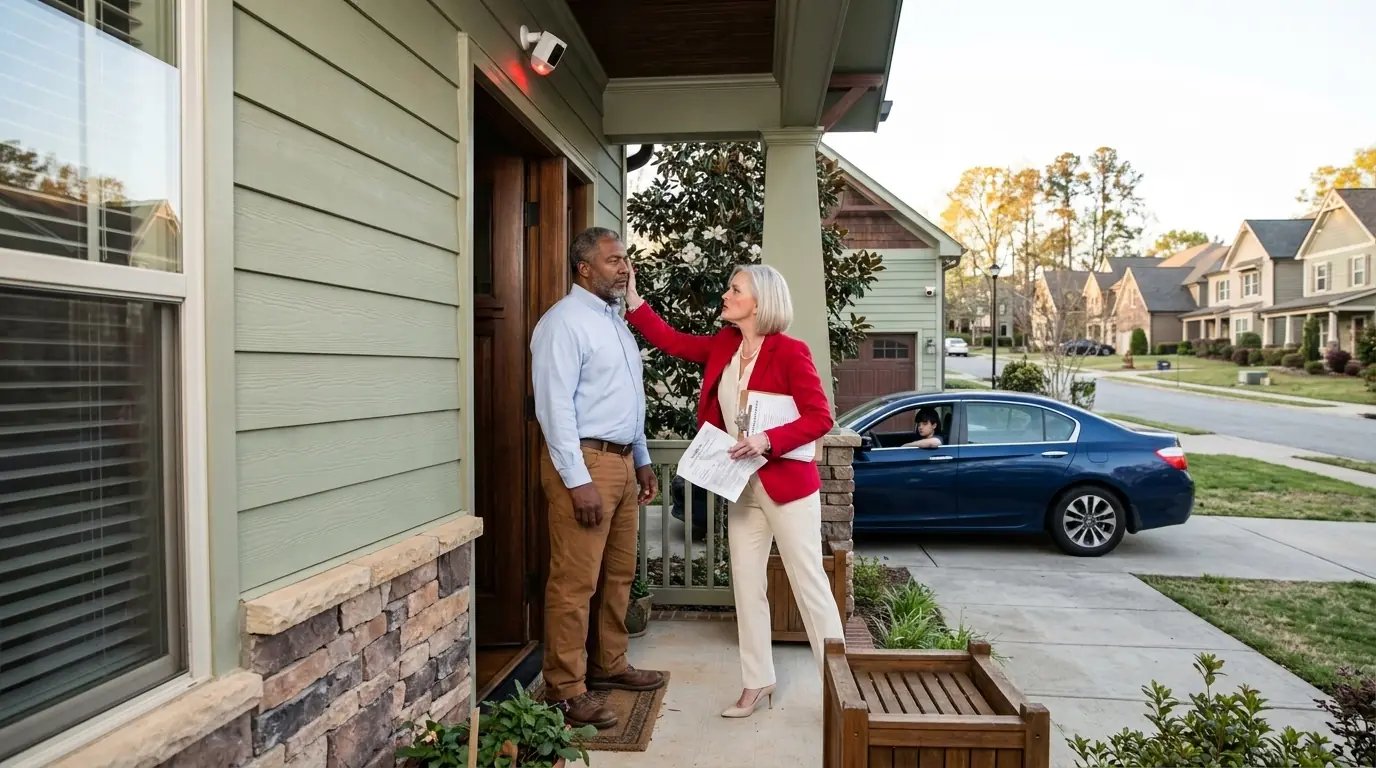
A wide front porch built for sweet tea and slow evenings. The kind of house that whispers instead of shouts. Sterling and his wife Nadine had bought it five years earlier, their forever home. She'd planted a magnolia tree out front the week they moved in. Said it would bloom every spring to remind them they'd made it.
Nadine didn't see the second bloom, pancreatic cancer. Fourteen months from diagnosis to funeral, the cruelest math Sterling ever had to calculate. Her last words to him weren't poetic, they were practical. That was Nadine. She'd grabbed his wrist from the hospital bed and said, "Don't you ever let anyone make you leave that house." Sterling had promised, and Sterling Vance was not a man who broke promises.
So, he stayed, kept the yard surgical, repainted the trim every spring, oiled the porch boards, maintained the magnolia like it was a living piece of his wife. His property was, by any objective measure, the best-kept lot on Ridgecrest Lane. And that, it turned out, was the problem. Because one Saturday morning, while Sterling was running his hand along a walnut board he'd been shaping for a bookshelf, he heard the porch swing creak. Except there was no porch swing anymore.
He'd taken it down after Nadine passed, too painful. The sound was just the first step of someone walking up to his front door. He wiped his hands on a shop rag, stepped out of the garage, and saw her. Colleen Whitfield, 52. Blonde bob streaked with silver, reading glasses on a pearl chain.
Linen blazer, pressed slacks, clipboard held against her chest like a shield. She looked like the friendliest real estate agent you'd ever meet, the kind of woman who brings cookies to the new neighbors and remembers everyone's dog's name. She smiled, sunshine and steel. "Mr. Vance, I'm Colleen Whitfield, president of the Briarcliff Estates Homeowners Association. I just wanted to stop by and welcome you to our little community." He had lived there for two years, but Sterling let it slide.
"Thank you, ma'am. I appreciate that." "Of course. We love having new faces. I just... well, I did want to mention a few tiny things." She flipped the clipboard around.
Three violations. Mailbox paint color unapproved. Trash cans visible from the street on a non-collection day. And an unauthorized structure, his workshop shelving, barely visible through the garage window. Sterling looked at the list, then at his immaculate yard, then back at Colleen.
He could smell her perfume, something floral and aggressive, the olfactory equivalent of a firm handshake that lasts too long. "I appreciate you stopping by, ma'am." Colleen left with a satisfied click of her heels on his walkway. She had found her project. Sterling glanced down at the violation notice.
The header read, Briarcliff Estates Homeowners Association, lots 1 through 120. He didn't think much of it at the time. He should have. That was violation number one. Over the next twelve months, fifty-nine more were coming, and each one would carry a little more venom than the last.
The truck parked six inches too close to the sidewalk, and yes, Colleen had measured it. Violation. Each notice was CC'd to the entire HOA board. Every word polished to a bureaucratic shine. Per section 4.3(B), as a friendly reminder, in the interest of maintaining the character of our community, the character of our community.
Sterling would learn to hate that phrase. And here's what made it brilliant, in a poisonous, methodical sort of way. Nothing Colleen did was technically wrong. Every notice cited a real section of the CC&Rs. Every letter was professional.
She wasn't breaking rules. She was weaponizing them. And if you've ever dealt with someone who can insult you while smiling, you know exactly how that feels. The neighborhood cookout happened on the third Saturday in June. Burgers, cold beer, a folding table of potato salad sweating in the Carolina heat.
Every house on Ridgecrest Lane got a flyer in their mailbox. Every house except one. Sterling found out the way you always find out. The smell. Charcoal and lighter fluid drifting over his back fence while he sat on his porch eating leftover meatloaf alone.
The sound of someone else's laughter carrying across the yards. A sprinkler clicking next door like a metronome counting down something he couldn't name yet. At the cookout, Colleen held court. Red Solo cup in one hand, the other resting on a lawn chair arm like a queen on a vinyl throne. She leaned toward a circle of neighbors and said, loud enough to carry, quiet enough to deny, "I'm sure he's a perfectly nice man, but some people just aren't used to this kind of community.
It's an adjustment. You know what I mean?" She didn't say his name. She didn't have to. Garrett Price, 61, retired electrician, Sterling's next door neighbor, and the closest thing he had to a friend on the block, was standing twelve feet away. He heard every word.
He looked at his baked beans. He looked at Colleen. He pulled out his phone and pretended to check a text. He said nothing. Now, here's what Sterling did, and this tells you everything about the man.
He didn't shout, didn't confront. He went inside, sat down at his desk, and opened a manila folder labeled HOA Correspondence. He responded to every violation in writing, point by point, photograph attached, timestamp included, polite as Sunday morning. The trash cans were visible for eleven minutes because his pickup ran late. Here's the photo at 7:02 a.m. showing them back in the garage.
The wreath was up two days past the window. The CC&Rs say seasonal decorations. The definition of seasonal isn't specified anywhere. The truck was six inches over. Here's a surveyor's measurement because Sterling Vance owned a surveyor's tape.
He corrected every violation within 24 hours, even the absurd ones. His yard became a museum exhibit of suburban perfection. Then he did something smarter. He wrote a formal letter to the full HOA board requesting a meeting to discuss selective enforcement. He cited the Fair Housing Act.
He cited the governing documents. The letter was airtight. It never reached the board. Dawn Prescott, board secretary, Colleen's loyal shadow, intercepted it and handed it to Colleen in the parking lot of the Food Lion on a Tuesday afternoon. Colleen read it, folded it, and dropped it into her purse.
The meeting was never scheduled. Sterling's complaint vanished. He didn't know that yet, but Garrett Price did because Garrett was loading groceries into his truck three rows over. He saw the whole thing. Garrett said nothing, at least not yet.
That night, Sterling called Briana. "Dad, this is harassment." "It's a nuisance, baby. I've dealt with worse." "This isn't the Army. You don't have to just take it." Sterling was quiet. After a pause, he said, "I'm not just taking it.
I'm keeping records." After they hung up, he walked out to the porch, stood in the spot where the swing used to be. The magnolia rustled in the dark, its waxy leaves catching the street light. He whispered, "I promised you, Nadine. Eleven violations down, forty-nine to go." And Colleen was just getting warmed up. Colleen was smart enough to know that one-on-one harassment leaves no witnesses, so she went public.
She created the Briarcliff Beautification Committee. Three retirees with nothing to do, matching visors, and a shared Google Doc for reporting violations. On paper, the committee existed to uphold community aesthetics. In practice, it was a surveillance squad with a single target. 90% of their reports landed on Sterling's doorstep.
The other 10% were decoys, just enough complaints against other homes to keep it looking fair. Then came the Facebook post. Colleen typed it out on a Sunday evening, probably with a glass of Chardonnay and a sense of divine purpose. Community standards update. Some residents have accumulated multiple violations and continue to disregard the rules that make Briarcliff a place we're proud to call home.
The board is evaluating next steps. Thank you to those who respect our standards. You know who you are. She didn't tag Sterling. She didn't need to.
Every neighbor on Ridgecrest Lane knew exactly who some residents meant. The post got 42 likes and a row of clapping hand emojis. Nobody commented on Sterling's defense. Not one person. But Colleen wasn't done.
She filed a formal complaint with Caldwell County Code Enforcement, claiming Sterling was operating an unlicensed business from a residential property, his surveying consultancy. Two days later, a county inspector showed up in a white truck, clipboard in hand, looking apologetic before he even reached the porch. Sterling invited him in, offered him coffee, then handed him the home occupation permit he'd legally obtained from the county the month he moved in. The inspector compared the paperwork, nodded, finished his coffee, and left.
Complaint dismissed. Case closed. But here's what the complaint cost Sterling that the paperwork couldn't measure. A Tuesday morning spent proving he had a right to work in his own house. The look on the inspector's face, polite but already skeptical before the door opened.
The neighbor across the street watching from behind her curtain, probably wondering what kind of trouble the county was investigating, Sterling started losing sleep. Not dramatically, not tossing and turning with his fist against the pillow. Quietly, the way men his age lose sleep. He'd lie flat on his back at 2:00 a.m., eyes open, listening for footsteps near his property line, checking the mailbox twice a day now, once before coffee, once after dinner, dreading the next envelope with the Briarcliff logo. His blood pressure crept up six points at his next checkup.
The doctor told him to reduce stress. Sterling thanked him and said nothing else. But Sterling Vance was not a man who folded. He was a man who measured. He went to his desk, pulled out every violation notice issued to every homeowner in Briarcliff Estates over the past twelve months, all obtained through a formal records request.
And here's your first practical insight. In most states, homeowners have the legal right to inspect HOA records, including violation histories and financial statements. You don't need a lawyer. You need a certified letter and a copy of your state's HOA statute. If they refuse, that refusal becomes evidence.
Sterling built a spreadsheet, rows for every homeowner, columns for every violation, color-coded, timestamped. The data was brutal. Sterling had received four times more violations than any other resident. The next highest was the Davis family on Birchwood Court, and their offense was an unpermitted deck, not a garden hose on a driveway. Then he went further.
He pulled the county GIS records for Colleen's own property. And there it was, a storage shed in her backyard, built without HOA architectural approval and without a county building permit. Sterling filed a complaint, politely, by the book, certified mail. He sent copies of the spreadsheet and violation records directly to every board member's home address, bypassing Colleen and Dawn entirely. Five envelopes, five certified receipts, no interception this time.
And here's something the narrator needs to remind you because it matters later in ways nobody saw coming. Sterling Vance was a land surveyor. The man drew property boundaries for a living and somewhere in the back of his mind, while he was building spreadsheets and filing complaints, a quiet thought was beginning to form. A thought about boundary lines. That evening, he pulled out his original deed, ran his finger along the legal description, opened the county GIS website on his laptop, zoomed in, zoomed in again.
He frowned. Something didn't look right. He closed the laptop, pressed his palms flat on the desk, and stared at the wall for a long time. Not ready to chase that thought yet, but it was there now. A splinter under the skin, too deep to ignore.
The code enforcement complaint against Sterling was dead on arrival, but the one Sterling filed against Colleen, that one was about to make her absolutely lose her mind. The county code enforcement notice arrived at Colleen Whitfield's house on a Friday morning. Unpermitted structure, storage shed, violation of Caldwell County building code. Please remediate or appear before the zoning board within 30 days. Colleen knew exactly who filed it and this time, the clipboard stayed home.
She showed up on Sterling's front lawn the next morning at 8:15. No linen blazer, no pearl glasses chain, no HOA letterhead. Just the woman running hot, fists tight at her sides, heels sinking into the damp grass like she was trying to pin the earth in place. The magnolia threw a long shadow across the yard. A mockingbird was screaming somewhere in the branches, the way mockingbirds do when something wrong enters their territory.
Sterling was on the porch, coffee in hand. He saw her coming and set the mug down on the railing, slowly. "You filed a complaint against me." It was not a question. I filed a code enforcement report, Mrs. Whitfield.
Same process you used on me. "That is not the same thing." Her voice climbed a full octave. I am the president of this association. I protect this neighborhood.
I maintain standards. You, you're a troublemaker. That's all you've ever been since you showed up. I've been here five years, ma'am. And every single one of those years, this street has gone downhill.
You think I don't see it? You think people don't talk? She stepped closer. Her finger came up, pointed, trembling, aimed at his chest like a weapon. People like you move into a nice community and you don't understand the rules.
You don't respect how things work here. Sterling said nothing. He let the silence do the work. This was a good neighborhood. Her voice cracked.
Not from sadness, from something uglier. A safe neighborhood. A clean neighborhood. Before she stopped. Sterling looked at her, steady, patient, the way you watch a trap closing in slow motion.
"Before what, Mrs. Whitfield?" The Hendersons were washing their car across the street. Both of them frozen. Sponge in one hand, hose in the other. They heard every word.
The wet slap of the sponge hitting the bucket was the only sound on the block for three full seconds. Colleen's jaw tightened. The mask was off. She knew it, but she couldn't stop. "Don't twist my words. Don't you dare twist my words. I am not the villain here. You are harassing me. You filed that complaint to intimidate me. I will call the police."
"You're standing on my property, ma'am." She stared at him. Her nostrils flared. Then she turned on her heel and walked back toward the street, fast. Heels punching the sidewalk like she was trying to crack it.
And here's the part that stung worse than anything Colleen said. One of the Hendersons, the husband Doug, set down his sponge and walked across the street. Sterling thought he was coming to say something decent. Maybe, "Sorry about that." Maybe, "She was out of line." Instead, Doug Henderson looked at the ground and said, "You know, Sterling, it might just be easier to go along with what she wants. She's connected.
That's all I'm saying." Then he walked back to his driveway, picked up the sponge, and kept washing his car. Sterling went inside, closed the door, sat down at the kitchen table, hands flat on the wood, jaw locked, eyes wet. He picked up a framed photo of Nadine from the sideboard, the one from their anniversary trip to Savannah, her laughing on a bench by the river. He held it and said quietly, "She was going to say it before people like me moved in. She almost said it, Nadine." He set the photo down, picked up his phone, called Briana.
She didn't waste time on comfort. "Dad, I want you to get a full boundary survey on your property. Pull the original plat for Briarcliff from the register of deeds." "Baby, I am a surveyor." "Then act like one." The next morning, Sterling filed a formal request for mediation through Caldwell County's alternative dispute resolution program. Here's your second practical insight. Most counties offer free or low-cost ADR services for HOA disputes.
And in many states, courts look favorably on parties who attempt mediation before filing suit. It shows good faith, and it puts the other side on record for refusing. The board voted three to two to decline mediation. Colleen and Dawn voted no. The system had failed him again.
But Briana's words were still rattling around his skull. Act like one. That night, Sterling opened his filing cabinet, pulled out his deed, his closing documents, his title insurance policy, spread them across the dining room table under the yellow kitchen light. And what he found in those pages would change everything. But that, that's for the next chapter.
Sterling Vance had spent 30 years reading legal descriptions, metes and bounds, lot numbers, subdivision plats, easements drawn in faded ink on county maps older than his truck. He could look at a property description and see the shape of the land, the way a pianist sees music in the notes. So, when he spread his deed, his closing documents, and his title insurance policy across the dining room table that night, he wasn't guessing. He was reading. The deed described his parcel by metes and bounds, compass bearings and distances tracing the border of his 1.2 acre lot.
No lot number, no subdivision reference, no mention of Briarcliff Estates anywhere. He opened his laptop, pulled up the Caldwell County GIS portal, found the recorded plat for Briarcliff Estates, filed with the register of deeds in 1998 when the developer carved 120 lots out of old tobacco farmland. Lots 1 through 120 neatly numbered, arranged along four streets. Sterling's property sat at the corner of Ridgecrest Lane, but on the plat, it wasn't lot 121. It wasn't lot anything.
It was labeled parcel 0-A, an existing homestead predating the subdivision by 40 years, explicitly excluded from the platted boundary. He pulled up the CC&Rs, page one, paragraph three. These covenants, conditions, and restrictions shall apply to lots 1 through 120 of Briarcliff Estates as recorded in plat book 14, page 312, Caldwell County Register of Deeds. Lots 1 through 120, not parcel 0-A. Sterling sat back.
The kitchen light hummed above him. A moth tapped against the window screen. He could hear his own breathing, slow, measured, the way it got when he was processing something enormous. His property was never part of Briarcliff Estates. The HOA had no jurisdiction.
Every violation, all 60, had been issued by an entity with no more authority over his land than the book club three streets over. The $4,250 in dues he'd paid over five years went to an organization he didn't belong to. The $14,400 in fines sitting in Colleen's binder was worth exactly nothing. He didn't smile, didn't celebrate. He stared at the plat map and said one word, "Nadine." Here's your third practical insight.
An HOA can only enforce its rules on properties legally bound by the recorded CC&Rs. If your deed doesn't reference those covenants and your lot isn't on the recorded plat, the HOA has zero authority. Check your deed. Check the plat. $15 at the register of deeds might be the most important $15 you ever spend.
He picked up his phone, called Briana, told her what he'd found. Silence. Then a slow laugh, low, disbelieving, building. "Dad, she's been fining a man who isn't even in her HOA, and I've been paying dues to an organization I don't belong to. That's fraud.
That's conversion. That's Dad, that's a lawsuit." Now, here's where most people would have gone straight to court, slapped Colleen with the plat map, and watched her crumble. But Sterling Vance was a patient man, a military man. He understood something every good strategist knows. The best trap is the one the target walks into willingly.
He wasn't ready to file, not yet. Colleen Whitfield still had two more moves to make, and Sterling wanted her to make every single one of them. On the record. He put the plat map back in the folder, closed the filing cabinet, and for the first time in months, Sterling Vance slept through the night. Sterling didn't move fast.
He moved right. The morning after his discovery, he sat at the kitchen table with a legal pad and drew three columns. Phase one, phase two, phase three. The handwriting was small, precise, the lettering of a man who'd spent decades writing notes in field margins during windstorms. By the time his coffee went cold, the plan was done.
Phase one, document everything going forward. Every knock on the door, every envelope in the mailbox, every word spoken on or near his property. He drove to the hardware store that afternoon and came home with a ring doorbell camera and two weatherproof security units. One aimed at the front yard, one covering the property line along Colleen's side. Mounted them himself, took him 40 minutes.
Here's a detail the audience should file away. North Carolina is a one-party consent state for audio recording. That means Sterling could legally record any conversation he was part of and his cameras could capture anything visible or audible from his own property. He tested the angles twice. Every inch of his porch, walkway, and front yard was covered.
Phase two, let Colleen escalate. This was the hardest part, doing nothing. Every instinct told him to file the lawsuit now, slam the plat map on her kitchen table, and watch her choke on it. But Briana had talked him through the math. Every violation Colleen sent from this point forward was another count in the lawsuit.
Every fine was another dollar of damages. Every act of harassment, documented, timestamped, recorded, was another brick in a wall that would eventually fall on her. "Dad, she's building your case for you," Briana said. "All you have to do is let her." Sterling taped a note to his bathroom mirror. Three words, let her dig.
Phase three, the counterstrike. Briana connected him with Nolan Crawford, a real estate litigator out of Charlotte she'd worked with at her firm. Crawford was 50, lean, quiet, the kind of lawyer who read everything twice and said little until it mattered. Sterling drove the banker's box of documents to Crawford's office on a Wednesday morning. Crawford spent two hours going through the plat map, the deed, the CC&Rs, the 60 violation notices, and the five years of dues receipts.
When he finished, he leaned back and took off his glasses. "Mr. Vance, I've handled a lot of HOA overreach, selective enforcement, bad-faith fines, and power-tripping board presidents. I have never, not once in twenty-two years, seen someone fined sixty times by an HOA they don't belong to."
"What does that mean for me?" Sterling asked.
"It means we file for declaratory judgment. Your property is not subject to the CC&Rs. We demand the return of all dues paid. We claim damages for harassment and selective enforcement under the Fair Housing Act, and we pursue punitive damages for fraud. They collected money from a non-member property for five years." Crawford put his glasses back on. "This is extraordinary."
Sterling nodded. "When?"
"Not yet. You said she's planning a lien vote?"
"October 15."
"Then we file October 10, five days before. Let her walk into that meeting with a lawsuit already on the docket." While Crawford prepared the complaint, Sterling assembled his witnesses. Garrett Price came first, sat in Sterling's kitchen, hands wrapped around a coffee mug, eyes on the table. He told Sterling about the phone call he'd overheard. Colleen on her cell outside the clubhouse, voice sharp and careless.
"I don't care what it takes. I want him out of this neighborhood. He is dragging down the value of every house on this street," Colleen had said. Garrett added, "She said that about my property on Ridgecrest Lane." He signed an affidavit. His hand shook, but he signed it.
Then came Edith Calloway, 74, widow of six months, fined $200 for hanging mourning wreaths on her own front door. Her voice was thin but steady. "She told me the wreaths were unsightly. My husband's name was on those wreaths." Edith provided a written statement. The Davis family, the ones with the unpermitted deck, added theirs.
A pattern was forming on paper that matched the pattern Sterling had felt in his bones for a year. Sterling commissioned a certified boundary survey from a former Army Corps colleague, someone with no connection to Caldwell County, eliminating any conflict of interest claim. The survey confirmed what Sterling already knew. Parcel 0-A was not within the Briarcliff Estates plat, period. Everything went into the banker's box, certified plat map, certified deed, 60 violation notices, five years of dues receipts, survey report, affidavits.
Briana stuck a label on the side in black marker, Whitfield versus reality, October 10th. Crawford filed case number 2024-CV-00882: Sterling Vance v. Briarcliff Estates HOA, Colleen Whitfield, and Dawn Prescott, a twenty-two-page complaint. Attached to the complaint, a single sheet that was about to make Colleen's entire world go silent, the 1998 subdivision plat map. Sterling walked past the magnolia that evening, touched the bark. Almost, Nadine, almost.
Five days until the meeting. Colleen had no idea what was coming. Colleen didn't know about the lawsuit yet. She was still operating in a world where she held all the cards, the board, the rules, the neighborhood's silent compliance. October was her month.
The lien vote was scheduled. The binder was ready. Sterling Vance was about to learn what happened when you cross the queen of Briarcliff Estates. So, she escalated, hard. The false police report came first.
She called the Caldwell County Sheriff's Office on a Monday afternoon and told the dispatcher that Sterling Vance had threatened her during their last encounter on his property. Her voice was shaking, practiced, precise, the exact frequency of a woman in fear. She used the words aggressive and intimidating and I don't feel safe in my own neighborhood. She did not mention that she'd been the one standing on his lawn. She did not mention the words she'd said.
Deputy Roy Collier showed up at Sterling's door two hours later. 45, crew cut, the kind of face that had already decided what it was looking at before the conversation started. He stood on the porch with his thumbs hooked in his belt and said he was responding to a complaint. Sterling invited him inside, opened his laptop, played the ring camera footage from the confrontation, every second of it. Colleen on his property, Colleen shouting, Colleen's finger in his face, Sterling standing still, hands at his sides, voice level.
The deputy watched the whole thing without blinking. When it ended, Collier shifted his weight, looked at the floor, then at Sterling. "I don't see a threat here, sir." "No, you don't. What you see is a woman trespassing on my property and making discriminatory statements. Will you be filing a report against her?" Collier put his notepad back in his pocket.
That's a civil matter. And there it was, the phrase Sterling had heard before. Different uniform, same language. A civil matter. Translation, not my problem.
The deputy left. No report filed against Colleen. No consequence. The system didn't protect Sterling. It just shrugged and drove away.
The exhaust fumes from Collier's cruiser hung in the October air like a stale excuse. But Colleen was just getting started. The smear campaign launched the same week. She created an email chain. Subject line, neighborhood safety concern, sent to every household in Briarcliff.
The text was careful, surgical, built for deniability. Dear neighbors, it has come to the board's attention that an individual in our community has been making threats against HOA leadership. We encourage all residents to remain vigilant. Keep doors locked, and report any suspicious activity. Your safety is our top priority.
She didn't name Sterling, but she'd already built twelve months of context. Every neighbor knew exactly who an individual meant. The subtext was clear. The black man on Ridgecrest Lane is dangerous. Lock your doors.
A neighbor Sterling barely knew crossed the street to avoid walking past his house the next morning. Just casually, phone out, pretending to check directions, cutting across two lawns to reach the sidewalk on the other side. Sterling saw it from his workshop window. He set down his sanding block and stared at nothing for a long time. A delivery driver asked him if everything was okay around here.
Saw something on the neighborhood page about trouble. Sterling thanked him and carried his package inside without a word. Then came the emergency board session, called without notice to Sterling, without his presence, without his knowledge. Colleen pushed through a resolution to fast track the lien vote from October 15th to October 12th. Dawn Prescott seconded it before the sentence was finished.
Three to two, motion passed. But Colleen couldn't resist one more move. The master stroke that she was certain would bury Sterling forever. She sent a mass email to every resident in Briarcliff, urging them to attend the October 12th meeting. And this time, she named Sterling Vance directly.
Full name, home address, listed his history of non-compliance in bullet points, called it a matter of community safety and property value protection. She just violated the HOA's own privacy clause. She just defamed a man in writing, distributed to 120 households. And she just handed Sterling's attorney another cause of action on a silver platter. Crawford read the email and laughed.
A short, dry sound, like a judge cracking a walnut. Defamation, invasion of privacy, and she's poisoned the jury pool for her own lien hearing. This woman is digging her own grave with a tablespoon. Sterling's reply was two words, let her. The lawsuit was already filed.
The plat map was already on the docket. And Colleen Whitfield, so busy sharpening her knives, had no idea she was standing on a trapdoor. October 11th, four days before the original meeting date, a process server knocked on Colleen's front door and handed her a blue-backed legal document. Twenty-two pages. She opened it on her porch, and that's when things got ugly, really ugly. Colleen read the lawsuit on her porch, all twenty-two pages.
Hands steady on page one. By page 11, fraud and conversion, trembling. By page 22, punitive damages and a HUD referral, the paper shaking so hard the staple rattled. She didn't cry, didn't call her lawyer. She got in her car, told Connor to get in, and drove to Ridgecrest Lane.
It was 7:40 p.m., October dusk. The sky over Caldwell County was the color of a bruise. Sterling was washing dishes when he heard the car door slam. Then footsteps, fast, heels on concrete. The Ring doorbell caught her at twelve feet and started recording.
She pounded on the door, not knocked, pounded. Sterling dried his hands, walked to the door, opened it, stayed inside the threshold. Colleen was on his porch, mascara smudged. Jaw clenched so tight the tendons in her neck stood out like cables. The lawsuit was crushed in one hand.
You think you can sue me? Mrs. Whitfield, you should speak to my Me? You're suing me? Her voice broke upward. I held this community together while people like you People like me?
Yes, people like you. The mask didn't slip, it shattered. You move into a place like this and think your money makes you equal. It doesn't. You will never be equal here.
This was a safe street. Children played outside. Then you show up with your junk and your music like the world owes you something. I'd like you to leave my property now. Your property?
She laughed, high and jagged like glass in a paper bag. You don't deserve this property. You don't deserve to breathe the same air as the people on this street. You are nothing. Sterling stood still, hands at his sides, porch light casting half his face in shadow.
Say something, Colleen screamed, and she slapped him, open palm, full force, left side of his face. The crack carried across the yard like a branch snapping. His head turned with the impact, his left ear ringing and the inside of his cheek stinging where it caught against his teeth. He did not step back, did not raise his hands. Three full seconds of silence.
Then he turned his head back, slowly, jaw tight, eyes wet but steady. Raised one hand, palm open, not a fist, and pointed at the ring camera above the door. You just assaulted me on my own property, on camera, with your son watching. Colleen looked up. Red light, recording.
Looked right, second camera on the garage eave, also recording. Her hand dropped like a cut from a string. Color left her face so fast it looked like someone pulled a plug. She backed away. Heel caught the porch step, stumbled, caught the railing, walked to her car without turning around.
Connor was in the passenger seat, 16 years old. He watched his mother scream discriminatory insults at a man standing still in his own doorway, watched her slap him, watch that man do nothing but point at a camera. When Colleen got in, Connor didn't look at her, stared at his shoes, eyes red. She pulled away. Tail lights disappeared around the corner.
The street went quiet. Just crickets and the porch light buzzing, and and camera recording the empty doorway. Sterling touched his cheek, hot, swelling. He closed the door, sat at the kitchen table, stared at Nadine's photograph a long time. Under North Carolina law, what Colleen did was simple assault, a Class 2 misdemeanor.
Combined with the racial statements on the same footage, it supported bias-related enhancement under state statute. Criminal charges and civil damages for battery. Every word, every slap, recorded, timestamped, backed up to the cloud before her car reached the stop sign. Sixty violations, a false police report, a defamation campaign, and now on camera, full color with audio. She had slapped a homeowner on his own porch while calling him nothing. If Sterling's lawsuit was a house, Colleen just handed him the roof, the walls, and the foundation.
The next morning, Edith Callaway broke her silence with a reply-all message on the neighborhood email chain. "I have been quiet long enough. Colleen fined me $200 for hanging memorial wreaths after my husband died. She has targeted Sterling Vance since the day he moved in. I watched. Many of you watched. I am ashamed of my silence, and I am ashamed of yours." Three residents replied in support. The tide was turning, but Colleen had one move left. She hired Russell Bennett, a litigator who took the case on contingency without researching the boundary issue. He filed a counterclaim alleging Sterling conducted a campaign of intimidation against HOA leadership.
Bennett was about to walk into a courtroom carrying a case built on quicksand, and he had no idea the ground was already gone. October 28, Caldwell County Courthouse, courtroom 3B. The gallery was standing room only. HOA board members in the second row, Dawn Prescott clutching her purse like a life vest. Garrett Price near the aisle, arms folded, a man who'd finally picked a side.
Edith Calloway beside him, back straight, 74 and done being quiet. A reporter from the Caldwell County News Tribune in the third row. Briana had made that call. And in the very back, alone, hoodie pulled up, Connor Whitfield, 16. He'd driven himself.
Judge Ruth Eddington entered at 9:00 a.m. sharp, reading glasses, no smile. The kind of judge who could silence a room by adjusting her pen. The air smelled like old wood polish and nervous sweat. Colleen sat at the respondent's table in a navy blazer. Her binder, sixty violations, tabbed, color-coded, sat before her like a monument to twelve months of righteous work.
Russell Bennett beside her, still confident. Sterling sat at the other table, gray suit, calm hands. He hadn't looked at Colleen once. Bennett presented first, organized, professional, walked the judge through violations one by one. The photographs, $14,400 in fines, called Sterling a chronic non-compliant resident, and asked the court to compel payment and authorize a lien. Twenty-two minutes.
When he sat down, Colleen straightened her blazer and allowed herself a small nod. She thought the binder had done its job. Then Nolan Crawford stood up. He didn't touch the binder, didn't address the violations, buttoned his jacket, took one step toward the bench, and said, "Your Honor, before we address the merits of any alleged violation, we'd like to raise a threshold issue, jurisdiction." The word landed like a stone in still water. Bennett looked up.
Colleen tilted her head. Crawford presented three documents. First, the certified 1998 subdivision plat, lots 1 through 120. Second, Sterling's deed describing parcel 0-A by metes and bounds, no lot number, no mention of Briarcliff. Third, the CC&Rs, page one, paragraph three.
Covenants applying exclusively to lots 1 through 120. He let the silence build. Then, "Mr. Vance's property is parcel 0-A on the county tax map. It is not within the platted boundaries of Briarcliff Estates. It is not referenced in the CC&Rs.
The HOA has no jurisdiction over this property. It never has. Every violation, every fine, every dollar of dues collected over five years was issued by an entity with no legal authority to do so." The courtroom went still. Not quiet, still. Quiet is the absence of sound.
Still is the absence of breath. Bennett flipped through the CC&Rs searching for a lot number that didn't exist. He leaned toward Colleen and whispered something urgent. Her lips moved, but nothing came out. Her face went the color of old paper.
Judge Eddington looked down at her. "Ms. Whitfield, is the respondent's property referenced in the CC&Rs filed with this court?" "I... we've always considered everyone on Ridgecrest Lane part of Briarcliff." "That's not what I asked. Is the property in the recorded covenants? Yes or no?" Silence. The clock on the wall ticked three times.
Someone in the gallery shifted in their seat. Bennett stood. "Your Honor, may I request a brief recess?" "No, you may not." Then Crawford played the video. The television flickered on. October 11th, 7:40 p.m., Sterling's front porch.
The full sequence, the screaming, the discriminatory insults building to a crescendo, and then the slap. The crack of palm on skin through the courtroom speakers. Sterling standing motionless, pointing at the camera. Not a flinch, not a word. Just a finger aimed at a red recording light.
Several people gasped. A board member covered her mouth. The reporters' pens stopped. Dawn Prescott stared at the floor like she wanted it to swallow her. Crawford let the footage end.
Five full seconds of silence. Then, "This is not a case about community standards. This is about a woman who used an HOA to harass, fine, and displace a black homeowner never subject to her authority. When he exercised his rights, she went to his home and assaulted him. We seek declaratory judgment, return of all dues, compensatory and punitive damages, and referral to HUD and the district attorney." Judge Eddington looked at Colleen over her reading glasses.
The silence lasted long enough to hear the clock tick twice more. Remember that first violation notice? The header. Lots 1 through 120. Sterling Vance wasn't lot anything.
He was parcel 0-A. And Colleen Whitfield had spent a year proving, on paper, on camera, and in front of a courtroom full of witnesses, exactly who she really was. In the back row, Connor Whitfield stood up, walked to the door, didn't look at his mother. The door closed behind him with a soft click that somehow sounded louder than anything else in the room. Judge Eddington ruled from the bench that afternoon.
No recess. No delay. No mercy. Sterling Vance's property was not subject to the Briarcliff Estates HOA covenants. All sixty violations, void.
All fines, void. The HOA was ordered to return $4,250 in dues plus five years of accrued interest. The civil suit settled three weeks later. $85,000 covering harassment, emotional distress, battery, and defamation. Colleen was personally liable for $15,000 more in punitive damages.
Her own money, not insurance, hers. The district attorney filed criminal charges based on the Ring footage. Simple assault, a Class 2 misdemeanor. Colleen pleaded no contest. Twelve months of supervised probation, 100 hours of community service, and a permanent criminal record that would follow her through every background check for the rest of her life. She resigned as HOA president.
Dawn Prescott resigned two days later. The remaining board issued a public apology printed in the Caldwell County News Tribune. HUD opened a formal investigation into discriminatory enforcement. Deputy Collier was placed under administrative review. Russell Bennett quietly refunded Colleen's retainer and took his name off the file.
The binder, sixty violations, tabbed, color-coded, was entered as exhibit A, but not in the case Colleen expected. It became the prosecution's centerpiece proving her campaign was systematic, targeted, and racially motivated. The thing she built to destroy Sterling became the thing that buried her. Sometimes the trash takes itself out. Just needs a little patience.
That evening, Garrett Price walked over with two cold beers, sat on Sterling's porch step. The October air was cool and clean, carrying the faint smell of wood smoke from down the road. The magnolia rustled overhead. Neither spoke for a while. "I'm sorry I didn't speak up sooner." "You spoke up when it counted." They sat until the bottles were empty and the street lights flickered on down Ridgecrest Lane.
Somewhere a dog barked. Somewhere a screen door slapped shut. The neighborhood sounded normal again, maybe for the first time in a year. That weekend, Briana drove down from Charlotte, found her father in the hallway holding a framed photograph. Nadine laughing on a bench in Savannah.
It had been in the linen closet three years. He couldn't look at it after she died. He hung it above the fireplace, stepped back. "There she is," Briana said softly. "There she is." Next Saturday, Sterling came home with a porch swing, white oak, wide enough for two, mounted it where the old one used to hang.
The chains creaked when he sat down, and if you closed your eyes, the sound was almost the same as before. He used part of the settlement to establish the Nadine Vance Community Land Trust, free boundary surveys and title reviews for homeowners in Caldwell County, prioritizing first-time buyers and elderly residents vulnerable to HOA overreach. The trust sponsored a quarterly know-your-rights workshop at the county library, co-led by attorney Crawford. At the first workshop, Sterling held up a plat map before forty-three people.
"This piece of paper costs $15 at the register of deeds. It might be the most important $15 you ever spend." Months later, on a quiet Saturday morning, the doorbell rang. Sterling opened the door to a young couple on his porch. Behind them, a little girl in a yellow dress was poking at the magnolia tree.
They just moved into lot 84, inside the actual HOA, and they were holding their first violation notice. Their faces looked the way Sterling's had felt a year ago. Sterling smiled. First time in a long time it reached his eyes. "Come on in. Let me take a look at that."