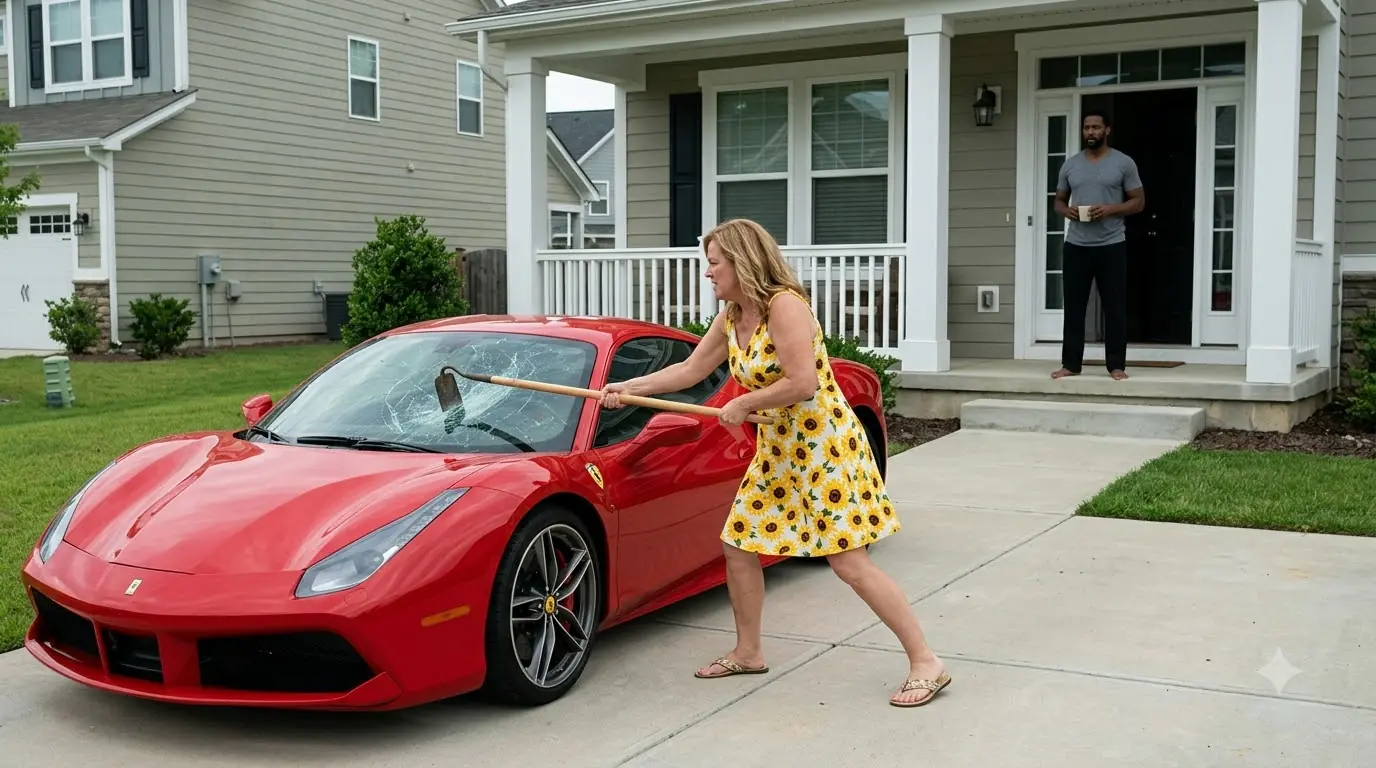
"Get away from my car!" Andre shouted. Patricia turned, her gray-blond hair flying loose from its clip, her expression so furious that for an instant he barely recognized her. She wore a flowered dress and gardening gloves, as though she had wandered over to prune roses instead of destroy a quarter-million-dollar automobile. "You think you can parade this thing in front of decent families?" she screamed. Then she swung again, and the spade scraped across the driver's door with a sound Andre would hear in his dreams for weeks.
He did not charge her or try to wrestle the tool away. He backed onto the porch, called 911, and told the dispatcher exactly what he could see. Patricia advanced two steps toward him, still gripping the spade, and demanded that he put the phone down. "I warned you what would happen," she said, her voice suddenly low. Andre looked past her at the neighboring houses, where blinds were shifting and front doors were beginning to open, and wondered how many people had been waiting for this moment.
Six months earlier, he had arrived in the town of Fairhaven with a moving truck, a stack of architectural drawings, and the hope of beginning again. He was forty-one, a Black entrepreneur who had spent most of his adult life building Walker Precision, a company that designed specialty components for medical equipment. His success had come slowly, through failed prototypes, sleepless nights, and a second mortgage on the little house where his late mother had raised him. The Ferrari had been his private celebration after the company secured its first major hospital contract. He loved its engineering, but he loved even more the memory of his mother's voice telling him that someday his patience would pay off.
The neighborhood was called Willow Creek, a development of brick houses, mature oaks, and immaculate lawns. Andre chose it because it was close to the company's new fabrication facility and far enough from downtown that evenings were quiet. His teenage niece, Chloe, visited most weekends, and he wanted somewhere she could ride her bicycle without fighting traffic. He also wanted a place where his business accomplishments would not become the only thing people knew about him. For the first two weeks, he thought he had found exactly that.
Patricia Bell introduced herself on his third morning, while Andre was rinsing dust from the Ferrari. She was fifty-eight, always perfectly dressed, and had served for years as the neighborhood association's social committee chair. She looked at the car before she looked at him, then asked whether it was borrowed. When Andre said it belonged to him, she smiled in a way that never reached her eyes and remarked that the neighborhood preferred understated vehicles. He assumed she was making awkward conversation and offered her a friendly good morning.
The first complaint arrived the following week. A typed letter claimed his car violated a neighborhood rule against commercial vehicles, though the Ferrari carried ordinary passenger registration and the recorded covenants contained no such restriction. Andre sent a polite reply to the property manager and received an apology for the error. Two days later, someone reported that he was running a repair shop from his garage. A city inspector came, saw the neatly parked car and a rack of gardening tools, and closed the complaint without action.
Andre's friend and operations manager, Marcus Hill, laughed when he heard about it. "Some people need a hobby that doesn't involve your driveway," Marcus said over lunch. Andre tried to laugh too, but the inspection had cost him half a workday, and his employees had noticed his distraction. His company was preparing a demonstration for a major investor, and he could not afford to be pulled into neighborhood nonsense. He decided to ignore Patricia unless she confronted him directly.
She did, on a Saturday when Chloe was helping him wash the car. Chloe was sixteen, sharp-eyed and stubborn, with her father's smile and her grandmother's talent for asking uncomfortable questions. Patricia stopped on the sidewalk and told her that young people should not be encouraged to worship expensive possessions. Chloe replied that she was learning how to care for something her uncle had worked hard to earn. Patricia's expression tightened, and she said, "There are reasons some people shouldn't have things they can't explain." Andre stepped between them and asked her to leave his niece out of their disagreement.
That evening Chloe asked whether Patricia had meant what she thought she meant. Andre did not pretend otherwise. He explained that some people made assumptions about success when it belonged to someone they did not expect to see succeed. Chloe sat quietly with that answer, then asked why he kept smiling at a woman who was trying to humiliate him. "Because I don't want her choosing the kind of man I become," he told her. He meant it, although the words would be harder to live by than he knew.
In the weeks that followed, Patricia spread rumors with a confidence that suggested she had never been challenged. She told neighbors that Andre's business was a front for something suspicious and that unfamiliar vehicles visiting his home were evidence of illegal activity. In fact, the vehicles belonged to clients, relatives, and a visiting engineer who had helped design the company's first successful device. Patricia photographed license plates from the sidewalk and forwarded them to a private neighborhood message group. A few neighbors pushed back, but most read the posts without responding.
One of the few who objected was Mrs. Evelyn Carter, a retired school principal who lived beside Andre. She brought him a plate of lemon bars and warned him that Patricia had spent years appointing herself the judge of everyone else's life. "She drove a young couple out over the color of their shutters," Evelyn said. "And when they left, she told everybody she'd saved the neighborhood." Andre thanked her, but he still believed the situation would fade if he refused to feed it. Evelyn looked toward Patricia's house and said that silence did not always make bullies bored; sometimes it made them ambitious.
Patricia's husband, Robert, was almost her opposite. He was a quiet accountant with tired blue eyes who spent long evenings repairing old radios in his garage. Andre first spoke to him while helping carry a heavy parcel that had been left in the rain. Robert thanked him twice and seemed embarrassed when Patricia appeared and ordered him back inside. A week later, Robert approached Andre near the mailbox and asked about his company. They talked for ten minutes about precision machining, and Robert admitted he had once dreamed of opening a workshop of his own.
"It's never too late to build something," Andre said. Robert gave a small, sad smile and looked toward his house before answering. "Some people don't like it when you remember you had dreams," he murmured. He changed the subject so quickly that Andre did not press him. But he remembered the remark, especially when Robert stopped appearing outside during daylight hours.
Andre installed two additional cameras after finding a handwritten warning under his windshield wiper. The note said that his vehicle would be removed one way or another. Marcus urged him to report it, and Andre filed a nonemergency police report and saved photographs of the paper. He also documented the complaints, the inspection, and screenshots from the neighborhood message group. It felt excessive until he reviewed the dates and realized how steadily the pressure had increased.
Then came a night that changed his understanding of the situation. At 1:42 in the morning, his porch camera recorded Patricia crossing the street in a bathrobe, standing beside the Ferrari, and staring through the windshield for nearly eight minutes. She did not touch it, but she circled the car twice and photographed the dashboard. When Andre showed Marcus the footage, his friend stopped joking. "She's not looking at a car anymore," Marcus said. "She's looking for a way to hurt you."
Andre brought the video to the local police station. An officer took the report and explained that standing near a driveway was not itself enough to establish a crime, though the earlier threats mattered. The officer recommended preserving the footage and calling immediately if Patricia entered his property or damaged anything. Andre left feeling both reassured and uneasy. The law could respond to an act, but it could not always prevent the moment before one.
The next week, Andre received a letter from the neighborhood association claiming that his Ferrari had caused a decline in nearby property values. It included no appraisal, no evidence, and no citation to an enforceable covenant. The property manager, Dana Lewis, told him privately that Patricia had insisted the letter be sent despite objections from other committee members. Dana apologized and promised the association would not issue a fine. Andre asked whether Patricia had authority to send notices on her own, and Dana admitted that she had been using the association's letterhead without approval.
At the same time, something was changing inside Patricia's house. Robert's car began appearing in the driveway packed with cardboard boxes. Andre saw a moving-company van arrive one afternoon and leave empty after Patricia argued with the driver. Later, Robert stood at the curb holding a framed photograph while Patricia shouted that he was embarrassing her. Andre heard enough to understand that their marriage was unraveling, but he closed his front door rather than intrude.
Two days before the attack, Robert knocked on Andre's door. He looked exhausted and asked whether Andre knew of a local accountant who might need part-time work. Andre gave him the name of a reputable firm and offered to make an introduction if Robert wanted one. Robert seemed relieved, but before leaving he said, "If Patricia comes over here, please don't argue with her. Just record what happens." Andre asked what he meant. Robert shook his head and said only that his wife had been getting worse.
The morning of the attack was bright and ordinary. Andre had planned to drive the Ferrari to a charity exhibition supporting a children's rehabilitation clinic, where Walker Precision had donated equipment. The car had been detailed the previous afternoon, and a small invitation card lay on the passenger seat. Andre was in the kitchen making coffee when the first crash came from outside. He recognized the sound of breaking automotive glass before he recognized the danger.
On the porch, he watched Patricia lift the spade again. The windshield was shattered, the hood dented, and a deep scratch ran along the passenger side. She was shouting that he had poisoned the neighborhood, that his money was an insult, and that he had turned her husband against her. The last accusation startled Andre more than the others. He had barely spoken to Robert, and suddenly Patricia was talking as though they had been conspiring for months.
"Robert was happy until you arrived," she screamed. "Now he thinks he can walk out and become somebody!" Andre told her he had nothing to do with their marriage. Patricia laughed harshly and struck the side mirror, sending its housing across the driveway. "You put ideas in his head," she said. "I'll take away the thing that put them there."
The dispatcher remained on the line while Andre retreated inside the doorway. He gave the street address twice and warned that Patricia was still holding a metal tool. A neighbor, Daniel Ortiz, stepped onto his porch and called out for her to stop, but she told him to mind his business. Other residents filmed from windows, and someone began crying across the street. Andre kept his eyes on Patricia's hands and waited for the police.
Two patrol cars arrived within minutes. Officer Leah Bennett approached from the sidewalk while Officer Samuel Price moved toward the driveway, keeping a clear distance from the spade. They instructed Patricia to put the tool down. She dropped it, then immediately lunged toward Andre, accusing him of staging the entire incident. When Bennett stepped between them, Patricia grabbed the officer's sleeve and bit her forearm through the fabric.
The shout that followed silenced the street. Price restrained Patricia while Bennett stepped back, shocked and bleeding, and radioed for medical assistance. Patricia fought the handcuffs and continued screaming that everyone had been bought by Andre's money. Andre stood in his doorway, trembling with adrenaline, and watched the officers guide her into a patrol car. Her face was pressed against the window as she shouted one final accusation: "Ask him what he promised my husband!"
Andre had no answer because there had been no promise. He had offered Robert a name and a phone number, nothing more. Yet the accusation lodged in his mind as the ambulance arrived for Bennett and a tow service came to collect the Ferrari. The damage was severe enough that the car could not be driven safely. When the transport operator raised it onto the truck, Andre felt as though he were watching a piece of his own history being carried away.
Neighbors gathered at the edge of his property, but very few crossed the driveway. Some looked ashamed; others seemed fascinated by the spectacle. Daniel Ortiz finally walked over and offered to help sweep the glass, followed by Evelyn Carter with a broom and dustpan. Andre accepted because his hands were shaking too badly to hold the broom steadily. Chloe called while they were working, and he told her he was safe before he told her what had happened to the car.
She arrived with Marcus an hour later and stood beside the gouged pavement where the Ferrari had been parked. "She really did it," Chloe whispered, as though the fact still needed confirmation. Andre put an arm around her shoulders and felt the anger he had been suppressing finally rise. He was not angry only about the car. He was angry that his niece had learned to look over her shoulder in a neighborhood that was supposed to feel like home.
Robert came over that afternoon carrying a small black recorder and a folder of printed messages. His face was pale, and he kept glancing back toward the house he shared with Patricia. "I should have come sooner," he said. Andre invited him inside, where Marcus and Chloe sat at the kitchen table. Robert placed the recorder between them and admitted that Patricia had been planning to damage the Ferrari for nearly two weeks.
He explained that his marriage had been troubled long before Andre moved to Willow Creek. Patricia monitored his spending, opened his mail, and ridiculed his attempts to restart his career after an early retirement. She controlled their social life and had threatened to ruin him financially if he left. Robert had begun seeing a counselor and consulting a divorce attorney, but he had kept those decisions private. When Patricia overheard him admiring Andre's business, she turned her resentment outward.
"She thinks your car made me realize what I missed," Robert said. "The truth is, watching you work reminded me that I still had choices." He opened the folder to reveal text messages Patricia had sent him, some insulting Andre, others promising to make the Ferrari disappear. One message, sent the previous evening, read, "Tomorrow he'll learn what happens when he encourages you to leave me." Andre read it twice and looked up slowly.
Robert also had an audio recording from an argument in their kitchen. In it, Patricia demanded that he tell Andre to sell the car and move away. When Robert refused, she threatened to damage it herself and blame Andre for provoking her. The recording was clear, and its date was consistent with the messages. Andre asked Robert whether he would share it with investigators, and Robert said he had already decided to do so.
The discovery made the attack more frightening, not less. Patricia had not simply lost her temper when she saw the Ferrari that morning. She had chosen a day, selected a tool, and crossed the street with a plan. Andre thought about the late-night footage, the anonymous note, and the repeated complaints. All of them had been warnings that he had tried to treat as ordinary unpleasantness.
Detective Hannah Reeves took over the investigation after the initial arrest. She interviewed Andre, Robert, and the neighbors, collected the camera footage, and requested the recordings Robert had preserved. She also documented Officer Bennett's injury and arranged for photographs of the damaged Ferrari before repairs began. Reeves was careful not to promise any particular outcome, but she told Andre that the available evidence supported a deliberate act rather than an accident. Andre found that measured certainty more comforting than any dramatic assurance.
The estimate from the specialist repair shop arrived eleven days later. The windshield, hood, mirror assembly, and several body panels needed replacement, and the manufacturer-approved shop would have to inspect sensors and electronics affected by the blows. The preliminary figure was more than ninety thousand dollars, with the possibility of additional costs after disassembly. Andre's insurer arranged the repair process and explained that it might pursue reimbursement from the responsible party. The car was valuable, but the number still made him feel sick.
News of the arrest spread quickly through Fairhaven. A photograph of Patricia leaving the courthouse circulated in neighborhood groups, and people who had repeated her rumors began deleting their posts. Andre refused requests for interviews from several local outlets because he did not want the attack turned into entertainment. He did agree to speak with a reporter who had independently verified the complaints filed against him. The resulting article focused less on the Ferrari's price and more on how easily unsupported accusations had become neighborhood gossip.
The article brought unexpected responses. A delivery driver wrote that Patricia had once accused him of stealing packages after he stopped for lunch on the street. A young couple said she had tried to pressure them into selling their home because their visiting relatives parked too often along the curb. A retired nurse recalled being threatened with association fines after refusing to volunteer for Patricia's committee. None of these accounts proved the criminal allegations against her, but together they showed a pattern of intimidation that residents had tolerated for years.
Andre began to understand why Evelyn had warned him. Patricia had built her influence through small confrontations that seemed too exhausting to challenge. She did not need official power when she could make neighbors afraid of complaints, gossip, and public embarrassment. People who disagreed with her privately often remained quiet in meetings. The silence had made her seem stronger than she was.
Meanwhile, Robert moved into a small apartment across town. Patricia's attorney contacted him through his divorce lawyer and accused him of manipulating the recordings. Robert worried that his savings would disappear in legal fees, but he continued cooperating with the investigation. He told Andre that he was afraid of what Patricia might do when she was released under court conditions. Andre encouraged him to speak with his attorney and the prosecutor about those concerns rather than handle them alone.
A temporary protective order prohibited Patricia from contacting Andre while the criminal case proceeded. She was also barred from entering his property, and the court imposed conditions concerning Officer Bennett. Her lawyer argued that she had been under extreme emotional stress and needed treatment. The prosecutor did not dispute that stress could matter, but emphasized that the threats, recordings, and deliberate damage had occurred over an extended period. The case was not resolved in a single dramatic hearing; it moved through months of evidence review and negotiations.
During those months, Andre struggled more than he expected. He became alert to every sound outside his window and stopped parking his ordinary sedan near the street. He avoided the front yard when unfamiliar cars passed, then felt ashamed of avoiding a place he owned. Marcus noticed that he was staying late at the factory simply to postpone going home. One evening, he told Andre that surviving an attack did not mean he had to pretend it had left no mark.
Andre eventually spoke with a counselor recommended through his company's employee assistance program. He described the moment the spade hit the windshield and the way Patricia's anger seemed directed not at his actions but at his right to be there. The counselor helped him separate reasonable precautions from the constant anticipation of another confrontation. Andre installed better lighting and maintained his cameras, but he also began sitting on his porch again. The first evening felt like an act of defiance; the tenth felt almost normal.
Chloe had her own questions. She asked why neighbors who had believed the rumors were suddenly so friendly and whether an apology meant anything if it came only after the police arrived. Andre did not have a simple answer. He told her that people could change, but change required more than embarrassment. It required admitting what they had believed, why they had believed it, and what they would do differently next time.
Evelyn organized a neighborhood meeting at the community center after learning that Patricia had used association letterhead without permission. Dana Lewis brought the actual covenants and a record of complaints submitted over the previous two years. Residents discovered that several warning letters had never been authorized by the board. Patricia's social committee had no enforcement powers, yet she had presented herself as the voice of the entire association. The board voted to revoke her committee role and establish a formal review process for all future notices.
Andre attended the meeting but did not speak until the end. When the chair invited comments, he stood and asked one question: "When she was telling people I was dangerous, how many of you asked for evidence?" The room fell quiet. He looked at the people who had avoided his eyes for months and said that he did not need their admiration or their permission to live on the street. He needed them to stop treating rumors as facts simply because repeating them was convenient.
Daniel Ortiz stood and admitted that he had believed some of Patricia's claims. He said he had been wrong and apologized without offering excuses. A woman near the back admitted that she had forwarded the rumors to friends and promised to correct them. Others said nothing, but their silence felt different now. It was no longer the silence of people waiting for Patricia to decide what was acceptable.
A few days after the neighborhood meeting, Andre learned that the trouble had reached further into his work than he realized. A potential client forwarded an anonymous message accusing Walker Precision of using stolen equipment and falsifying its financial records. The claims were specific enough to sound credible to someone unfamiliar with the company, but the attached photograph was simply a cropped image of a delivery truck outside Andre's home. Marcus traced the message to a temporary email account and helped assemble documents disproving every allegation. The client renewed its interest, but Andre was shaken by how easily an invented story could threaten jobs belonging to people who had never met Patricia.
The company's attorney advised Andre not to accuse anyone without proof. Instead, Walker Precision sent the client audited statements and manufacturing certifications and asked the sender to preserve the anonymous message. Andre hated the restraint, but he understood it. Every unsupported allegation he made would risk turning his demand for fairness into another round of gossip. He wanted an investigation, not a new rumor with his name attached.
One evening, Marcus brought takeout to Andre's office and found him staring at a photograph of the company's first workshop. It had been a rented storage unit with a leaking roof and a heater that worked only when someone kicked its side. Andre remembered repairing machines after midnight while his mother sat nearby with a thermos of coffee, reading library books and pretending not to worry about his debts. She had died before he bought the Ferrari, but she had seen the first successful prototype. Marcus listened as Andre admitted that the attack had made him feel foolish for buying something beautiful after so many years of denying himself everything.
"You built a company that helps people," Marcus said. "You paid your workers before you paid yourself. You took care of your mother. Why should enjoying one thing cancel out all the rest?" Andre looked down at the old photograph and realized how much of Patricia's contempt he had begun carrying inside himself. He had spent months defending the purchase as though the car were evidence in a trial. Marcus reminded him that a person did not need a perfect explanation for every lawful joy.
The following weekend, Chloe asked Andre to drive her to the empty parking lot where she was practicing for her driver's test. They took his ordinary sedan, and she spent twenty minutes learning to reverse between two painted lines. Afterward she admitted that she had been afraid he might sell the Ferrari to avoid another confrontation. Andre said he had considered it. Chloe looked at him and replied that keeping it was not about winning an argument with Patricia; it was about refusing to let someone else's cruelty rewrite a good memory.
She also told him about a conversation at school. A classmate had seen the news report and joked that expensive cars attracted trouble. Chloe had answered that people attracted trouble when they chose to threaten and hurt others, and the victim's possessions did not make that choice for them. Andre was proud of her answer, but it saddened him that she had needed to give it. He had hoped the adults around her would provide better examples.
As Robert prepared to testify, he faced a different kind of pressure. A relative urged him to withdraw from the case, arguing that Patricia's arrest was punishment enough and that airing private marital problems would disgrace the family. Robert nearly agreed. Then he remembered the day Patricia had blocked the front door to prevent him from leaving for a job interview, and how he had apologized to her afterward for making her angry. He called his lawyer, discussed his concerns, and decided to tell the truth within the limits of what the court asked him to address.
Robert later explained that decision to Andre over coffee at a diner outside Fairhaven. He said he had spent years confusing peace with the absence of shouting, even when that absence required him to surrender every choice. Andre recognized the thought immediately. He had been trying to preserve peace by ignoring threats that were steadily growing more serious. Their circumstances were different, but both men had learned that avoiding conflict was not the same as being safe.
There was one more surprise before sentencing. Detective Reeves informed Andre that a review of Patricia's phone, conducted under lawful investigative authority, had identified messages discussing the planned damage with an acquaintance who declined to participate. The acquaintance had replied that destroying a car was a crime and urged her to seek help instead. The exchange did not change what Andre had seen with his own eyes, but it undermined the claim that Patricia had acted in a moment of uncontrollable confusion. The prosecutor disclosed the relevant material through the normal process, and the defense had the opportunity to examine it.
Andre read the summary with a feeling he could not name. Someone had warned Patricia before she crossed the street with the spade. She had been given a chance to stop and had chosen not to. He thought about the many warnings he himself had ignored, then reminded himself that none of those omissions made him responsible for her decision. He had been entitled to live in his own house without anticipating that a neighbor would attack his property.
Officer Bennett returned to limited duty while her injury healed. She visited the neighborhood once to follow up on a witness statement and found Andre outside trimming a hedge. They spoke for several minutes about the strange bond created by a morning neither had expected. Bennett said she had responded to countless disputes but still found it difficult when ordinary anger became physical violence without warning. Andre thanked her for stepping between him and Patricia, and she replied that she had been doing her job, though she appreciated hearing it.
Their conversation stayed with him. In the first days after the attack, Andre had thought mostly about the cost of the Ferrari and the humiliation of being watched. Now he understood that several people had carried pieces of the event home: an injured officer, a frightened teenager, a husband escaping a troubled marriage, and neighbors who had watched their own inaction exposed. There would be no single moment that repaired every consequence. Recovery would be a series of ordinary decisions made long after the cameras stopped recording.
At the repair shop, the technician showed Andre a small fragment of the original windshield that had been retained for documentation. Andre did not want it as a souvenir. He asked that it be disposed of safely after the records were complete, then spent an hour learning how the replacement sensors were calibrated. The explanation reminded him why he had fallen in love with engineering in the first place: problems could be studied, measured, and addressed with patience. Human motives were less predictable, but evidence still mattered.
The fundraiser eventually raised enough money to purchase several pieces of adaptive equipment for the rehabilitation clinic. The clinic director invited Andre and Chloe to see how the devices would be used, and they watched a young patient practice a movement that had once seemed impossible. The boy grinned when he succeeded, and Chloe squeezed her uncle's hand. Andre realized that the Ferrari had brought him to the clinic, but the work his company did there was the part of his success that would outlast any machine.
The criminal case reached a resolution after the defense reviewed the video evidence and Robert's recordings. Patricia entered a negotiated plea to felony property damage and a separate assault offense related to Officer Bennett, with the precise sentence determined by the court after considering the evidence and a presentence report. At the sentencing hearing, her lawyer described the collapse of her marriage and her deteriorating emotional state. The prosecutor presented the advance threats and the recording of Patricia striking the car while Andre pleaded with her to stop.
Officer Bennett spoke briefly about the bite and the fear that accompanied a routine response turning violent. Robert described years of intimidation inside their marriage and said he had finally decided to stop excusing it. Andre told the court that the worst damage had not been to the Ferrari but to the sense of safety he had worked so hard to build. He did not ask the judge to humiliate Patricia. He asked that her actions be treated as choices with real consequences.
The judge imposed a custodial sentence followed by supervised probation, ordered restitution subject to the court's determination, and required compliance with treatment and no-contact conditions. Patricia was warned that violating those conditions could bring additional penalties. Her face remained rigid as the sentence was read, but she lowered her eyes when Officer Bennett passed her on the way out. Andre could not tell whether she felt remorse. He had learned that he did not need to know.
The civil and insurance matters continued separately. Andre's insurer paid covered repair costs under the policy and pursued recovery through the appropriate process. Robert's divorce moved forward in family court, where questions about marital property were handled independently of the criminal judgment. No judge erased anyone's financial obligations with a single speech, and no dramatic seizure of a mansion solved everything overnight. Consequences arrived through paperwork, hearings, payment schedules, and the slow dismantling of the certainty that Patricia could always escape accountability.
The Ferrari returned on a clear afternoon in early spring. Andre stood outside the specialist shop while the technician walked him through the completed repairs and showed him the inspection records. The red finish reflected the clouds without a trace of the spade marks, and the replacement glass shone in the sunlight. He should have felt only relief. Instead, he found himself remembering the ambulance outside his house and Chloe standing beside the empty driveway.
He drove home carefully, choosing the long route through town. At a stoplight, he noticed a little boy pointing excitedly at the Ferrari from the back seat of another car. The child's mother smiled and gave Andre a thumbs-up. Andre smiled back, surprised by how much the simple exchange meant to him. For the first time in months, the car felt like something he could enjoy rather than something he had to defend.
When he reached Willow Creek, Evelyn was watering her roses and Daniel was helping his daughter with a bicycle chain. Both waved as he pulled into the driveway. Chloe arrived shortly afterward carrying a small framed photograph of Andre's mother, the one that had stood on his desk during the earliest years of Walker Precision. She had written a message on the back: She would be proud of the man, not just the machine. Andre held the frame for a long moment before thanking her.
He invited a few neighbors over that weekend, not for a celebration of Patricia's downfall but for a small fundraiser supporting the clinic that had missed his appearance on the day of the attack. Marcus arranged a demonstration of the medical devices his company made, and Chloe organized a raffle for donated local artwork. Andre parked the Ferrari near the curb, where children could look at it without touching the bodywork. He answered questions about the engine, but he spent more time explaining how his company built equipment that helped children regain mobility.
Robert came too. He looked healthier than Andre remembered and said he had accepted a part-time position at an accounting firm. He was renting a modest apartment and taking evening classes in small-business management. Andre asked whether he still wanted to open a workshop. Robert smiled and said he had begun saving for one, even if it took years.
"You didn't put the idea in my head," Robert told him quietly. "You just reminded me I was allowed to have one." Andre looked across the lawn at Chloe laughing with Evelyn and thought about how Patricia had tried to destroy a symbol of freedom because she feared losing control of someone else's life. She had never understood that admiration did not have to become envy. One person's success could open a door without closing another.
Weeks later, Andre received a handwritten apology from a neighbor who had once shared Patricia's accusations. The letter did not ask him to forget what happened. It acknowledged the rumors, explained how the writer had repeated them without evidence, and described an effort to correct the record. Andre appreciated the difference. He kept the letter, not because it repaired the past, but because it represented the kind of accountability he had asked for from the beginning.
He also established a small neighborhood fund to help residents install basic security cameras and exterior lighting. He made sure the program was voluntary and administered by a committee that included people who had challenged Patricia when others would not. The purpose was not to turn Willow Creek into a place where everyone watched everyone else. It was to make it harder for threats to disappear behind closed doors and easier for neighbors to support one another when something went wrong.
On the anniversary of the attack, Andre stood in his driveway with a cup of coffee and watched the sunrise touch the Ferrari's hood. The car was beautiful, but he no longer needed it to prove anything. His mother had taught him that a good life was built through patience, work, and the courage to remain generous when bitterness offered an easier path. Patricia had tried to make him feel that his success was an accusation against everyone around him. Instead, the experience had shown him how many people could choose to be better once someone finally demanded the truth.
Chloe stepped onto the porch and asked whether he was coming inside for breakfast. Andre looked once more at the red car, then at the home behind him, the quiet street, and the niece who had helped him remember what mattered. He set down his coffee and followed her through the door. The Ferrari remained outside in the sunlight, exactly where it belonged, and for the first time in a long while Andre did not look back to make sure it was safe.