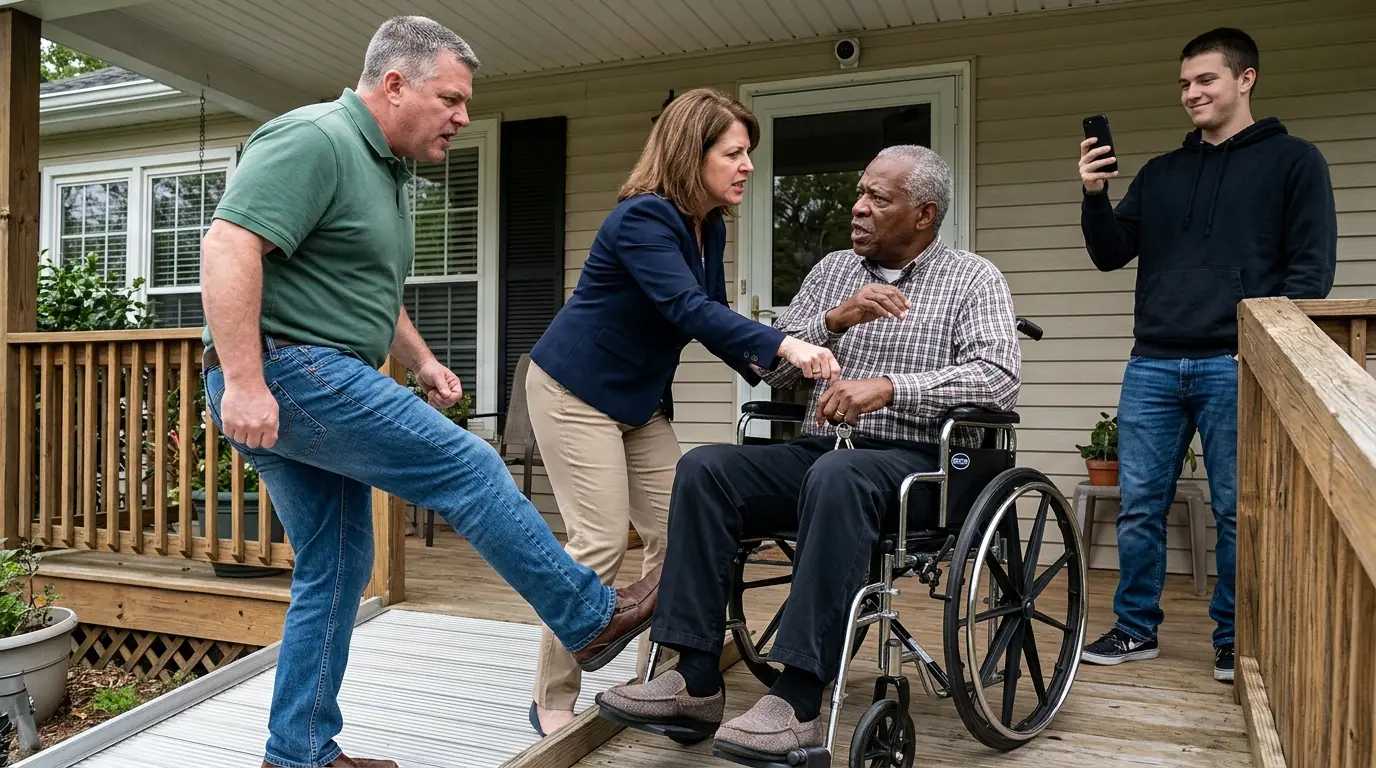
The woman had one hand wrapped around my house keys and the other braced against the arm of my wheelchair when her husband shouted, "Just take them. " He can't keep pretending that house is only his. I remember staring at all three of them on my porch, wondering whether they actually understood what they were saying. Her 22-year-old son was smiling behind her like they had already won. What none of them knew was that I had replaced every exterior lock 48 hours earlier.
The keys she was ripping out of my hand opened absolutely nothing inside my house. And the reason I changed those locks was sitting in a folder beneath my kitchen table. My name is Vernon. I'm 71 years old and I had lived in that house for 28 years after an accident left me using a wheelchair. I spent nearly $60,000 modifying the place.
So I continue living independently. Wider doors, an accessible bathroom, lowered counters, ramps, automatic door controls. The house wasn't simply property to me. It was the reason I could still live on my own. Lorraine and her family moved into their house beside mine that spring.
At first, they seemed overly friendly. Her husband, Russell, offered to bring my garage bins in. Their son, Nolan, carried a package onto my porch once. Looking back, I realized every favor came with a question about my house. Lorine wanted to know whether I had children, whether my mortgage was paid off, whether anybody else was listed on the deed.
She even asked what would happen to the property when I eventually couldn't manage it anymore. The question bothered me, but I laughed it off. Then she started telling neighbors that my home had originally belonged to someone in her husband's family. That part was technically true, but misleading. Almost 30 years earlier, I had purchased the house from Russell's uncle through a completely normal sale.
Mortgage, closing attorney, title search, register deed, everything. Russell had apparently grown up visiting the property and never got over the fact that his uncle had sold it instead of leaving it to the family. One Saturday morning, Lorraine arrived carrying a cardboard folder. Russell and Nolan stood behind her. She sat down across from me at my patio table and placed a photocopied handwritten note in front of me.
It supposedly came from Russell's uncle. According to Lorraine, the note proved he always intended for Russell to eventually reclaim the family home. I read it twice. There was no legal description of the property, no witness, no date that made sense, and nothing resembling an actual transfer. I told her the obvious.
Whatever emotional attachment Russell had to my house, I had purchased it legally. Lorine smiled and said, "Ownership isn't always as simple as whose name is on a paper. " That sentence stayed with me. A week later, somebody taped the notice to my front door. It looked official from a distance.
Across the top, it said, "Property occupancy dispute. " The document claimed Russell's family had an ancestral interest in my property and instructed me not to sell, refinance, or alter it until their claim was resolved. I called the county immediately. Nobody there had issued it. Then I called the number printed at the bottom.