The first thing Toby Whitaker felt was the cold water hitting the back of his neck.
It came so suddenly that he dropped the sponge from his hand and staggered against the side of the wash bay, one trembling palm slapping the wet concrete to keep himself from falling. For a second, all he could hear was the sharp hiss of the pressure hose and the roaring laughter of the young woman holding it. Water ran down his gray hair, into the collar of his faded work shirt, and across the name patch stitched over his chest. TOBY. The patch had been sewn on crooked, but he had never complained about it. He had been grateful simply to have a job.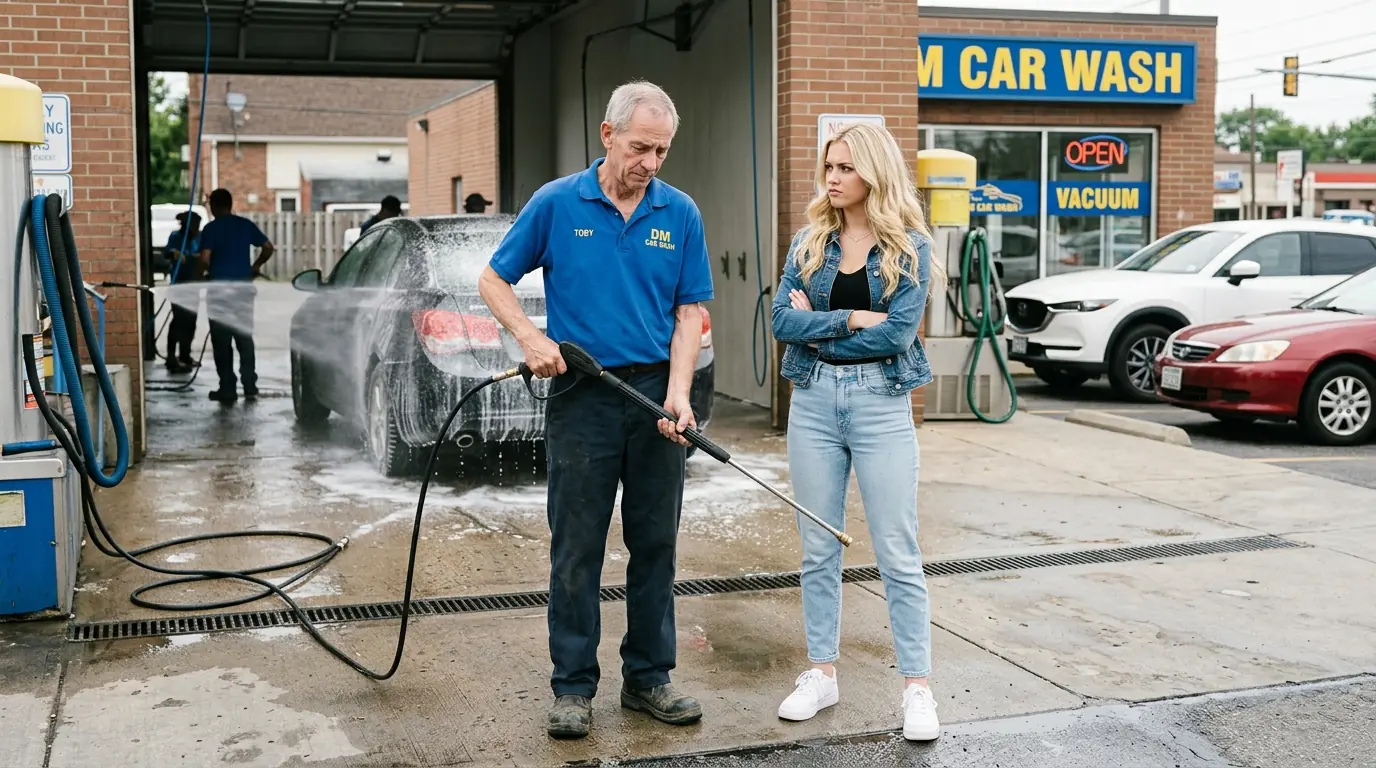
“Hey,” the young woman shouted over the spray, her phone raised in her other hand. “What are you doing? Trying to run away from responsibility?”
“I didn’t do anything,” Toby said, coughing as water dripped from his chin. “Please. I don’t know what you’re talking about.”
Her name was Meredith Chase, though online she called herself MeriMoves, a lifestyle and career influencer with almost a million followers and a talent for making cruelty sound like confidence. She was twenty-eight, polished, expensive, and loud in a way that made people turn before they even understood what was happening. Her hair was perfect, her suit was perfect, and her phone camera never seemed to stop recording.
“This is what you get for destroying my boss’s car,” she snapped.
“I didn’t do it,” Toby said again. His voice shook now, not because he was guilty, but because he was seventy-two years old, wet, exhausted, and humiliated in front of three customers, two coworkers, and a livestream audience he could not even see. “I swear I didn’t.”
Meredith tilted her head and smiled at her phone. “Wrong answer.”
A younger employee named Katie Morales came running from the drying area. She was twenty-four, quick-footed, and still wearing the blue apron she used when she worked the interior vacuum line. “What is going on over here?” she shouted.
Meredith turned the hose away from Toby but kept the camera on him. “I’m doing your little car wash a favor.”
“A favor?” Katie stared at Toby’s soaked shirt and shaking hands. “By drowning him?”
“I’m educating this geriatric,” Meredith said. “He’s far too old and incompetent to be working here. That says a lot considering how dumb he is. He can’t even cut it working at a car wash.”
Toby looked at Katie with desperate eyes. “I didn’t do that to her car, Katie. You have to believe me.”
Katie glanced toward the black Porsche parked near the entrance. A long dent ran across the rear quarter panel, deep enough to catch the afternoon light. Meredith had arrived fifteen minutes earlier claiming the damage had happened during the wash. She had refused to let anyone inspect the camera footage. She had refused to wait for the manager. Instead, she had found Toby, the oldest employee on the lot, and decided the story would work better if he became the villain.
“Okay, Boomer,” Meredith said, rolling her eyes. “I don’t think he remembers because of all the dementia.”
“I don’t have dementia,” Toby said quietly.
Meredith swung the phone camera toward herself. “This is a public service announcement to everyone watching. If you need a car wash, avoid this place like the plague. DM Car Wash doesn’t care about its customers. They let this old pile of bones destroy Porsches.”
The front office door opened, and Steven Marsh, the car wash manager, hurried outside. He was a nervous man in his late thirties who lived in constant fear of bad reviews, lawsuits, and angry customers with followers. “Hey, what’s all the yelling about out here?” he asked. “What’s going on?”
“The world’s oldest employee damaged my boss’s car,” Meredith said. “That’s what happened.”
Meredith spun on Steven. “And now, because of what he did, I’m going to be fired. How is that fair?”
Steven’s face went pale. “I’m terribly sorry, miss.”
“You should be. This is all your fault.”
Katie stepped between them. “How is it his fault?”
“Because he hired the walking corpse in the first place,” Meredith said. “I’m livestreaming this entire encounter, by the way, to my almost one million followers. Once I’m done dragging your filthy little business to the ground, you’ll all be lucky to have jobs.”
Steven swallowed. He looked at the phone. Then at the Porsche. Then at Toby, soaked and shaking in front of him. “Wait a second,” Steven said. “I’m sure we can work something out.”
“Not unless you’re paying for the damage to my boss’s car.”
Katie shook her head. “Steven, we don’t even know if Toby damaged the car.”
“Of course he damaged it,” Meredith said. “And if I’m not fully compensated, I swear, by the time I’m done roasting your little car wash, you’ll be begging to be bankrupt.”
Something about the situation didn’t sit right with Katie. Meredith had come in too aggressive, too prepared, too eager to blame. Katie had seen customers exaggerate before, but this felt different. It felt staged.
“Something doesn’t seem right,” Katie said.
Meredith turned the phone toward her. “Are you blaming me for the damage to my car?”
Toby wiped water from his eyes. “I didn’t do anything.”
Meredith snapped her fingers. “You know what? I’m done. Have fun being bankrupt.”
“Wait,” Steven said quickly. “There’s no need for that. If you’ll come with me into the office, I’ll cut you a check for the damage.”
Meredith smiled. “And one more thing. I want him fired immediately.”
Toby’s face collapsed. “But I didn’t do anything.”
Steven looked away. “No. She’s right. Anyone who does that to a customer’s car has no business working here.”
“Steven,” Katie said. “You can’t be serious.”
“And don’t bother asking about your last check,” Steven continued, avoiding Toby’s eyes. “I’m docking your entire pay to cover part of the damage.”
“You can’t do that to him,” Katie said.
“Too late. It’s done.”
Toby’s mouth opened, but for a moment no sound came out. He thought of his wife, Marlene, asleep in their small apartment with a blanket over her knees, waiting for him to bring home soup because the chemotherapy made solid food hard for her to swallow. He thought of the prescription refill he was supposed to pick up Friday. He thought of rent. “Don’t do this to me,” he whispered. “You know how much I need this job.”
“That’s not my problem,” Steven said, but there was no strength in it. Only cowardice. “You have two minutes to get off the property or I’m calling the cops.”
Katie stood frozen while Toby took off his soaked apron and folded it out of habit before setting it on the counter. Even humiliated, even fired, he could not bring himself to leave a mess. Then he walked away under the late afternoon sun, each step slow, his shoes squishing with water.
That evening, Marlene heard the front door open earlier than usual. “You’re home early, hun?” she called from the couch.
Toby stood in the doorway for a moment, trying to decide what kind of face to wear. He chose the one he had been wearing for the past two years since her diagnosis: calm, gentle, hopeful, even when he felt none of those things.
“What is it?” Marlene asked, sitting up. “What’s wrong?”
“I’m afraid I have some bad news,” Toby said. “I lost my job today.”
Her hand went to her mouth. “Oh, no. Are you okay?”
“I’m fine,” he lied. “And we’re going to be fine, too. I don’t want you worried about a thing.”
“But the treatments. The insurance. The bills.”
“I’ll figure it out,” Toby said. “I promise.”
He sat beside her, still smelling faintly of soap and wet concrete, and let her hold his hand. He didn’t tell her about the hose. He didn’t tell her about the livestream. He didn’t tell her how helpless he had felt when Steven chose a stranger’s threat over his word. Marlene had enough pain for one lifetime. He refused to add to it.
Across town, Meredith was laughing over dinner with her friend Chloe, replaying her livestream on a tablet. “Check it out,” she said. “That’s how you get yourself out of trouble. Just find someone old and feeble and blame it on them. Works every time.”
Neither of them noticed the comment thread turning against her.
Someone had slowed down the livestream and noticed something strange. Meredith had filmed herself pulling into the car wash. In one frame, barely visible, the Porsche’s rear quarter panel was already dented before Toby came anywhere near it. Then someone found one of Meredith’s earlier stories from the same morning. In it, she was bragging about driving her boss’s Porsche to a meeting, and the same dent glinted under the parking garage lights.
Katie noticed the comments first. She had been unable to sleep, replaying Toby’s face in her mind. When she saw the screenshots, she sat straight up in bed. Then she saved everything.
The next morning, Katie went to Meredith’s company.
She did not go alone. She found Toby’s old resume after asking around the car wash and discovered something Steven apparently never cared to learn. Toby Whitaker had once been a senior operations director at a logistics firm. He had managed teams, negotiated contracts, and increased annual revenue by millions before resigning to care for his wife full-time. The car wash job had not been proof that he was useless. It had been proof that he was willing to do whatever honest work was necessary to keep Marlene alive.
Katie brought Toby with her because he deserved to hear the truth from the people who had been lied to.
Meredith, meanwhile, walked into her boss’s office glowing with confidence. Her boss, Martin Fletcher, was a calm, silver-haired man who owned Fletcher & Rowe, a mid-sized commercial distribution company known for treating employees well and expecting them to treat others even better. He had lent Meredith the Porsche for a client visit because she had been on track for a senior promotion. She thought the promotion was guaranteed.
“You wanted to see me, boss?” Meredith asked, smiling as she entered.
“Yes,” Fletcher said. “Please come in. Sit down.”
“If this is about the promotion, I just wanted to let you know I’m ready for it.”
“Do you think so?”
“Absolutely. I think I proved myself very well when I handled the whole car situation.”
Fletcher leaned back. “About that. What exactly did happen to my car?”
“Some old buffoon at the car wash damaged it,” she said. “Why he was even working there in the first place is beyond me.”
“And that’s what really happened?”
“Of course. Why would I lie?”
Fletcher’s expression did not change, and that somehow made Meredith nervous for the first time. “I don’t know,” he said. “That’s what makes this so very disappointing.”
“What is, sir?”
Fletcher pressed a button on his desk phone. “Please send them in.”
The door opened. Katie entered first. Toby followed, wearing his only sport coat over a neatly pressed shirt. Meredith’s mouth dropped open.
“What are they doing here?” she demanded.
“They came to tell me what really happened to my car,” Fletcher said.
“But I already told you what happened. He’s the old dummy who did it.”
Katie placed a folder on Fletcher’s desk. “If you really wanted to get away with the lie, maybe don’t broadcast the truth on your socials.”
Fletcher turned his monitor toward Meredith. Security footage from the car wash showed her arriving. The Porsche’s dent was clearly visible before the vehicle entered the wash bay.
“That doesn’t prove anything,” Meredith said. “You could have doctored that video.”
Katie clicked to the next clip. Meredith’s own social media story played on the screen. “When your boss entrusts you with his Porsche,” Meredith’s recorded voice said, “that’s how you know you’re about to get promoted.” The camera angle shifted, and the dent flashed unmistakably along the rear panel.
Fletcher paused the video. “Instead of taking responsibility for damage you caused, you blamed Toby.”
“You don’t understand,” Meredith said.
“No,” Fletcher replied. “You don’t understand. Do you even know why Toby works at a car wash?”
Meredith’s lip curled. “Because he’s a loser. Duh.”
Toby lowered his eyes, but Katie stepped forward. “No. Toby used to be a corporate executive just like you wanted to be. Then his wife got sick. Very sick. When his company wouldn’t cover the cost of her treatments, he quit so he could take care of her. He took the car wash job because it was honest work and because his wife needed medicine. Toby is a good man who works hard every day. You tried to destroy his life with a lie.”
Fletcher stared at Meredith as if he were seeing her for the first time. “I promoted you because I thought you understood our company’s values. I see now that I was wrong.”
“No,” Meredith said quickly. “It wasn’t like that. I swear.”
“I’m tired of the excuses. Meredith, you’re fired. Get out.”
Her face twisted. “You can’t do that. I will sue all of you.”
“You can speak with legal on your way out.”
When security escorted Meredith from the office, Fletcher turned to Toby. His voice softened. “Mr. Whitaker, I owe you an apology. What happened to you should never have happened.”
Toby shook his head. “You didn’t do it, sir.”
“But I employed the person who did. That matters.” Fletcher slid an envelope across the desk. “This should cover the paycheck you lost because of Meredith’s lie, plus the wages your former manager illegally tried to dock.”
Toby opened it and saw a check large enough to cover rent, Marlene’s prescriptions, and more than one month of groceries. His eyes filled before he could stop them. “I don’t know what to say.”
“I do,” Fletcher said. “Come work for me.”
Toby blinked. “Sir?”
“I did a little research after Katie called me. Your work history is impressive. Very impressive. I could use someone like you. It just so happens I have an opening on my operations staff. And did I mention our benefits are excellent?”
Toby’s hand trembled around the check.
“Your wife,” Fletcher said gently, “will have coverage that actually covers what she needs.”
For the first time in months, Toby allowed himself to breathe without fear. “Thank you,” he whispered. “Thank you.”
Fletcher nodded toward the door. “Let’s get you settled in.”
Within six months, Toby had become indispensable. He came early, left late, and treated every employee from the warehouse crew to the accounting team with the same respect. Fletcher quickly understood what Katie had seen from the beginning: Toby had not lost his value when life knocked him down. He had simply been waiting for someone with enough character to notice it.
Marlene’s treatments stabilized under the new insurance. She began walking around the block again with Toby every evening, holding his arm and teasing him about how much better he looked in dress shirts than in car wash aprons. Katie, inspired by what had happened, applied for an entry-level position at Fletcher & Rowe and was hired into customer relations. She and Toby became close friends, and Toby never forgot that one young woman had chosen truth over convenience when almost everyone else stayed silent.
Two years later, Fletcher & Rowe announced an internal competition for a department head role. Two finalists emerged: Anna Torres and Martin Vale.
Anna was thirty-one, quiet, patient, and deeply respected by the employees who actually worked with her. She had started in customer support and risen through the company because she solved problems without humiliating anyone. She trained new hires on her lunch breaks. She stayed after hours to help warehouse supervisors organize safety reports. She remembered birthdays, sick parents, and the names of people’s children. Her quarterly numbers were strong, but her greatest strength was harder to measure: people trusted her.
Martin Vale was the opposite. He was polished, ambitious, and always visible when senior management walked by. His reports looked perfect because he took credit for his team’s work and blamed them for his mistakes. He called himself “the future of the company” and believed saying it often enough would make it true.
The final interview was scheduled for ten o’clock on a rainy Tuesday morning at the downtown office.
Anna was early. She had left her apartment with enough time to stop for coffee, review her notes, and gather herself before the biggest interview of her life. The promotion would triple her salary. It would let her pay off her student loans, help her younger sister with college, and finally move out of the tiny apartment where the bathroom ceiling leaked whenever it rained.
She was two blocks from the office when an elderly woman reached for her sleeve.
“Please,” the woman said softly. “I’m trying to find my way home.”
Anna stopped.
The woman looked to be in her late seventies, with silver hair tucked beneath a pale scarf and a wool coat too thin for the weather. Her shoes were damp. Her hands shook slightly. She looked frightened, but not in a loud way. In a lost way.
Before Anna could answer, Martin appeared at the corner, checking his watch. “Don’t invite her into your day,” he said. “You’ll be late.”
“She needs help,” Anna said.
“She’s probably trying to distract you so someone can steal your bag.”
The old woman flinched.
Anna turned to Martin. “Everybody deserves respect, especially elderly ladies who clearly need help.”
“No, no, no,” Martin said. “Not happening. I’m not letting some random street trash throw me off my game before the interview. But if you want to throw away your chances at a major promotion, go for it. I’ll happily become your boss.”
Anna ignored him and guided the woman toward the sheltered bench outside a closed bakery. “What’s your name?”
The woman looked around uncertainly. “Molly, I think.”
“Do you know where you live, Miss Molly?”
“I remember Jack,” she said. Her face softened. “My son Jack. He’s such a good boy. So kind and hardworking. He’s my pride and joy.”
“That’s something we can build on,” Anna said. “Do you remember where Jack works?”
Miss Molly smiled vaguely. “He’s great at his job. Makes me proud every day.”
Anna’s phone buzzed. A message from the interview coordinator: Final interviews begin in 15 minutes. Late arrivals cannot be guaranteed a slot.
Martin saw the message over her shoulder and laughed. “So much for that promotion.”
Miss Molly looked guilty. “Sweetie, if you have somewhere to be, just go. I’ll be okay.”
Anna put her phone away. “First, I want to make sure you’re safe. Then I’ll worry about work.”
She called the company and asked if the interview could be moved back. The assistant apologized and said the schedule was fixed. Anna closed her eyes for one second, then opened them with her decision made.
“Tell you what,” she said to Miss Molly. “The police station is a few blocks away. Maybe they can help find your son Jack.”
Miss Molly held Anna’s arm the whole walk. She repeated the same sentence every few minutes. “My son Jack is such a good boy.” Each time, Anna answered as if it were the first time she had heard it.
At the station, an officer at the front desk stood as soon as he saw the elderly woman. “Miss Molly,” he said with relief. “You’ve had a lot of people worried sick.”
“You look familiar to me,” Miss Molly said.
“I should. We’ve met like this four times this month alone.” The officer turned to Anna. “Thank you so much for helping her. She keeps slipping away from her home healthcare worker. Her son’s had half the city looking for her since yesterday.”
“So you know Jack?” Anna asked.
“I sure do. I’ll call him right now.”
Miss Molly patted Anna’s hand. “You’re so kind.”
“You don’t have to thank me,” Anna said. “I’m just happy I was there.”
“Your meeting,” Miss Molly said suddenly, as if the thought had just found its way through the fog.
“Don’t worry about that. Sometimes doing the right thing means doing the hard thing. I’d rather make sure you’re safe than get a promotion.”
While Anna sat beside Miss Molly at the police station, Martin sat across from Fletcher & Rowe’s CEO, Jack Young.
Jack was in his mid-forties, sharp-eyed and composed, the kind of executive who listened more than he spoke. “Your quarterly numbers are impressive,” he said. “For this role, I’m looking for someone who has the pulse of the staff. Someone who knows their people and has their respect.”
“That’s me, sir,” Martin said. “Ask anyone. Unlike some of the other managers, like Anna Torres, who only looks out for herself, I pride myself on being available to my team twenty-four seven. They know they can depend on me to get the job done right.”
“They told you that?” Jack asked.
“Absolutely. They call me super.”
Jack glanced at his phone. A message had come in from the police station: We found your mother. She is safe. A woman named Anna Torres brought her in and stayed with her.
Jack’s expression changed so slightly that Martin didn’t notice.
“Well,” Jack said, standing. “We have to cut this short. Based on what I heard today, I think it’s safe to say the decision is clear.”
Martin beamed. “Thank you, sir. You have no idea what this means.”
Jack left immediately.
At the police station, Miss Molly lit up when Jack came through the door.
“Mama,” he said, rushing to her. “I was so worried.”
“I’m okay,” she said. “Thanks to Anna here.”
Anna froze. “You’re Mr. Young?”
“Yes.” He looked at her closely. “Anna Torres. Weren’t you supposed to interview for department head today?”
“Yes, sir. I tried to call and ask if it could be moved, but I understood when they said no.”
The officer stepped in. “For what it’s worth, she wouldn’t leave your mother alone. She stayed until we reached you.”
Miss Molly nodded proudly. “She wanted to make sure I was safe.”
Jack looked at Anna for a long moment. “I can’t even begin to describe how grateful I am for what you did today.”
Anna shook her head. “Anyone would have helped.”
“No,” Jack said quietly. “I wish that were true.”
A few minutes later, Martin arrived outside the station in a brand-new Porsche, still wearing the smile of a man who thought life had finally confirmed his greatness. He spotted Anna and grinned.
“Take one guess who got the promotion,” he said. “Go on. Guess.”
Anna smiled politely. “Congratulations, Martin.”
“While you were busy ending your career to take care of some old bag, I tripled my salary.” He tapped the hood of the Porsche. “Check this out. Just bought it. Paid in full. And as wonderful as that is, it’s not half as good as knowing I’m now your boss.”
Jack stepped forward. His voice was cold. “About that. There’s been a change in plans.”
Martin’s smile faltered.
“The old bag you’re referring to happens to be my mother,” Jack said. “And the company has decided to go in a different direction.”
“Sir, wait. Just hear me out.”
“You’re fired.”
Martin’s face drained of color. “What?”
Jack turned to Anna. “Which means I now have a department head position open. Would you like the position, Miss Torres?”
Anna’s eyes filled. “Absolutely. Thank you so much. You won’t regret this.”
“I know I won’t,” Jack said. “Not only is your work record impressive, but you demonstrated great character today. You are the best person for the job.”
Miss Molly smiled from her chair. “I told you he was a good boy.”
Martin stepped away, fumbling for his phone. “Pick up. Pick up,” he muttered. When the dealership answered, his voice cracked. “Hello. Yes. I just placed an order for a new Porsche, but I need to cancel it and get a full refund.”
“I’m afraid that’s not possible, sir,” the voice on the other end said. “All sales are final.”
“You don’t understand. I need that money back. My rent check will bounce without it.”
The call ended.
Martin stood beside the car he could not afford, in the suit he had worn to become someone important, realizing that ambition without character had finally become a bill he could not pay.
Anna started her new role the following Monday. One of her first decisions was to create a company emergency care policy, allowing employees to request immediate flexibility when a family or community crisis came up. Toby helped design the operations process. Katie helped build the communication plan. Jack approved it without hesitation.
Over time, the policy became one of Fletcher & Rowe’s proudest achievements. Employees stopped feeling forced to choose between doing the right thing and keeping their jobs. Managers were trained to measure character, not just numbers. The company grew stronger because people trusted one another more.
Toby’s wife, Marlene, improved enough to visit the office holiday party that year. She sat beside Miss Molly, who had good days and difficult days but always brightened when Anna walked into the room. Katie eventually moved into a leadership role of her own. Toby became the mentor younger employees went to when they were afraid one mistake had ruined their lives.
As for Meredith and Martin, their stories became quiet warnings inside the company. Not because people enjoyed seeing them fall, but because their failures taught the same lesson from two different directions. Meredith thought cruelty could protect her status. Martin thought selfishness could speed up his success. Both discovered that the way you treat people when you think they cannot help you is the clearest picture of who you really are.
Years later, Anna would tell new managers the story of the morning she missed the most important interview of her life and still got the job. Toby would tell new hires about the day a lie cost him a car wash apron and gave him back a career. Katie would remind trainees that speaking up for someone else can change more than one life.
And at Fletcher & Rowe, one sentence became part of every leadership training session: Talent may get you in the room, but character decides whether you deserve to stay.