The first time Caroline Mercer tried to take my car, she used a tow truck and an orange violation sticker placed directly across my windshield as though visibility were a privilege the homeowners association could revoke. The second time, she arrived before sunrise with a wheel boot she had bought herself, a laminated notice bearing the HOA logo, and instructions saying I owed seventy-five dollars before my own vehicle could move from my assigned parking space. The third time, after the board had already declared every citation she issued against me invalid, Caroline stepped between me and the driver’s door at six forty-five on a gray Tuesday morning and ripped the keys straight from my hand. That was the moment an argument about parking stopped being an HOA dispute and became something four police cars, five cameras, three witnesses, and one very nervous association attorney could no longer describe as a misunderstanding.
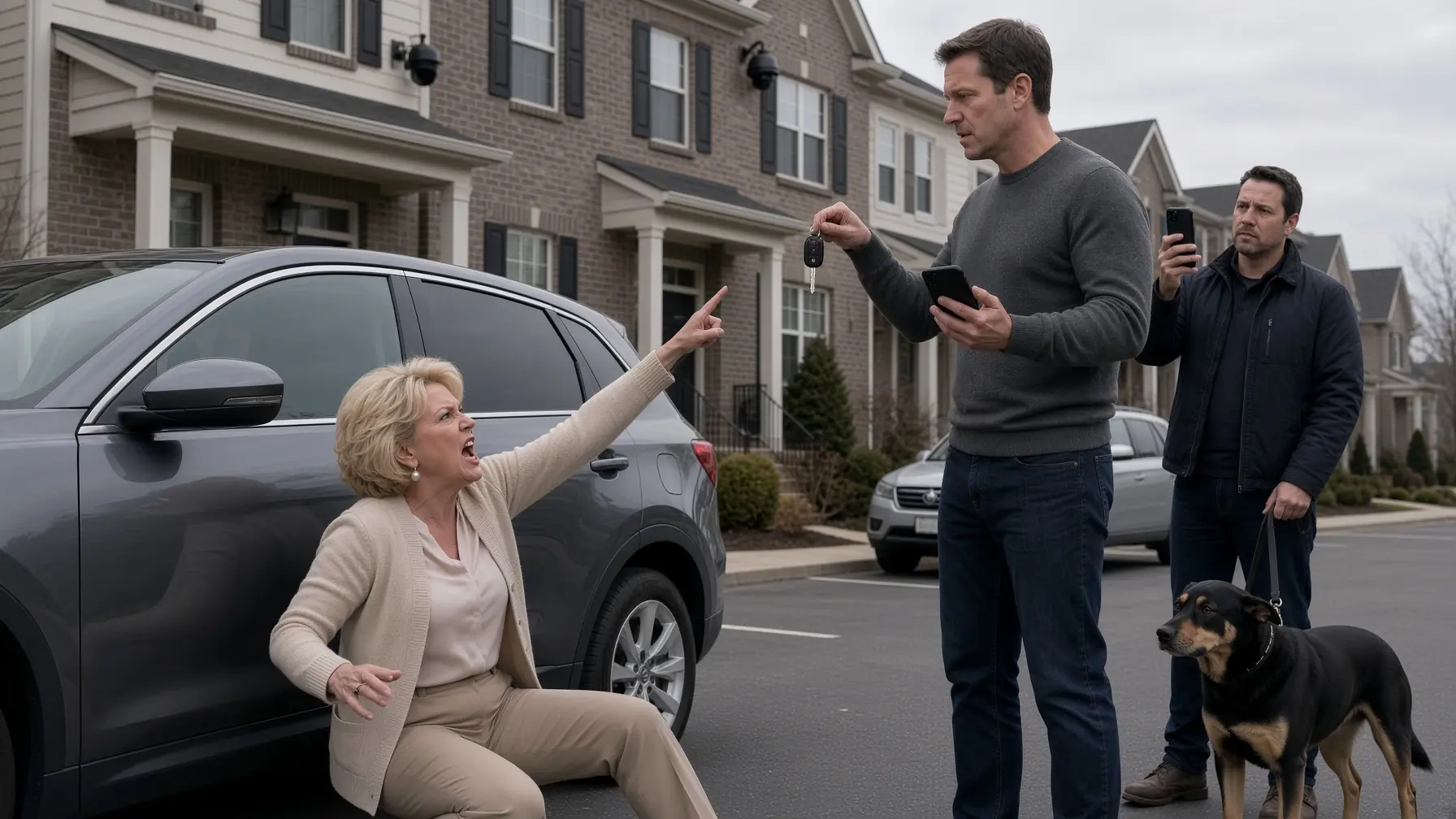
My name is Aaron Blake, and I was thirty-nine when I purchased Unit 124 in Brookstone Commons, a townhouse development outside Raleigh, North Carolina, where the buildings were beige, the shrubs were clipped into identical shapes, and the residents could argue for forty-five minutes about whether a recycling bin had remained visible too long after collection. I worked as a network operations supervisor for a regional hospital system, which meant my professional life involved preventing small technical failures from recruiting larger ones, documenting what changed, and refusing to assume the loudest person in the room understood the system best. I was not a lawyer, police officer, politician, wealthy executive, or secretly powerful owner waiting to reveal some impressive title after being treated badly, and nothing that happened later depended on me becoming one. I was simply a homeowner with a mortgage, an assigned parking space, an old car I maintained carefully, and enough patience to read the documents Caroline apparently believed nobody else would ever bother opening.
The car was a dark blue 2010 Toyota Camry that had belonged to my father, Leonard, before congestive heart failure made driving unsafe during the final year of his life. He had purchased it used, kept every service receipt inside a brown envelope in the glove compartment, changed fluids earlier than recommended, and once drove forty miles back to a repair shop because the mechanic had forgotten to replace a plastic engine cover clip that probably cost less than lunch. When he died, my sister Melissa took his woodworking tools, I took the Camry, and neither of us considered those choices inheritance strategy so much as finding homes for ordinary objects that still felt connected to ordinary mornings with him. The car had faded paint across the roof and one repaired dent above the right rear wheel, but it passed inspection, carried current registration, ran quietly, leaked nothing, and met every vehicle requirement written into Brookstone Commons’ governing documents.
Caroline disliked it from the week I moved in. She was fifty-seven, served on the HOA board, chaired a volunteer parking committee created after residents complained about guests occupying numbered spaces, and approached neighborhood rules with the intensity of someone who believed civilization survived because she personally noticed every deviation before breakfast. Her husband Derek was quieter in public but supported her almost automatically, usually standing half a step behind her with folded arms while she explained things other adults had not asked her to explain. Their townhouse faced the main parking row, which gave Caroline a wide view of thirty-two spaces and apparently convinced her that looking at something frequently was similar to owning jurisdiction over it.
My deed assigned Space 124 to my townhouse. The HOA declaration repeated that assigned spaces were exclusive-use common elements tied to specific units, while the parking rules prohibited abandoned vehicles, unregistered vehicles, major repairs in the lot, commercial trucks above a certain size, and parking in another owner’s numbered space without permission. Nothing prohibited older cars, faded paint, backing into a space, leaving a vehicle parked for several days, or possessing a model Caroline considered aesthetically disappointing. Those details became important because by the time she issued her seventeenth violation, Caroline had accused me of all four.
Our first conversation about the Camry happened nine days after I moved in. I was carrying groceries toward my townhouse when Caroline stopped beside the car, pointed at the repaired rear quarter panel, and asked whether I planned to “keep that vehicle long term,” using a tone normally reserved for discussing a refrigerator abandoned on public property. I told her I did, and she said Brookstone Commons encouraged residents to maintain an appearance consistent with community standards, so I asked which vehicle standard she believed the Camry violated. Caroline looked at the car again, then answered, “Nothing formal yet, but we try to be proactive,” which was the first time I realized she sometimes treated rules she hoped might exist as though they were waiting patiently for everyone else to catch up.
I let it go because neighbors are allowed opinions. Two weeks later she left a yellow card beneath my windshield wiper saying the vehicle had remained “stationary for an extended period” and asking me to move it regularly to prevent the appearance of abandonment. I worked from home three days that week and had driven Melissa to the airport in her car, so the Camry had remained parked for five days, but no Brookstone rule defined an operable registered vehicle as abandoned merely because its owner did not create unnecessary mileage. I emailed the property manager, Nina Patel, who replied within an hour that the card was advisory only, that I had committed no violation, and that no action was required.
I saved the email and forgot about the issue. Caroline did not. Three days later she saw me checking tire pressure and said, “I hope Nina explained we’re trying to protect property values,” and I answered that Nina had explained I had violated no rule. Caroline’s expression tightened as though the distinction between those statements were an administrative technicality rather than the entire point.
The next notice came by email from Caroline’s personal account. She wrote that backing the Camry into Space 124 created an “inconsistent streetscape” and made it difficult for volunteers to verify license plates during parking checks. I searched the declarations, bylaws, parking resolution, architectural guidelines, meeting minutes available online, and every amendment posted in the resident portal, then found absolutely nothing requiring residents to park front-first. I forwarded the message to Nina, who responded that residents could park in either direction as long as vehicles remained inside assigned lines.
Caroline replied-all before Nina could close the conversation. She wrote that the parking committee had discussed standardizing orientation and that “common sense” supported front-first parking because rear bumpers facing the central lane looked less orderly. Nina answered more firmly that no such rule had been approved and asked Caroline not to present discussion items as current requirements. I assumed that would end things, which was my first serious mistake in understanding Caroline.
The first formal-looking violation arrived four days later. It carried the Brookstone Commons logo, listed my unit number, cited “Parking Policy 8.14,” and assessed a twenty-five-dollar fine for failing to park “in the required forward orientation.” There was only one problem with Policy 8.14, which was that it did not exist. The association’s parking resolution ended at Section 8.9.
I emailed Nina a photograph and asked whether the notice came from management. Her response arrived eleven minutes later and contained only two sentences before her signature: management had not issued the document, and I should not pay it. She asked me to leave the original in my mailbox so she could collect it for board review. That was the moment I stopped treating Caroline’s behavior as merely irritating.
The board president was Martin Ellis, a sixty-six-year-old retired civil engineer who lived on the opposite side of the development and preferred disputes that could be solved with drainage diagrams. He called that evening and apologized, explaining that board members had access to blank violation templates for committee documentation but were not authorized to issue fines independently because management first had to verify the rule, notify the resident formally, provide an opportunity to cure, and follow the hearing process if disputed. Martin said Caroline believed the parking committee needed faster authority because residents often ignored informal reminders, but no vote had granted what she apparently thought she possessed. I asked whether the association would tell her that clearly, and Martin said they already had.
For approximately one week, nothing happened. Then an orange sticker appeared on the driver’s window stating the vehicle had been “identified for removal” because its exterior condition created a nuisance and suggesting I contact the parking committee before towing expenses accumulated. There was no signature, but I recognized the wording from Caroline’s earlier messages and photographed the sticker before removing it carefully. Nina confirmed again that management had issued no tow authorization.
I asked whether Brookstone’s towing company had been contacted. Nina checked the management log and said no. She also told me the HOA’s contract required written authorization from management or the board president before towing from assigned owner spaces except in limited emergencies such as blocking fire access. My Camry was centered inside Space 124 with six feet of clear roadway behind it.
That evening I installed a small security camera above my front door angled only toward my entry walkway, the first several feet of my assigned parking area, and the public lane beyond it. I checked the HOA camera policy before mounting anything because at that point Caroline had trained me to assume every ordinary choice might become an argument. The camera did not record through windows, into neighboring patios, or anywhere a resident could reasonably expect privacy. It simply showed my car, door, and the portion of the parking lot anyone could see from the sidewalk.
Garrett Moore from Unit 126 noticed me adjusting it. Garrett was forty-four, worked as an HVAC technician, owned a small brown mutt named Winston, and had lived beside my townhouse for seven years without joining a single HOA committee despite repeated recruitment attempts. He asked whether Caroline had started “the car campaign” again, which made me realize I was not the first person to experience one of her private enforcement projects. When I asked what he meant, Garrett sighed and said, “You should talk to Elena in 118.”
Elena Ruiz was a sixty-year-old respiratory therapist who worked night shifts and owned a silver pickup truck she used primarily for gardening supplies and visiting her grandchildren. Two years earlier, Caroline had repeatedly accused Elena of operating a commercial vehicle because a removable magnetic hospital parking permit remained attached to one door after work. The board dismissed the complaints because the truck had no business advertising, carried passenger registration, and fell below the size restrictions in the parking policy. Elena eventually removed the permit anyway because she became tired of waking after night shifts to find another notice beneath her windshield wiper.
“That wasn’t the same as what she’s doing to you,” Elena told me when we spoke that weekend, “but she keeps testing how much authority she can create by acting like she already has it.” She showed me three old emails in which Caroline called compliance “mandatory” before management later clarified that the issue had been only a request. Elena had not filed a formal complaint because each incident seemed too small individually, and she had been working enough hours that fighting about parking felt like volunteering for another job. I understood that calculation better after another week.
Caroline’s fourth notice accused me of storing an “inactive vehicle” because she had not personally observed it leave the complex for seventy-two hours. The fifth claimed the rear license plate was “difficult to verify” because I continued parking backward. The sixth alleged a leaking fluid after rainwater beneath the car darkened the pavement, even though the spot dried completely once the sun emerged. The seventh called the faded clear coat an “appearance maintenance issue” under architectural rules governing exterior townhouse surfaces rather than vehicles.
I challenged each notice in writing, and Nina invalidated each one. Caroline responded by changing the theory. She began attaching photographs taken from multiple angles, noting dates, and writing phrases such as “continuing noncompliance” even after management had explained there was no underlying violation. The more the association corrected her, the more she treated correction as evidence that somebody else had failed to enforce standards strongly enough.
Martin finally scheduled an executive board discussion. I attended the open portion first and explained that I did not want Caroline removed merely for disliking my car, but I wanted the board to state clearly whether volunteer committee members could invent fine categories, place tow warnings, or repeatedly demand compliance after management found no violation. Caroline sat two chairs away, taking notes with a red pen, and told the board she was attempting to prevent “neighborhood deterioration through small exceptions.” Martin answered that rules could be changed through the proper amendment process but could not be expanded through personal interpretation.
Caroline asked whether the board intended to wait until Brookstone looked like “an apartment parking lot.” Elena, sitting near the back, laughed once before covering it with a cough. I asked Caroline what specifically distinguished my legal car in my assigned space from the kind of deterioration she feared. She said, “Presentation matters,” which answered more than she probably intended.
The board voted four to one to suspend the parking committee’s ability to place any violation notices until procedures were reviewed. Caroline cast the only dissenting vote. Martin instructed Nina to remove the blank template folder from committee access and told residents that future parking concerns had to go through management. I went home believing bureaucracy had finally defeated enthusiasm.
At six twelve the following morning, a tow truck reversed toward my Camry. My door camera notified my phone, and I opened the live feed to see a driver outside attaching a wheel lift while Caroline stood beside him holding a clipboard. I ran downstairs in sweatpants, stepped onto the walkway, and shouted, “Please stop, that vehicle is legally parked and management has not authorized a tow.” The driver immediately paused.
Caroline told him, “I’m a board member and this car has multiple unresolved violations.” I said, “They were all dismissed, and the board suspended your parking enforcement authority last night.” The driver looked from her to me with the exhausted expression of a man who had expected an easy six-minute pickup and had instead entered a constitutional convention before sunrise. He asked Caroline for the written authorization.
She produced a form. The driver read it, then asked, “Where’s management’s signature?” Caroline said the board had delegated authority to her months earlier. I told him to call Nina before moving the car one inch.
To his credit, he did. Nina answered because towing contractors had an emergency contact number, and I could hear enough of the conversation to know she was not pleased. The driver disconnected, lowered his equipment, and told Caroline, “They’re saying no authorization exists, so I’m not taking it.” Caroline accused him of violating his contract.
He answered, “My contract says I need approval from management, and I’m getting told you aren’t approval.” Garrett had emerged with Winston by then and laughed so loudly the dog started barking. Caroline turned toward him and said the situation did not concern him. Garrett answered, “The tow truck blocking my car makes it concern me a little.”
The driver left. Caroline remained beside my Camry for another minute and told me I was creating unnecessary hostility because the easiest solution would be replacing the vehicle or parking it farther from the entrance where its appearance would be less noticeable. I asked whether she was actually admitting that the goal had nothing to do with violations. She said, “I’m saying responsible homeowners think about the community, not only technicalities.”
I remember that word because it explained our disagreement perfectly. To Caroline, the written rules were technicalities standing between her judgment and the result she considered proper. To me, the rules were the thing preventing every board volunteer from converting taste, irritation, assumptions, and private priorities into somebody else’s obligation. That difference became more important than the Camry itself.
Nina emailed the board immediately and documented the unauthorized tow attempt. Martin removed Caroline from the parking committee pending a formal hearing, but the bylaws allowed board removal only through procedures requiring notice and a vote rather than an immediate presidential decree. Caroline remained a director temporarily, though she was instructed not to contact towing vendors or issue parking notices. She replied that Martin was exceeding his authority.
The following week was strangely quiet. I drove to work, parked, returned home, and discovered nothing beneath the windshield. Caroline walked past twice without speaking. Derek watched me from their porch but did not approach.
Then Friday morning I found a black-and-yellow wheel boot locked around the Camry’s front tire. A laminated notice beneath the windshield said the vehicle had been immobilized for seventeen outstanding parking violations and would be released upon payment of seventy-five dollars to Brookstone Commons. The notice included a payment address directing checks to the association office, but Nina’s printed name appeared beneath a signature she had not made. I called her before touching anything.
Nina arrived twenty-five minutes later with Martin. She stared at the boot, photographed the notice, and said, “I did not sign this.” Martin looked physically ill. I asked whether Brookstone even owned wheel boots.
It did not. Nina checked the serial number and manufacturer label while Martin called the association attorney, Grace Chen. Garrett came outside with Winston and said, “I’m guessing we’ve left normal HOA territory.” Martin answered, “Several exits ago.”
Caroline emerged from her townhouse while we were still standing there. She said the boot belonged to a private parking enforcement kit purchased with her own money because management had repeatedly refused to enforce violations. Martin told her to remove it immediately. She refused.
“It is securing association property,” Caroline said. I answered, “My car isn’t association property.” She said the space belonged to the HOA even if assigned to my unit, so she believed that gave the board broad authority to regulate what occupied it.
Grace joined the conversation by speakerphone. She told Caroline clearly that the governing documents did not authorize individual directors to immobilize vehicles, that no board vote had approved booting, that every listed violation remained disputed or dismissed, and that the notice bearing Nina’s name created an additional problem Caroline should not discuss casually. Caroline asked whether Grace represented the board or “the people trying to sabotage it.” Grace answered that she represented the association and recommended removing the device before the police became involved.
Caroline finally retrieved the key from her townhouse. She unlocked the boot while Derek stood behind her telling Martin the board had “lost its backbone.” I filmed the removal without commentary. Nina collected the false notice in an evidence envelope Grace had asked her to prepare.
The boot had scratched the wheel slightly but caused no meaningful mechanical damage. I could have demanded immediate reimbursement, but Grace recommended waiting until the board completed its review. I agreed because the larger issue was no longer the cost of paint. Somebody had created a document in the association’s name, copied a manager’s signature, demanded money, and physically prevented a homeowner from using his vehicle without any approved authority.
The emergency board meeting was scheduled for Monday evening. Caroline received formal notice that the board would consider removal from all committee assignments, censure, referral of document concerns to law enforcement if warranted, and a membership process regarding her director position. She sent a fifteen-page response accusing Martin, Nina, me, Elena, Garrett, and Grace of participating in a campaign to weaken parking standards. She also attached seventeen violation notices as proof of my chronic noncompliance.
The problem was that several notices had dates after the board suspended her authority. Two cited nonexistent sections. Four used wording copied from a neighboring HOA’s parking policy, including a reference to visitor decals Brookstone had never issued. Nina discovered the similarity after searching a sentence Caroline had repeated verbatim.
Grace told the board not to turn the hearing into a debate over whether my Camry was attractive. The question was authority, process, authenticity, and whether Caroline knowingly continued enforcement after being instructed to stop. Martin agreed. Caroline did not.
At Monday’s meeting, she arrived with Derek and three neighbors who believed the board had become too permissive generally. She argued that the association’s broad duty to protect property values implied powers necessary to accomplish that purpose even where the governing documents did not list each enforcement tool specifically. Grace answered that general duties did not allow one director to fabricate procedural authority, impose charges independently, or sign another person’s name. Caroline said the signature was only a “formatting shortcut.”
Nina’s face changed when she heard that. She said, “You copied my signature onto a notice demanding money, Caroline.” Caroline answered that Nina would have issued the same notice if she had properly enforced the rules. Nina said, “No, I wouldn’t have, because the rules you cited do not exist.”