The first time Karen saw my wife’s pink Porsche 911, she didn’t ask how much it cost.
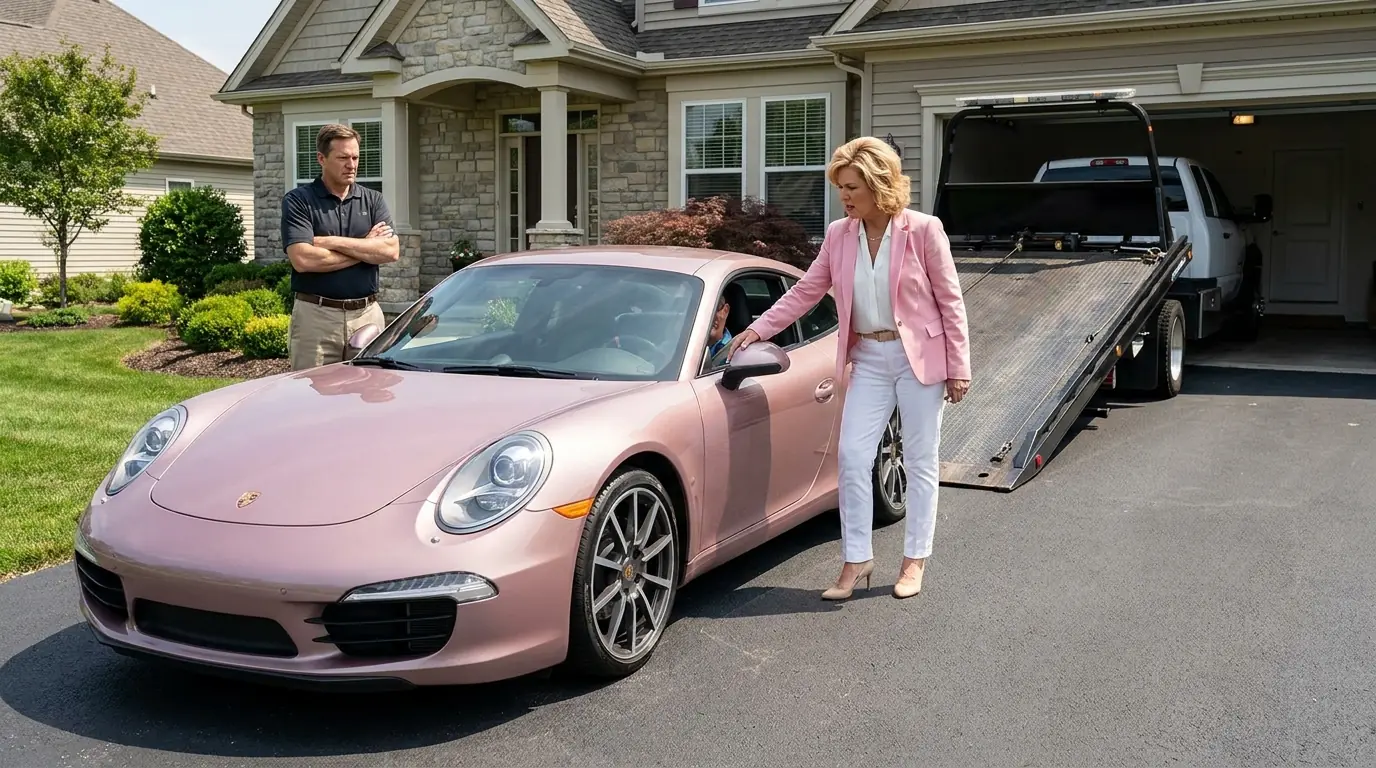
She asked why we thought we were allowed to own something like that in her neighborhood.
Less than twenty-four hours later, she stood in front of the HOA board demanding that the car be seized from us and donated to a community raffle because, according to her, “no one family should be allowed to flaunt that much excess.”
What Karen didn’t know was that the Porsche had nothing to do with showing off.
And by the time she tried to have a tow truck take it from my driveway, she had already created enough evidence to destroy the little authority she imagined she had.
My name is David Marshall.
I was forty-six years old when this happened, married to my wife, Rachel, for twenty-one years, and living in one of those neighborhoods where everything looked peaceful enough to make you suspicious.
Trimmed lawns.
Freshly painted mailboxes.
Stone entrance signs.
Matching streetlights.
A clubhouse nobody used unless the HOA scheduled something unpleasant.
Our neighborhood was called Briarwood Hills, even though there wasn’t a hill within five miles of us.
That always made me laugh.
The developers apparently thought Briarwood Flat Subdivision Beside the Highway lacked emotional appeal.
Rachel and I had lived there for almost nine years.
We weren’t rich.
At least, I never thought of us that way.
I owned a small engineering firm that had grown steadily over fifteen years.
Rachel worked as a speech-language pathologist before eventually cutting back to part-time after her mother became ill.
We had one daughter, Hannah, already in college.
The mortgage was manageable.
Retirement accounts were healthy.
We traveled once or twice a year.
We had been fortunate.
But neither of us came from money.
Rachel grew up in a house where her mother reused aluminum foil.
I grew up with a father who considered paying full price for anything a character flaw.
Even after we started earning more, those habits stayed.
Rachel drove the same Lexus for thirteen years.
Not because we couldn’t replace it.
Because it worked.
She wore nice clothes, but half came from clearance racks.
Whenever we went somewhere expensive for dinner, she still studied the menu prices before deciding whether she “really wanted” the salmon.
That was Rachel.
Practical almost to the point of absurdity.
There was, however, one completely impractical thing she had wanted since she was seventeen.
A Porsche 911.
A pink one.
That part required explanation.
Rachel’s father, Alan, owned an old Porsche 944 when she was young.
Used.
Silver.
Always breaking.
Nothing extraordinary by collector standards.
But Alan loved that car with the devotion some people reserve for family members and baseball teams.
Rachel learned to drive stick in it.
She told me that on our first date.
At the time, I probably pretended to understand why that was impressive.
Years later, I did.
Alan died when Rachel was twenty-two.
Sudden heart attack.
The Porsche had already been sold because repairs had become too expensive.
But whenever Rachel saw an old Porsche on the road, she pointed.
Never jealously.
More like someone hearing a song from childhood.
Then, sometime in her twenties, she found a magazine photograph of a custom-painted pink 911.
Not bubblegum pink.
Not cartoonish.
A soft rose color.
Elegant.
Unexpected.
She stared at it for almost a full minute.
“I’m getting one someday.”
We were newly married and living in an apartment where the air conditioner only worked when the downstairs neighbor wasn’t using his microwave.
I looked at her.
“With what money?”
“Future money.”
“Excellent financial plan.”
“I’m serious.”
“Okay.”
“Pink 911.”
“I’ll remember.”
And I did.
Twenty years passed.
We raised Hannah.
Moved twice.
Paid off student loans.
Buried Rachel’s mother.
Built my business.
Watched friends divorce, remarry, change careers, move states, lose parents, become grandparents.
The Porsche remained a joke between us.
Whenever Rachel bought something cheap instead of what she actually wanted, I would say:
“Saving for the pink 911?”
She would answer:
“Obviously.”
Then came our twenty-first anniversary.
Three months earlier, I had sold a minority stake in my engineering firm to two senior employees.
It wasn’t enough to retire.
But it was more cash than I had ever received at one time.
I paid taxes.
Put most into investments.
Set aside money for Hannah’s remaining tuition.
Then I kept one portion separate.
I found the car in Arizona.
A four-year-old Porsche 911 Carrera S.
Low mileage.
Immaculate service records.
White originally.
The previous owner had already installed several options Rachel would never have paid for herself.
I bought it.
Then had it professionally finished in a muted rose-pink wrap that matched the magazine photograph Rachel had kept for years inside one of Alan’s old photo albums.
On our anniversary morning, I handed her a small black box.
Rachel opened it.
Inside was a Porsche key.
She stared at me.
“No.”
I smiled.
Her eyes widened.
“David.”
“Come outside.”
“No.”
“Rachel.”
“What did you do?”
“Come outside.”
She actually started crying before she saw the car.
When the garage door opened, she covered her mouth.
The Porsche sat there under the morning light, pale rose paint glowing against the concrete.
For maybe ten seconds, Rachel said absolutely nothing.
Then:
“You idiot.”
“That’s not the response I expected.”
“You bought this?”
“Yes.”
“For me?”
“No, for the mailman.”
She hit my arm.
Then walked toward it so slowly it almost looked ceremonial.
Her fingers moved across the front fender.
Then the driver’s door.
Then the steering wheel.
She sat inside.
Closed her eyes.
And cried harder.
That was when I knew the money had been worth it.
Not because of the car.
Because of what it meant.
“My dad would have hated the color,” she said.
“I know.”
“He would’ve called this ridiculous.”
“Definitely.”
“He would’ve wanted to drive it.”
“Absolutely.”
She laughed through her tears.
Then she started the engine.
The sound filled the garage.
Rachel laughed again.
It was one of the happiest sounds I had heard from her in years.
Unfortunately, Karen Whitmore heard the engine too.
Karen lived three houses down.
Fifty-three years old.
Blonde bob.
Large sunglasses.
Expensive athletic clothes she never seemed to exercise in.
She had been elected president of the Briarwood Hills Homeowners Association eleven months earlier after promising to “restore standards.”
Nobody had understood what standards needed restoring.
We soon learned.
Karen sent warning letters about trash cans visible for twelve minutes too long after collection.
She complained about basketball hoops.
She tried to ban work vans from driveways.