"Ma'am, what exactly are you doing in here?" "I'm shopping. It's a store." "Yeah. See, people like you don't usually hang around places like this.
Why don't you put that down and head out before this becomes something?" "Excuse me. I've done nothing wrong." a woman named Patricia Patterson saw Amara Bennett, a woman, browsing through expensive dresses at Bellacor Luxury Boutique for 10 minutes and immediately called her husband, Officer Dennis Patterson, telling him that there was a suspicious woman in the store who looked like she was planning to steal something and making her feel unsafe. Officer Patterson arrived within minutes and confronted Bennett while she was selecting dresses to try on, demanding ID and telling her that someone like her didn't belong in an expensive boutique and needed to leave before he arrested her for making other customers uncomfortable. When Bennett, the actual owner and founder of the boutique, revealed her identity, and stated she built the business from nothing, Officer Patterson refused to believe her, accused her of lying and impersonation, handcuffed her in front of shocked customers, and began dragging her out of her own store while she protested that she was telling the truth.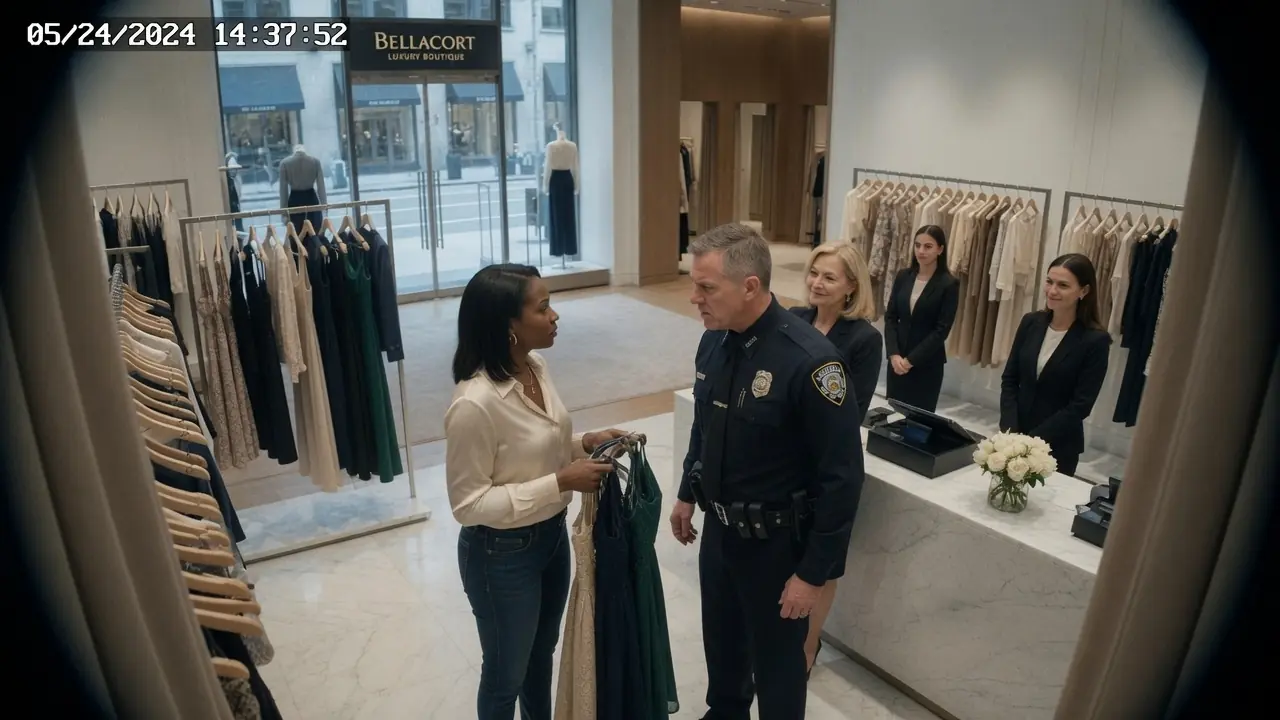
What Officer Patterson and his racist wife didn't know was that the boutique manager, Peter Prescott, would return from his errand and immediately recognize his boss being arrested in handcuffs. that a simple internet search would instantly prove Bennett owned the luxury boutique chain and that their racist assumption that a woman couldn't possibly own an upscale store would cost both of them their careers and result in a $680,000 lawsuit that would expose their long pattern of targeting and harassing people. Amara Bennett pulled her car into the upscale shopping district on Madison Avenue just after 2:00 on a Thursday afternoon, looking forward to a few hours of browsing and shopping in the city she just moved to 2 weeks earlier. At 38 years old, Bennett was the founder and CEO of Bellacor Luxury Boutique, a high-end women's clothing chain she'd built from absolutely nothing over the past 5 years. She'd started with a single small store funded by her life savings and a business loan, worked 16-hour days for three years straight, and turned that one location into a four-store chain worth over $3 million. She employed 42 people across her locations, and she just moved to this city to personally oversee the opening of her newest flagship store scheduled for next month.
Today, Bennett had decided to visit the original Bellacor boutique location incognito, wanting to browse quietly and observe how the staff was running things without announcing herself as the owner. She wore elegant but understated clothes, designer jeans that fit perfectly, a cream silk blouse, understated gold jewelry, and expensive leather flats. Looking exactly like the affluent customers her boutiques catered to, she walked through the glass doors of Bellacor Boutique with a small smile on her face, excited to see her first location after being away for several months, focused on expansion. The boutique was beautiful, exactly as Bennett had designed it. High ceilings, elegant lighting, carefully curated racks of dresses and separates arranged by color and style, plush seating areas for customers, and soft music playing in the background.
There were about six other customers browsing through the store. most of them women in their 30s and 40s, examining the merchandise with the careful attention that expensive clothing deserved. One of those customers was Patricia Patterson, a woman in her mid-40s wearing a tennis outfit and carrying a designer handbag who had been browsing the sale rack near the front of the store when Bennett walked in. Patricia glanced up at the sound of the door chime, and her eyes immediately locked onto Bennett. Patricia watched as Bennett walked past her toward the main dress displays, and something in Patricia's mind clicked into suspicion mode the moment she saw a woman entering this expensive boutique. Bennett was completely unaware of Patricia's attention as she made her way to a display of evening dresses near the back of the store.
She ran her fingers along the fabrics, checking the quality and the way the dresses were displayed, mentally noting that the staff had done an excellent job with the merchandising. She pulled out a deep blue cocktail dress and held it up, examining the stitching and the drape of the fabric. She was genuinely shopping, but also evaluating her own inventory with the critical eye of someone who had personally selected every item in the store. 5 minutes passed. Bennett moved from the evening wear to the casual dress section, pulling out items, checking price tags, considering what might work for the business events she had coming up.
She was acting exactly like any other customer in the boutique, taking her time, being thoughtful about her selections. Patricia Patterson watched her the entire time. Patricia pretended to examine a blouse while keeping Bennett in her peripheral vision, tracking every move Bennett made through the store. In Patricia's racist mind, Bennett's careful browsing wasn't the behavior of a discerning customer. It was the behavior of someone casing the place, looking for opportunities to steal.
Patricia had no evidence for this belief, no reason beyond the color of Bennett's skin to think anything suspicious was happening. But her prejudice filled in a narrative that made sense to her warped worldview. 10 minutes passed. Bennett had now moved to a third section of the store, looking at designer separates, silk blouses and tailored pants that could be mixed and matched for professional settings. She still hadn't made a final selection, just browsing and enjoying the experience of shopping in her own beautifully designed space.
But to Patricia, the fact that Bennett had been in the store for 10 minutes without buying anything was proof positive that something criminal was happening. Patricia pulled out her phone and stepped toward a quiet corner of the boutique near the dressing rooms. She kept her voice low as she dialed her husband's number, but her eyes never left Bennett. "Dennis, it's me," Patricia said quietly when her husband answered. "I'm at Bellacor Boutique on Madison Avenue.
There's a woman in here acting very suspicious. She's been walking around for 10 minutes just looking at things and not buying anything. I think she's planning to steal something. I don't feel safe. Officer Dennis Patterson was sitting in his patrol car 2 miles away finishing paperwork when his wife's call came through.
I'll handle it when I get there." Patricia ended the call and slipped her phone back into her purse. Feeling satisfied that she'd done her civic duty by reporting suspicious activity. She went back to pretending to shop while continuing to watch Bennett like a hawk watching prey. Bennett, still completely unaware that police had been called on her, finally made her selections.
She pulled three dresses from the racks. a navy blue cocktail dress, a charcoal gray business dress, and a burgundy evening gown and draped them over her arm. She started walking toward the fitting rooms at the back of the store to try them on, which was completely normal and expected behavior in any clothing boutique, but she never made it to the fitting rooms. The boutique door opened and officer Dennis Patterson walked in wearing his full police uniform, navy blue with his badge prominently displayed on his chest, his service weapon visible on his belt, his radio crackling occasionally with dispatcher chatter. He was a tall man with graying hair, and the confident bearing of someone who'd spent two decades exercising authority without having it questioned very often. Patterson's eyes scanned the boutique and immediately found what he was looking for, a woman holding expensive dresses.
He walked directly toward Bennett with purposeful strides that made other customers step out of his way. Bennett was about 5 ft from the fitting room entrance when she noticed the police officer approaching her. She stopped, confused about why a cop would be in the boutique, and turned to face him. ""Excuse me, ma'am," Patterson said, his tone already carrying an edge of authority and suspicion. I need to speak with you. Bennett looked at him with genuine confusion.
"Yes, officer. Is there a problem?" "What are you doing in this store?" Patterson asked, his eyes moving from Bennett's face to the dresses in her arms and back to her face. Bennett's confusion deepened.
"I'm shopping, obviously. Is something wrong?" Patterson's expression hardened. I received a call that there is a female in this store acting suspicious, possibly planning to steal merchandise. The caller said she felt unsafe.
Bennett felt her stomach drop and anger immediately flare up in her chest. She looked around the boutique and saw other customers now staring at the confrontation. She saw Patricia Patterson standing near a display rack, watching the scene with barely concealed satisfaction. Bennett turned back to the officer with disbelief in her voice. Are you serious right now?
I'm shopping. That's what people do in clothing stores. I'm holding dresses that I selected to try on. Is this because I'm? Patterson held up his hand in a gesture that was meant to look calming, but came across as condescending.
"Ma'am, I need you to calm down. I'm just responding to a call and doing my job. I need to see some form of identification." Bennett's jaw tightened with anger, but she kept her voice controlled. Identification for what exactly?
I haven't done anything wrong. I'm a customer in a store selecting dresses to try on in the fitting room. That's not a crime. Patterson's professional mask slipped slightly, and his underlying racism showed through clearly. Look, let's be real here.
Someone like you in this expensive boutique looks kind of suspicious. People like you don't normally shop in places like this, so I need to see some ID and verify who you are. The words hung in the air like poison. Several customers gasped audibly. Someone pulled out their phone and started recording.
Bennett stared at Officer Patterson with a mixture of fury and disbelief. Someone like me? Bennett repeated, her voice tight with controlled anger. People like me? You mean people like me?
Officer, you're saying people don't shop in expensive stores? Patterson's face flushed slightly, but he doubled down. I'm saying I received a call about suspicious activity, and I need to verify your identification. That's all. Bennett shifted the dresses to one arm and pulled her wallet from her purse.
She extracted her driver's license and held it out to Patterson. Here's my identification. Now, unless you're charging me with a crime, I'm going to continue shopping. Patterson took the ID and barely glanced at it before handing it back. In his mind, he'd already decided that Bennett didn't belong in this boutique, regardless of what her identification said.
He'd made his judgment based on the color of her skin, and nothing was going to change that assessment. "Ma'am, I need you to leave this store," Patterson said firmly. "You're making other customers uncomfortable. If you leave now, there won't be any further issues." Bennett looked around at the other customers again.
Most of them looked uncomfortable, but not because of her. They looked uncomfortable because they were watching a police officer racially profile someone. A few customers looked sympathetic to her situation. Patricia Patterson stood off to the side looking pleased with how events were unfolding. Bennett turned back to Officer Patterson with absolute certainty in her voice.
I'm not leaving. I haven't done anything wrong. I'm not done shopping. I have every right to be here and try on these dresses. Patterson's expression went cold.
Ma'am, if you refuse to comply with my lawful order to leave these premises, I will place you under arrest for trespassing and disturbing the peace. Trespassing? Bennett's voice rose slightly. Disturbing the piece? I'm holding dresses.
I'm shopping. This is insane. A young woman who worked at the boutique, a sales associate named Jennifer, who'd been helping another customer, approached the confrontation nervously. She looked at Officer Patterson and then at Bennett, clearly trying to figure out what was happening. Officer, "Is there a problem?"
Jennifer asked. Patterson gestured toward Bennett without taking his eyes off her. "This woman is refusing to leave after making customers uncomfortable and acting suspiciously. I've asked her to leave voluntarily, but she's refusing to comply." Jennifer immediately looked at Bennett with suspicion and sided with the officer without asking Bennett a single question or attempting to understand the situation.
"Ma'am, if the officer is asking you to leave, you need to comply. You're disturbing the peace of our boutique." Bennett couldn't believe what she was hearing. She looked at Jennifer with shock. Disturbing the piece?
I'm shopping. I selected three dresses to try on. How is that disturbing anything? Jennifer crossed her arms. Ma'am, you need to leave now or we'll have to support the officer in whatever action he deems necessary.
Bennett realized this situation was completely out of control and spiraling into something that would end very badly if she didn't stop it immediately. She looked at Officer Patterson, then at Jennifer, then at the customers watching and recording on their phones. She made a decision. "Do you know who I am?" Bennett said loudly and clearly so everyone in the boutique could hear her.
Her voice carried authority and confidence that made everyone pause. My name is Amara Bennett. I am the owner and founder of Bellacor Luxury Boutique. This store, the one you're accusing me of trying to steal from, I own it. I built this business from nothing. and you're racially profiling me in my own establishment.
The boutique went completely silent. Jennifer's face went pale as the blood drained from it. Several customers gasped. Someone's phone clattered to the floor. Patricia Patterson's satisfied expression faltered slightly.
Officer Dennis Patterson's expression didn't change at all. He didn't believe Bennett for even a fraction of a second. ""Nice try," Patterson said coldly. "But lying about who you are and impersonating a business owner just made this a lot worse for you. You're under arrest. Bennett's eyes went wide with shock and fury.
I'm not lying. I'm the owner. Ask the manager. Check the business registration. Google my name right now.
Patterson pulled his handcuffs from his belt. "Turn around and put your hands behind your back." This is illegal. Bennett's voice rose. I'm telling you the truth.
I own this boutique. You're making a massive mistake. Turn around now. Patterson ordered his voice hard and final. The three dresses Bennett had been holding fell from her arms and landed on the boutique floor as Patterson grabbed her wrist and forced her arm behind her back.
The metal handcuffs clicked closed around her right wrist with a sound that seemed impossibly loud in the silent store. He grabbed her other arm and cuffed it as well, pulling the restraints tighter than necessary. "You're arresting me for shopping in my own store," Bennett said loudly, making sure everyone could hear. "This is false arrest. This is racial profiling.
I'm the owner." You should have left when I gave you the chance," Patterson said, grabbing Bennett by the arm and starting to pull her toward the exit. Bennett resisted, planting her feet. "I'm Amara Bennett, the owner. Someone call Peter.
Call the manager. He'll tell you." Patterson yanked her forward roughly. Customers pulled out their phones and started recording. Jennifer stood frozen, her face showing the first hints of doubt about what was happening.
Patricia Patterson moved toward the exit, ready to leave before things got more complicated. Bennett was pulled past the displays she had personally selected, past the elegant fixtures she had chosen, past the customers she had hoped to serve. She was being dragged out of her own business in handcuffs while protesting her identity and demanding that someone verify the truth. Patterson reached the glass front doors and pulled them open. Bennett was halfway through the doorway, still protesting, still demanding they check her identity when the door opened from the outside and a man in his early 50s carrying shopping bags stepped into the boutique.
Peter Prescott, the general manager of Bellacor Boutique, stopped dead in his tracks. He looked at Officer Patterson, then at the woman in handcuffs being forcibly removed from the store. Then his eyes focused on the woman's face and recognition hit him like a physical blow. "Oh my God," Peter said, his shopping bags falling from his hands and hitting the floor with a loud thud. "Why is the owner of this boutique in handcuffs?"
Everything stopped. Peter Prescott dropped his shopping bags and rushed forward, positioning himself directly between Officer Patterson and the exit, his face showed complete shock as he stared at Amara Bennett, standing there in handcuffs with her wrists bound behind her back. "Officer, what are you doing?" Peter demanded, his voice rising with urgency. "That's Amara Bennett.
She owns this boutique. She founded the entire Bellacor chain. Why is she in handcuffs? Officer Patterson looked at Peter with immediate suspicion and dismissiveness. This woman was acting suspicious in the store, refused to leave when instructed, and then claimed to be the owner, which I know is false.
She's under arrest for trespassing, disturbing the peace, and lying to a police officer. Peter stared at Patterson like the officer had lost his mind. It's not false. She is the owner. I'm the general manager of this location.
I work directly for her. That's my boss you have in handcuffs. Patterson's grip on Bennett's arm didn't loosen. Sir, this woman has been lying about her identity. I suggest you step aside and let me do my job.
Peter pulled out his phone with shaking hands and opened Google. He typed quickly. Bellacor boutique owner found her. The search results loaded instantly, and Peter turned the screen toward Patterson, showing him article after article about Amara Bennett. There were photos of Bennett at ribbon cutting ceremonies for new store openings, interviews and business magazines about her success as a entrepreneur in the fashion industry, features about her journey from working three jobs to building a multi-million dollar boutique chain.
Look, Peter said, practically shoving the phone in Patterson's face. That's her, Amara Bennett, founder and CEO of Bellacor Luxury Boutique. Those are articles about her business. That's her face in every single photo. She's telling you the truth.
Officer Patterson looked at the phone screen and Bennett could see the exact moment when realization hit him. His face went from confident authority to pale uncertainty in the span of 3 seconds. He looked at the photos on the phone, then at Bennett's face, then back at the phone. The articles were undeniable. Amara Bennett, successful entrepreneur, owner of Bellacor Boutique, with her photo prominently displayed in every search result.
Jennifer, the sales associate, covered her mouth with both hands, her eyes wide with horror, as she realized she had just accused her actual employer of disturbing the peace and told her to leave her own store. Patricia Patterson, who had been moving quietly toward the back of the boutique trying to disappear, froze in place as she realized what was unfolding. Officer Patterson quickly unlocked the handcuffs and removed them from Bennett's wrists. His hands fumbled slightly with the key as the gravity of his mistake became clear. Ma'am, I apologize.
There was a misunderstanding here. Bennett rubbed her wrists where the metal had been too tight and cut him off with ice in her voice. A misunderstanding? You told me people like me don't shop in places like this. You said someone like me looks suspicious.
You refused to believe me when I told you I own this business. You arrested me in my own boutique because you couldn't imagine a woman owning a luxury store. Peter looked at Patterson with fury building in his expression. Officer, is that true? Did you really say those things to her?
Patterson tried to backtrack quickly. I was responding to a call about suspicious activity. Someone reported. Suspicious activity? Bennett interrupted, her voice sharp and controlled.
I was browsing dresses. That's it. I was shopping in my own store, selecting items to try on, doing exactly what customers are supposed to do. Someone saw a woman in an expensive boutique and decided I must be a criminal. Peter turned to look at the other customers in the store. his manager instincts taking over even in the middle of this crisis.
Who called the police on Miss Bennett? Several customers looked around uncertainly. Then a woman near the register pointed toward Patricia Patterson who was trying to blend into a display of scarves. That woman was on her phone earlier. I saw her watching Miss Bennett and then making a call.
Peter walked directly toward Patricia with his phone still in his hand showing the search results proving Bennett's identity. Ma'am, did you call the police on our owner? Patricia's face turned bright red and she stammered trying to find words. I I thought she looked suspicious. She was just walking around for so long.
I was concerned for safety. That's why I called my husband. The boutique went completely silent. Every person in the store heard those last three words clearly. My husband.
Peter's head snapped toward Officer Patterson and then back to Patricia. The connection became instantly obvious to everyone. You called your husband? Peter said slowly, his voice heavy with disgust and disbelief. Bennett looked at Patricia and then at Officer Patterson, and everything clicked into place.
You two are married. She saw me shopping, called you claiming I was suspicious, and you showed up already convinced I was a criminal before you even spoke to me. Patricia tried to defend herself. I genuinely thought something was wrong. I mean, she was just browsing and not buying anything.
Browsing and not buying anything? Peter cut her off, his voice rising with anger. That's what shopping is. That's what every customer in this store does. They browse.
They look at items. They take their time deciding what they want. What exactly about that seems suspicious to you? Was it the browsing, or was it the fact that she's? Patricia had no answer.
Her face showed a mixture of embarrassment, defensiveness, and the dawning realization that she had just destroyed her husband's career. Bennett turned to Jennifer, the sales associate who had sided with Officer Patterson without question. And you, when the officer told you I was disturbing the peace, you immediately agreed without asking me a single question. You told me to leave. You supported him arresting a customer in your store based on absolutely nothing.
Jennifer's voice came out as a whisper. Miss Bennett, I didn't know it was you. If I had known you were the owner. If you had known I was the owner, you would have treated me differently. Bennett interrupted.
But because you thought I was just a customer, you assumed the racist cop was right and I was wrong. That's exactly the problem, Jennifer. You made a choice based on what you saw, and what you saw was my skin color. Bennett turned to Peter, her voice firm and clear. Jennifer is fired.
Effective immediately. She can collect her belongings and leave. Jennifer started a protest, but Peter held up his hand. Miss Bennett is right. You supported false accusations against a customer based on racial bias.
You're terminated. Leave now. Jennifer grabbed her purse from behind the counter and walked out of the boutique with tears streaming down her face, knowing that video of this incident was already being recorded and would follow her for the rest of her life. Officer Patterson tried one more time to apologize. Ms. Bennett, I made a serious error in judgment.
If we could just discuss this. Bennett's eyes were cold as she looked at him. You humiliated me in my own business. You handcuffed me in front of my customers and employees. You treated me like a criminal for shopping while in a store I built with my own hands.
Your apology means absolutely nothing. You and your wife are going to answer for this. Patterson opened his mouth to respond, but another police officer walked through the boutique door, having been called as backup when Patterson radioed that he was making an arrest. The new officer looked around at the scene with confusion, clearly not understanding why Patterson was standing there apologizing instead of bringing in a suspect. Bennett addressed the new officer directly.
Your colleague just falsely arrested me, the owner of this business, based on a racist phone call from his wife. I'm filing a formal complaint with your department and a federal civil rights lawsuit. Everything that happened here was caught on security cameras and multiple customer phones. The backup officer looked at Patterson with an expression that made it clear he understood his colleague had just made a career-ending mistake. Peter spoke up, his voice firm with authority.
Miss Bennett, what do you need from me? Bennett took a breath and composed herself, though her hands were still shaking slightly from adrenaline and anger. Call our attorney, Sarah Chen. Tell her exactly what happened and that I need her here immediately. Pull all security footage from the past hour.
Get contact information from every customer who witnessed this, and I want a list of every complaint ever filed against Officer Patterson. Peter nodded and immediately pulled out his phone to start making calls. Bennett looked at Officer Patterson and Patricia Patterson, both of them standing there realizing their lives were about to fall apart. "Get out of my store, both of you, now." The Pattersons left without another word, walking out into the afternoon sunlight, knowing that videos of this incident were already spreading across social media, and their racism had just cost them everything.
Sarah Chen arrived at Bellacor Boutique within 40 minutes of Peter's call and immediately began building what would become one of the most clear-cut civil rights cases she'd ever handled. She started by reviewing the security footage, and what she saw made her hands clench into fists. The footage showed everything in perfect detail. Amara Bennett entering the boutique at 2:14 p.m., browsing peacefully through the dress displays, acting exactly like every other customer in the store. Patricia Patterson watching Bennett with visible suspicion from the moment she walked in, tracking her movements while pretending to shop.
Patricia pulling out her phone at 2:23 p.m. and making a call while staring directly at Bennett. Officer Patterson arriving at 2:31 p.m. and immediately approaching Bennett with hostility and aggression. The security system had audio and Chen listened to every word. She heard Patterson tell Bennett that people like her don't shop in expensive boutiques. She heard him order Bennett to leave for making customers uncomfortable when Bennett had done absolutely nothing.
She heard Bennett clearly state she was the owner and heard Patterson accuse her of lying. She heard the handcuffs click closed and Bennett's protests as she was dragged toward the exit. The footage was damning and irrefutable. Chen also obtained copies of the videos that customers had recorded on their phones. One video had already gone viral with 8 million views in just 3 hours.
The caption read, " business owner arrested in her own luxury boutique by racist cop and his Karen wife." The comments section was filled with outrage and demands for justice. But the security footage and viral videos were just the beginning. Chen subpoenaed officer Dennis Patterson's complete personnel file from the police department, and what she found was a pattern of racist behavior that should have ended his career years ago. Patterson had worked for the police department for 22 years.
During that time, 15 excessive force complaints had been filed against him. 13 of those complaints came from or Hispanic suspects. He had 19 wrongful detention complaints in his record. 16 were filed by minorities. Every single complaint had been investigated internally and either dismissed or resulted in nothing more than a written warning that went into his file and was ignored.
Chen dug deeper and pulled Patterson's arrest records for the past 7 years. She found that 44% of his arrests of suspects were later dismissed due to lack of evidence, procedural violations, or prosecutorial discretion. The dismissal rate for his arrests of suspects was 9%. The pattern was undeniable and had been documented for nearly a decade, but the police department had never taken meaningful action to stop him. Chen also discovered that Patricia Patterson had called the police on people in her neighborhood seven times over the past four years.
She'd reported a man acting suspicious while jogging in the park. He was a cardiologist who lived two blocks away. She'd called about a family having a barbecue in a public recreation area, claiming they were being too loud. No other neighbors had complained. She'd reported a teenager walking through her neighborhood.
He was delivering newspapers. None of her calls had ever resulted in actual crimes being discovered because there were no crimes. Just Patricia's racism seeing threats where none existed. The investigation also revealed something that made the case even more explosive. Ryan Mitchell, a attorney who lived in the same affluent neighborhood as the Pattersons, came forward after seeing the viral video.
He told Chen that officer Patterson had stopped him six times over 2 years while he was driving through his own neighborhood, demanding to know where he was going and what he was doing there. Mitchell had filed three formal complaints with the police department. All three were dismissed as unsubstantiated. Chen tracked down four other people who had been racially profiled by officer Patterson, a doctor detained while walking to her car after her hospital shift because Patterson decided she looked suspicious in the parking garage. A Hispanic business owner stopped and questioned while opening his own restaurant early in the morning because Patterson assumed he was breaking in.
A professor stopped while jogging because Patterson thought he was running from something. Every single one of them had been treated like criminals for the offense of existing while from a minority background. The state attorney general reviewed all the evidence Chen had compiled and announced that criminal charges would be filed against officer Dennis Patterson. The charges were serious and specific. False arrest, official misconduct, deprivation of rights under color of law, and filing a false police report.
Combined, Patterson faced up to 12 years in prison if convicted on all counts. Chen also built the civil case with devastating precision. She calculated damages based on the humiliation Bennett suffered, the harm to her business reputation, the emotional distress of being handcuffed and arrested in front of her own employees and customers, and the need for punitive damages large enough to send a message that this behavior would not be tolerated. She filed a federal civil rights lawsuit demanding $680,000 from Officer Patterson, Patricia Patterson, and the police department. During the deposition process, both Pattersons destroyed what little remained of their defense.
Patricia admitted under oath that she called her husband because Bennett didn't look like she belonged in that kind of store. And you can just tell when someone doesn't fit in. When pressed on what specifically made Bennett not fit in, Patricia couldn't articulate anything beyond vague feelings and ultimately admitted it was because Bennett was and Patricia had never seen a woman own a luxury boutique. Officer Patterson's deposition was even more damaging. When asked why he didn't believe Bennett when she said she owned the store, he stated, "It just didn't seem credible.
I've never encountered a situation like that." When asked what he meant by a situation like that, he tried to backtrack, but eventually admitted he meant he'd never seen a woman own an upscale business and therefore assumed Bennett must be lying. The most devastating moment came when Chen asked Patterson directly, "If a woman had told you she owned the boutique, would you have believed her?" Patterson paused for a long time before answering. probably yes. That answer recorded in an official deposition ended any chance he had of defending himself.
Amara Bennett held a press conference outside her boutique one week after the incident. She stood in front of the store she had built, wearing a business suit that she'd designed herself and spoke directly to the cameras with a voice that was calm, clear, and absolutely unforgiving. My name is Amara Bennett. I built Bellacor Boutique from nothing. I worked three jobs to save the money to open my first store.
I spent years learning the fashion industry, developing relationships with designers, understanding what women want when they shop for luxury clothing. I created something beautiful and successful through hard work and determination. And when I walked into my own store to shop, I was treated like a criminal because officer Dennis Patterson and his wife Patricia could not imagine that a woman could own a business like mine. Bennett paused and let her words sink in before continuing. Their racism didn't just hurt me personally.
It sent a message to every entrepreneur, every professional, every person who works hard and achieves success that no matter what we accomplish, some people will always see us as criminals first. Officer Patterson saw my skin color and decided I was suspicious. His wife saw me shopping and called the police. And when I told them the truth about who I was, they refused to believe me because their prejudice was stronger than reality. Bennett's voice hardened.
I'm not staying silent about this. I'm filing a lawsuit. I'm pursuing criminal charges. I'm making sure that officer Patterson never wears a badge again and that his wife faces consequences for weaponizing the police against a woman who was simply shopping. And I'm going to use every resource I have to make sure this never happens to anyone else.
The press conference was watched by millions. The video was shared across every social media platform. Amara Bennett became the face of a national conversation about racial profiling in retail spaces and the ways that racism manifests in everyday interactions. Officer Dennis Patterson watched the press conference from his home where he'd been suspended without pay, knowing that his career was over, his pension was gone, and he was facing prison time. Patricia Patterson watched it, too, knowing that she was about to become unemployable and that her name would forever be associated with racist behavior that destroyed her husband's life.
The trial would prove Bennett right about everything. But first, the consequences had to unfold in all their devastating detail. Officer Dennis Patterson's criminal trial began 6 months after Amara Bennett's arrest and lasted two weeks. The prosecution presented overwhelming evidence that left no room for doubt or sympathy. The security footage showing Patterson's aggressive approach and racist comments.
The audio recording of him telling Bennett that people like her don't belong in expensive boutiques. customer testimony describing his refusal to verify Bennett's identity even when she explicitly told him she was the owner and his own deposition where he admitted he wouldn't have arrested a woman who had made the same claim. The defense tried to argue that Patterson had made an honest mistake under pressure and was simply responding to a call about suspicious activity. But the prosecution destroyed that argument by presenting Patterson's 22-year history of complaints showing a clear and documented pattern of targeting minorities. his dismissal rate for arrests of suspects being nearly five times higher than for suspects and the seven other victims who testified about being racially profiled by Patterson in situations where they had committed no crimes. The jury deliberated for 9 hours and returned guilty verdicts on all four charges, false arrest, official misconduct, deprivation of rights under color of law, and filing a false police report. Patterson sat completely still as the verdicts were read, his face empty of expression, knowing that his life as he'd known it was finished.
At sentencing 3 weeks later, the judge showed no sympathy. Officer Patterson, you were given a badge and the public's trust to protect and serve all citizens equally without regard to race. Instead, you spent 22 years targeting minorities, making unlawful arrests, and using your authority to harass people based on the color of their skin. You arrested a successful businesswoman in her own store and treated her like a criminal because your racism wouldn't allow you to believe a woman could own a luxury boutique. This sentence must reflect the severity of your abuse of power.
The judge sentenced Patterson to 8 years in state prison. The city settled Amara Bennett's civil rights lawsuit for the full $680,000 rather than face a jury trial where damages could have been even higher. The settlement was the largest racial profiling payout in a retail case in the state's history. As part of the agreement, the police department was required to implement comprehensive reforms, including mandatory bias training for all officers, an independent civilian oversight board to investigate complaints, immediate suspension for any officer with patterns of racial bias complaints, and quarterly public reports on arrest statistics broken down by race. Police Chief Donald Morrison was forced to resign after it was revealed he had personally dismissed three of the complaints against Patterson over the years without proper investigation.
Internal affairs conducted a departmentwide audit and identified 37 officers with complaint patterns similar to Patterson's. Multiple excessive force or wrongful arrest complaints filed primarily by minorities. All inadequately investigated or dismissed. 22 of those officers were fired. 15 were placed on final warning with mandatory retraining and supervision.
Patricia Patterson faced social and financial ruin even though she wasn't criminally charged. Her identity as the woman who called police on a business owner went viral with over 60 million views across all platforms. Her country club revoked her membership. Her friends stopped returning her calls. Her part-time job at a charity organization terminated her after donors threatened to pull funding if she remained associated with them.
She became nationally known as the Karen, who destroyed her husband's career and sent him to prison. And that reputation followed her everywhere she went. Jennifer, the sales associate who had been fired for siding with Patterson, found herself unemployable in retail after the incident. Her face was in multiple viral videos supporting the false arrest of her own boss. When she applied for jobs, hiring managers would Google her name and find the videos.
She ended up working fast food for minimum wage, carrying the permanent stain of being the employee who told the business owner to leave. Amara Bennett used $200,000 of her settlement to establish the Equality in Commerce Foundation, a nonprofit organization that provided legal assistance to victims of racial profiling in retail and business settings and offered anti-bias training for retail employees and managers. The foundation helped 96 people in its first three years, many of them shoppers who had been followed, questioned, or falsely accused of shoplifting by store employees or security guards who assumed they were criminals. Bennett's business experienced significant growth after the incident. Sales across all four Bellacor boutique locations increased by 53% as people deliberately chose to shop there to support her.
She opened three additional locations within two years, expanding into new markets and employing over 70 people. She became a highly sought speaker on entrepreneurship and racial justice, traveling to business conferences and universities to share her story and advocate for change. Major retail chains contacted Bennett, asking her to consult on their anti-discrimination policies and training programs. She worked with six national retailers to develop comprehensive protocols for handling suspected shoplifting that removed racial bias from the equation and focused on actual observable behavior rather than assumptions based on appearance. 5 years after her wrongful arrest, Amara Bennett owned nine Bellacor boutique locations, generating over $12 million in annual revenue.
Her foundation had helped hundreds of racial profiling victims and change policies at dozens of retailers. Officer Dennis Patterson was still in prison serving his sentence with 3 years remaining before parole eligibility. known among inmates as the cop who arrested a business owner in her own store and destroyed his own life in the process. Patricia Patterson had moved to a different state and changed back to her maiden name, but the internet never forgot, and the videos still circulated with millions of views, ensuring she could never fully escape what she had done. The security footage and customer videos from Bennett's arrest remain some of the most widely viewed examples of racial profiling in retail, used in corporate training sessions, college courses on racism and bias, and diversity workshops as proof that success and achievement don't protect people from being treated as criminals by those who refuse to see beyond skin color. The lesson was brutal and public.
Officer Patterson and his wife saw a woman shopping and their racism made them see a criminal instead of a business owner. That assumption cost Patterson eight years of freedom and his entire career, cost Patricia her reputation and social standing, cost the city $680,000, and exposed a police department's decades of failure to address racial bias in its ranks. Amara Bennett had walked into her own boutique to shop and was arrested for being profiled in a space racists thought she didn't deserve to occupy. But her refusal to accept that injustice silently had forced an entire system to confront its failures and created protections that would help countless others who came after her.