The newest turn in the Epstein-files litigation is not dramatic because a judge threatened somebody with jail or announced that a hidden list had suddenly been discovered. It is significant for a quieter reason: a federal court has moved past asking the Justice Department what it intends to disclose and has begun asking the department to show the basis for what it is still withholding. The dispute is unfolding in Phang v. Blanche, a case brought by attorney and independent journalist Katie Phang against Todd Blanche in his official capacity as Acting Attorney General.
At the center of the case is the Epstein Files Transparency Act, enacted in November 2025. The statute requires the Attorney General, subject to limited exceptions, to make publicly available unclassified Justice Department records relating to Jeffrey Epstein, Ghislaine Maxwell, their investigations, associates, travel records, prosecutorial decisions, and other covered material. Congress also wrote something unusually direct into the law: covered information cannot be withheld merely because disclosure could cause embarrassment, reputational damage, or political sensitivity to a public figure or government official.
That does not mean the law requires the government to publish everything without redaction. Congress expressly allowed protection of personally identifying information about victims, child sexual-abuse material, information whose disclosure would jeopardize an active investigation or prosecution, certain graphic material, and properly classified national-security information. What makes the statute unusually demanding is that it also says redactions must be accompanied by written justification published in the Federal Register and submitted to Congress.
The Justice Department began releasing material in December 2025 and later said that roughly 3.5 million pages had been produced. DOJ also acknowledged that the review involved millions of pages, enormous quantities of images and video, victim-sensitive information, privilege questions, foreign-language material, and records that could not simply be uploaded without review. The department has defended at least some of its redactions as necessary to protect victims and other legally protected information.
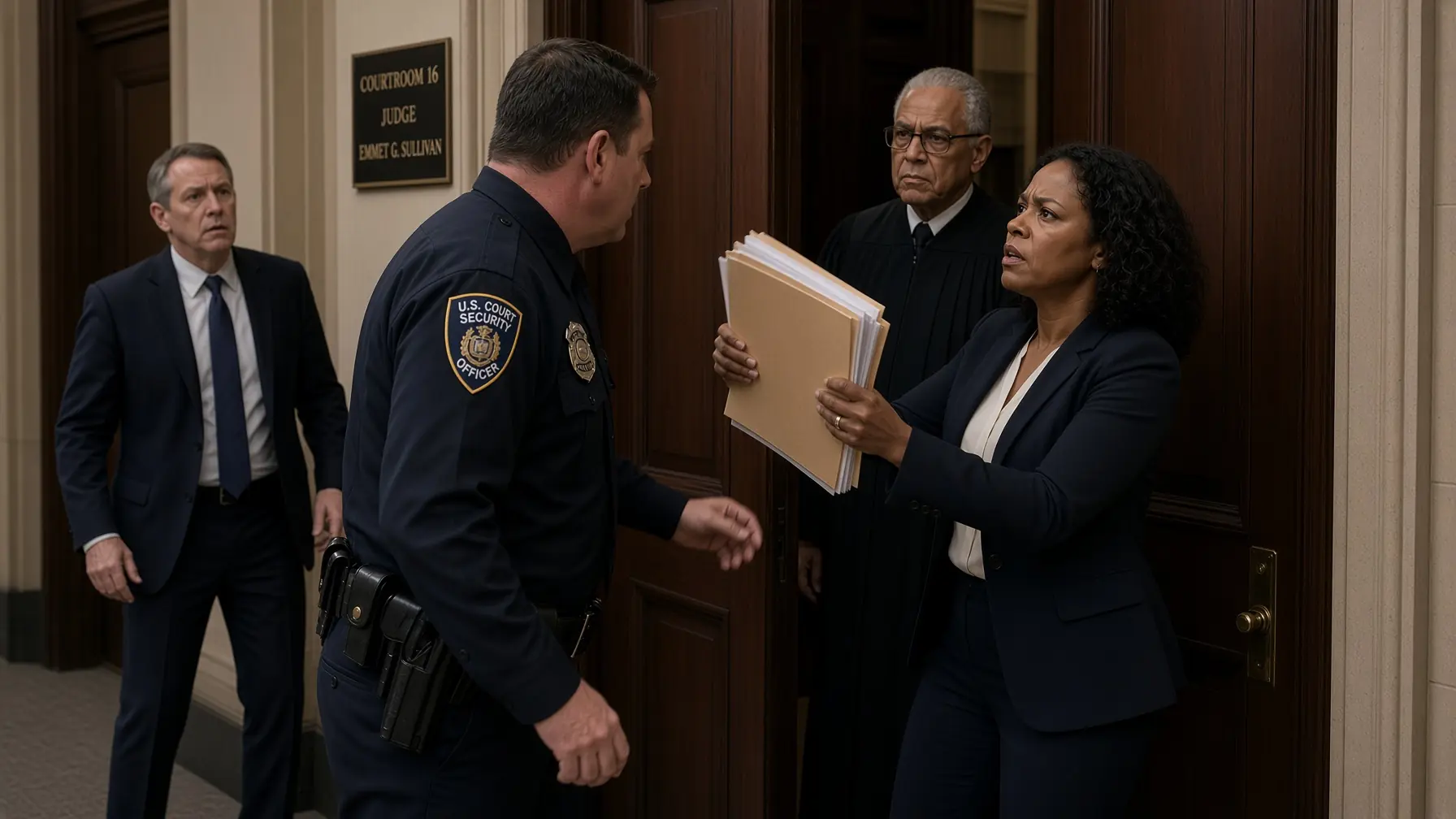
Katie Phang’s lawsuit argued that DOJ had gone beyond those permitted limits. She challenged specific blacked-out names, certain underlying FBI interview material, potential co-conspirator references, foreign-language records, and the absence of the redaction documentation contemplated by the statute. On June 25, 2026, Judge Emmet Sullivan granted her motion for a preliminary injunction on a limited set of issues.
The order was specific rather than sweeping. Sullivan directed the Attorney General to either disclose sender and recipient names in eight identified emails or show cause for keeping them redacted, and to do the same with potential co-conspirator names in two specified DOJ documents. He also ordered DOJ either to produce the underlying FBI interview notes associated with four identified FD-302 reports, with appropriate protection of victim information, or explain why those notes should remain undisclosed.
Sullivan also required the department to begin reviewing potentially responsive foreign-language material. Finally, the June order directed the Attorney General either to publish the redaction log required by the Act and update it with future releases, or show cause why that could not be done. The deadline for the requirements in that order was July 2.
That order is important because it did not simply accept DOJ’s statement that its redactions were lawful. It required explanations tied to particular records. The difference sounds procedural, but it is fundamental: when a statute allows secrecy only for identified reasons, a court can ask the government to demonstrate that its reasons actually fit the law rather than merely repeating the conclusion that the redactions are appropriate.
Sullivan’s accompanying forty-eight-page opinion went further in explaining why the dispute had reached that point. The opinion records that DOJ had publicly announced that it considered its production obligations completed after the January 30 release, even though the case challenged specific information that Phang argued remained improperly withheld or redacted. Sullivan concluded at the preliminary-injunction stage that Phang had established the required showing for relief on the issues before him.
One of the most sensitive portions of the case concerns underlying FBI interview notes. The relevant materials reportedly relate to FBI documents summarizing unverified allegations concerning President Donald Trump; the existence of an allegation in an FBI file is not a judicial finding that the allegation is true. Sullivan’s June 25 order did not adjudicate the truth of those allegations—it addressed whether the underlying interview notes must be produced or whether DOJ has a legally sufficient reason for withholding them.
That distinction is essential. An FBI interview memorandum can memorialize what a witness or complainant told investigators without establishing that the account was corroborated, charged, or proven. Treating such material as a final finding would be inaccurate, just as pretending the underlying material has no relevance to a transparency dispute would also miss what the court is being asked to decide.
The commentary describes a later August 6 order in which Sullivan scheduled an August 13 status hearing and identified unresolved compliance questions. In that account, the judge focuses on three areas: documentation supporting certain victim-related redactions, the continued withholding of handwritten FBI interview notes, and the timing of the redaction justification required by the statute. Those subjects are consistent with the issues already identified in the June 25 injunction.
The first dispute is deceptively simple. If DOJ says a blacked-out name belongs to a victim or potential victim, the statute provides strong reasons for protecting that person’s identity. But when the court asks DOJ to provide documentation supporting that assertion, merely repeating that attorneys have requested victim treatment is not necessarily the same as showing the court why a particular statutory exemption applies.
That does not mean Sullivan has determined that DOJ is secretly protecting some politically powerful non-victim. It means that a judge reviewing the government’s justification is entitled to ask for enough material to evaluate the claim. Courts regularly conduct sensitive review privately, including in camera, precisely so judges can examine information without automatically making it public.
This is one place where some political commentary outruns the court record. A lawyer for an individual could contact DOJ and ask that a person’s identity receive protection, but that request by itself does not prove either that the individual is legally a victim or that the government is engaged in misconduct. What matters in litigation is whether DOJ can connect the redaction to one of the grounds Congress actually authorized.
The second issue concerns handwritten interview notes and the later FD-302 reports prepared from FBI interviews. DOJ’s position, as described in the litigation, has included the argument that some underlying notes are substantially similar to the typewritten reports and present heightened difficulty because victim-identifying information in handwritten material can be harder to redact reliably. Sullivan’s June order nevertheless required production of the underlying notes with appropriate victim protections or a sufficient explanation for withholding them.
The legal question is therefore not whether handwritten notes are automatically more trustworthy than an FD-302. They are different records, and the Epstein Files Transparency Act broadly covers investigative material in DOJ’s possession. If Congress created no general exception for “duplicative” records, DOJ may have to explain why similarity alone permits withholding rather than simply releasing both versions with lawful redactions.
At the same time, the victim-protection concern is real. DOJ’s enormous Epstein release has already faced criticism from victims and attorneys over information that allegedly should have been protected but was exposed, and Sullivan’s own June opinion recounts concerns raised in related proceedings about victim-identifying information appearing in earlier productions. A court can therefore insist on transparency while simultaneously recognizing that careless disclosure could cause irreversible harm to people Epstein abused.
That tension is one of the reasons the case is more complicated than “release everything” versus “cover everything up.” Congress deliberately wrote both transparency and victim protection into the same statute. The hard judicial work lies in policing the boundary.
The third issue may ultimately prove less sensational but more consequential. Section 2(c)(2) of the Act says that all redactions must be accompanied by written justification published in the Federal Register and submitted to Congress. The law itself contains that language; it is not an invention of Phang, Kirschner, Sullivan, or partisan critics of the administration.
The dispute described in the transcript is about timing. DOJ has represented that it will comply, while the parties disagree over when the law requires those justifications to appear. If Sullivan sets a concrete timetable, the litigation could shift from debating an abstract statutory duty to measuring compliance against an actual judicial deadline.
That matters because deadlines change the nature of a case. “We intend to provide it” is difficult to enforce indefinitely, while “provide it by this date” creates an objective event a court can evaluate. If the government complies, the dispute narrows; if it does not, Phang can seek enforcement remedies and DOJ can present whatever legal justification it believes excuses compliance.
None of that automatically means Blanche personally faces contempt. Civil contempt generally requires more than an angry judge or incomplete production; courts consider whether an order was clear, whether the party failed to comply, whether compliance was possible, and what remedy is appropriate. Phang has previously sought stronger enforcement, but an application for contempt and an actual contempt finding are not the same thing.
The same caution applies to the phrase “Judge Sullivan is hauling Todd Blanche into court.” It captures the drama of a required status hearing, but federal litigation routinely uses hearings to make lawyers and parties explain unresolved compliance issues. The legal significance comes from what Sullivan requires the government to answer and what he does after hearing those answers, not from the mere fact that a hearing occurs.
Another important point is that Blanche is being sued in his official capacity. The caption itself identifies him that way. That means the litigation is fundamentally directed at the conduct and obligations of the Attorney General and Department of Justice, rather than functioning like an ordinary personal damages lawsuit against Blanche.
The broader political context is impossible to ignore, but it should not replace the legal analysis. Blanche previously represented Donald Trump in criminal matters before joining DOJ, and his prior representation naturally fuels scrutiny whenever records involving Trump become part of an Epstein-files dispute. A conflict allegation, however, must still be separated from evidence that a particular redaction was actually made to protect Trump.
Congress anticipated political sensitivity when drafting the statute. That is why the Act explicitly says embarrassment, reputational harm, and political sensitivity—including sensitivity involving government officials and public figures—are not lawful grounds for withholding covered records. The statute therefore gives the court a relatively clear question whenever an important name is blacked out: which permitted withholding provision, if any, actually justifies it?
That does not mean every famous person mentioned in an Epstein file committed wrongdoing. Names can appear in investigative records for countless reasons, and association, correspondence, travel records, witness references, or inclusion in an investigative lead are not themselves proof of a crime. A responsible release regime has to preserve that distinction even while complying with Congress’s command not to hide information merely because it would embarrass somebody powerful.
It is particularly important when discussing Donald Trump. The FBI-related materials referenced in reporting contain allegations described as unverified. Sullivan’s orders concern whether covered records were properly withheld, not whether the allegations have been proven, and nothing in the June 25 order constitutes a judicial finding that Trump committed the alleged conduct.
That makes some of the original commentary rhetorically stronger than the evidence warrants. Statements suggesting that DOJ is withholding handwritten notes because they implicate Trump state motive as though it were already established. The more accurate formulation is that critics suspect political motivation, while DOJ says redactions and withholdings reflect victim protection and other legal concerns; Sullivan’s job is to test the government’s explanations against the statute and the record.
The Justice Department has publicly defended its handling of the records. After Sullivan’s June ruling, DOJ disputed the judge’s interpretation, maintained that victim identities required protection, said it had produced responsive documents, and indicated that it planned to appeal. That is the government’s position, and it belongs in any account that aims to describe the dispute rather than advocate one side of it.
Phang’s side argues essentially the opposite. Her case maintains that DOJ has applied redactions beyond what Congress authorized and failed to provide information and documentation that the Act requires. Sullivan’s preliminary injunction represents an important win for that argument, but preliminary relief is not identical to a final judgment after every issue has been fully litigated.
This is also why the word “conceded” has produced so much political argument. Sullivan’s June opinion stated that Blanche had not disputed certain merits arguments in the relevant briefing, and the court treated that procedural posture as significant. DOJ later publicly rejected the characterization that Blanche had substantively “conceded” violating the law, illustrating how a statement can carry one procedural meaning inside litigation and a broader political meaning once converted into a headline.
The documents themselves remain the center of gravity. Sullivan identified particular emails, potential co-conspirator references, underlying FBI interview notes, foreign-language materials, and the redaction log rather than issuing a generalized demand to expose every unredacted page immediately. That specificity is one reason the order matters: it gives the government discrete obligations that can be tested one by one.
Consider the emails. If a sender or recipient’s name is concealed because the person is a victim whose privacy the statute protects, DOJ can seek to establish that. If the person is not within a permitted category and the only concern is political embarrassment or reputational harm, the statute says that is not enough.
The same framework applies to potential co-conspirator names. The word “co-conspirator” in an investigative or draft prosecution document is serious, but it is still not automatically equivalent to a conviction or even a charge. Release of a name may be required by the transparency statute while the public still has an obligation not to transform an investigative reference into a proven criminal finding.
The foreign-language materials present another revealing problem. DOJ’s own description, quoted in Sullivan’s opinion, said some foreign-language material had not been reviewed or produced because first-level reviewers could not practically determine responsiveness. Sullivan’s injunction required the department to initiate review and production of foreign-language materials that may fall under the Act and notify the court that the review was underway.
That is mundane compared with allegations involving politicians, but it illustrates why transparency litigation often comes down to process. A statute requiring “all” covered records cannot easily be satisfied if an entire subset was never reviewed for responsiveness. A court does not need a conspiracy theory to identify that problem.
The redaction log may operate the same way. A public accounting of why information was blacked out allows Congress, journalists, victims, courts, and citizens to compare the government’s stated reasons against the limited grounds provided by the statute. Without explanations, a black rectangle asks the public to trust that somebody applied the law correctly; with explanations, at least part of that decision becomes reviewable.
That is ultimately what Phang v. Blanche is becoming a case about. It is not merely a fight over whether more Epstein files exist, because the government has already released millions of pages. It is a fight over whether the executive branch gets to decide for itself that its compliance is complete or whether a court can require it to demonstrate compliance record by record when Congress has created enforceable statutory obligations.
Judge Sullivan has already answered part of that question by granting preliminary relief. The June 25 order required concrete steps and did not treat DOJ’s declaration of compliance as the final word. What happens next depends on the government’s responses, the court’s assessment of them, any further orders, and potentially appellate review.
For political audiences, the temptation will be to reduce the case to Trump versus his critics. For supporters of the administration, every demand for more files can be described as another attempt to manufacture scandal; for opponents, every redaction can be treated as proof of a cover-up. Neither shortcut does the difficult part of the work.
The difficult part is reading the statute, reading the orders, identifying exactly what DOJ withheld, examining the government’s justification, protecting actual victims, and refusing to confuse allegations with findings. That process is slower and less emotionally satisfying than declaring that one side has already been exposed as corrupt. It is also closer to how judicial accountability is supposed to function.
The most important sentence in the Epstein Files Transparency Act may therefore be one of its least dramatic. Congress said redactions require written justification.
That sentence turns secrecy from an assertion into something that can be questioned. It requires the government, at least in principle, to explain why the public cannot see information Congress otherwise ordered disclosed. And once a federal judge begins asking for the proof behind those explanations, the issue is no longer simply whether the public trusts Todd Blanche, Katie Phang, Glenn Kirschner, Donald Trump, or anyone else commenting on the case.
The issue becomes the record.
That is why the next hearing matters. Not because a judge is preparing some theatrical confrontation with the Attorney General, and not because the hearing itself proves political interference or a cover-up. It matters because the Justice Department may have to answer, document by document, what remains hidden, which legal exception allows it to remain hidden, and what evidence supports that choice.
If the government has lawful reasons, those reasons can be presented and evaluated. If it does not, the court has tools to enforce its orders, while DOJ has appellate rights to challenge rulings it believes are wrong. That tension—judicial review on one side and executive-branch legal defenses on the other—is not a failure of the system.
It is the system doing the part that matters most.
Making power explain itself.