The auctioneer’s gavel came down at sixty dollars, and half the yard turned to laugh before the echo had even died. Walt Henley stood beside the rusted machinist’s toolbox with one rough hand resting on its welded lid, his faded denim cap pulled low over his steel-gray hair. The box looked like something dragged from the bottom of a ditch, its sides scaled with orange rust, its corners dented, and the word “JUNK” written across the front in pale chalk. But Walt did not look embarrassed, and he did not take his hand away.
The estate auction was being held behind the old Ward Machine Shop on Depot Road, two miles east of Caldwell, Ohio. The morning was cold and bright, with rows of tools, old lathes, engine parts, and shop benches spread across the gravel lot. Farmers, scrap men, mechanics, and curious townspeople stood in loose groups, their hands in jacket pockets, waiting for the next bargain to appear. Behind them, the closed machine shop sat silent, its windows dusty and its sign faded by fifty years of sun.
Buck Mallerie laughed louder than anyone. He was a heavy man in a tight red company polo, owner of the largest salvage yard in three counties, and he had built a reputation on buying what other people were too slow to value. His flatbed tow truck sat near the gate, clean and shining, with Mallerie Salvage painted proudly on the door. Buck pointed at Walt and shouted, “Sixty dollars for junk? You finally lost your mind, old-timer.”
The crowd laughed because Buck gave them permission to laugh. Walt heard the laughter roll over the gravel, but he did not turn toward it. He only bent slightly, studying the thick bead of weld that sealed the toolbox lid to the body. The weld ran around the seam like a crude scar, but Walt’s old eyes saw more than rust and damage.
Walt Henley was seventy-two years old and had spent nearly his entire life with a torch in his hands. He had welded bridge rails, repaired broken farm machines, rebuilt cracked frames, and saved equipment younger men would have thrown away. His shoulders were still broad, though his knees were stiff now from fifty years of kneeling on concrete. His hands were permanently darkened in the cracks by welding soot that no soap had ever fully removed.
Buck walked closer, grinning as if the whole auction belonged to him. “What are you going to do with it, Walt?” he said. “Hang it on the wall? Use it as a tombstone?” A few men near the chain-link fence laughed again, and one of them muttered that the tin man had bought himself a tin box.
Walt lifted his eyes at last. They were pale, steady, and slow-moving, the eyes of a man who had long ago stopped answering noise. He looked at Buck, then back at the toolbox. “A man only welds shut what matters,” he said quietly.
Buck threw back his head and laughed. “That box won’t open,” he said. “Neither will your luck.” Walt gave no answer. He had learned early that steel never cared who was loudest.
Two younger men helped load the toolbox onto Walt’s old pickup. It was heavier than it looked, nearly one hundred and sixty pounds, and the tailgate dropped hard under its weight. Walt strapped it down carefully, checking both ratchets twice before he climbed into the cab. Buck stood near his flatbed, shaking his head like a man watching foolishness drive away.
Walt drove home slowly. The toolbox rattled once over the railroad crossing, then settled again under the straps. Caldwell passed by in familiar pieces: the feed store, the diner, the hardware shop, the church, and the quiet streets where people knew one another’s business before supper. By the time Walt pulled behind his small shop, the story of the sixty-dollar junk box had probably already reached town.
His shop stood behind his house, a low cinder-block building with a corrugated roof and one wide sliding door. Inside were old workbenches, a drill press, a vise, racks of clamps, steel scraps, welding rods, and an acetylene torch set that had outlasted three trucks. The place smelled of metal dust, old oil, and work done slowly. Walt backed in, lowered the tailgate, and used a chain hoist to lift the toolbox down onto the concrete floor.
For a long while, he only looked at it. The lid was welded shut on all four sides with a bead that looked rough at first glance, but not careless. Under the rust, the line was steady, deliberate, and close. The welder had not been hiding bad work; he had been sealing something with purpose.
Walt pulled his reading glasses from his shirt pocket and crouched beside the box. His knees complained, but he ignored them. He ran one thumb along the welded seam, feeling the pauses, the heat marks, the changes in pressure. To most men, it was only a ruined toolbox, but to Walt it was handwriting in steel.
He thought of Otis Freeman, the old shop foreman who had taught him to weld when Walt was fifteen. Otis used to say any fool could lay a bead, but a tradesman could read one. A weld told whether a man was calm, rushed, scared, careful, angry, tired, or hiding something. Walt had never forgotten that lesson.
The bead on the toolbox told a story. It had been laid by someone who knew how to control heat, someone whose hands might have been weak but whose mind remained exact. It had not been sealed by a thief in a hurry or a fool with a torch. It had been sealed by a tradesman who wanted the lid to stay closed until the right person opened it.
Walt knew the shop it came from. Elias Ward had run Ward Machine Shop for more than fifty years, making gears, shafts, pump parts, brackets, and repairs for half the county. Eli Ward had been quiet, precise, and respected in the way useful men are respected until they are gone. He had died the winter before, and his estate was now scattered across the gravel for strangers to price.
Walt had never been close to Eli, but tradesmen did not always need closeness to understand one another. They had nodded across hardware store aisles for forty years, sometimes speaking only three words at a time. Eli could turn a part to a thousandth of an inch and never brag about it. That kind of man did not weld a toolbox shut because he had nothing better to do.
By Monday morning, people began stopping by Walt’s shop. Roy Tibbitz from the feed store came with a broken gate hinge he did not really care about. A farmer named Clyde brought a cracked mower bracket that could have waited another month. Both men looked past Walt’s shoulder at the rusted toolbox sitting on the floor.
Roy finally said what everyone was thinking. “Walt, you paid sixty dollars for a thing that won’t ever open.” Walt filed a burr from the hinge and did not look up. “It’ll open,” he said. That was all.
By Wednesday, people at the diner had started calling him the tin man. They did not say it with real hatred, but the name still carried laughter in its teeth. Buck Mallerie repeated the auction story over breakfast and made it bigger each time. According to Buck, Walt had stared at the box like it was treasure, while everyone else had seen common sense.
Walt heard about it from Roy, who looked ashamed while telling him. Walt only nodded. He had been laughed at before by men who judged work before understanding it. A crowd could be wrong very loudly, and Walt had seen that more times than he could count.
For three evenings, he did not cut the box. He cleaned it first. He wire-brushed the rust from the welded seam, wiped away old dirt, marked the corners, and examined where the bead began and ended. Each night, under the light above his bench, the story in the steel grew clearer.
The weld had been done after the box was already old. The rust on the body and the lid was older than the weld line, which meant someone had taken a long-used toolbox and sealed it late in its life. Walt found a small place where the torch had paused, as if the man doing it had needed to steady his hands. That touched him more deeply than he expected.
“Eli,” Walt muttered one night, kneeling beside it. “What did you put in here?” The shop gave no answer except the hum of the fluorescent light overhead. But Walt felt certain now that the dead machinist had left something behind in the only way he trusted.
On the fourth night, Walt prepared to open it. He moved the box onto two steel stands, set a bucket of water nearby, laid out a fire blanket, and checked the torch tips. He marked a chalk line just inside the welded bead so he could cut the seal without destroying the box itself. A careless man would have attacked it with a grinder and anger, but Walt intended to open it like a letter.
The torch hissed to life a little after eight. Blue flame tightened at the tip, clean and controlled, and Walt lowered his welding helmet. The first orange spark jumped from the seam, then a fan of sparks scattered across the concrete. Walt moved slowly, letting the steel give at its own pace.
His knees ached. His back tightened. His eyes were not as sharp as they had once been, but his hands still knew the old rhythm. Heat, pressure, patience, breath, and cut. The seam began to part a quarter inch at a time.
Outside, Caldwell settled into evening. Lights went out in kitchens, dogs barked somewhere far away, and trucks passed on the county road. Inside Walt’s shop, the only world that mattered was the glowing line under the torch. He followed it around the lid until the last section gave way with a small metallic sigh.
Walt shut off the gas and waited. A careful man never reaches into hot metal, no matter how badly curiosity pulls at him. He removed his gloves, wiped his hands on a rag, and stood looking down at the box as it cooled. The lid sat loose now, no longer a secret sealed against the world.
A little before ten, Walt lifted it. The lid opened with a stiff groan, and a smell of old oil cloth rose from inside. The interior was clean and dry, untouched by the weather that had eaten the outside. Whoever had sealed it had done the job well.
There were three things inside. Walt took them out one by one and placed them on the workbench beneath the light. The first was a folder wrapped in oil cloth. The second was a thick brick of cash banded in old paper. The third was a sealed envelope with pencil writing across the front.
Walt opened the folder first. Inside lay a partnership agreement dated 1961, signed by Elias Ward and Dell Mallerie, Buck’s father. The document stated plainly that Dell had purchased half interest in Ward Machine Shop, and nothing more. Half the business, not the building, not the land, not the whole estate.
Folded behind it was another sheet in Eli’s careful handwriting. It was a statement declaring that he had never signed any later agreement giving Dell Mallerie full ownership. It said any paper claiming otherwise was false, laid over Eli’s shaking signature after his hands had begun to fail. At the bottom was a witness signature from Otis Freeman.
Walt sat down slowly. He knew Otis’s signature the way some men know a family face. The old foreman had witnessed Eli’s statement before he died, which meant Eli had known trouble was coming and had prepared for it. But he had not trusted the papers to a drawer, a bank, or any lawyer Dell Mallerie could reach.
He had sealed them in steel. Walt looked at the toolbox again and felt a chill move across the back of his neck. Buck had stood eight feet from the truth and laughed because all he could see was rust. Walt had read the weld and found a dead man’s voice inside.
The money came next. Walt did not count every bill, but he could see enough to know it was a serious sum, saved in fives, tens, and twenties over many years. It was not flashy money. It was careful money, the kind earned one repair at a time and hidden from hands that could not be trusted.
Then Walt opened the envelope. The pencil writing on the front said, “To the man with patience enough to open this.” Walt put on his reading glasses and unfolded the page. Eli Ward’s handwriting filled it, still neat despite the uneven pressure of a failing hand.
“If you are reading this,” the letter began, “then you did what no man in a hurry could do.” Walt paused after the first line because it felt too much like Eli had spoken across the years directly into the quiet shop. He read on slowly. Eli explained that Dell Mallerie had a false paper and meant to use it after his death to take everything.
Eli wrote of his daughter, Ruth Kesler, who was meant to inherit his half of the shop and savings. He wrote that he had no strength left for courtrooms, no faith in men who smiled while stealing, and no time to argue with a partner who had turned slick. So he had sealed the truth in the toolbox because Dell could not read steel and would never waste time on something he thought was worthless.
“Find my Ruth,” Eli wrote near the end. “Put this in her hands. Let an honest tradesman undo what a dishonest one tried to bury.” Walt read the last line twice. “A man’s life is not the noise spoken over his grave, but the one true thing he troubles to leave behind.”
Walt sat in the shop until nearly midnight. The open toolbox rested on the bench, its cut seam bright against the old rust. He could have put everything back and told no one. He could have avoided trouble, avoided Buck, avoided lawyers, avoided becoming a story in town again.
But Walt had not spent his life fixing broken things only to ignore a broken truth. He wrapped the papers, money, and letter back in the oil cloth. Then he placed them in a clean metal cabinet and locked it. Before going to bed, he stood in the shop doorway and looked once more at the toolbox.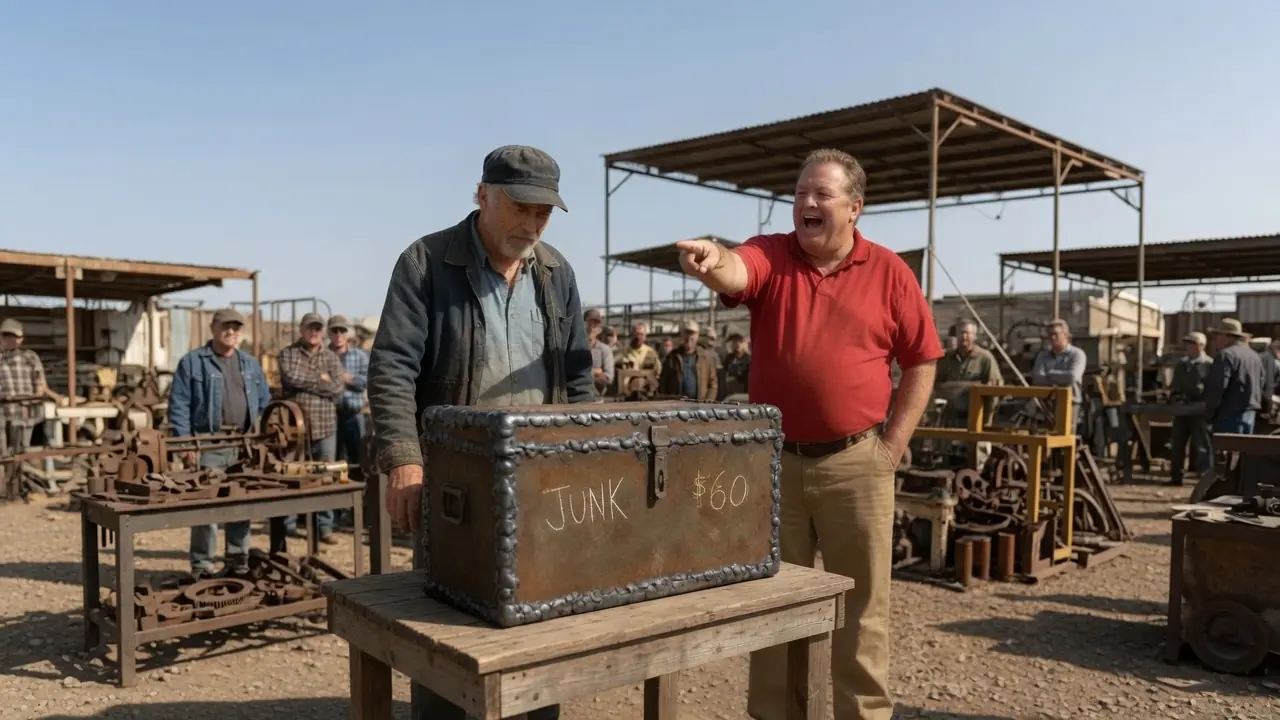
The next morning, he went to Roy Tibbitz at the feed store. “Where did Ruth Ward Kesler move?” he asked. Roy looked surprised. “Two counties over, near Marietta, I think.” Walt nodded. “I need the address.”
Roy studied his face and did not joke. By noon, Walt had the address written on a scrap of paper. He packed the oil-cloth bundle carefully into a canvas bag and drove his old pickup south through winding county roads. He did not stop for lunch.
Ruth Kesler lived in a small white house with peeling porch paint and a narrow garden that had gone dry at the edges. She opened the door wearing a faded cardigan, her hair pinned back, her face tired and careful. Walt saw Eli in her hands before he saw it in her eyes. They were machinist’s hands, steady even after life had given them reason not to be.
“Mrs. Kesler?” Walt asked. “My name is Walt Henley.” Ruth looked at him warily. “I knew your father a little,” he said. “I bought something from his auction.”
Her face closed slightly, as if the word auction still hurt. Walt lifted the canvas bag. “This was your dad’s,” he said. “He sealed it himself. He wanted you to have what was inside.”
Ruth did not move at first. Then she stepped back and let him into the front room. Walt placed the bundle on her small kitchen table and unwrapped it carefully, as if the papers were fragile tools. When Ruth saw her father’s handwriting, her hand went to her mouth.
She read the letter standing up. Halfway through, her knees weakened, and Walt pulled out a chair for her without speaking. Tears ran down her face, but she made no sound. When she reached the part about her inheritance, she pressed the paper to her chest and closed her eyes.
“They told me he left me nothing,” she whispered. “They said Daddy signed everything over.” Walt nodded toward the documents. “He said he didn’t.” Ruth looked at the agreement, the witness statement, the money, and the letter. For the first time since Walt entered, anger rose through her grief.
A lawyer in Marietta took the case that afternoon. The money from the box paid the retainer before Ruth had to ask anyone for mercy. Within days, the attorney compared the original partnership agreement, Eli’s statement, Otis Freeman’s witness signature, and the document Dell Mallerie had used to claim everything. The lie did not survive being placed beside the truth.
The forged paper had depended on silence. It had depended on Ruth being too poor to fight, Eli being too dead to speak, and the town being too willing to accept whatever the loudest family said. But a sealed toolbox had kept its evidence clean while people laughed at it. Now the laughter came back like a bill due.
Buck Mallerie heard before Walt saw him again. The salvage man came to Walt’s shop one afternoon, no longer laughing, his red polo replaced by a brown jacket. He stood in the doorway looking at the cut-open box. “You had no right getting involved,” Buck said.
Walt looked up from his workbench. “Your family had no right taking what wasn’t yours.” Buck’s face darkened, but he did not step inside. Men like Buck understood noise, pressure, and public confidence, but he did not understand what to do with someone who did not fear him.
“You think this makes you some kind of hero?” Buck snapped. Walt set down his file. “No.” He looked at Buck steadily. “It makes me the man who opened the box.”
Buck had no answer to that. He turned and left, and by the end of the month, the Mallerie family agreed to return the shop, the accounts they had taken, and Ruth’s rightful share. They did it quietly, not from remorse, but because court would have made the forgery public in ways even Buck could not laugh away. The law looked at them hard enough that settlement became their safest road.
Caldwell changed its tone after that. The same men who had laughed at the auction now repeated the story with lowered voices. At the diner, nobody called Walt the tin man anymore unless they meant it with respect. Buck’s loudness shrank, and the Mallerie name lost its shine.
Ruth reopened Ward Machine Shop the following spring. She had worked beside her father as a girl and could still feel measurements through her fingertips. The old machines were cleaned, the sign repainted, and the front windows washed until sunlight reached the benches again. Farmers and mechanics began bringing parts back to the shop on Depot Road.
In the front corner, Ruth placed the rusted toolbox behind glass. She left the cut seam visible, bright and honest against the old rust. Beside it, she put a small card with her father’s name and one sentence beneath it: “The truth was sealed here until patient hands opened it.” People stood before it quietly when they came in.
Walt never accepted money. Ruth offered more than once, and each time he shook his head. “Your father paid me,” he said. “He trusted the weld to say something, and I got to hear it.” That was enough for him.
One evening late that summer, Walt drove back to Ward Machine Shop after closing. The sun was low, the depot road was quiet, and swallows moved under the eaves. He stood outside the window and looked at the toolbox behind the glass. His hand rested against the pane over the place where his palm had rested on the lid at the auction.
He thought of the crowd laughing. He thought of Buck pointing. He thought of Eli Ward sitting alone in his shop, hands shaking, still determined to leave one clean weld behind. Then he thought of Ruth turning the key in her father’s shop door again.
Walt did not go inside. He only stood there a while with his cap in his hands. The toolbox no longer looked like junk. It looked like a promise kept.
After a few minutes, Walt put his cap back on and walked to his pickup. His knees were stiff, and his back ached, but his steps were steady. Behind him, the open toolbox remained under glass, rusted, scarred, and finally understood.
A man does not weld a box shut to hide something worthless. He welds it shut because he hopes the wrong hands will pass over it and the right hands will take their time. Walt Henley had paid sixty dollars for what everyone else dismissed, and that was all it cost to give a dead man his voice back. Sometimes the truth does not need a crowd to believe in it; sometimes it only needs one patient man with a torch.