Mrs. Elijah Carter stepped into Lux District Boutique at exactly 10:15 on a Tuesday morning, carrying nothing but a small worn handbag and a folded note in the pocket of her plain gray coat. The jewelry store sat inside the most expensive shopping plaza in downtown Houston, a building of glass walls, marble floors, polished brass doors, and display windows bright enough to make every diamond look like captured lightning. She paused just inside the entrance, blinking softly as the door closed behind her with a quiet hiss. Her shoes were old, her coat was faded, and her white hair was pinned back with two simple silver clips.
Behind the glass diamond counter stood two employees, both young, polished, and already bored before she said a word. Chloe Bennett wore a crisp blue suit with a gold name pin, her dark hair pulled into a perfect knot, her smile bright for wealthy customers and cold for everyone else. Beside her stood Mark Ellis, a tall associate in a fitted black store uniform, his arms folded as he leaned near a velvet tray of engagement rings. They both looked up when Mrs. Carter approached, and in that first second, they judged her completely.
Mrs. Carter did not notice the full cruelty of their stare at once. She was looking at the diamond case, searching for a ring that matched the description written on the folded note. It was not the largest diamond in the case, nor the most expensive, but it had a delicate old-fashioned setting with a small halo around the center stone. Her late husband had once promised her a ring like that after he built his first business, and life had delayed the promise for more than fifty years.
“Good morning,” Mrs. Carter said, her voice soft but clear. “May I see the diamond ring in the second row, the oval one near the left side?” Chloe did not reach for the key. She looked first at Mrs. Carter’s coat, then at her shoes, then at the small handbag pressed gently against her hip. Her smile bent into something sharp.
“The oval diamond?” Chloe asked, as if repeating a joke. Mark turned his head and looked at the case, then back at Mrs. Carter. “That one starts at thirty-eight thousand dollars,” he said, letting the number hang in the air like a warning sign. Mrs. Carter nodded politely, as though she had simply heard the weather report.
“Yes,” she said. “I would still like to see it.” Chloe placed one hand on top of the locked glass case and tilted her chin slightly. “Ma’am, we normally show pieces like that to serious buyers.” The words were smooth enough to pass for policy, but the meaning underneath was clear enough to sting.
Mrs. Carter’s fingers tightened around the handle of her handbag. “I understand,” she said. “I am asking to see it because I am a serious buyer.” Mark covered a laugh with the back of his hand, badly pretending he was clearing his throat. Chloe glanced sideways at him, and the two shared the kind of look that makes a customer feel smaller without a single shouted word.
“Look at this,” Mark said quietly, but not quietly enough. “Poor old woman wants to try on diamonds.” Chloe’s lips twitched. “Maybe she thinks this is the thrift counter.” Mrs. Carter froze for half a second, not because she had never heard an insult before, but because it always surprised her how easily people could become cruel when they thought there would be no consequence.
She had spent eighty-two years learning that disrespect often arrived dressed as confidence. It came from doctors who spoke over her head, bankers who looked for a husband, salesmen who ignored her questions, and neighbors who assumed age made a person invisible. Still, standing in front of that glass counter, she felt the small wound open again. She had entered the store to buy a memory, not to beg for dignity.
“I do not need to try it on if that is difficult,” Mrs. Carter said. “You may simply show it to me.” Chloe’s face hardened, irritated by the old woman’s refusal to leave. “Ma’am, we cannot unlock high-value pieces for people who are just looking.” Mark gave a low laugh and folded his arms tighter. “You don’t look like someone buying jewelry.”
The sentence struck harder than its volume. It was casual, cruel, and spoken with the confidence of someone who believed poverty could be seen from across a counter. Mrs. Carter looked at Mark for a long moment. “And what does someone buying jewelry look like?” she asked.
Mark blinked, surprised she had answered at all. Chloe leaned forward slightly. “Someone who understands where they are.” Mrs. Carter’s eyes moved from Chloe’s face to the locked case beneath her hand. “I understand exactly where I am.”
That answer annoyed Chloe more than any argument would have. She had expected confusion, embarrassment, maybe a mumbled apology before the old woman shuffled out. Instead, Mrs. Carter stood calmly, her shoulders small but straight, her gaze steady. That quiet dignity made Chloe feel challenged, and people like Chloe often mistook dignity for defiance.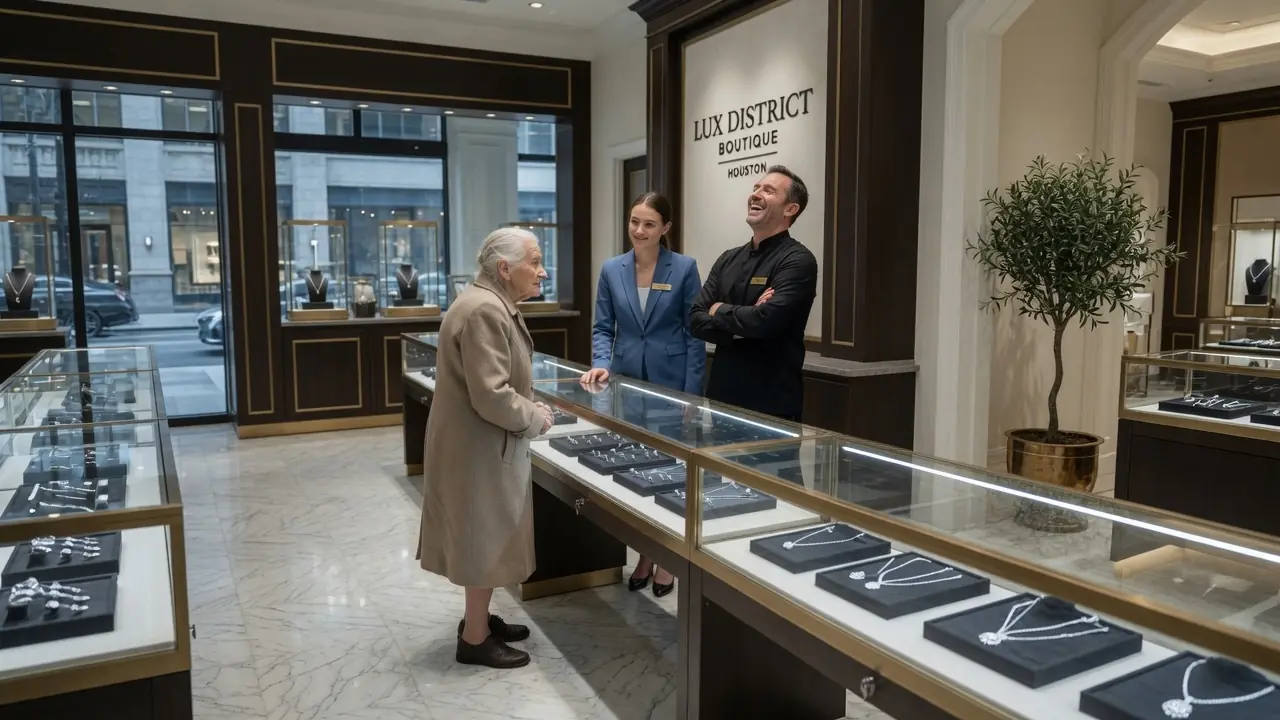
“Then you should also understand that we protect our inventory,” Chloe said. “People come in here every day wasting time.” Mrs. Carter slowly nodded. “I have no wish to waste yours.” Mark snorted. “Could have fooled me.”
The store was quiet except for the soft music playing overhead and the faint hum of the lighting above the diamonds. No other customers stood in the room. There was no crowd, no manager watching, no wealthy shoppers to impress. The cruelty belonged entirely to the two employees behind the counter, which made it cleaner and more personal.
Mrs. Carter opened her handbag and touched the folded note inside. It was written in her husband’s handwriting, slightly shaky from his final years but still readable. “Ellie, one day buy yourself the ring I was too slow to buy you.” She had carried that note for six months before finally deciding to walk into the jewelry store.
Chloe mistook the movement for hesitation. “Ma’am, there are costume jewelry stores three blocks over,” she said. “They may have something more comfortable for your budget.” Mark laughed again, this time openly. “Or maybe the mall kiosk. They let anybody touch the glass there.”
Mrs. Carter closed the handbag slowly. Her face did not twist with anger, but something changed in her eyes. The softness remained, yet beneath it came a firmness that had built buildings, signed contracts, survived widowhood, and outlived men who thought power belonged only to loud voices. “What is your name?” she asked.
Chloe’s smile returned, smug and professional. “Chloe Bennett.” Mrs. Carter looked at Mark. “And yours?” “Mark Ellis,” he said, giving a tiny mocking bow. “Would you like to complain to someone, ma’am?”
“Yes,” Mrs. Carter said. “Eventually.” Mark looked at Chloe and laughed. Chloe tapped the glass case once with her manicured nails. “Then please do that somewhere else. We have real customers scheduled this morning.”
Mrs. Carter stood still. The phrase real customers settled over her like dust. She looked around the store, at the velvet trays, the polished counters, the security cameras, the silk-lined displays, and the gold letters on the wall spelling Lux District Boutique. Then she looked beyond the front windows toward the plaza corridor, where sunlight washed across the marble floor she owned.
She did not tell them that. Not yet. She simply gave them one last chance because her husband had always said that character reveals itself most clearly when people think they are safe. “Young lady,” she said gently, “are you refusing to show me the ring because of store policy, or because of how I look?” Chloe’s face tightened.
Mark answered before Chloe could stop him. “Because you look like you wandered in for air conditioning.” Chloe tried not to laugh, failed, then turned her face slightly away. Mrs. Carter’s fingers trembled once on the handle of her handbag. She steadied them before either employee could see.
“Thank you,” Mrs. Carter said. Chloe frowned. “For what?” “For being clear.” Mrs. Carter turned and walked toward the door, each step slow but steady.
Behind her, Mark muttered, “Poor thing probably thought diamonds were on sale.” Chloe laughed softly. “I’m just glad she didn’t ask for champagne.” The door opened, and Mrs. Carter stepped back into the plaza without looking over her shoulder.
Outside the store, the corridor felt wide and strangely silent. Shoppers passed with bags from designer boutiques, men in tailored suits checked watches, and a young mother pushed a stroller past a fountain of white stone. Mrs. Carter walked to a bench near the central atrium and sat down carefully. Only then did she open her handbag again and take out the folded note.
Her husband’s name had been Walter Carter. He had started as a janitor in a Houston office building, saved every spare dollar, bought one neglected storefront in the seventies, then another, then a whole block nobody wanted during a downturn. People laughed at him back then too. They said a Black man with a mop and a dream could not become a landlord in downtown Houston.
Walter proved them wrong brick by brick. Mrs. Carter had kept the books at their kitchen table, negotiated repairs, collected rent, argued with banks, and learned the language of deeds and leases because nobody else cared to teach her. By the time Walter passed, the Carter family owned three commercial properties, including the plaza where Lux District Boutique now paid rent every month.
Mrs. Carter had not come to the store to test anyone. She had come to buy a diamond ring in memory of the man who once promised her one. But as she sat beneath the atrium skylight with the note in her lap, she understood that the morning had become something else. It was no longer about a ring.
She took out her phone, found the number of her attorney, and pressed call. “Mr. Lowell,” she said when he answered, “I need you to meet me tomorrow morning at the plaza.” She listened for a moment, then looked toward the jewelry store. “Bring the lease file for Lux District Boutique.”
The next morning, Chloe Bennett arrived early, still amused by the old woman from the day before. She told Mark about it again while arranging diamond bracelets on a velvet pad. “She really asked if I was refusing because of how she looked,” Chloe said, rolling her eyes. Mark adjusted his name pin in the reflection of the glass. “You should’ve said yes.”
They were still laughing when the door opened. Mrs. Elijah Carter stepped inside wearing the same plain gray coat, the same simple shoes, and the same small handbag. But this time, she was not alone. Beside her walked a tall attorney in a navy suit, carrying a black leather briefcase and a thick folder marked Carter Holdings Plaza Properties.
Chloe’s smile faded at once. Mark straightened behind the counter. Mrs. Carter approached them with the same calm steps as before and stopped outside the glass diamond case. The position was almost identical to yesterday, but the room felt entirely different.
“Good morning,” Mrs. Carter said. Chloe forced a professional smile, the kind she should have used the day before. “Ma’am, welcome back.” Her voice had lost its sharpness. “How may we help you today?”
Mrs. Carter did not answer immediately. She looked at the ring in the second row, still locked beneath the glass. Then she turned to the attorney. “Mr. Lowell, please place the documents on the counter.”
The attorney opened the folder and laid several papers across the glass. Chloe looked down and saw the plaza name, the lease agreement, the ownership structure, and Mrs. Carter’s full legal name printed in black ink. Mark leaned closer, and the color drained from his face. Carter Holdings was not just a name on a rent invoice; it was the company that owned the entire building.
Chloe’s lips parted, but no sound came out. Mark looked from the papers to Mrs. Carter, then back to the papers, as if hoping the words would rearrange themselves into something less terrifying. Mrs. Carter rested one hand lightly on the folder. Her hand was wrinkled, small, and steady.
“Yesterday,” she said, “I asked to see one diamond.” Chloe swallowed. “Mrs. Carter, we didn’t realize—” “No,” Mrs. Carter interrupted, still calm. “You realized everything you thought mattered.” Mark lowered his eyes.
Mr. Lowell stood beside her, silent but watchful. He had represented Mrs. Carter for twelve years and had seen powerful people become nervous in her presence. He admired that she never needed to shout. When she was angry, she became very precise.
“You saw my coat,” Mrs. Carter continued. “You saw my shoes. You saw my age. Then you decided I was not worth the key to a display case.” Chloe’s hands began to tremble at her sides. Mark’s face tightened with panic.
“Mrs. Carter,” Chloe said quickly, “I am so sorry. It was a misunderstanding.” Mrs. Carter looked at her with quiet disappointment. “A misunderstanding is when two people fail to hear each other. This was not that.” She turned slightly toward Mark. “You said I looked like I came in for air conditioning.”
Mark’s jaw opened, then closed. He looked at Chloe, but she could not save him. “I was joking,” he said weakly. Mrs. Carter nodded once. “Cruel people often call cruelty a joke when consequences arrive.”
Chloe gripped the edge of the counter. “Please, we can fix this. I can show you the ring now.” Mrs. Carter looked down at the diamond case. “You think the problem is that I did not see the ring.” Chloe went still. “The problem is that you showed me the store.”
Mr. Lowell opened another document. “Lux District Boutique is currently operating under a lease renewal clause that requires compliance with plaza conduct standards.” Chloe’s eyes widened. Mark whispered, “Conduct standards?” The attorney slid a page forward. “Specifically, tenant staff may not discriminate, deny service without cause, or damage the public reputation of the property.”
Mark’s voice shook. “Are we being evicted?” Mrs. Carter looked at him. “That depends on whether your company understands what happened here.” Chloe clasped her hands together. “Please, Mrs. Carter, our district manager should be called before anything happens.” “I already called her,” Mr. Lowell said.
At that exact moment, Chloe’s phone buzzed on the counter. The name on the screen made her flinch. District Director — Marissa Vale. Chloe stared at it like it was a snake. Mrs. Carter looked at the phone, then back at her. “Answer it.”
Chloe answered with trembling fingers and put it on speaker after Mr. Lowell quietly requested it. Marissa Vale’s voice came through sharp and controlled. “Chloe, I just received a call from Carter Holdings. Tell me exactly why the owner of the plaza was refused service in our store.” Chloe closed her eyes.
Mark stared at the marble floor. Chloe tried to speak, but her voice cracked. “We made a judgment error.” Mrs. Carter’s expression did not change. Marissa’s voice turned colder. “No. You made a character error.”
The silence after that was heavy. Chloe wiped at one eye, but Mrs. Carter could not tell whether the tears came from regret or fear. She had seen both many times and had learned not to confuse them. Fear cries louder than remorse.
Marissa spoke again. “Mrs. Carter, on behalf of Lux District Boutique, I deeply apologize.” Mrs. Carter looked at the phone. “Apologies are easy when rent is at risk.” Marissa paused. “You’re right.”
That answer was the first honest thing Mrs. Carter had heard from the company. She respected it enough to continue. “I will not ask you to close this store today,” she said. Chloe inhaled sharply, hope rushing into her face. Mrs. Carter saw it and lifted one hand.
“But these two employees will not serve another customer in this plaza unless your company retrains them, reviews their conduct, and sends me written confirmation of corrective action.” Mark’s shoulders slumped. Chloe nodded quickly even though Marissa could not see her. “Yes, ma’am,” Marissa said. “Immediately.”
Mrs. Carter looked at Chloe. “You may keep your job if your company allows it. But you will remember this.” Chloe nodded, tears slipping down her cheeks. “I will. I swear I will.” Mrs. Carter turned to Mark. “And you?”
Mark’s face twisted with shame. “I’m sorry,” he whispered. Mrs. Carter studied him for a long moment. “Sorry for what?” He swallowed. “For laughing at you. For deciding you were nobody because of your clothes.” His voice broke slightly. “For making you feel small.”
Mrs. Carter’s eyes softened, but only a little. “You did not make me small, Mr. Ellis. You only revealed how small your thinking was.” Mark nodded, unable to answer. That sentence seemed to land harder than any firing would have.
Then Mrs. Carter opened her handbag and removed the folded note. She placed it gently on the counter beside the lease papers. Chloe looked at it, confused. Mrs. Carter smoothed the paper with two fingers.
“My husband wrote this before he died,” she said. “He wanted me to buy myself a diamond ring.” Chloe’s hand went to her mouth. Mark looked away, ashamed beyond words. Mrs. Carter looked through the glass at the oval diamond she had asked to see.
“He built the first store in this plaza with hands that cleaned floors before they signed deeds,” she said. “He knew what it meant to be judged before speaking.” Her voice tightened for the first time. “That is why yesterday mattered.”
Chloe reached slowly for the key, then stopped, waiting for permission. Mrs. Carter nodded. Chloe unlocked the case with shaking hands and carefully lifted the oval diamond ring from the velvet tray. This time, there was no smirk, no insult, no lazy assumption. She placed it on a clean pad in front of Mrs. Carter as if it were sacred.
Mrs. Carter picked up the ring and held it beneath the light. The diamond caught the glow and broke it into small flashes across her palm. It was beautiful, yes, but not because of the price. It was beautiful because Walter had dreamed of it when they had nothing.
She tried it on. The ring fit her finger almost perfectly. Chloe watched silently, tears still on her face. Mark stood very still, arms no longer folded, pride gone from his posture.
“I will buy this,” Mrs. Carter said. Chloe nodded. “Yes, ma’am.” Mrs. Carter looked up. “Not because you finally showed it to me.” Chloe’s face flushed. “I understand.” “Because my husband kept his promise,” Mrs. Carter said softly.
The transaction was completed in near silence. Mr. Lowell placed the lease documents back into his folder, but he left one notice on the counter. It required the store to submit a conduct review within ten business days. Chloe stared at the notice as if it weighed more than the diamonds.
Before leaving, Mrs. Carter paused at the door. Chloe and Mark looked up at her. Neither spoke. The store felt larger now, emptier, stripped of the false glamour they had used as armor.
Mrs. Carter turned back. “Luxury is not the price of what you sell,” she said. “It is the standard of how you treat people who can do nothing for you.” Chloe nodded through tears. Mark lowered his head.
Mrs. Carter walked out into the plaza with the ring on her finger and the note tucked safely back into her handbag. The marble corridor looked the same as it had the day before, but she felt different moving through it. Not triumphant, not cruel, not even satisfied. Just steady.
She sat again on the bench near the atrium fountain. This time, she held her hand out and watched the diamond sparkle in the clean morning light. “Walter,” she whispered, smiling through the ache in her chest, “you were late, but you got it done.”
Inside Lux District Boutique, Chloe stood behind the counter staring at the empty spot in the diamond tray. Mark said nothing for several minutes. When he finally spoke, his voice was low. “We laughed at the woman who owned the ground under our feet.”
Chloe wiped her cheeks and looked toward the plaza corridor. “No,” she said quietly. “We laughed at an old woman who asked for respect.” That was worse, and they both knew it.
By the end of the week, every employee in Lux District Boutique was required to attend conduct training. By the end of the month, Mrs. Carter ordered all plaza tenants to sign a new dignity policy for customer treatment. Some managers complained privately, saying it was unnecessary. Then they heard what had happened at the jewelry store, and the complaints stopped.
The story spread through the plaza faster than any advertisement. Not the legal details, not the lease clause, not even the possibility of eviction. What people remembered was the image of an 82-year-old woman in a faded gray coat standing outside a diamond counter while two employees laughed behind it. And then they remembered her returning with the papers that proved she owned everything around them.
Mrs. Carter never tried to become famous from it. She did not give interviews, post statements, or punish the store beyond what was necessary. But every Tuesday morning after that, she walked through the plaza slowly, wearing her plain gray coat when the weather called for it and the oval diamond ring on her finger. Employees in every store greeted her with respect.
Some greeted her because they knew who she was. Others greeted her because the plaza had changed. Mrs. Carter preferred the second kind. Respect born from fear was useful, but respect born from understanding could last.
One morning, months later, Chloe Bennett saw Mrs. Carter pass the store window. Chloe stepped out from behind the counter and walked to the entrance. Her voice trembled, but she spoke anyway. “Mrs. Carter?”
Mrs. Carter stopped. Chloe clasped her hands in front of her. “I wanted to tell you I’m still here,” she said. “And I’m trying to do better.” Mrs. Carter looked at her carefully, then gave a small nod. “Trying is only meaningful if it changes how the next person is treated.”
“It has,” Chloe said. “I promise.” Mrs. Carter studied her face and saw something that looked closer to humility than fear. “Good,” she said.
Then she continued down the corridor, her walking pace slow, her coat plain, her diamond catching the light with each movement of her hand. People passed without knowing the full story. They saw an elderly woman moving through a shopping plaza, quiet and ordinary at first glance. They did not know she owned the building, carried a love note in her handbag, and had once taught two laughing employees the cost of judging a person by worn shoes.
Mrs. Carter knew, and that was enough. Walter had always told her that true ownership was not about deeds alone. It was about responsibility for the kind of place your name allowed to exist. After that morning at Lux District Boutique, she understood him more deeply than ever.
The plaza still sold diamonds, watches, designer clothing, handbags, and luxury gifts. But under Mrs. Carter’s policy, it also carried a new rule that no display case could outrank human dignity. And whenever someone in the building forgot that, the story of the 82-year-old woman in the faded coat returned quietly to remind them.
Because diamonds can glitter under any light. Marble can shine after any polishing. But character shows brightest in the moment a person believes nobody important is standing in front of them.