The apartment door had not finished closing when someone knocked from the other side.
Jermaine Carter stood in the middle of the living room with Tiffany’s engagement ring still resting in his palm.
For a moment, he thought she had changed her mind.
He looked toward the door, afraid to hope and too exhausted not to.
“Tiffany?”
Nobody answered.
The knock came again.
Three short taps.
Then a man’s voice called from the hallway.
“Jermaine, open up. It’s Leon.”
Jermaine closed his fingers around the ring.
He had known Leon Harris for almost twelve years. They worked together at the Westfield Distribution Center, first loading trucks on the night shift and later supervising separate warehouse sections.
At least, they had worked there until that morning.
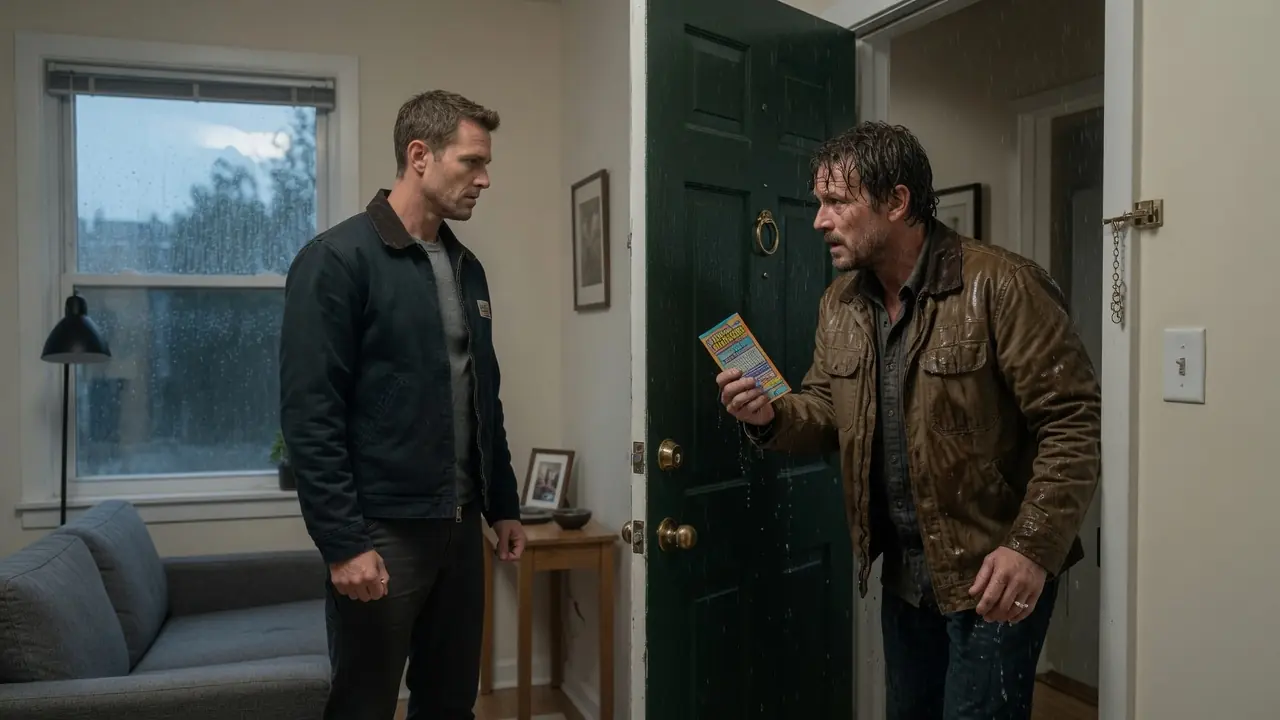
Jermaine crossed the apartment and opened the door.
Leon stood in the hallway wearing the same navy work jacket he had worn when security escorted the final shift from the building. Rain darkened the shoulders. His breathing was uneven, as though he had run from the parking lot.
A folded piece of paper trembled in his right hand.
“You need to look at this.”
Jermaine stepped aside.
“Not tonight, Leon.”
“I know what happened.”
“You don’t know half of it.”
“I know Tiffany left.”
Jermaine’s expression hardened.
News traveled quickly when lives were falling apart.
Leon raised both hands.
“I’m not here about her.”
“Then why are you here?”
Leon looked down at the paper.
“Do you remember the lottery pool?”
Jermaine stared at him.
The question was so absurd that for several seconds it meant nothing.
Every Friday, twelve warehouse employees contributed five dollars each to a lottery pool. Leon bought the tickets on his way home and placed copies of the numbers on the notice board near the break room.
Most weeks, they won nothing.
Once, they matched four numbers and received enough money for everyone to buy lunch.
On the final Friday before the closure, Jermaine nearly refused to participate. He needed every dollar for rent, groceries, and Tiffany’s overdue car payment.
Leon insisted.
“It might be our last ticket together,” he had said.
Jermaine handed him five dollars.
Now Leon unfolded the paper.
“The drawing was last night.”
Jermaine looked at him without understanding.
Leon placed the ticket on the kitchen table.
Six numbers had been circled in blue ink.
Below them was the jackpot amount.
One hundred eighty-six million dollars.
Jermaine looked from the ticket to his former coworker.
“Why are you showing me this?”
“Because we matched all six.”
The room became silent.
Rain tapped against the window.
A refrigerator motor switched on in the kitchen.
Jermaine gave a short, humorless laugh.
“That isn’t funny.”
“I’m not laughing.”
“We got laid off this morning.”
“I know.”
“My fiancée walked out ten minutes ago.”
“I heard the door from the stairwell.”
“And now you’re telling me we won the lottery?”
Leon pulled out his phone.
The official state lottery page showed the winning numbers.
They matched.
Jermaine checked each one twice.
Then a third time.
“It could be a mistake.”
“It isn’t.”
“The ticket could be fake.”
“I bought it at Patel’s Market. Same place as always.”
“Someone else could have the real one.”
Leon removed a plastic sleeve from inside his jacket.
The original ticket rested within it.
Jermaine’s knees weakened.
He pulled out a chair and sat.
“How many people were in the pool?”
“Twelve.”
“Still twelve after the layoffs?”
“We bought it before they closed the warehouse.”
Jermaine performed the calculation slowly.
After federal and state taxes, the lump-sum option would still leave each worker with several million dollars.
Enough to remove mortgages.
Enough to pay medical bills.
Enough to change every life connected to the final shift.
Leon sat across from him.
“I came here first because you kept the pool records.”
Jermaine looked toward the small metal box beneath the kitchen counter.
As a supervisor, he had maintained the signed contribution sheet each week to prevent disputes.
Every participant’s name was there.
Every payment had been recorded.
“What do we do now?” Jermaine asked.
“We say nothing until we speak to an attorney.”
“I don’t have an attorney.”
“You do now.”
Leon almost smiled.
“My cousin knows one who handles estates and financial planning.”
Jermaine looked at the engagement ring in his hand.
The diamond caught the kitchen light.
Leon noticed it.
“She really left?”
Jermaine placed the ring on the table.
“She said love couldn’t pay rent.”
Leon leaned back.
“She knew the warehouse closed?”
“She was waiting when I came home.”
“What did you tell her?”
“The truth. No severance beyond two weeks. Health insurance ends next month. I don’t know when I’ll find another job.”
“And she left immediately?”
Jermaine looked toward the closed door.
Tiffany had packed most of her clothes before he arrived.
That detail hurt more than the argument.
The suitcase had been waiting beside the couch.
The decision had been made before Jermaine entered the apartment.
“She said she was tired of being afraid,” he answered.
Leon’s eyes moved toward the ticket.
“Are you going to call her?”
“No.”
“You should at least tell her—”
“No.”
The word came more sharply than Jermaine intended.
He lowered his voice.
“She didn’t leave because I treated her badly. She didn’t leave because I betrayed her. She left because the numbers in our bank account changed.”
“That doesn’t mean she never loved you.”
“It means her love had conditions I didn’t know about.”
Leon did not argue.
Jermaine picked up the ticket.
A few hours earlier, he had stood outside the distribution center carrying a cardboard box containing eleven years of his life.
A framed photograph of the warehouse softball team.
Two coffee mugs.
A safety award.
The desk calendar Tiffany gave him for Christmas.
A plant he had forgotten to water.
The Westfield Distribution Center had employed nearly four hundred people in Jefferson County, Ohio. For decades, trucks moved through its loading bays day and night, carrying appliances, tools, and building supplies across the Midwest.
Then the parent company merged with a larger corporation.
Executives promised there would be no immediate closures.
Six months later, Westfield was considered redundant.
Jermaine received the official announcement at seven thirty that morning.
All operations would end immediately.
Some workers cried.
Others shouted.
Several stared at the floor as though waiting for the building to explain what they had done wrong.
Jermaine spent the final hour calming younger employees even though nobody calmed him.
He helped a forklift operator named Raymond call his wife.
He gave Leon the number of a union employment adviser.
He carried boxes for two women from payroll.
Only after the parking lot was nearly empty did he place his own belongings in the back seat of his twelve-year-old sedan.
He sat behind the steering wheel for twenty minutes before starting the engine.
Jermaine had built his life around being dependable.
His mother raised him and his younger sister alone after their father disappeared. At sixteen, Jermaine took a grocery-store job and contributed part of every paycheck to rent.
He did not finish college.
He worked.
He advanced slowly.
He became a shift supervisor because he arrived early, learned every position, and never asked someone to perform a task he would not perform himself.
The salary was not impressive.
But it was steady.
Steady allowed him to help his mother replace her furnace.
Steady paid for his sister’s final semester of nursing school.
Steady allowed him and Tiffany to plan a wedding for the following spring.
Then steady disappeared in a single morning.
When Jermaine entered the apartment, Tiffany was standing beside two suitcases.
She wore the gray sweater he bought her on their first Christmas together.
Her face was swollen from crying.
He stopped near the door.
“What’s happening?”
“I heard about the warehouse.”
“Who told you?”
“Danielle’s husband worked in shipping.”
Jermaine placed the cardboard box on the floor.
“We should sit down.”
“I can’t.”
“Tiffany.”
“I’ve been sitting here for three hours trying to convince myself not to do this.”
He looked at the suitcases.
“Do what?”
Her chin trembled.
“I’m going to my sister’s.”
“For how long?”
“I don’t know.”
Jermaine felt something cold move through his chest.
“We lost one income.”
“You lost the income that paid most of the bills.”
“I’ll find another job.”
“When?”
“I don’t know yet. It happened this morning.”
“That’s what scares me.”
He stared at her.
“You expected me to have another job before I got home?”
“No.”
“Then what did you expect?”
“I expected not to be here again.”
Jermaine understood.
Tiffany grew up in a house where electricity was regularly disconnected. Her mother moved the family seven times before Tiffany turned eighteen. Landlords knocked. Cars were repossessed. Food sometimes disappeared before the end of the month.
She feared instability the way other people feared illness.
Jermaine had always known that.
He did not know her fear was stronger than the future they promised each other.
“This is not your childhood,” he said.
“It feels exactly like it.”
“We have some savings.”
“Three months at most.”
“I can take temporary work.”
“And if that doesn’t cover everything?”
“We adjust.”
“I’ve spent my whole life adjusting.”
Her voice rose.
“I’m tired, Jermaine. I’m tired of counting every dollar. I’m tired of pretending one emergency won’t destroy us.”
“I thought we were building something.”
“So did I.”
“Then why are your bags already packed?”
Tiffany looked down.
The answer existed in the silence.
Jermaine removed the engagement ring from her finger only after she tried twice and could not manage the clasp of emotion around her hands.
She placed it in his palm.
“I do love you.”
Jermaine looked at the ring.
“But not poor.”
“That isn’t fair.”
“Neither is leaving me on the day I lose my job.”
Tiffany wiped her face.
“I can’t go back to having nothing.”
“We don’t have nothing.”
“It’s coming.”
“No. A difficult season is coming.”
She picked up the suitcase.
“Sometimes a difficult season becomes your whole life.”
Jermaine opened the door.
He did not beg.
That surprised both of them.
Tiffany waited in the doorway as though hoping he would stop her.
He wanted to.
But he imagined spending the rest of their marriage wondering whether she would leave whenever the ground shifted beneath them.
“Goodbye, Tiffany.”
She walked into the hallway.
Then Leon arrived carrying a ticket worth millions.
The pool members met the following morning inside the basement of a neighborhood church.
Leon insisted they avoid the warehouse, restaurants, and private homes where curious neighbors could see unfamiliar vehicles.
Jermaine brought the contribution records.
The twelve former employees sat in a circle of folding chairs.
Raymond Carter, who had three children and a mortgage already in foreclosure, cried before the attorney finished explaining the claim process.
Maria Santos held both hands over her mouth.
Her husband needed a kidney transplant.
A forklift mechanic named Dennis laughed until he began sobbing.
The ticket had transformed fear into possibility, but the attorney warned them not to behave as though the money already existed.
The claim had to be verified.
The ticket required secure storage.
The group needed legal agreements, tax planning, and privacy protection.
“No social media,” she said. “No new cars. No promises to relatives. No phone calls to reporters.”
Everyone agreed.
Within three days, someone told a spouse.
The spouse told a brother.
The brother mentioned it at a bar.
By the end of the week, local news vans waited outside the closed distribution center.
The lottery commission confirmed that the winning ticket belonged to a twelve-person workplace pool.
Individual names were not immediately released.
Jermaine changed his phone number after receiving more than eighty calls in one day.
Some came from relatives who had not spoken to him in years.
Some came from acquaintances proposing businesses.
One came from Tiffany.
He let it ring.
Then she sent a message.
I heard about the warehouse ticket. Please tell me you’re okay.
Jermaine read the message twice.
He did not answer.
Another followed.
I know what this looks like. I’m not asking for anything.
That was exactly what someone asking for something would say.
Jermaine placed the phone face down.
His mother, Gloria, learned about the ticket from the evening news.
She drove to his apartment wearing slippers and a winter coat over her nightgown.
“Is it true?”
Jermaine let her in.
“It looks true.”
“How much?”
“I don’t know exactly.”
“Enough?”
He smiled for the first time in days.
“Enough for what?”
Gloria slapped his shoulder lightly.
“Enough that you’re making that foolish face.”
He told her.
His mother sat on the couch.
For a full minute, she said nothing.
Then she whispered, “We won’t owe anybody?”
“No.”
“The house?”
“I’ll pay it off.”
“My medical bills?”
“All of them.”
Gloria looked toward him.
“You don’t have to do that.”
“I know.”
Tears filled her eyes.
“You were taking care of people before you had money.”
“That doesn’t change now.”
“It will try.”
Jermaine sat beside her.
“What do you mean?”
“Money doesn’t change everybody, baby. Sometimes it just gives the hidden parts more room.”
He thought about Tiffany.
Gloria noticed.
“She called me.”
Jermaine turned.
“When?”
“This morning.”
“What did she say?”
“That she made a terrible mistake.”
“Did she know about the ticket?”
“Yes.”
“Then the timing answered the question.”
Gloria studied him.
“Maybe.”
“There’s no maybe.”
“You think pain follows clean rules?”
“She packed before I got home.”
“Yes.”
“She left while I was unemployed for less than one day.”
“Yes.”
“Now I’m rich and she wants to talk.”
Gloria nodded.
“That looks bad.”
“It is bad.”
“It can be bad and still not be the entire truth.”
Jermaine stood.
“I’m not taking her back.”
“I didn’t tell you to.”
“She chose.”
“So did you when you refused to stop her.”
Jermaine looked at his mother.
“You think I should have begged?”
“No. I think both of you acted while terrified.”
“She wasn’t the one who had just lost everything.”
Gloria’s expression softened.
“She believed she was about to.”
“That isn’t the same.”
“No.”
His mother rose.
“But fear can make people leave before they are abandoned. It can also make people punish before they understand.”
Jermaine did not respond.
The group claimed the prize anonymously through a legal trust.
After taxes and professional fees, Jermaine received a little more than nine million dollars.
He did not purchase a mansion.
He remained in the apartment for six months.
He paid off Gloria’s home and established a medical fund for her.
He created education accounts for his sister’s children.
He replaced his car only after the old sedan failed to start for the third time.
The largest decision concerned the closed warehouse.
Leon brought the idea during a meeting at Jermaine’s kitchen table.
“What if we buy it?”
Jermaine looked at him.
“The warehouse?”
“The corporation wants to sell the property. They don’t care what happens to it.”
“What would we do with a building that already failed?”
“It didn’t fail. The company decided another building was cheaper.”
Leon opened a folder.
A regional furniture manufacturer needed distribution space. Two local suppliers wanted shared storage. Several former Westfield clients still required shipping services in the county.
“We know the building,” Leon continued. “We know the workers. We know the routes.”
Jermaine reviewed the numbers.
Buying the property would require a significant investment from any pool members willing to participate.
It could fail.
The lottery money allowed Jermaine never to work again.
But retirement at thirty-eight felt less like freedom than surrender.
He remembered the employees walking into the parking lot with cardboard boxes.
“What would we call it?” he asked.
Leon smiled.
“Second Shift Logistics.”
Six of the twelve winners invested.
Jermaine contributed the largest share and accepted the role of operations director.
They hired former Westfield employees before advertising positions publicly.
Raymond returned as transportation supervisor.
Maria managed client accounts.
Dennis led equipment maintenance.
Within a year, Second Shift employed one hundred and forty people.
The story attracted attention because it sounded like a fantasy: laid-off workers won the lottery and purchased the warehouse that dismissed them.
Reporters focused on the money.
They rarely understood that the ticket made the purchase possible, but knowledge made the business work.
Jermaine still arrived before sunrise.
He wore work boots.
He walked the loading floor each morning and learned the names of new employees.
Wealth did not remove the part of him that needed to be useful.
Tiffany called several times during those months.
Jermaine ignored the first four calls.
He responded to the fifth with a message.
I’m not ready to talk. Please respect that.
She replied:
I will. I’m sorry.
Then she stopped calling.
The silence surprised him.
He expected flowers, letters, or dramatic appearances at the warehouse.
Nothing came.
Three months later, Jermaine visited a community employment center to discuss a training partnership for Second Shift.
He saw Tiffany through the glass wall of a classroom.
She stood beside six women reviewing résumés.
Jermaine waited in the hallway until the session ended.
Tiffany emerged carrying folders.
She stopped.
Neither spoke at first.
Her appearance had changed.
The polished office clothes she wore during their relationship were gone. She wore simple black trousers, a white blouse, and worn flats.
“What are you doing here?” Jermaine asked.
“I work here.”
“Since when?”
“Two months.”
“You left the insurance office?”
“They eliminated my position.”
Jermaine stared at her.
“You lost your job?”
“Yes.”
“When?”
“Three weeks after I left you.”
He searched her face for some sign that the story had been designed for sympathy.
“What did you do?”
“I applied everywhere.”
“Why didn’t you call me?”
“You told me not to.”
“You could have after losing the job.”
“To ask the lottery winner for help?”
Her voice held no anger.
“I had already made myself look like someone who only stayed when life was easy. Calling then would have made it worse.”
Jermaine looked toward the classroom.
“What do you do here?”
“I help displaced workers with applications and interviews.”
“That pays almost nothing.”
“I know.”
“Where are you living?”
“With my sister.”
“Why?”
“Because fear made me leave the best home I ever had.”
Jermaine’s chest tightened.
Tiffany continued before he could answer.
“I’m not asking you to take me back.”
“Then what are you asking?”
“Nothing.”
She adjusted the folders in her arms.
“I wanted to apologize before the lottery. I drove to your apartment the morning the news broke. Reporters were outside. I left because I knew anything I said after that would sound like a lie.”
Jermaine remembered the first message.
Please tell me you’re okay.
Not congratulations.
Not how much did you win.
Only whether he was okay.
“You packed before I got home,” he said.
“I did.”
“You didn’t give me a chance.”
“No.”
“Why?”
Tiffany looked toward the floor.
“My father lost his job when I was twelve. He promised he would fix everything. Two months later, he left. My mother stopped paying rent because she believed he was coming back. We were evicted.”
“I’m not your father.”
“I know that now.”
“You knew it then.”
“I loved you then. But I had never learned the difference between danger and a memory of danger.”
Jermaine said nothing.
“I saw your cardboard box,” she continued. “I saw the fear on your face, and suddenly I was twelve again. I left before you could leave me.”
“You punished me for what another man did.”
“Yes.”
The honesty removed some of his anger’s protection.
Tiffany’s eyes filled, but she did not look away.
“I don’t deserve to return just because you have money. I may not deserve to return at all.”
Jermaine folded his arms.
“Do you regret leaving because I won?”
“I regret leaving because I finally understood what I lost.”
“That sounds convenient.”
“It does.”
“How am I supposed to know the difference?”
“You can’t know from anything I say.”
She handed the folders to a passing employee.
“All I can do is live differently, whether you ever forgive me or not.”
Tiffany walked away.
Jermaine attended the scheduled meeting but remembered little of it.
Over the following weeks, Second Shift began sending job applicants to the employment center.
Jermaine saw Tiffany often.
She did not seek him out.
She treated warehouse applicants with patience, especially older workers struggling with online forms.
She stayed late to help a single mother arrange transportation for an interview.
She built a workshop about financial trauma and career loss.
The workshop’s opening sentence appeared on a handout:
Losing income can feel like losing identity, safety, and belonging. Fear may tell us to run before we understand what is actually happening.
Jermaine read the line twice.
Their first real conversation took place in a diner six months later.
He invited her.
Tiffany arrived early and ordered coffee.
Jermaine sat across from her.
“I’m still angry.”
“You should be.”
“I don’t trust you.”
“I understand.”
“I miss you.”
Her eyes changed.
She placed both hands around the coffee cup.
“I miss you too.”
“That isn’t enough.”
“No.”
He appreciated that she did not rush to promise more.
“We cannot return to what we had,” Jermaine said.
“I know.”
“That relationship ended when you walked out.”
Tiffany nodded slowly.
“Then maybe we don’t return.”
“What does that mean?”
“We start from where we are.”
Jermaine looked through the diner window.
His new truck waited outside. He owned a company, several properties, and enough investments to remain wealthy for the rest of his life.
Yet none of those things could purchase certainty.
Money solved problems of cost.
It did not solve questions of character.
“Would you have come back if the ticket lost?” he asked.
Tiffany’s answer came quietly.
“I don’t know.”
Jermaine faced her again.
She continued.
“I want to tell you yes because that is the answer that might save us. But on the night I left, I was still trapped inside my fear. Maybe losing my own job would have made me understand. Maybe pride would have kept me away.”
She wiped one tear from her cheek.
“I can only tell you what I know now. I was wrong. You deserved partnership, and I gave you panic. Whether you forgive me or not, I will never treat another person’s difficult season like proof their life is over.”
The answer was imperfect.
That made Jermaine believe it.
He did not return the engagement ring.
Not that night.
They began with dinner once a week.
Then walks.
Tiffany met Gloria again and apologized without excuses.
Gloria listened, hugged her, and warned her that forgiveness was not permission to repeat the harm.
Tiffany agreed.
Jermaine watched how she behaved when nothing was being offered.
She continued working at the employment center despite receiving better-paying offers from companies interested in her connection to him.
She eventually accepted a position directing workforce programs, but only after negotiating transportation assistance and emergency childcare for participants.
A year passed.
One evening, Jermaine brought Tiffany to the loading dock after the final shift.
The warehouse lights stretched across the polished floor.
“This is where they told us we were finished,” he said.
Tiffany looked around.
“And now?”
“Now people start again here.”
He removed a small box from his jacket.
Tiffany’s breath caught.
Jermaine opened it.
The same ring rested inside.
“I’m not asking you to continue the engagement we had.”
She waited.
“I’m asking whether you want to build a new one.”
Tiffany began crying.
“You’re sure?”
“No.”
She looked surprised.
Jermaine smiled faintly.
“I’ve learned that certainty is overrated. I trust what you’ve done more than what either of us promised before.”
He held out the ring.
“We may lose things again. The company could fail. Money can disappear. People get sick. Life changes.”
“I know.”
“If your answer depends on what I own, say no.”
Tiffany looked at the loading floor, the place built by people who had lost their jobs and refused to let loss define them.
Then she looked at Jermaine.
“My answer depends on who I’m willing to become beside you.”
She held out her hand.
“Yes.”
They married the following spring in the courtyard behind Gloria’s house.
The ceremony was small.
Leon served as best man.
The former warehouse lottery pool occupied two rows of folding chairs.
Jermaine and Tiffany did not present their relationship as a perfect story.
She had left.
He had allowed anger to become a wall.
They rebuilt slowly because neither believed love could survive on dramatic apologies alone.
Years later, a reporter asked Jermaine whether winning the lottery was the luckiest moment of his life.
He thought about the ticket.
Without it, Second Shift Logistics would not exist.
His mother’s house might still carry a mortgage.
Hundreds of workers might have been forced to leave Jefferson County.
But the money also attracted false friends, distant relatives, and strangers who loved the idea of access more than they cared about him.
“The ticket gave me choices,” Jermaine said. “That was luck.”
“And Tiffany?”
Jermaine looked toward his wife as she spoke with several workers near the warehouse entrance.
“That wasn’t luck.”
“What was it?”
“Work.”
The reporter appeared disappointed by the answer.
Jermaine understood.
People preferred stories in which fortune solved everything.
Those stories were easier.
The truth was that Tiffany did not deserve a second chance because Jermaine became wealthy.
She earned the possibility of one because she accepted responsibility when forgiveness was not guaranteed.
Jermaine did not take her back because the lottery made him powerful enough to overlook pain.
He allowed her to return because her actions proved she no longer believed hardship made a person disposable.
Opportunity had knocked on Jermaine’s door minutes after Tiffany walked out.
But the greatest change in his life did not come from the winning numbers.
It came later, when two people understood that a second chance was not the same as pretending the first betrayal never happened.
It was a new beginning built with open eyes.
And unlike lottery tickets, beginnings like that were never won by accident.