You don't get to decide who deserves shelter. Evelyn Harper's voice cuts through the thunder like a blade. The councilman's face goes red. Behind her, 35 leather-clad strangers dripping rainwater onto her diner floor. Outside, the storm tears the night apart.
He points at the Hells Angels patches. You're harboring criminals. She doesn't blink. I'm feeding people who walk through hell to get out of the rain. He leans closer.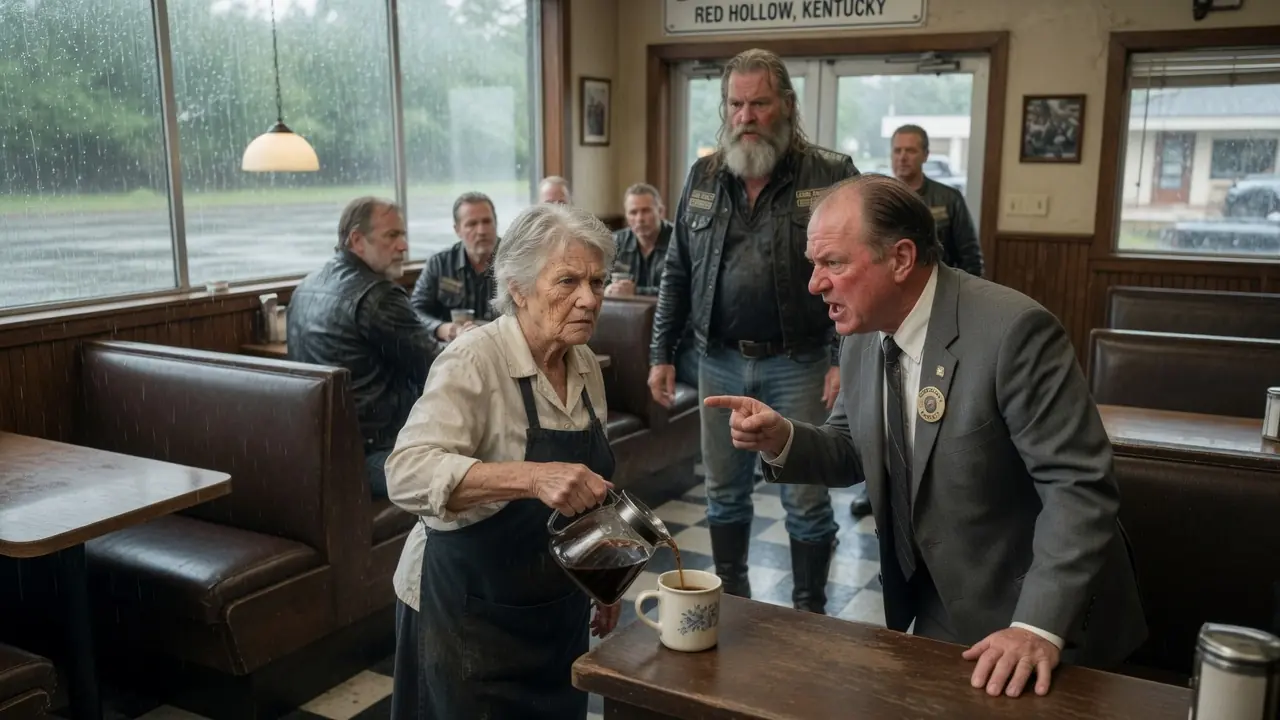
This will destroy you. She pours coffee into a chipped mug. Then I'll be destroyed. The bikers don't move. The town is watching. And Evelyn Harper just chose her side. If you want to see how One Woman's Choice ignites a movement that brings 400 bikers to a town of 2,000, subscribe to this channel and stay with me until the end.
Drop a comment telling me what city you're watching from so I can see how far this story travels. The rain hit Red Hollow like punishment. Evelyn Harper stood at the window of her diner, the Blue Ridge Cafe, watching water hammer the cracked asphalt parking lot, 72 years old, arthritis in both knees, a mortgage 3 months behind in a building that had been serving coffee since 1967. She'd owned it for 40 years. Tonight might be the night it finally broke her.
The phone on the wall rang. She didn't move to answer it. It had been ringing every 20 minutes since 6:00. Same voice every time. Councilman Gerald Pruittt, Mrs. Harper, we need to discuss the property taxes.
She knew what that meant. It meant the town wanted her land. It meant they'd been circling for months. It meant this place, the last diner for 60 mi on Route 29, was worth more empty than full. The phone stopped ringing.
Thunder rolled across the mountains. And then she heard it. Engines. Not one, not two, dozens. Evelyn turned from the window and walked to the front door. Her waitress, Marcy Talbot, 23, nursing school dropout, looked up from wiping down tables. You expecting a crowd?
No. The engines grew louder, closer. Evelyn opened the door. The first motorcycle pulled into the lot at 8:47 p.m. Then another, then five more, then 20. They kept coming.
Headlights cutting through the rain. Leather jackets slick with water. Faces she didn't recognize. Patches on their backs she'd only seen on television. Hell's angels.
Marcy stepped beside her. Oh my god. Go to the kitchen. Mrs. Harper. Now.
Marcy disappeared through the swinging doors. Evelyn stayed in the doorway. The bikes formed a rough semicircle in the parking lot. 35 of them, maybe more. The riders dismounted slowly, stiff, soaked, exhausted.
One woman stumbled getting off her bike. A man caught her elbow. The lead rider, tall, broad shoulder, gray beard, streaked with rain, pulled off his helmet, and looked directly at Evelyn. She didn't move. He walked toward her, stopped five feet from the door.
Ma'am, his voice was rough, worn down. We don't want trouble. Evelyn studied his face. in his fifties, with a scar above his left eye. Hands shaking not from fear, from cold. Then what do you want? Shelter.
He glanced back at his people. Just for tonight. We'll pay. We'll leave before sunrise. We just His voice cracked. We just need to get out of the rain.
Behind him, a woman coughed deep, wet, the kind of cough that rattled ribs. Evelyn looked past the man, saw another rider struggling to breathe, saw a third barely able to stand. They weren't threatening her, they were begging. How many of you? 35.
I've got seating for 40. The man blinked. You're saying I'm saying get inside before you drown. For Three seconds, nobody moved. Then the man turned to his crew. You heard her inside.
Wipe your boots. Don't touch anything you don't need to touch. They filed in one by one. Evelyn stepped aside and held the door. Marcy appeared from the kitchen.
Her face had gone pale. Mrs. Harper, what are you doing? Making coffee. You're going to help me. Do you know who these people are?
People who are cold and wet. They're Hell's Angels. And right now, they're customers. Evelyn walked behind the counter. Start the coffee. I'll get the soup going.
Marcy didn't move. This is insane. Then leave. Marcy stared at her, then at the bikers filling the booths and tables, then back at Evelyn. She didn't leave. The diner filled with the sound of wet leather and quiet conversation.
The bikers didn't shout, didn't slam things. They just sat grateful, exhausted, dripping onto the linoleum. The man with the gray beard approached the counter. What do we owe you for what? Shelter, food, whatever you're willing to give us.
Evelyn poured coffee into a mug, set it in front of him. You pay what you eat. Same as anyone. He looked at her for a long time. Then he pulled out his wallet. Name's Garrett.
Evelyn. Thank you, Evelyn. She nodded and moved down the counter, started pulling out bowls. Marcy brought bread from the kitchen. They worked in silence.
Outside, the rain didn't stop. Inside, 35 strangers waited, and Evelyn Harper fed them. At 9:14 p.m., the door opened again. Councilman Gerald Pruittt stepped inside. 60 years old, pressed suit, thinning hair, slicked back.
He stopped 3 ft into the diner and stared. Evelyn looked up from the counter. We're full Gerald. He didn't respond. Just stood there scanning the room, taking in the leather jackets, the patches, the faces. Then he walked to the counter.
Mrs. Harper, a word outside. I'm working now. Garrett stood up from his booth slowly. Pruitt's eyes flicked to him, then back to Evelyn. "It's fine," Evelyn said quietly.
She untied her apron, walked around the counter, followed Pruittt out into the rain. "The door closed behind them." Pruitt turned on her immediately. "What the hell are you doing running my business? You're harboring criminals. I'm serving customers.
Do you know who these people are?" His voice rose. "Do you have any idea what you've just invited into this town?" Evelyn crossed her arms. Rain soaked through her blouse. I know they're cold. I know they're wet.
I know they asked for help. They're Hells Angels, Evelyn. They're a gang. There are people sitting in my diner drinking coffee. Pruittt stepped closer.
This will not stand. You are endangering this community. I will shut you down. On what grounds? Public safety, a health code violations, zoning infractions.
Take your pick. His face was inches from hers. Now you think you're being kind. You're being reckless. And when something goes wrong, when one of them hurts someone, it's on you.
Evelyn didn't flinch. Are you finished? Pruittt's jaw tightened. You have 1 hour to get them out or I'm calling the sheriff. He turned and walked to his car, drove off into the rain.
Evelyn stood there for a moment. Then she walked back inside. The diner had gone quiet, every eye on her. Garrett stood near the counter. We'll leave. Sit down, ma'am.
Maybe this isn't worth it. Evelyn turned to face her. You ever been caught in a storm with nowhere to go? Marcy didn't answer. I have.
Evelyn's voice was quiet, steady. I was 19, pregnant. Husband left me on the side of a highway in Tennessee. Middle of winter, no money, no phone, just me in a storm. She paused.
A truck driver stopped. Didn't ask questions. Drove me 200 miles to my sister's house. Never saw him again. Marcy's eyes filled.
I don't care what patches they wear, Evelyn said. They asked for help. I'm giving it. She walked back to the counter, started making more coffee. Garrett approached again.
We don't want it to cause you trouble. Too late for that. Then let us make it right. We'll pay double, triple, whatever you need. Evelyn looked at him. I don't need your money, Garrett.
I need you to eat your soup and stay warm. His throat worked. He nodded. At 10:33 p.m., Evelyn's phone rang again. She answered it this time.
Blue Ridge Café. A woman's voice, sharp, unfamiliar. Is it true you're sheltering Hells Angels? Evelyn paused. Who is this channel 9 news?
We received a tip that Evelyn hung up. 2 minutes later, it rang again. Different number. Mrs. Harper, this is Todd Brennan from the Lexington Herald. We'd like to ask you a few questions about She hung up.
Marcy stared at her. How do they know? Evelyn looked out the window. Across the street, she saw a movement. A phone camera pointed at the diner. Then another.
People were watching and they were recording. At 11:08 p.m., Evelyn's email inbox started filling. She didn't have a computer at the diner, but Marcy did. A laptop for school. Marcy opened it.
Her face went. Mrs. Harper, what? You're trending. What does that mean? Marcy turned the laptop around.
There was a photo of the diner. Motorcycles in the lot. The headline read, "Small town diner shelters. Hell's Angels gang in Kentucky Storm. Below it, hundreds of comments, thousands.
She's putting the whole town at risk. This is what courage looks like. Someone needs to shut that place down. She's a hero. She's an idiot.
Evelyn stared at the screen. Then she closed the laptop. Doesn't matter. Doesn't matter. Marcy's voice cracked. You're all over the internet and they're still cold and I'm still cooking.
At 11:47 p.m. the door opened. Sheriff Tom Wakefield stepped inside. 58 gray mustache uniform soaked through. Evelyn met him at the counter. Tom.
Evelyn. He looked around the room. Pruittt called me. I figured said you're harboring fugitives. I'm serving dinner.
Tom sighed, took off his hat. Are any of them wanted? Garrett stood up, walked over, pulled out his wallet, handed Tom his ID. Garrett Mills, Akron, Ohio. No warrants.
Clean record. Tom looked at the ID, then at Garrett. And the rest? Same. We're not here to cause trouble, Sheriff. We're just passing through.
Storm caught us by surprise. Tom studied him. Then he looked at Evelyn. You know what you're doing? Yes. You sure about that?
Yes. Tom put his hat back on. I'll be parked outside. Anything happens, anything at all, you call me. Thank you, Tom.
He nodded, walked out. The room exhaled. At 12:23 a.m., a woman in the back booth started coughing again harder this time. She doubled over. Evelyn grabbed a glass of water, walked over.
The woman looked up, in her forties, brown hair plastered to her face, eyes red. I'm okay. You're not. I'll be fine. Evelyn set the water down.
When's the last time you saw a doctor? The woman didn't answer. There's a clinic in town. Opens at 8:00. I can't afford.
I'll take you. The woman stared at her. Why? Because you're sick. Tears started down the woman's face. She didn't wipe them away.
Evelyn sat down across from her. What's your name, Angela? Where are you coming from, Angela? Nowhere going nowhere. Her voice broke, just trying to stay ahead of it.
Ahead of what? Angela looked at her hands. Everything. Evelyn reached across the table, took her hand. You're not ahead of it tonight.
You're here, and you're safe. Angela's shoulders shook. She cried quietly, desperately, and Evelyn held her hand until it passed. At 1:15 a.m., most of the bikers had fallen asleep in the booths. A few stayed awake, keeping watch.
Marcy approached Evelyn at the counter. I'm sorry for what? For doubting you. Evelyn smiled. You're still here.
That's what matters. Marcy looked around the room. What happens tomorrow? I don't know. Are you scared?
Evelyn thought about it. No. Why not? Because I did the right thing. Whatever comes next, I can live with it. At 2:47 a.m., Evelyn finally sat down.
Her knees achd, her back screamed, but the diner was warm. The people inside were sleeping. And outside, the rain had started to ease. Garrett walked over, sat across from her. You didn't have to do this. Yes, I did.
Why? Evelyn looked at him. Because someone did it for me once, and I never forgot. Garrett nodded slowly. We'll be gone by sunrise.
I know. But before we go, he reached into his jacket, pulled out a phone. I need to make a call. To who? My chapter and a few others.
He looked at her. What you did tonight, it matters more than you know. I just fed you dinner. No. His voice was firm.
You saw us. When the whole world sees monsters, you saw people. That's rare, Evelyn. That's worth protecting. I don't need protecting.
You will. He stood, walked outside, made his call. Evelyn watched him through the window. And somewhere in the darkness, beyond the rain, beyond the mountains, beyond everything she could see, something was already moving toward her. At 6:12 a.m., the first biker woke up, then another, then all of them.
They cleaned their tables, stacked their dishes, left cash on the counter, more than they owed. Angela approached Evelyn at the register. "I don't know how to thank you." "You don't have to." "Yes, I do." She pressed something into Evelyn's hand. A folded piece of paper. If you ever need anything, call that number.
Evelyn looked at it. A phone number. Nothing else. Whose number is this? Angela smiled.
Someone who remembers. By 6:45 a.m., the parking lot was empty. The bikers were gone. The diner was quiet. Marcy sat at the counter, exhausted.
Think that's the end of it? Evelyn looked out the window. The sun was rising. The storm had passed, but down the road she could see cars pulling up, news vans, cameras, and her phone was ringing again. "No," Evelyn said quietly.
"I don't think it is." The first news van arrived at 7:03 a.m. Evelyn was wiping down the counter when the headlights swept across the diner windows. Then another van, then three more. Marcy looked up from refilling the coffee station. "They're here." Evelyn didn't stop wiping. Let them wait. By 7:30 a.m., the parking lot was full of vehicles that weren't motorcycles, satellite trucks, sedans with press credentials taped to dashboards, reporters checking their hair inside mirrors.
The phone hadn't stopped ringing since sunrise. Evelyn finally unplugged it from the wall. "Mrs. Harper," Marcy started. "Not now." A knock on the door, sharp, insistent. Evelyn walked over and opened it 6 in.
A woman in her thirties stood there, microphone in hand, cameraman behind her. Mrs. Harper, I'm Jennifer Kostas with Channel 9. Do you have a moment to comment on last night's events? No, just a few questions. I said no.
Evelyn closed the door, locked it. The woman knocked again harder. Evelyn walked back to the counter and started prepping for the breakfast shift. At 8:15 a.m., Evelyn's daughter called. Marcy handed her the cell phone.
It's Rachel. Evelyn wiped her hands on her apron, took the phone. Rachel. Mom, what the hell is going on? Her daughter's voice was tight, angry.
I'm seeing foes of the diner all over Facebook. People are saying you sheltered a gang. I sheltered people caught in a storm. Hells Angels mom. Hells Angels.
They were cold. I don't care if they were freezing to death. You don't invite criminals into your business. Evelyn's grip tightened on the phone. They weren't criminals.
How do you know that? Because I asked. Rachel laughed. Sharp, bitter. You asked. And they told you the truth. Because gang members are so honest. Rachel, do you have any idea what this could do to you, to the diner, to this town?
Her voice cracked. People are talking about boycotting you, about shutting you down, and for what? For 35 strangers who will never even remember your name. Evelyn closed her eyes. They already remember it.
What? Nothing. I have to go. Mom, wait. Evelyn hung up.
Marcy was staring at her. She doesn't understand, Evelyn said quietly. Maybe she's right. Evelyn looked at her. Then leave. Marcy's face flushed.
I didn't mean I know what you meant. Evelyn's voice was gentle. Tired. And maybe you should before this gets worse. Marcy didn't move. She looked at the locked door.
The news vans outside, the phone still unplugged on the wall. Then she tied her apron tighter. I'm staying. At 9:02 a.m., the first protester arrived. Evelyn saw him through the window. Late 20s, holding a handmade sign.
Evelyn Harper supports criminals. He stood near the road alone at first. By 9:30 a.m. there were six of them. By 10 a.m. 12. Marcy's hands shook as she poured coffee for the three customers who'd come in despite everything.
Mrs. Harper. Ignore them. They're calling you a criminal. Then they're wrong. One of the customers, Bill Hendricks, 71, retired postal worker, sat down his newspaper. Evelyn.
She walked over. Bill, you know I respect you. I do. But this, he gestured toward the window. This is dangerous. Those people last night, they could have hurt someone, could have destroyed property, and you welcomed them like like human beings.
Bill's jaw tightened. You're twisting my words. Am I You don't understand what you've done. This town, he paused. This town is scared.
Evelyn sat down across from him. Of what? Of them? Of change? of he stopped, looked at his coffee. Of what it means when someone like you chooses them over us.
I didn't choose anyone over you, Bill. I just didn't turn anyone away. That's the same thing. Evelyn leaned back. No, it's not.
Bill stood up, pulled money from his wallet, set it on the table. Hope you know what you're doing. He walked out. The other two customers followed. At 10:47 a.m., Councilman Pruittt returned.
He didn't knock, just walked in like he owned the place. Evelyn looked up from the register. We're closed. No, you're not. He walked to the counter, set down a folder.
Health inspection scheduled for this afternoon. I had one three months ago. You're having another one today. He smiled thin, cold, and tomorrow building inspector. And the day after, fire marshall. Evelyn opened the folder, flipped through it.
You're auditing me. I'm protecting this town. From what? From you. He leaned forward.
You made a choice last night, Evelyn. And choices have consequences. Then so do yours. His smile faded. Meaning meaning I'm not shutting down. I'm not apologizing. And I'm not pretending I did something wrong. Pruittt's face darkened.
You will lose everything. Maybe. Your business, your reputation, everything you've built. I built this place on taking care of people who needed it. That hasn't changed.
Those people are gone. They used you. And now you're standing here defending them while your own neighbors turn against you. Evelyn stood up, walked around the counter, faced him. Get out.
Excuse me? I said get out. You're not here for an inspection. You're here to intimidate me. It's not working.
Pit stared at her. Then he picked up his folder. You'll regret this. He walked out. Marcy exhaled. Oh my god.
Evelyn's hands were shaking. She pressed them flat against the counter. We need to prep for lunch. Mrs. Harper. Marcy, please.
Marcy nodded. Went to the kitchen. At 11:33 a.m., Evelyn's phone buzzed. A text message. Unknown number.
Check your email. Evelyn frowned, opened her laptop. Her inbox had 847 unread messages. She scrolled through them. Subject lines blurred together.
You're a hero. You're a disgrace. Thank you for your courage. You should be arrested. She stopped on one from Garrett Mills.
Subject. Thank you. She opened it. Evelyn, I don't have the words to properly thank you for what you did last night. You didn't just feed us, you reminded us what humanity looks like.
I need you to know something. What's coming? It's not your fault. It's ours. We called in reinforcements not to cause trouble, to make a statement.
Tomorrow morning, you're going to see something that scares you. Don't be afraid. We're coming to say thank you the right way. Stay strong. Garrett Evelyn read it three times.
Then she saw the second message sent Two minutes later from unknown subject. No subject. We're coming tomorrow. Be ready. Her stomach dropped.
Marcy appeared from the kitchen. What's wrong? Evelyn closed the laptop. Nothing. You look like you've seen a ghost.
I'm fine. But she wasn't. At 12:14 p.m., the health inspector arrived. Young, in his mid-thirties, clipboard in hand. He walked through the diner like he was looking for corpses. Evelyn followed him.
He opened the refrigerator, checked temperatures, made notes. This chicken is stored improperly. It's separated by type. Below beef, contamination risk. He moved to the grill, ran a finger along the edge, showed her the grease.
Buildup, a health code violation. That's from this morning's service. Doesn't matter. He spent 90 minutes documenting everything. Every smudge, every crack in the tile, every chipped plate.
When he finished, he handed Evelyn a citation. You have seven days to correct these violations. If you don't, I'll recommend closure. He walked out. Evelyn stood there holding the paper.
Marcy took it from her hands, read it, her eyes filled. This is insane. Half of these aren't even real problems. They are now. At 1:47 p.m., the first brick came through the window.
Evelyn heard the crash, turned. Glass scattered across the floor. A brick sat in the middle of the dining room. Paper wrapped around it. Marcy screamed.
Evelyn walked over, picked up the brick, unfolded the paper. Get out. She looked through the broken window. The protesters were still there. More of them now.
20, maybe 30. One of them was holding his phone up, recording. Evelyn set the brick on the counter. Call Tom. The sheriff.
Yes. Marcy pulled out her phone. Her hands were shaking so hard she could barely dial. Sheriff Wakefield arrived 12 minutes later. He looked at the window, the brick, the protesters outside.
Who threw it? I don't know. Tom walked outside. Evelyn followed. He approached the crowd.
All right. Who wants to explain this? Silence. Anyone? A man in his 40s stepped forward.
We're exercising our right to protest by throwing bricks through windows. I didn't throw anything, but someone here did. The man shrugged. can't control what other people do. Tom's face hardened. You've got two choices.
Disperse now or I start arresting people for vandalism and assault. We have a right to be here. Not when you're destroying property. Tom pulled out his handcuffs. Last chance. The crowd shifted, murmured. Then slowly, reluctantly, they started to leave.
Tom walked back to Evelyn. You okay? Yes. No, you're not. He looked at the broken window.
This is escalating, Evelyn. And I can't protect you from all of it. I'm not asking you to. You should be. At 3:21 p.m., Evelyn's landlord called. Marcy answered, handed Evelyn the phone.
Mrs. Harper, this is David Chen. I know who you are, David. I need to talk to you about the lease. Evelyn's chest tightened. What about it?
There's a clause, section 14. It states that if the property is used in a way that endangers public safety, the lease can be terminated. David, I'm getting calls, Mrs. Harper, from the town council, from business owners. People are threatening to pull their accounts from my firm. Firm Aish, if I don't want to act.
I didn't do anything wrong. I know, but that doesn't matter. His voice was pained. I have to protect my business by destroying mine. Silence.
David, please. I'm sorry. I'll give you 30 days. He hung up. Evelyn set the phone down.
Marcy was staring at her. What did he say? He's terminating the lease. He can't. He can. And he did.
Marcy sat down hard. This is really happening. Yes. What are you going to do? Evelyn looked around the diner.
40 years of her life. Every crack in the counter, every stain on the floor, every memory baked into the walls. I'm going to keep cooking. At 4:58 p.m., Evelyn's phone buzzed again. Another text.
Unknown number. Tomorrow. 8:00 a.m. Don't be afraid. She stared at it. Marcy looked over her shoulder.
What does that mean? I don't know. Should we be worried? Evelyn thought about Garrett's email, the message, the promise. No.
How do you know? I don't, but I'm choosing to believe it. At 6:47 p.m., the diner was empty except for Marcy. They'd cleaned up the glass, boarded the broken window, swept the floors. Now they just sat.
Marcy broke the silence first. Why are you doing this? Evelyn looked at her. Doing what? Fighting when everyone's telling you to stop.
Evelyn thought about it. About the truck driver who saved her. About the biker shivering in the rain. About every person who'd ever needed help and been turned away. Because someone has to. But why you? Because I'm the one who's here. Marcy's eyes filled.
I'm scared. I know. What if tomorrow? She stopped. What if it's bad?
Evelyn reached across the table, took her hand. Then we'll handle it together. At 9:12 p.m., Evelyn locked the diner and walked to her car. The parking lot was empty. The protesters were gone. The news vans had left, but she could feel something building, like pressure before a storm.
She drove home. A small house on the edge of town, one bedroom, peeling paint. 43 years of memories inside. She made tea, sat at her kitchen table, opened her laptop. Her inbox had doubled.
1,642 messages now. She scrolled through them. Hate, support, threats, praise, and then she saw one that made her stop. From Angela subject, tomorrow. Evelyn, you saved my life last night.
Not just from the rain, from giving up what you're about to see tomorrow. Don't be afraid. We're not coming to hurt you. We're coming to protect you. You showed us what grace looks like.
Now, let us show you what loyalty means. See you at sunrise. Angela. Evelyn closed the laptop, walked to her bedroom, lay down fully clothed, and waited for tomorrow. At 5:47 a.m., her alarm went off.
She got up, showered, dressed, drove to the diner in darkness. Marcy was already there. Couldn't sleep. No. They worked in silence, made coffee, prepped the grill, unlocked the door.
The sun started to rise. And then at 7:53 a.m., Evelyn heard it. That sound, engines, not 35 this time, hundreds. Marcy ran to the window. Oh my god. Evelyn walked to the door, opened it, and the ground began to shake.
They came from the east first. A line of headlights stretching back so far Evelyn couldn't see where it ended. The rumble grew louder, deeper, like thunder that wouldn't stop. Marcy grabbed Evelyn's arm. What do we do?
Nothing. Mrs. Harper, we do nothing. The first bike pulled into the lot at 7:58 a.m. Then 10 more, then 50. They kept coming, filling the parking lot, spilling onto the road, lining up along the shoulder. A wall of chrome and leather and purpose.
Evelyn stood in the doorway and watched. Garrett was on the lead bike. He killed the engine, dismounted, walked toward her. Behind him, the others did the same. One by one, engines cutting out, silence replacing the roar.
400 people, maybe more. All of them looking at her. Garrett stopped five feet away. Morning, Evelyn. Her voice came out steady, calm.
Garrett brought some friends. I see that. He smiled, tired, grateful. We heard what happened yesterday. The brick, the threats, the council coming after you.
He paused. We couldn't let that stand. So, you brought an army. We brought witnesses. He turned and gestured to the crowd behind him.
Every person here, they know what you did. They know you chose kindness when the world told you to choose fear. And they wanted to say thank you. Evelyn's throat tightened. You didn't have to. Yes, we did.
A woman stepped forward from the crowd. Angela, the one who'd been coughing. She looked stronger now, steadier. You took me to the clinic yesterday morning. Evelyn blinked.
You went? I did. Pneumonia. They gave me antibiotics. said, "If I'd waited another week." Her voice cracked. "You saved my life, Evelyn." Twice.
"Another man stepped forward, younger, maybe 30. You gave my brother a place to sleep when he couldn't stay on his bike anymore." Then another, "You fed my wife when she hadn't eaten in two days." Then another, "You treated us like people." The stories kept coming one after another, voices overlapping, gratitude pouring out, and Evelyn just stood there listening, shaking, trying not to cry. Marcy was already crying. At 8:14 a.m., the town started to notice. Cars slowed on the road, stopped.
People got out, stared, phones came up, started recording. Sheriff Wakefield's cruiser pulled up. He got out slowly, looked at the crowd, then at Evelyn. Evelyn, what's happening here? They're saying thank you.
Tom scanned the bikers. This is a lot of people. I know. Are they planning to stay? Garrett stepped forward. Just for the morning, Sheriff.
We're not here to cause trouble. We're here to make sure nobody causes trouble for her. Tom's hand rested on his belt near his radio. And if I ask you to leave, then we'll leave peacefully, but not until we're sure she's safe. Tom looked at Evelyn. you okay with us?
She nodded. He sighed, spoke into his radio. Dispatch, this is Wakefield. We've got a situation at the Blue Ridge Café. No immediate threat, but send backup and call the mayor.
At 8:31 a.m., more people arrived. Not bikers, towns people. Bill Hendricks pulled up in his truck, got out, walked slowly toward the crowd. He stopped at the edge, looked at Evelyn. I was wrong. Evelyn walked down from the diner steps.
Bill, no, let me say this. His voice was rough, ashamed. I called them animals. I said you were endangering us. I was scared.
He looked at the bikers then back at Evelyn. But I'm more scared of what I almost became. Someone who turned his back on kindness cuz it made him uncomfortable. Garrett extended his hand. No hard feelings. Bill stared at it, then he took it.
Thank you for not proving me right. At 8:47 a.m. Councilman Pruittt arrived. He didn't get out of his car at first, just sat there staring. Then he opened the door, stepped out. The crowd parted as he walked toward the diner. Evelyn met him halfway.
He stopped, looked at the 400 riders people watching him. Mrs. Harper. Gerald. This is He searched for words. This is quite a statement.
They're not making a statement. They're saying thank you by flooding our town with. He stopped himself. With what? Garrett's voice came from behind Evelyn.
Say it. Pruittt turned faced him. Withoutsiders. We were outsiders two days ago when we needed shelter. When your neighbor gave it to us.
Garrett stepped closer. Now we're here because that same neighbor is being punished for basic human decency. And we wanted you to see what happens when kindness meets loyalty. Pruittt's jaw worked. You can't intimidate me.
We're not trying to. We're trying to protect her from what? From people like you. The words hung in the air. Pruittt looked at Evelyn.
You think this makes you right? I think it makes me human. You've turned this town into a circus. No, the town did that when it decided to destroy me for helping people. Pruittt's face reened.
He looked at the crowd, the phones recording, the cameras from news stations that had returned. Then he turned and walked back to his car, but he didn't leave. He just sat there watching. At 9:03 a.m., a church van pulled up. Reverend James Cartwright stepped out, 78 years old, silver hair, kind eyes.
He walked straight to Evelyn. Sister Evelyn, Reverend, I heard what you did, what they're doing to you. He looked at the bikers and I'm ashamed it took 400 strangers to remind this town what grace looks like. He turned to face the crowd. My church is three blocks away.
We have coffee, bathrooms, shelter from the sun. He raised his voice. Anyone who wants it, you're welcome. A murmur ran through the bikers. Garrett stepped forward.
That's generous, Reverend. It's Christian, which is supposed to mean something in this town. He looked at Pruittt's car. though lately, I'm not sure it does. People started moving toward the church. Not all of them, but enough. At 9:28 a.m., something shifted.
A woman Evelyn recognized, Martha Simmons, owned the flower shop, walked up carrying a tray. I brought donuts. Evelyn stared at her. Martha, I know what I said yesterday about you being reckless. Her voice was quiet.
I was wrong. You were brave, and I want to help. She set the tray on a table outside the diner. Then another person arrived, Tommy Chen from the hardware store. He brought bottles of water, then someone else, and someone else. The line between bikers and townspeople started to blur.
At 9:51 a.m., Evelyn's daughter arrived. Rachel pulled up fast, got out, looked at the crowd, then she saw her mother. She walked through the sea of people. Her face was tight, scared. Mom.
Evelyn turned. Rachel, I saw it online. The photos, the videos. Rachel's eyes filled. I said terrible things to you.
You were scared. I was wrong. Rachel's voice broke. You've been telling me my whole life, treat people with dignity. All people.
And the first time it cost you something, I turned on you. Evelyn pulled her into a hug. Rachel sobbed against her shoulder. I'm so sorry. It's okay.
It's not. I should have been here. I should have defended you. You're here now. At 10:17, AM, Mayor Patricia Volkov arrived.
62, sharp suit, sharper eyes. She walked straight to Evelyn. Mrs. Harper, mayor, we need to talk about what? About ending this peacefully. Garrett stepped forward.
There's nothing to end. We're leaving at noon. The mayor looked at him. And if I asked you to leave now, then we'd discuss it. But we're not going anywhere until we know she's protected. Protected from what?
From losing everything because she did the right thing. The mayor's expression didn't change. And what would protection look like? Drop the health violations. Restore her lease. Back off.
I can't control the landlord, but you can control the council and the inspectors and the pressure they're putting on everyone in this town who supports her. The mayor was silent for a long moment. Then she turned to Evelyn. Did you know they were coming? No. Would you have stopped them if you could?
Evelyn thought about it. I don't know. Honest answer. The mayor looked around at the bikers, at the townspeople bringing food and water, at the news cameras capturing everything. This is going to make national news.
It already has, one of the reporters called out. The mayor's mouth twitched, almost a smile. Then I suppose we better make sure the story has a good ending. She walked over to Pruitt's car, knocked on the window. He rolled it down.
Gerald, a word. He got out reluctantly. They stood 20 ft away. Evelyn couldn't hear what they were saying, but she could see Pruittt's face getting redder, the mayor's posture getting stiffer. Then Pruittt threw up his hands, walked to his car, drove off.
The mayor walked back. The health violations will be reviewed by an independent inspector. The lease termination. She paused. I'll speak with Mr. Chen personally.
No promises. But I'll do what I can. Garrett extended his hand. Thank you, Mayor. She looked at it, then shook it. Don't make me regret this.
At 11:03 a.m., someone started singing. Evelyn didn't know who. It came from somewhere in the crowd. "Amazing Grace". Others joined in, voices blending, biker and towns person, young and old.
Evelyn stood there listening, tears running down her face. Marcy was beside her, also crying. This is really happening. Yes, they came for you. They came for all of us.
At 11:34 a.m., the bikers started their engines, not to leave yet, just to show the power of 400 motorcycles starting in unison. The sound was deafening, overwhelming. Then they cut the engines again. Silence. Garrett walked to Evelyn one last time. We're heading out soon.
Thank you. No thank you. He pulled something from his jacket. An envelope. Inside phone numbers, contacts.
If you ever need anything, anything at all, you call. Evelyn took it. I don't know what to say. You don't have to say anything. You already said it when you opened your door.
Angela stepped forward, hugged Evelyn tight. You changed my life. You did that yourself. No, you gave me a reason to. One by one, the bikers came forward, shook her hand, hugged her, thanked her.
It took 40 minutes. At 12:11 p.m., they left, not all at once, in waves, groups of 20 or 30, rolling out slowly, respectfully. The last bike Garrett pulled out at 12:43 p.m. He saluted Evelyn from the road, then he was gone. The parking lot was empty except for townspeople. Evelyn stood there exhausted, shaking, overwhelmed.
Bill Hendricks approached. Evelyn, she looked at him. I'm going to make sure the council knows what happened here today, what you did, what they tried to do to you. His voice was firm. and I'm going to make sure it doesn't happen again. Martha Simmons stepped forward.
We all are. Others nodded, murmured agreement. Evelyn looked at them. These people who doubted her, questioned her, turned against her, and now stood with her. Thank you.
At 1:18 p.m., the diner was full. Not with bikers, with neighbors. People who'd stayed away the day before, who had driven past without stopping, who joined the protesters. Now they sat at her tables, ordered coffee, ate lunch, and apologized. Evelyn served them all. Rachel worked beside her.
Marcy, too. Tom Wakefield sat at the counter. Hell of a morning. Yes. You know you're famous now, right?
Evelyn looked at him. What? The footage. It's everywhere. National news, social media.
People are calling you a hero. I'm not a hero. Tell that to 400 people who rode across state lines to protect you. Evelyn poured him more coffee. I just did what anyone should do.
That's what makes you a hero. You think it's normal. At 3:47 p.m., David Chen called. Marcy handed Evelyn the phone. Mr. Chen.
Mrs. Harper. I I need to apologize. For what? For everything. The lease.
The pressure. I let fear dictate my decisions. He paused. The mayor called me, explained what happened this morning, and I realized I'm on the wrong side of history here. Evelyn waited.
Your lease is reinstated. Full term, and I'm waving next month's rent as an apology. Her knees went weak. David, you don't have to thank me. I should have stood by you from the start.
He hung up. Evelyn set the phone down. Rachel was staring at her. What did he say? The lease is back.
Rachel grabbed her. hugging her hard. Oh my god, mom. Marcy started crying again. At 5:22 p.m., a second health inspector arrived. Different man, older.
He introduced himself as the regional supervisor. I'm here to review yesterday's citation. He walked through the diner carefully, checked everything. When he finished, he tore up the original citation. The violations were exaggerated, some fabricated.
He looked at Evelyn. You're in full compliance. I'll file my report tonight. Thank you. He nodded, left.
At 6:58 p.m., the diner finally emptied. Just Evelyn, Rachel, and Marcy remained. They sat at the counter, too tired to move. Rachel broke the silence. How are you feeling? Evelyn thought about it, grateful.
For what? That I didn't listen when people told me to be afraid. Marcy smiled. You never listen anyway. Evelyn laughed. soft, exhausted, real.
Rachel took her hand. I'm proud of you, Mom. I'm proud of us. They sat there together as the sun set outside. As the news vans finally left, as the town slowly, tentatively began to heal.
Evelyn looked around her diner, every table, every chair, every memory. She'd almost lost it all. But she'd kept the one thing that mattered, her humanity, and that she realized was worth more than anything. The morning after 400 bikers left Red Hollow, Evelyn woke up at 4:47 a.m. to 17 missed calls. She didn't recognize any of the numbers.
She got dressed, made coffee, drove to the diner in darkness like she had every morning for 40 years. Marcy's car was already there. Evelyn unlocked the door. Marcy looked up from the counter where she sat scrolling through her phone. You need to see this.
See what? Marcy turned the laptop around. The headline filled the screen. Small town diner owner shelters. 400 bikers returned to protector.
Below it, a video Evelyn pressed play. Footage from yesterday. The motorcycles arriving. The crowd gathering. Her standing on the steps.
Garrett speaking. The mayor negotiating. People singing. The view count kept climbing as she watched. 4.2 million views. Then 4.3 million.
Evelyn closed the laptop. Jesus, it's everywhere. Mrs. Harper, CNN, Fox, NBC, BBC, people are calling it the most powerful display of loyalty they've ever seen. Evelyn sat down hard. I don't want to be famous.
Too late. The phone on the wall started ringing. Evelyn stared at it. Marcy answered, "Blue Ridge Café." Pause. No, she's not available for interviews.
Pause. No, we don't have a publicist. Pause. Because we're a diner, not a media company. She hung up. It rang again immediately.
At 6:14 a.m., Rachel walked in carrying boxes. What's all this? Evelyn asked. Mail from the post office. Tom dropped it off at my place an hour ago.
Rachel set the boxes on the floor. There's more coming. Evelyn opened the first box. letters, hundreds of them, handwritten, typed, printed emails. She pulled one out at random. Dear Mrs. Harper, I'm a single mother in Portland.
Yesterday, I watched the video of what happened at your diner. I cried for an hour. Not because of the bikers, because of you. Because you reminded me that kindness still exists. That doing the right thing matters even when it costs everything. Enclosed is $20. It's all I can afford, but I want you to have it because people like you deserve to survive in this world.
Thank you for being brave. Evelyn's hand shook. She opened another letter. Mrs. Harper, I'm a veteran. Iraq two tours.
I came home to people who were scared of me, who crossed the street when they saw me coming, who treated me like I was dangerous. You didn't do that to those bikers. You saw them as human beings. That matters more than you know. Enclosed is $50.
You zoo it however you need. Another letter. Another. Each one with money inside. Fives, tens, 20s, hundreds.
Rachel was crying. Mom, there's thousands of dollars here. Evelyn couldn't speak. Marcy opened the second box. More letters, more money.
The phone kept ringing. At 7:33 a.m., a dark SUV pulled into the parking lot. A woman in her 40s stepped out, professional, confident. She walked to the door. Evelyn met her there.
Mrs. Harper. Yes. I'm Sarah Brennan and I run a PR firm in Louisville. She handed Evelyn a business card. I'd like to represent you.
I don't need representation. With respect, ma'am. Yes, you do. You're being contacted by national media, book publishers, documentary filmmakers. Without someone managing this, you're going to be overwhelmed.
I'm already overwhelmed. Sarah smiled, gentle, understanding. Then let me help. Pro bono. No charge. I just want to make sure your story is told right.
Evelyn looked at the card, then at Rachel. Rachel nodded. All right. Sarah stepped inside, pulled out her phone, started making calls. Within an hour, she'd scheduled three interviews, set boundaries with media outlets, created an email filter for the diner's account.
"You're good at this," Marcy said. "I've been doing it for 20 years, but I've never represented someone who actually deserves the attention." Sarah looked at Evelyn. "Most of my clients are trying to repair their image. You're just trying to live your values. That's rare." At 9:18 a.m., Councilman Pruittt walked in.
The diner went quiet. He stood just inside the door, hands in his pockets, face drawn. Evelyn walked over slowly. Gerald, Mrs. Harper. He looked around at the people eating breakfast, at the boxes of letters, at Rachel and Marcy watching him carefully.
Can we talk? We're talking now privately. Evelyn considered it, then nodded toward a booth in the back. They sat across from each other. Pruittt didn't speak for a long time.
He just stared at his hands. Finally, I was wrong. Evelyn waited. About you, about them, about everything. His voice was thick, strained.
I saw the video last night, watched the whole thing, saw 400 people show up to protect you, saw the town come together, saw the mayor back you up. He looked up and I realized I was the only villain in the story. You're not a villain, Gerald, aren't I? I tried to destroy you, called you reckless, threatened your business, all because you showed compassion to people I'd already decided weren't worth it. Evelyn leaned forward.
Why? Why? What? Why did you want to shut me down so badly? Pruittt's jaw worked.
Because they scared me, and I didn't want to admit it. So, I made it about public safety, about protecting the town, about everything except the truth. He paused. The truth is, I've spent my whole life drawing lines between people, us and them, safe and dangerous, worthy and unworthy, and you erased all those lines in one night. That terrified me. And now, now I'm ashamed.
He pulled out a folder, set it on the table. This is every citation, every audit, every complaint I filed against you. I'm withdrawing of them officially. Evelyn opened the folder, stamped across each page, withdrawn. I can't undo what I did, Pruittt said.
But I can stop doing it, and I can make sure nobody else on the council tries to punish you for being decent. Evelyn closed the folder. Thank you. I don't deserve your thanks. Maybe not, but you're getting it anyway.
Pruittt stood, extended his hand. Evelyn took it. He walked to the door, stopped, turned back. For what it's worth, you're the bravest person I've ever met. Then he left. Rachel slid into the booth.
Did that just happen? Oh, yes. He apologized. He did. Do you believe him?
Evelyn thought about it about the shame in his voice, the weight in his eyes, the way he couldn't look at her until the very end. Yes, I do. At 10:42 a.m., a TV crew arrived CBS this morning. Sarah had scheduled it. The reporter, a woman in her 50s named Clare Daniels, set up in a booth, camera operator behind her.
Mrs. Harper, thank you for doing this. I'm not sure what I'm doing. Clare smiled. Just tell me what happened in your own words. Evelyn told the story from the storm to the 35 bikers to the town's reaction to the 400 riders who came back. Clare listened, asked gentle questions, didn't interrupt.
When they finished, Clare turned off her microphone. "Off the record." Evelyn nodded. "I've been doing this job for 30 years. I've interviewed presidents, celebrities, heroes, and most of them were performing." She leaned forward. "You're not performing.
You're just being honest. That's going to resonate with people in ways you can't imagine." "I don't want to resonate. I just want to run my diner." "I know. That's exactly why you will." The segment aired that afternoon. By evening, it had been shared 200,000 times.
At 1:27 p.m., a man walked in carrying a toolbox. Mrs. Harper. Yes. I'm Ben Crawford. I own a glass company in Lexington.
Saw what happened to your window. He gestured to the boarded up frame. I'm here to replace it. No charge. Evelyn stared at him.
You drove 2 hours to fix my window for free. Yes, ma'am. You stood up for people when nobody else would. Least I can do is make sure you've got a proper window. He worked for 3 hours, installed a new pane, reinforced the frame.
When he finished, he refused payment. Just promise me something, he said. What? Keep being exactly who you are. At 3:15 p.m., the mayor returned. Patricia Volkoff walked in with a manila envelope.
Mrs. Harper, can we talk? They sat at the counter. The mayor slid the envelope across. This is a formal resolution from the town council recognizing your service to the community and apologizing for the way you were treated. Evelyn opened it, read the document signed by every council member, including Pruittt.
We're also designating next Tuesday as Evelyn Harper Day if you'll allow it. Evelyn looked up. That's not necessary. It absolutely is. What you did, it changed this town.
People are talking to neighbors they'd stop speaking to. volunteering at the church, donating to the shelter. You reminded us what community actually means. I just fed some people. No, you showed us who we could be. That's worth celebrating.
At 5:08 p.m., a group of teenagers walked in. Evelyn recognized one of them. Casey Palmer, 17, had been part of the protest with the brick. Casey approached the counter, nervous, eyes down. Mrs. Harper.
Casey, I I need to tell you something. Her voice shook. I was there when someone threw the brick. I didn't throw it, but I didn't stop it either. I just stood there.
Evelyn waited. I've been sick about it ever since, watching what you did. Seeing all those people come to protect you, realizing she stopped, wiped her eyes, realizing I was on the wrong side. Why were you there? because everyone else was. Because I was scared, because it felt easier to be angry than to think about whether I was right.
She looked up, tears streaming. I'm so sorry. Evelyn came around the counter, stood in front of her. You came back. That's what matters.
I don't deserve. Yes, you do. Evelyn's voice was firm. Everyone deserves a second chance, especially when they're brave enough to ask for it. Casey broke down.
Evelyn hugged her. The other teenagers stepped forward one by one, apologized, asked how they could help. Evelyn put them to work, washing dishes, wiping tables, sweeping floors. They stayed until closing. At 7:43 p.m., Evelyn sat with Rachel and Marcy counting the donations from the letters. $47,000.
Rachel stared at the number. "This is insane. What do I do with it?" Evelyn asked. Marcy spoke up. You could finally fix the roof and the walk-in cooler and pay off the mortgage.
Evelyn thought about it about all the things she'd needed for years. All the repairs she'd put off. All the stress of barely scraping by. No. No.
Half goes to the church for their community programs. The other half, she paused. We're going to start something. A fund for people passing through who need help. food, gas, money, a place to stay, whatever they need. Rachel grabbed her hand.
Mom, you can't save everyone. I'm not trying to save everyone. I'm just trying to help the ones I can. At 9:21 p.m., Garrett called. Marcy handed Evelyn the phone.
Evelyn, it's Garrett. Hi, Garrett. I've been watching the news, seeing what's happening. You doing okay? I think so.
Good, because I need to tell you something. He paused. What happened yesterday that wasn't just about you? It was about all of us. Every person who's ever been dismissed because of what they look like, what they wear, where they've been.
You saw past that and it changed us. Evelyn's throat tightened. I didn't do anything special. That's where you're wrong. Special is exactly what you did.
Normal people turn away. You didn't. Thank you for coming back. Thank you for giving us a reason to. At 10:54 p.m., Evelyn finally locked the diner.
Rachel walked her to her car. "How are you really feeling?" Rachel asked. Evelyn looked at the diner, the new window, the lights still on inside, the place that had almost been taken from her. Grateful, exhausted, overwhelmed, proud, Evelyn smiled. "Maybe a little." Rachel hugged her.
"You should be. You changed people's lives. They changed mine, too. Evelyn drove home, walked into her quiet house, made tea, sat at her kitchen table, and opened her laptop. Her inbox had 3,847 new messages.
She started reading stories from people across the country, the world, thanking her, sharing their own experiences, telling her she'd given them hope. One message stopped her from the presidential office subject invitation. She stared at it, didn't open it. Not yet. Instead, she closed the laptop. Tomorrow, she'd deal with it.
Tomorrow, she'd figure out what came next. Tonight, she just wanted to sit in the silence and remember what it felt like to be an ordinary woman who made an ordinary choice. Even though she knew deep down that nothing about her life would ever be ordinary again. At 11:47 p.m., lying in bed, Evelyn's phone buzzed one more time. A text from Angela.
You okay? Evelyn typed back. Yes, thank you. Good. We're still watching.
If you need us, we're here. Evelyn smiled. I know. She set the phone down, closed her eyes, and for the first time in three days, she slept through the night because she knew no matter what came next, she wasn't alone. She'd never been alone.
She just hadn't known how many people were waiting for someone to show them it was safe to care again. And now they had. 3 weeks after 400 motorcycles descended on Red Hollow, Evelyn Harper stood in the presidential office. She wore the same dress she'd worn to her husband's funeral 16 years ago. Simple, the only formal thing she owned. Rachel stood beside her.
Marcy too, both of them looking around the reception hall like they'd stumbled into a dream. "This is insane," Marcy whispered. "It's just a room," Evelyn said, "with the president in it." Evelyn had tried to decline the invitation, told Sarah Brennan, who was still managing the media chaos pro bono, that she didn't belong here. Sarah had laughed. Mrs. Harper, you're exactly who belongs here.
You just don't know it yet. Now standing among senators and celebrities and people who move through power like it was there, Evelyn felt the weight of every eye in the room, a woman approached, Secret Service earpiece visible. Mrs. Harper, the president will see you now. They were led down a hallway through double doors into the president's office. President Katherine Morrison stood from her desk, 50s, warm smile, firm handshake.
Mrs. Harper, thank you for coming. Thank you for inviting me, Madame President. Please sit. The president gestured to chairs arranged near the fireplace. I've been wanting to meet you since I saw the video.
My chief of staff must have played it for me six times. Evelyn sat. Rachel and Marcy remained standing until the president nodded toward other chairs. What you did in Red Hollow, it resonated with people in ways I haven't seen in years. The president leaned forward.
In a country that feels more divided every day, you reminded us that our shared humanity matters more than our differences. I just helped some people who needed it. Exactly. And that's why it mattered. The president paused. I'm creating a new initiative, the Community Courage Award.
It'll recognize Americans who exemplify the values we claim to hold but often forget. Grace, compassion, moral courage. She smiled. You're the first recipient. Evelyn's throat tightened.
I don't deserve. Yes, you do. And more importantly, the country needs to see that doing the right thing still means something. The ceremony lasted 20 minutes. The president presented Evelyn with a medal, made a speech.
Photographers captured every moment. Evelyn barely heard any of it. All she could think about was getting back to Red Hollow, back to her diner, back to the work that actually mattered. When it ended, the president walked Evelyn to the door. One more thing, ma'am.
The fund you started for people passing through who need help. The president handed her an envelope. This is a donation from my personal account, not the government, just me. Evelyn opened it. A check for $25,000.
Her hand shook. I can't accept this. You can and you will because you'll use it to help people who need it. That's who you are. Evelyn looked at the president, saw something in her eyes.
Recognition, understanding. Thank you. The president smiled. No, thank you for reminding us what leadership actually looks like. They flew home that afternoon.
At the airport, reporters were waiting. Mrs. Harper, how does it feel to meet the president? What's next for you? Are you writing a book? Sarah stepped in front of Evelyn.
No further comments today. Thank you. She guided them through the crowd to the car. In the back seat, Rachel turned to her mother. How are you holding up?
I want to go home. We're almost there. But home Evelyn was learning had changed, too. They arrived in Red Hollow at 6:47 p.m. The diner was packed. Not with strangers, with neighbors. Bill Hendricks, Martha Simmons, Tommy Chen, Reverend Cartwright, Mayor Volkov, even Councilman Pruittt. A banner hung above the counter.
Welcome home, Evelyn. Evelyn stood in the doorway, overwhelmed, grateful. We wanted to celebrate you, Martha said. the way you celebrated us by just showing up. They ate together, shared stories, laughed, and for the first time in weeks, Evelyn felt like herself again. At 9:33 p.m., after everyone had left, Evelyn sat at the counter with Rachel and Marcy.
"What happens now?" Marcy asked. Evelyn looked around the diner. "We open tomorrow at 6:00, same as always." "You're not going to change anything." "Why would I?" "Because everything's changed, Mrs. Harper. You're famous. You have money.
You have opportunities. Evelyn smiled. And I have a diner that needs running. Rachel took her hand. Mom, you could do anything now. Travel, retire, start a foundation.
I could, but this she gestured around the room. This is what I built my life on. Feeding people, making them feel welcome. That doesn't change just because some camera showed up. Marcy's eyes filled.
You're really not going anywhere, are you? No. Good. Marcy wiped her face because I'm not either. Over the next month, the attention slowly faded.
The news crews moved on to other stories. The interview requests slowed. The letter still came dozens every day, but Evelyn developed a rhythm. Read them in the morning. Responded to as many as she could.
Used the donations to help people who reached out in need. A woman in Ohio whose car broke down on the way to a job interview. Evelyn sent money for the repair. a veteran in Arizona struggling with medical bills. Evelyn connected him with resources and sent a check. A single father in Florida who couldn't afford his daughter's school supplies.
Evelyn bought them and shipped them overnight. Rachel started helping her, then Marcy, then other people in town. The fund grew, not just from strangers, from neighbors who wanted to be part of something bigger than themselves. By June, they'd helped over 200 people. At 7:15 a.m. on a Tuesday in late July, a motorcycle pulled into the diner parking lot.
Evelyn looked up from the grill. Garrett walked through the door. Morning, Evelyn. She smiled, walked around the counter, hugged him. "You're a long way from home." "Was in the area?
Thought I'd stop by." They sat at a booth. Evelyn poured coffee. "How have you been?" Garrett asked. "Busy, good. Tired." I saw the presidential office ceremony.
That was months ago. Still pretty incredible. Evelyn shrugged. It was just a medal. It was recognition for what you did.
I didn't do it for recognition. I know. That's why it meant something. Garrett stirred his coffee. I wanted to tell you what happened here at Changed the Club.
All the clubs. We started talking about what we could do, how we could give back. You don't owe anyone anything. That's not true. We owe you. and we owe the people who see us the way you did.
He pulled out his phone, showed her photos. We started a program helping veterans, homeless people, families in crisis. We're calling it the Harper Initiative. Evelyn's eyes filled. You didn't have to do that.
Yes, we did. Because you showed us we could be more than what people assume, and that matters. They talked for an hour about the road, about life, about the strange ways the world had changed since that night in the rain. When Garrett stood to leave, he handed Evelyn an envelope. What's this?
Open it later. He walked to his bike, waved, drove off. Evelyn opened the envelope. Inside a letter, Evelyn, you'll never know how many lives you changed that night. Not just mine, not just the 35 people who walked through your door, but thousands, maybe millions.
Because the video didn't just go viral, it went into people's hearts. And it reminded them that kindness isn't weakness. That humanity isn't naive. That standing up for what's right, even when it costs everything, is the only thing that actually matters. You didn't set out to be a hero. You just refused to be a coward.
And in a world full of people hiding behind fear, that made all the difference. Thank you for seeing us. Thank you for choosing us. Thank you for being exactly who you are. Garrett in the 400 riders.
Evelyn folded the letter, put it in her apron pocket. Marcy walked over. You okay? yes. You sure? Evelyn smiled.
I'm sure. At 3:22 p.m., a family walked in. Parents in their 30s, two kids, exhausted, scared. The father approached the counter. Excuse me, we're we're traveling.
Our car broke down about 10 miles back. We don't have much money, but if we could just get some water for the kids. Evelyn held up a hand. Sit down. Ma'am, we can't.
I said sit down. They sat. Evelyn brought water, then sandwiches, then soup. The mother started crying. We can't pay for all this.
I didn't ask you to. But you needed help. I'm giving it. That's how this works. The father's voice broke. Why?
Evelyn looked at him, at his wife, at their children drinking water like it was the first thing they'd had all day. Because someone did it for me once, and I never forgot. She fed them, called a mechanic she trusted, paid for the repair, sent them on their way with a full tank of gas and food for the road. When they tried to thank her, she just smiled. Pay it forward.
That's all I ask. They promised they would. At 8:47 p.m., Evelyn locked the diner and sat on the front steps. Rachel pulled up, got out, sat beside her. Long day.
They're all long days. You love it, though. Evelyn thought about it. I do. Why?
Because every person who walks through that door is carrying something. Fear, pain, hope, exhaustion. And for a few minutes or a few hours, I get to lighten that load. That's worth more than anything else I could do with my life. Rachel leaned her head on Evelyn's shoulder.
I'm proud of you, Mom. I'm proud of you, too. They sat in silence for a while. Then Rachel spoke. Do you ever wonder what would have happened if you'd turned them away that night? Evelyn didn't hesitate.
Every day, an and I'm grateful I'll never know. At 10:14 p.m., Evelyn stood in her kitchen at home. She made tea, opened her laptop, read messages from people she'd never meet. People whose lives had been touched by a story that had nothing to do with fame and everything to do with choice. One message stood out from Casey Palmer.
Subject update. Mrs. Harper, I'm writing from college. Started this semester at UK studying social work. I keep thinking about that day I apologized to you. how you hugged me told me I deserved a second chance. That changed me.
Made me want to be someone who gives people second chances, who sees the good in them even when they can't see it themselves. I don't know if I'll ever impact people the way you did, but I'm going to try. Thank you for showing me what grace looks like, Casey. Evelyn typed a response. Casey, you already are just by choosing to try.
Proud of you, Evelyn. She closed the laptop, walked to her bedroom, lay down, and thought about the strange path that had led her here. From a 19-year-old girl abandoned on a highway to a 72-year-old woman who'd accidentally started a movement, she hadn't set out to change the world. She'd just opened a door and the world had walked through. 6 months later, on a cold December morning, Evelyn stood at the counter of the Blue Ridge Café watching snowfall outside.
The diner was warm, full, alive with conversation. Bill Hendricks sat in his usual booth reading the paper. Martha Simmons was at the counter finishing pie. Marcy was training a new waitress, a young woman named Sophie, who'd shown up 3 weeks ago looking for work and hope. Rachel walked in carrying her grandson.
Evelyn's first great grandchild born in October. Brought someone to see you. Evelyn took the baby, held him close, felt the weight of him. The promise. "What are you going to teach him?" Rachel asked.
Evelyn looked at her daughter at the diner, at the people gathered there, at the life she'd built from kindness and coffee and refusing to look away when it would have been easier. That everyone deserves shelter from the storm. That grace isn't a weakness. That the world changes one choice at a time. And that the most powerful thing any of us can do is see each other. really see each other as human beings worthy of dignity.
Rachel smiled. Think he'll understand someday. The door opened. A man walked in, young, wet from the snow, scared. Excuse me.
I'm I'm looking for work, food, anything. Evelyn handed the baby back to Rachel, walked over to the man. Sit down. I don't have money. I didn't ask if you did.
She poured him coffee, brought him food, let him warm up. And as she watched him eat, watched the fear leave his eyes, watched his shoulders relax, she understood something she'd always known but never quite articulated. This was her legacy. Not the medal, not the news coverage, not the fund or the awards or the recognition. This moment, this man, this choice to see someone in need and simply help.
That was everything. That was all that would ever matter because when the world asks who deserves our compassion, the answer is always the same. Everyone, especially the one standing in the rain. And Evelyn Harper would keep opening the door every single time until the day she couldn't anymore. Because that's what it meant to be human. To choose kindness when fear would be easier.
To extend grace when judgment would feel safer. To see the person, not the label. That was the only revolution that ever mattered. And it started with one woman in a forgotten diner who refused to turn anyone away. The rest was just 400 people saying thank you in a world learning that sometimes the bravest thing you can do is simply