"All right, let's make this simple. Show me proof that you're in this country legally." "And what authority do you have to ask me that while I'm filling up my truck?" "If you don't prove you're a citizen right now, you're going in cuffs." "I'm a citizen and a lieutenant with seventeen years of service.
You want proof?" ICE Agent Derek Mitchell saw Michael Johnson, a man in his early forties, filling up his tank at an empty gas station and signaled his team, agents Kevin Torres and Amanda Brennan, to surround the moment they confirmed he was completely alone with no witnesses around. The three agents demanded proof of citizenship. And when Lieutenant Johnson showed them his Ohio driver's license and official police identification, proving he was a seventeen-year veteran and supervising officer, they pretended to accept it and walk away while their body cameras captured them leaving. Then deliberately turned off all three cameras before turning back and violently arresting Johnson while calling him demeaning insults and telling him his badge meant nothing because he was minority.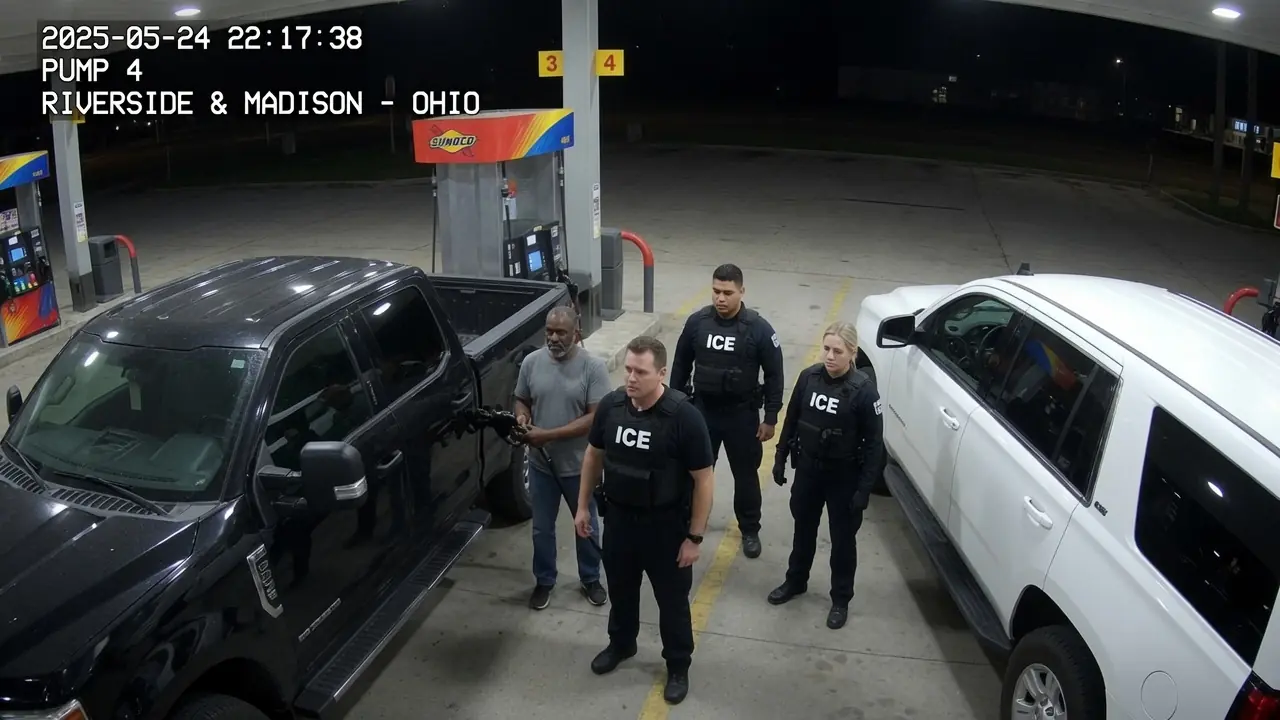
Johnson was driven to an ICE detention facility, stripped of his phone and belongings, and locked in a cell for six hours. What they didn't know was that Johnson's wife had tracked his phone and alerted his captain. Michael Johnson had just finished loading the last of his grocery bags into the bed of his Ford F250 pickup truck at the Riverside Shopping Center. It was 3:45 p.m. on a Saturday afternoon, and he'd promised his wife Denise and their two kids, twelve-year-old Maya and nine-year-old Marcus Jr., that he'd be home by 4 to help prep for their family dinner. At 4two years old, Johnson had been a police officer for seventeen years, the last five as a lieutenant supervising a team of 12 officers in the city's east precinct.
He wore plain civilian clothes today, jeans, a gray t-shirt, and sneakers, looking like any other dad running the weekend errands. As he climbed into the driver's seat and checked his fuel gauge, the needle hovered just above empty. Johnson sighed. The Sunoco station was only two miles away on the route home and stopping now would only add 5 minutes to his trip. He pulled out of the parking lot and headed toward the gas station, unaware that three federal agents had just spotted him from across the street.
Derek Mitchell sat in the driver's seat of an unmarked light-colored SUV with government plates, watching the shopping center parking lot with the calculated patience of a predator. At thirty-four years old, Mitchell had spent six years with Immigration and Customs Enforcement. And in that time, he developed what he called an instinct for identifying undocumented immigrants. His two partners sat beside him, Kevin Torres in the passenger seat, and Amanda Brennan in the back, both younger agents who'd learned to follow Mitchell's lead without question. When Mitchell saw Johnson loading groceries into an expensive pickup truck, something triggered in his mind. a man, nice truck, suburban neighborhood.
Mitchell's jaw tightened as he watched Johnson drive away. ""Follow him," Mitchell said quietly, starting the engine. Torres glanced at him. ""You see something? "" ""Just follow him," Mitchell repeated. They trailed Johnson's truck at a distance, watching as he pulled into the Sunoco gas station at the corner of Riverside and Madison. The station had eight pumps arranged in two rows, but at 4:00 on a Saturday, the place was completely empty. No other cars, no customers inside the convenience store.
Just Johnson pulling up to pump number four, stepping out of his truck and reaching for the gas nozzle. Mitchell surveyed the area carefully. Empty parking lot, no pedestrians, no witnesses. He looked at Torres and Brennan. "No one's around.
Let's move. " Johnson had just inserted his credit card and begun pumping it when he noticed the light-colored SUV pull into the station behind him, blocking his truck from behind. Three people stepped out wearing tactical vests with ICE printed across the chest. Johnson's stomach tightened. He was a police lieutenant and he knew exactly what this looked like. Federal agents positioning themselves strategically, cutting off exit routes.
But why would ICE be approaching him? Mitchell walked directly toward Johnson with Torres and Brennan fanning out on either side, creating a triangle formation that boxed Johnson in against his truck. Mitchell's hand rested casually near his sidearm as he stopped three feet away. "Afternoon," Mitchell said, his tone flat and official. I'm Agent Mitchell with Immigration and Customs Enforcement.
Why are you asking me this? " Torres stepped closer. "We don't need to explain our enforcement actions. Show us your papers. " Johnson knew his rights. He knew this was profiling, but he also knew that three federal agents had him surrounded in an empty gas station and escalating wouldn't end well. "I don't walk around with my birth certificate," Johnson said carefully.
"But I have my driver's license. " "Let's see it," Mitchell said. Johnson slowly reached for his back pocket, pulled out his wallet, and extracted his Ohio driver's license. He handed it to Mitchell, who examined it with exaggerated scrutiny, checking the photo, the name, the address. Johnson's information was all there. Michael Johnson, local residential address, just four blocks away, valid through 2027.
Mitchell handed it back without expression. "We asked for proof of citizenship, not a driver's license. " Johnson felt anger rising, but pushed it down. "I just came from the grocery store. You expect me to carry my birth certificate everywhere I go? " Brennan spoke up for the first time. "If you can't provide proof of citizenship right now, you're getting arrested. " The words hung in the air.
Johnson realized these agents weren't going to let this go. They wanted something from him, some reason to justify this stop. He was boxed in alone with no witnesses. This could go very wrong very fast. He made a decision.
"I'm not just a citizen," Johnson said clearly. I'm a police lieutenant with the city police department. "I have my badge to prove it. " All three agents exchanged glances. Mitchell's expression shifted to something between disbelief and amusement. "Sure you are. " "I can prove it," Johnson said.
Mitchell's smirk widened. "Then prove it. " Johnson reached back into his wallet and pulled out his official police identification card. The one with his photo, his badge number, his rank clearly printed. Lieutenant Michael Johnson, East Precinct. He held it up so all three agents could see it.
The smirk vanished from Mitchell's face. Torres leaned in to look closer. Brennan's eyes widened slightly. The identification was clearly legitimate. Official City Police Department seal, proper formatting, laminated credentials.
This wasn't some fake ID. This was real. Mitchell took the card from Johnson's hand and studied it for a long moment. His face had gone carefully neutral, but Johnson could see the tension in his jaw. Mitchell handed the card back without a word.
"You're free to go," Brennan said quietly. The three agents turned and began walking back toward their SUV. Johnson exhaled deeply, feeling the tension drain from his shoulders. He turned back to the gas pump, watching the numbers climb as fuel flowed into his tank. It was over.
They'd seen his badge and backed off. He'd be home in 10 minutes. But then Johnson heard footsteps behind him. He turned to see all three agents had stopped about fifteen feet away. Their backs to him, walking toward their vehicle, their body cameras mounted on their chests, faced forward, capturing their departure.
Professional by the book agents walking away from a routine check that turned out to be nothing. Then, in perfect synchronized motion, all three agents reached up to their body cameras and pressed the power button. The small red recording lights blinked off. Johnson's blood went cold. Mitchell turned around first.
His expression completely changed. The professional federal agent mask was gone, replaced with something ugly and raw. Torres and Brennan turned with him, and all three began walking back toward Johnson. ""You know what, though? "" Mitchell said, his voice different now, harder, meaner. ""You think that badge makes you belong? "" Johnson's hand tightened on the gas nozzle. ""What are you doing? "" ""I showed you my credentials. "" Mitchell stepped close, invading Johnson's space. "You're minority. Nothing can change that.
So, you don't belong here. Before Johnson could respond, Torres grabbed his arm and yanked him away from the pump. Johnson stumbled, trying to pull free. "This is illegal. You saw my badge. " Brennan moved in from the other side, grabbing his other arm.
They slammed Johnson against the side of his truck, pitting him there. The gas nozzle fell from his hand, clattering against the concrete. ""Your badge doesn't mean anything,"" Mitchell said, his face inches from Johnson's. "You're still just another man who thinks he's better than he is. " "I'm a police lieutenant," Johnson shouted, struggling against their grip. "You're assaulting a police officer! " Torres wrenched Johnson's arm behind his back. ""Shut up! "" Johnson felt the cold metal of handcuffs snap around his wrists. He looked around desperately.
The gas station was still empty. No cars, no witnesses, no one to see what was happening. ""This is false arrest. I have rights. "" Mitchell leaned in close, his voice a low hiss. ""Rights? You don't have rights. You're coming with us. " They dragged Johnson toward their SUV.
He planted his feet trying to resist, but three against one with his hands cuffed behind his back left him helpless. They shoved him into the back seat and slammed the door. As the vehicle pulled away from the gas station, Johnson twisted to look back through the rear window. His truck sat abandoned at pump 4, groceries still in the bed, gas nozzle lying on the ground. His phone was in his pocket, but his hands were cuffed.
His family was waiting for him. And he was being kidnapped by federal agents who had just turned off their cameras to make him disappear. 25 minutes later, the SUV pulled into the ICE detention facility on Marshall Boulevard. Johnson was hauled inside through a side entrance past processing desks and into an intake area. An officer at the desk looked up.
New detainee, Mitchell said. Suspected immigration violation. I'm a police lieutenant, Johnson said loudly. My name is Michael Johnson. I'm a US citizen.
This is illegal detention. No one responded. They processed him like he was any other detainee. Took his phone, his wallet, his keys, his watch, his police badge. Everything that identified him as Lieutenant Michael Johnson disappeared into an evidence bag.
They walked him down a hallway lined with holding cells and shoved him into cell number seven. The metal door slammed shut. The lock clicked. Johnson grabbed the bars. I need to call my captain.
I have a right to a phone call. A guard walked past without looking at him. I'm a police officer, Johnson shouted. You can't hold me without cause. Silence.
Johnson sank onto the metal bench in his cell. six hours. That's how long he would sit there in his civilian clothes in a concrete cell, treated like a criminal. All because three ICE agents saw a minority man pumping gas and decided he didn't belong. Michael Johnson sat on the cold metal bench in holding cell number seven, staring at the concrete walls that had become his world for the past 3 hours. He had asked for a phone call six times.
Each time the guards told him processing wasn't complete yet. Each time they walked away before he could argue. Johnson was a police lieutenant with 17 years of experience and he knew exactly what was happening. They were stalling, hoping he would just disappear into their system like countless others before him. At his home four blocks away, Denise Johnson checked her watch for the 15th time.
It was 7:30 in the evening. Michael had left at 3:45 to grab groceries. Nearly four hours ago, their daughter Maya sat at the kitchen table doing homework while nine-year-old Marcus Jr. played video games in the living room. Both of them asking every 20 minutes when dad was coming home with the food for dinner. Denise had called Michael's phone 11 times.
The first few calls rang through to voicemail. The last eight went straight to a message saying the phone was unavailable. Something was wrong. Michael always answered her calls. Always.
Even when he was working a case or dealing with an emergency, he would text her back within minutes. Four hours of silence wasn't like him. She tried to think of reasonable explanations. Maybe his phone died. Maybe he ran into a colleague and they were catching up.
Maybe there was an accident on the road and he was stuck in traffic. But none of those explanations felt right. Her husband was dependable to a fault. If he was going to be late, he would find a way to let her know. By 8:00, Denise's worry had turned into real fear.
She opened her phone and pulled up the location sharing app. She and Michael had set it up years ago for safety reasons, mostly so she could track him during dangerous calls. She tapped on his name and waited for the map to load. The pin appeared on her screen and her breath caught in her throat. Michael's phone was showing a location on Marshall Boulevard.
The address made her blood run cold. Ice detention facility. She stared at the screen, refreshing it twice to make sure it wasn't an error. The pin didn't move. Her husband's phone was inside an immigration detention center.
Denise didn't waste another second. She scrolled through her contacts and found Captain Rodriguez, Michael's commanding officer, and one of his closest friends on the force. She pressed call and waited through two rings before Rodriguez picked up. "Denise, hey, what's going on? " Rodriguez said, his voice relaxed like he'd been watching television. "Captain, I need your help," Denise said, her voice shaking.
"Michael left to get groceries at 3:45 this afternoon. He's not back. He's not answering his phone. I checked his location and it's showing that he's at the ICE detention center on Marshall Boulevard. I don't understand what's happening.
There was a pause on the other end of the line. When Rodriguez spoke again, his voice had changed completely. Ice? Are you sure? I'm looking at it right now on my phone.
Denise said his location hasn't moved in hours. Captain, why would Michael be at an ice facility? He's a police lieutenant. He's a citizen. This doesn't make any sense.
Rodriguez was already moving. Denise could hear him grabbing his keys, his footsteps quick and purposeful. "I'm heading there right now. I'll find out what's going on and call you back immediately. " "Please hurry," Denise said. "I'm scared. " "I'll get him out," Rodriguez promised.
"Whatever this is, I'll handle it. " He hung up and drove straight to the ice facility, arriving at 8:45 in the evening. Rodriguez walked through the front doors, wearing his police captain's uniform, his badge clearly visible on his chest. The intake officer at the front desk looked up as Rodriguez approached. "I'm Captain Rodriguez with the city police department," he said firmly. "I'm looking for one of my officers, Lieutenant Michael Johnson.
I have reason to believe he's being held here. " The intake officer was Kevin Torres, one of the agents who had arrested Johnson. Torres recognized the name immediately, and his face remained completely blank. We don't have anyone here by that name. Rodriguez stared at him. Check again.
Lieutenant Michael Johnson. He would have been brought in sometime this afternoon. Torres pretended to look at his computer screen. No one by that name in our system. Rodriguez pulled out his phone and showed Torres the location map with Michael's phone clearly pinging from inside this building.
That's not possible. His phone location is showing he's inside this facility right now. He has to be here. Torres didn't even glance at the phone. Our system says otherwise.
Maybe his phone location is wrong. Rodriguez felt his anger rising. His phone isn't wrong. I know he's here. Bring him out now.
Sir, I'm telling you, we don't have anyone by that name, Torres said with practiced indifference. Then explain why his phone is transmitting from inside your building, Rodriguez demanded. Torres shrugged. I can't explain that, but we don't have him. Rodriguez leaned forward, his voice dropping to something cold and dangerous.
Listen to me very carefully. If you're holding one of my officers without cause, you're creating a federal incident. I will call the FBI. I will call the Justice Department. And I will call every news station in this city and tell them ICE is disappearing American citizens. Now check your system again and tell me the truth.
Torres's confident expression faltered slightly. He glanced toward the hallway where the holding cells were located. Then back at Rodriguez. The captain wasn't bluffing and Torres knew it. If this became a media story, if the FBI got involved, everything they'd done today would be exposed.
Torres picked up his phone and made a quick call. Rodriguez couldn't hear the conversation, but he watched Torres's body language shift from defensive to uncertain. After a minute, Torres hung up and looked back at Rodriguez. "Let me check with my supervisor," Torres said quietly. "Maybe someone with a similar name came in. " "Not someone with a similar name," Rodriguez said.
"Lieutenant Michael Johnson, my officer, who has been missing for five hours. " Torres disappeared into a back office. Rodriguez stood at the desk, his hands clenched into fists. If they had done something to Michael, if they had hurt him, Rodriguez would make sure every single person involved paid for it. 5 minutes later, Torres returned with Derek Mitchell. Mitchell wore the same practiced neutral expression.
"Captain Rodriguez," Mitchell said. "There may have been some confusion. We might have someone matching that description in holding. " Rodriguez's eyes went cold. "Might have? You either have my lieutenant or you don't.
Mitchell shifted uncomfortably. We detained someone earlier today for suspected immigration violations. The individual claimed to be a police officer, but we needed to verify his credentials for five hours. Rodriguez said, "He told you he was a lieutenant. He showed you his badge.
You could have called our station and verified his identity in 5 minutes. Instead, you locked him up and pretended he didn't exist when I came looking for him. " Mitchell had no response to that. "Bring him out," Rodriguez said. "Right now. " They brought Michael Johnson out 20 minutes later and Captain Rodriguez felt rage flood through his body the moment he saw his lieutenant. Johnson was still in his civilian clothes, jeans and t-shirt now wrinkled and dirty from sitting in a cell.
His wrists showed red marks where the handcuffs had been too tight. His eyes were exhausted but burning with anger. six hours he'd been locked in that cell for pumping gas while being unfairly profiled. "Lieutenant, are you okay?" Rodriguez asked. Johnson's voice came out hard and controlled.
They arrested me at a gas station, captain, after I showed them my driver's license and my police badge. They turned off their body cameras and told me my badge meant nothing because I'm minority. Then they threw me in a cell and refused to verify my identity, even though I gave them your direct number. Rodriguez turned to Mitchell with an expression that could have melted steel. You arrested a police lieutenant after seeing his credentials.
Mitchell tried to maintain his authority. We had reasonable suspicion that his identification might be fraudulent. "Fraudulent?" Rodriguez repeated slowly. You thought the official police department badge of a lieutenant in your own city was fake.
So instead of making one phone call to verify it, you detained him for six hours. Mitchell said nothing. ""Give him back his belongings,"" Rodriguez ordered. ""All of them now." " Johnson was handed a plastic bag containing his phone, wallet, keys, watch, and police badge. His phone had forty-three missed calls, most from Denise, several from Rodriguez, a few from other officers at the precinct. Johnson's hands shook slightly as he put everything back in his pockets. Rodriguez drove Johnson home in silence for the first few minutes.
Then Johnson spoke, his voice quiet, but filled with cold fury. "They knew exactly what they were doing, Captain. They looked around to make sure no one else was at that gas station. They waited until I was completely alone. Then they surrounded me and demanded papers like I was some criminal.
I showed them my driver's license. They said it wasn't enough. I showed them my badge. They looked at it, saw it was real, and started walking away." Rodriguez listened, his jaw clenched.
"Their body cameras were recording them leaving." Johnson continued, "Professional, by the book. " Then all three of them reached up at the same time and turned off their cameras. I watched them do it. They turned those cameras off, then they came back and attacked me. Mitchell got in my face and told me I didn't belong because I'm minority.
They said my badge meant nothing. They handcuffed me, threw me in their vehicle, and drove me to that facility like I was some dangerous criminal they just caught. "They turned off their cameras deliberately," Rodriguez said, his voice tight with anger. "They knew what they were about to do was illegal," Johnson said. So they made sure there would be no evidence.
Then at the facility, when I told them I was a police lieutenant, when I begged them to call you to verify who I was, they just ignored me. They stripped me of everything that proved I was a cop and locked me in a cell like I was nobody. Rodriguez pulled into Johnson's driveway. Denise burst out of the front door and ran to the car. Johnson stepped out and his wife threw her arms around him, holding him tight.
"What happened? " Denise asked, pulling back to look at his face. "Are you hurt? " Johnson looked at his wife and saw his daughter Maya standing in the doorway watching. He saw his son Marcus Jr. peeking out from behind his sister. How could he explain to his children that their father, a police lieutenant who had dedicated 17 years to protecting people, had been arrested and caged like an animal because three federal agents saw his skin color and decided he didn't deserve basic human dignity. "I'm okay," Johnson said quietly.
"But we need to talk." Inside the house, Johnson sat down with Denise while the kids went to their rooms. He told her everything. the gas station, the agents surrounding him showing his identification, the body cameras being turned off, the demeaning words, the arrest, the cell, the six hours of being treated like he was invisible. Denise listened with tears streaming down her face. When Johnson finished, she asked the question he'd been asking himself for six hours.
"Why? " she whispered. "You showed them your badge. Why would they still arrest you? " Johnson looked at his wife with an expression that held seventeen years of exhaustion from fighting against a truth he could never escape. "Because to them, I wasn't a police lieutenant," he said. I was just a man, and in their minds, that made me guilty of something.
The next morning, Rodriguez called Johnson at 7:00 a.m. "I'm filing an official complaint with ICE Office of Professional Responsibility, but Michael, I think you need to talk to a lawyer. What they did to you wasn't just wrong; it was criminal." Johnson contacted a civil rights attorney named Sarah Chen, one of the best in the state. She listened to his story, then asked one question. "Do you know if the gas station had security cameras?" two days later, Chen's investigator retrieved the footage.
The silent security video showed everything. Johnson pumping gas alone. Three agents pulling in and surrounding him. Johnson showing documents. The agents walking away.
Then all three reaching up simultaneously to their chest-mounted cameras and then returning to violently arrest Johnson. The timestamp showed the entire encounter. Johnson never resisted, never became aggressive, just stood there while three federal agents destroyed his freedom. Chen also subpoenaed the body camera footage from all three agents. The footage showed Mitchell, Torres, and Brennan approaching Johnson, demanding identification.
Johnson showing his driver's license and police badge. The agents examining the credentials, then beginning to walk away. The cameras captured their departure perfectly. Three agents walking back to their vehicle. Incident resolved.
Then all three cameras cut to minority at the exact same second. When the cameras turned back on 30 minutes later, the agents were shown driving on the highway with no mention of Johnson, no arrestee in their vehicle, no documentation of what had happened in those missing 30 minutes. They turned off their cameras, arrested you illegally, then turned them back on and pretended it never happened. Chen said, "This isn't just biased profiling. This is premeditated deprivation of rights under color of law.
That's a federal crime. " Chen dug deeper into the three agents' histories. Derek Mitchell had eleven complaints filed against him over 6 years for biased profiling. Kevin Torres had seven. Amanda Brennan had five. twenty-three complaints total between three agents. Every single complaint had been dismissed by ICE supervisors as unsubstantiated.
But Chen found something worse. She subpoenaed ICE detention records for the past two years and discovered a pattern that made her blood run cold. Mitchell, Torres, and Brennan had made 41 immigration stops in twenty-four months. 38 of those stops were of minority or Hispanic individuals. Only four of the 41 stops resulted in actual immigration violations.
That meant 37 American citizens had been detained, questioned, and released. Chen tracked down as many of them as she could find. twelve agreed to be interviewed. The stories were all similar. stopped while shopping, stopped while walking, stopped while sitting in a park, demanded to show papers, held for hours, then released with no apology and no explanation. Most were too afraid to complain. Some didn't speak English well enough to navigate the complaint system.
Others didn't trust that complaining would change anything. Michael Johnson was just the first one with enough power to fight back. Sarah Chen filed a federal civil rights lawsuit three weeks after Michael Johnson's arrest, demanding 11.9 million dollars in damages and requesting a full investigation into ICE's detention practices. The lawsuit named Derek Mitchell, Kevin Torres, and Amanda Brennan individually along with the federal government for failing to supervise agents with documented histories of biased profiling. The gas station security footage went public within days.
News stations across the country played the silent video on repeat. Three federal agents surrounding a man at a gas pump. The man showing documents, the agents walking away, then all three simultaneously reaching up to turn off their body cameras before returning to violently arrest him. The video had been viewed 50 million times within the first week. ICE tried to defend their agents initially.
A spokesperson released a statement claiming Mitchell, Torres, and Brennan had followed proper protocol and had reasonable suspicion to detain Johnson. But then Chen released the body camera footage showing the exact moment all three cameras cut to minority simultaneously and ICE's defense collapsed. There was no explanation for why three trained federal agents would all turn off their recording devices at the same time unless they knew what they were about to do was illegal. The Department of Justice opened a criminal investigation into all three agents for deprivation of rights under color of law, a federal crime carrying up to 10 years in prison. The investigation expanded when Chen's research revealed the pattern of wrongful detentions.
DOJ investigators reviewed every single stop Mitchell, Torres, and Brennan had made over two years and found that they had systematically targeted and detained minority citizens without cause, holding them for hours before releasing them without charges or documentation. The investigation uncovered something even darker. ICE had been operating an unofficial quota system that rewarded agents for high numbers of detentions regardless of whether those detentions led to actual deportations. Mitchell had the highest detention numbers in the region and had been praised repeatedly by supervisors for his productivity. No one had ever questioned why 91 percent of his stops resulted in innocent citizens being released.
All three agents were fired within 2 months. Derek Mitchell, Kevin Torres, and Amanda Brennan had their federal law enforcement credentials permanently revoked. They could never work in law enforcement again anywhere in the United States. Criminal charges were filed against all three for civil rights violations. Mitchell faced additional charges for leading the conspiracy.
The federal government, facing overwhelming video evidence and a paper trail of ignored complaints, settled Johnson's lawsuit for the full 11.9 million after fourteen months. The settlement was the largest wrongful detention payout in the state's history. As part of the agreement, ICE was required to implement sweeping nationwide reforms. The new policies mandated that all ICE agents complete forty hours of bias training annually. Agents were required to have specific, articulable, probable cause before demanding identification from anyone.
Body cameras could not be turned off during any enforcement action, and any agent found tampering with their camera faced immediate termination. An independent civilian oversight board was created to review all detention decisions and investigate complaints of biased profiling. The settlement also required ICE to audit the past five years of detention records across the country. The audit revealed systemic problems in multiple regions. eighty-nine agents with patterns similar to Mitchell's were identified. sixty-seven were forced to resign. twenty-two faced criminal investigations. Derek Mitchell's life was destroyed completely.
At 34 years old, he was unemployable in any field related to law enforcement or federal work. He took a job at a warehouse making 14 dollars an hour. His wife divorced him after the video went viral and she became known as the racist ICE agents wife in their community. He lost custody of his two children. The video of him turning off his body camera and attacking a police lieutenant followed him everywhere he went. five years later, he was still working minimum wage jobs and carrying the weight of being the face of ICE's biased profiling crisis.
Torres and Brennan faced similar fates. divorced, unemployed in their chosen field, working retail and service jobs, forever marked by their decision to participate in the illegal detention of an innocent man. Michael Johnson returned to work after a month of stress leave. The department offered him counseling, which he accepted. His fellow officers rallied around him, wearing blue ribbons in solidarity. 18 months after his arrest, Johnson was promoted to captain in recognition of his years of service and his courage in fighting back against injustice.
Johnson used a significant portion of his settlement to create the Rights and Dignity Foundation, a nonprofit organization that provided legal assistance to victims of immigration profiling. The foundation helped over two hundred people in its first three years, many of them the same people who had been detained by Mitchell, Torres, and Brennan, but had been too afraid or too poor to seek justice on their own. Johnson also became a national speaker on civil rights and police accountability. He trained law enforcement agencies across the country on constitutional rights, bias, and the importance of treating every person with dignity, regardless of their appearance. His case was taught in law schools as a landmark example of civil rights violations by federal agents.
5 years after his arrest, Johnson was named deputy chief of police. He ran the department's training academy and community relations division. His daughter, Maya, was now 17 and planning to study criminal justice in college. His son, Marcus Jr., was 14 and knew his father's story by heart. Not as a tragedy, but as a testament to the power of standing up for what's right.
Derek Mitchell was 39, still stocking shelves at a grocery store for 15 dollars an hour, still living with the knowledge that his bias had cost him everything and given Michael Johnson a platform to create real change. The body camera footage of three agents simultaneously turning off their cameras remained one of the most damning pieces of evidence ever captured of premeditated civil rights violations. It was used in federal training programs, congressional hearings, and civil rights seminars as proof that some officers know exactly when they're about to break the law. The lesson was expensive and public. 11.9 million, three destroyed careers, 67 force resignations, and a complete overhaul of ICE detention policies nationwide.
Michael Johnson had been arrested for pumping gas while being unfairly profiled. But his refusal to stay silent had exposed a system that had been kidnapping and detaining minority citizens for years. Justice had cost almost 12 million dollars. But for the two hundred people Johnson's foundation helped, for the thousands of citizens who would never be illegally detained because of the new policies, and for Johnson's own children who learned that fighting back against injustice was possible, the price had been worth paying.