"I need to see proof of citizenship." "I'm just having breakfast. I'm not doing anything wrong." "If you're a citizen, show me the proof." "I don't have to show you anything.
I know my rights." "You don't have any rights unless you prove you belong here." "That's not how it works." "Stand up. You're coming with us."
"You're dragging me out of here." "Step out of the booth. Hands behind your back." "This is harassment." "You'll have a chance to talk downtown.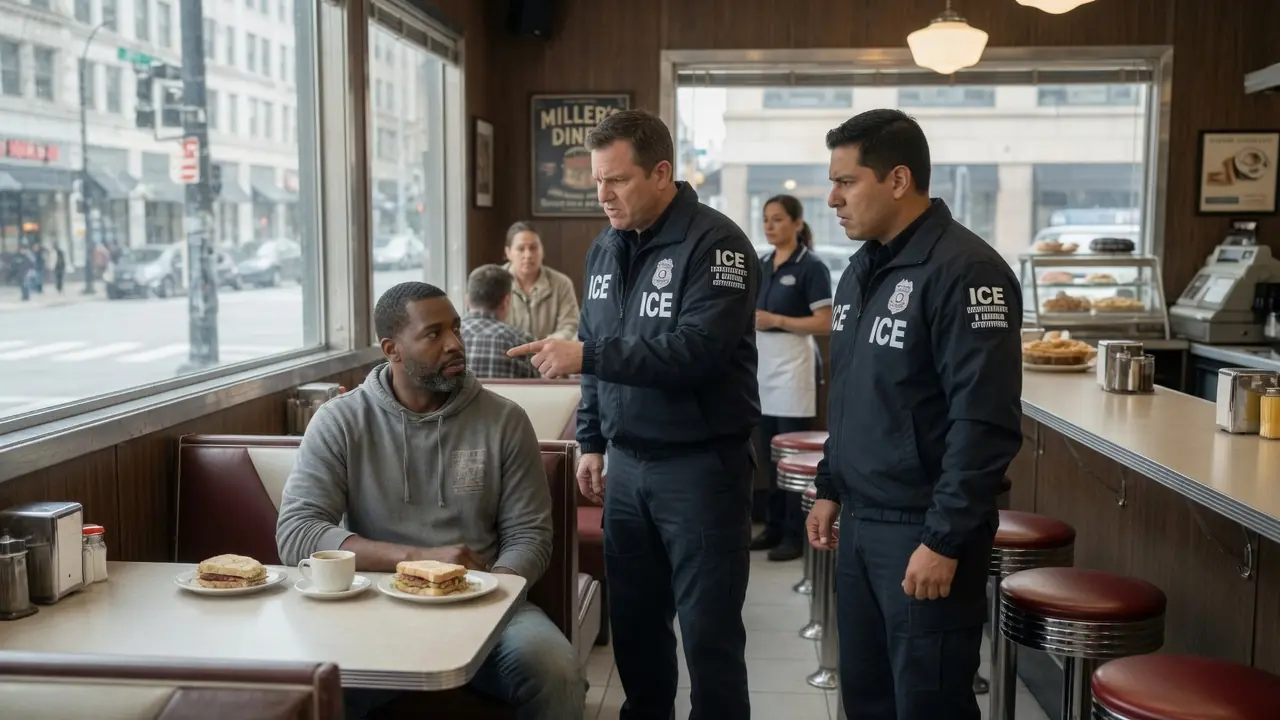
The cuffs are going on." ICE agents Robert Keller and Steven Morales were patrolling downtown when they saw a man sitting alone in a diner booth, and without any legal basis or reasonable suspicion, they walked into the diner, asked the staff member if she knew him, and when she said she didn't, they used that as justification to approach him and demand proof of citizenship. When Lance Morgan, calmly told them he knew his rights and did not consent to their questioning, Keller responded by telling him he had no rights if he wasn't a citizen, and that he better comply or end up in handcuffs. Then Morgan told them they had no legal authority to stop him based on racial profiling, and that they were part of the problem America was facing. Morales snapped, grabbed Morgan, dragged him out of the booth, and handcuffed him roughly while shouting that he was coming downtown.
What ICE agents Keller and Morales didn't know, and what they were about to discover was that Lance Morgan was an FBI agent, and that they had just unlawfully detained and handcuffed a federal agent, that their entire interaction was being recorded, and that their decision to profile and arrest an FBI agent would cost them their careers, trigger an agency-wide investigation, and result in a 1.2 million dollars settlement that would make national headlines. Miller's diner on a Tuesday afternoon in late March had the kind of quiet rhythm that came from being in the middle of the weekday lull. A handful of customers scattered across booths and counter seats. The lunch rush had passed an hour ago, and the dinner crowd wouldn't arrive for another three hours. The waitresses moved between tables, refilling coffee, and clearing plates, and the cook worked in the back with the radio playing low enough that you could hear it if you listened, but not loud enough to bother anyone.
Lance Morgan sat in a booth near the back corner of the diner with a cup of coffee that had gone lukewarm and a plate with half a sandwich he hadn't touched in twenty minutes. He was 36 years old, ten years with the FBI, currently assigned to the organized crime division working undercover on a case that had taken him across three states over the past six months. He was dressed in plain clothes that were chosen specifically not to draw attention. Faded jeans, a gray hoodie with the sleeves pushed up to his elbows, worn sneakers that had seen better days. Nothing about his appearance said federal agent.
Everything about his appearance said ordinary guy having a late lunch. Lance had been sitting in that booth for about ninety minutes, and he wasn't there because he loved the diner's coffee or the sandwich that was going cold on his plate. He was there because he was waiting for a contact who was supposed to meet him with intelligence related to a trafficking operation the bureau had been building a case against for months. The contact was running late, which wasn't unusual in this line of work, so Lance was killing time, blending in, looking like just another customer scrolling through his phone and minding his own business. He checked his watch.
ICE agents patrolled this area sometimes, and seeing a marked vehicle wasn't unusual. But then he saw two agents get out of the car and start walking toward the diner, and something about the way they moved purposeful, focused, already scanning through the windows before they even reached the door made Lance's instincts kick in. ICE agents Robert Keller and Steven Morales had been driving through downtown that afternoon as part of what their agency called targeted enforcement operations. Keller was thirty-eight years old, 12 years with ICE, and he had built a reputation over those years for being aggressive, for making arrests that other agents might have hesitated on, and for operating on assumptions more than evidence. Morales was thirty-four years old, with eight years with the agency, and he had learned early on that following Keller's lead made his job easier, even when Keller's instincts didn't always line up with what the law actually allowed.
They had been doing sweeps in this part of the city all week, stopping people who looked unfamiliar, asking for identification, running checks, and making arrests when they found someone without documentation. Keller had a theory that certain areas attracted undocumented immigrants, and he operated on that theory without much concern for whether it constituted reasonable suspicion under the Fourth Amendment. As they drove past Miller's Diner, Keller looked through the window and saw Lance sitting alone in a booth. A man sitting by himself, not doing anything that would constitute a crime or even suspicious behavior, but in Keller's mind that didn't matter. Unfamiliar face, sitting alone, in an area where Keller thought undocumented people might be.
Keller pulled the car over."Let's check him out." Morales didn't question it. He never did. They walked into the diner, and the first thing Keller did was walk up to the counter where a waitress was wiping down the coffee station. He pulled out his ICE badge and held it up so she could see it."Excuse me, ma'am.
Do you know that man over there?" He pointed toward Lance's booth. The waitress looked over at Lance, then back at Keller."No, I don't know him. I've never seen him before." Keller nodded."How long has he been here?"
"About an hour, maybe a little longer, but he's been ordering, so there's no problem with him being here." Keller's expression didn't change, but inside he had everything he needed. Unfamiliar. Been here for a while. Staff doesn't know him.
That was enough."Thank you, ma'am." Keller and Morales walked across the diner toward Lance's booth. They stopped at the edge of the table, standing over him in a way that was clearly meant to be intimidating. Keller spoke first, and his tone wasn't polite or conversational. It was a demand."We are ICE agents.
We need to see your proof of citizenship right now." Lance looked up from his phone, his expression calm but cautious. He had dealt with overzealous law enforcement before, and he knew how these situations could go if you didn't stay composed."I'm sorry. What is this about?" Morales stepped closer, his voice carrying the same authoritative edge."We're conducting citizenship inspections.
We've got information that people in this area are not actually citizens. We're sweeping the area, so we need to see your ID and proof of citizenship." Lance set his phone down on the table and looked at both agents. His voice stayed calm and even."I don't consent to this. I'm sitting in a diner minding my own business.
I'm not obligated to give you anything." Keller's voice got louder, sharper."Do you know who we are? We're ICE. We're demanding your proof of citizenship right now before this escalates." Lance didn't flinch."I know my rights, and I'm telling you I don't consent."
Morales cut him off, his voice turning aggressive."You won't have any rights if you're not a citizen, and we need to verify that. So, as of right now, you don't have any rights. You better comply or you're ending up in cuffs." Lance's voice stayed steady, but there was an edge to it now."End up in cuffs for asserting my rights?" Keller leaned in, his face closer to Lance now."Like we just said, you don't have any rights.
The president has given us the authority to bring in anyone who's not a citizen. Now show us your ID." Lance looked directly at both of them, and his voice carried a weight that made it clear he wasn't backing down. You do not have the legal authority to stop or question individuals based solely on a hunch or, as critics allege, racial profiling. He paused, letting that sink in.
You are part of the problem America is facing right now. Abusing and overreaching your authority. And as an American citizen, minority or not, I won't tolerate that. That was when Steven Morales lost whatever patience he had left. He reached across the table, grabbed Lance by the arm, and yanked him out of the booth with enough force that Lance's shoulder hit the edge of the table as he was pulled forward.
Morales spun him around, pulled his arms behind his back, and snapped handcuffs onto his wrists with rough, aggressive movements that left red marks on Lance's skin almost immediately. You think you know the law, huh? Morales shouted, his voice loud enough that every person in the diner turned to look. You're coming with us downtown. Lance didn't resist physically.
He knew better than to give them any excuse to escalate further. But his voice stayed calm, controlled, and deliberate as Morales started dragging him toward the door."For your own good, you should check my left pocket since you want to see my ID so much." Morales, still angry and not thinking clearly about what Lance had just said, reached into Lance's left jacket pocket without hesitation. His hand closed around something solid and metallic. And he pulled it out.
It was an FBI badge. Morales stared at it. His face went pale. His hands started shaking. He stood there frozen, holding the badge, unable to process what he was looking at.
Keller, standing a few feet away, saw Morales freeze and frowned."What is it? What did you find?" Lance's voice cut through the silence, quiet but carrying an authority that made both agents go completely still. Before I count to 10, you better remove those handcuffs, or what's about to happen to you, not even the president can save you from. Morales fumbled with the keys, his hands shaking so badly it took him three tries to get the cuffs unlocked.
Lance brought his arms forward, rubbed his wrists where the metal had dug into his skin, and turned around to face both agents. Keller finally saw the badge in Morales' hand. His face drained of color. Lance looked at both of them, his voice cold and precise."Congratulations. You just ruined your careers."
Robert Keller and Steven Morales stood in the middle of Miller's diner staring at the FBI badge in Morales' shaking hand, and the reality of what they had just done was starting to sink in with a weight that neither of them knew how to carry. Lance Morgan rubbed his wrists where the handcuffs had left deep red marks, and his expression was calm, but his eyes were cold in a way that made it very clear this situation was far from over. Keller tried to speak first, his voice coming out defensive and rushed. We didn't know you were FBI. You should have identified yourself from the beginning.
We were just doing our job. Lance looked at him with an expression that said he had heard that excuse before and it didn't mean anything. You didn't ask who I was. You saw a minority man sitting alone in a diner and decided that was enough reason to demand my papers. That's not doing your job.
That's racial profiling. Morales, still holding the badge like it was evidence he wished he could make disappear, tried to explain. We had information that people in this area might not have documentation. We were conducting sweeps. It's standard procedure.
Lance's voice stayed level, but there was an edge underneath it now that hadn't been there before. Standard procedure requires reasonable suspicion. You didn't have that. You had a hunch based on my appearance. That's not legal.
That's discrimination. Keller stepped forward trying to regain some control over the situation. Look, this is a misunderstanding. We made a mistake, but you have to understand we're under a lot of pressure to enforce immigration laws. The president has made it very clear that we need to be more aggressive.
Lance pulled his phone out of his pocket and held it up so both agents could see the screen. This entire interaction was recorded. Every word. Every threat. Every unlawful demand.
You told me I had no rights. You physically detained me without cause. You handcuffed me and attempted to arrest me. All of that is on tape. Morales' face went even paler.
You were recording? Lance nodded. I'm an undercover agent. I record everything when I'm in the field. And you just gave me one of the clearest examples of unlawful detention I've ever captured.
Keller's voice got louder. More desperate. We were doing our jobs. We didn't know. Lance's expression didn't change.
You didn't care to know. You made assumptions and you acted on them without any legal justification. That's the problem. He turned away from both agents and walked back to his booth where his phone was still sitting on the table next to his cold coffee. He picked it up and dialed a number.
It rang twice before someone answered. This is supervisory special agent Harding. Lance's voice was calm and professional. Sir, this is special agent Morgan. I was just unlawfully detained and handcuffed by two ICE agents while conducting surveillance in the field.
The agents approached me without reasonable suspicion, demanded proof of citizenship, and when I refused to comply with their unlawful orders, they physically detained me. I have the entire interaction recorded. I need this documented immediately and I need you to contact their supervisors. There was a pause on the other end of the line and then Harding's voice came back sharp and focused. They handcuffed you?
Where are you now? Miller's Diner on 5th Street. The agents are still here. Stay there. I'm on my way and I'm bringing their supervisors with me.
Lance ended the call and looked back at Keller and Morales who were both standing near the door now looking like they wanted to leave but weren't sure if they were allowed to. My supervisor is on his way. You two should stay here. You're going to need to explain yourselves. Keller opened his mouth to respond but before he could say anything, his own phone rang.
He looked at the screen, saw his supervisor's name, and his face went tight. He answered the call and within 10 seconds his expression shifted from defensive to terrified. Yes, sir. We're still at the diner. Yes, sir.
We'll wait here. He ended the call and looked at Morales. Our supervisor is coming and he's bringing the regional director. Morales looked like he was about to be sick. twenty minutes later the diner had gone from a quiet afternoon spot to something that looked more like a crime scene. FBI Supervisory Special Agent Marcus Harding arrived first walking through the door with the kind of controlled fury that made everyone in the room go quiet.
He walked straight to Lance, looked him over and saw the red marks on his wrists. You all right? Lance nodded. I'm fine, but they need to be dealt with. Harding turned to look at Keller and Morales and his expression made it very clear what he thought of them.
You two stay right where you are. Five minutes after Harding arrived, the ICE supervisor showed up. There were two of them. A field supervisor named Martinez and a regional director named Stevens. Both of them walked into the diner, saw Keller and Morales standing near the door, and the look on their faces said they already knew this was going to be bad.
Stevens walked up to Keller first. Explain to me what happened here. Keller tried to give his version of events talking about sweeps and enforcement priorities and following procedures, but Stevens cut him off halfway through. Did you have reasonable suspicion to approach this man? Keller hesitated.
We we saw him sitting alone and the staff didn't know him and that's not reasonable suspicion. That's profiling. Harding stepped forward holding up Lance's phone with the recording cued up. I have the entire interaction recorded. Your agents told a U.
S. citizen he had no rights. They demanded identification without cause. They physically detained and handcuffed the federal agent conducting an undercover operation. All of it is on tape. Stevens looked at Keller and Morales and his voice dropped to something cold and final."You two are suspended effective immediately.
Go back to the office. Don't talk to anyone. Don't leave the city. You'll be hearing from internal affairs." Keller tried to argue."Sir, we were just at "Leave.
Now." Keller and Morales walked out of the diner without saying another word, and the door closed behind them with a sound that felt like the end of something. Harding looked at Stevens."This isn't over. We're filing a formal complaint and we're pursuing a federal lawsuit." Stevens nodded slowly."I understand.
And we'll cooperate fully with the investigation." Lance sat back down in his booth, picked up his cold coffee, and took a sip. His contact never showed up that day. The operation had been compromised, and two ICE agents had just destroyed their own careers in under ten minutes. The recording of Lance Morgan's interaction with ICE agents Robert Keller and Steven Morales was reviewed by FBI Internal Affairs, the Department of Homeland Security's Office of Inspector General, and the US Attorney's Office within forty-eight hours of the incident.
What they heard on that recording was so clear, so undeniable, and so damning that there was no room for interpretation or defense. The recording started with Keller's voice demanding proof of citizenship without any stated reason. It captured Lance calmly asserting his rights and refusing to consent to an unlawful search. It recorded Keller telling Lance he had no rights if he wasn't a citizen, and Morales threatening him with handcuffs for asserting those rights. It captured Lance explaining that they had no legal authority to stop him based on racial profiling, and it recorded the exact moment when Morales grabbed him, dragged him out of the booth, and handcuffed him while shouting that he was taking him downtown.
Every word, every threat, every violation of Lance's Fourth Amendment rights, all of it preserved in audio that couldn't be explained away or reframed. But the recording was only part of the story. The investigation into Keller and Morales expanded quickly, and what investigators found made the situation much worse than a single incident of racial profiling. When internal affairs pulled the personnel files for both agents, they discovered patterns that should have been addressed years ago, but had been ignored by supervisors who either didn't see the problem or didn't care. Robert Keller had been with ICE for 12 years, and over those twelve years, he had been the subject of seven formal complaints from individuals who claimed he had stopped them without reasonable suspicion, demanded identification based on their appearance, and treated them like criminals for refusing to comply with unlawful orders.
All seven complaints had one thing in common. They all came from individuals from underserved communities. All seven complaints had been documented, reviewed, and dismissed with minimal consequences. Keller had been verbally warned twice, but he had never been suspended, never been reassigned, and never been required to undergo additional training on constitutional rights. Steven Morales had been with ICE for eight years, and his file showed four similar complaints over that time.
All four involved individuals from underserved communities. All four described the same behavior. Stops without reasonable suspicion, aggressive questioning, and threats of detention for asserting rights. Morales had been warned once. Nothing else had been done.
The pattern was undeniable, and the agency had documented evidence of it sitting in personnel files that no one had acted on. The investigation didn't stop with Keller and Morales. Once the FBI and the Department of Homeland Security started looking at enforcement practices in the unit where both agents worked, they found that the problem was systemic. Over a two-year period, the unit had conducted what they called targeted enforcement operations in specific neighborhoods, and the data showed that 87 percent of the people stopped during those operations were minority. Of those stops, only 14 percent resulted in any enforcement action, which meant that the vast majority of the people stopped had been detained, questioned, and released without any legal justification.
The unit had been operating on assumptions and bias rather than reasonable suspicion, and the agency had allowed it to continue for years. By the time the investigation findings were compiled into a report, the scope of what had happened was clear. This wasn't just about two agents making a bad decision in a diner. This was about an agency that had ignored warning signs, dismissed complaints, and allowed racial profiling to become standard practice. Lance Morgan held a press conference 1 week after the incident.
He stood at a podium with FBI supervisory special agent Marcus Harding beside him. And he spoke with the calm, measured tone of someone who had spent years testifying in court and knew how to make every word count. I am an FBI agent. I have 10 years of service. I have worked undercover operations across three states.
I know my rights and I know the law. And on the afternoon of March 14, I was racially profiled, unlawfully detained, and handcuffed by two ICE agents who saw a minority man sitting in a diner and decided that was enough reason to demand proof of citizenship or He paused, and the room full of reporters stayed silent. I had an FBI badge in my pocket the entire time, but I shouldn't have needed it. My rights as a U. S. citizen should have been enough.
The fact that I'm a federal agent shouldn't be what protects me from unlawful detention. The Constitution should protect me. And it should protect every person in this country regardless of their job or their badge. Lance looked directly into the cameras. If this can happen to an FBI agent, imagine what's happening every day to people who don't have a badge to pull out.
Imagine how many people have been stopped, questioned, detained, and treated like criminals for sitting in a diner, walking down the street, or existing in a neighborhood where someone decided they didn't belong. He held up a folder containing the investigative report. The investigation into this incident found that the two agents who detained me have a documented history of racial profiling. Seven complaints for one agent, four for the other. All dismissed, all ignored.
And the unit they worked in has been conducting enforcement operations that targeted underserved communities at a rate of 87 percent with only 14 percent of those stops resulting in any actual enforcement action. The room erupted with questions, but Lance continued. This is not an isolated incident. This is a pattern. And I will not let it be swept under the rug.
I am filing a federal lawsuit and I will pursue every available remedy to make sure that what happened to me is the last time this agency ignores its responsibility to uphold the Constitution. He stepped back from the podium and Harding stepped forward to take questions from the press. But the damage was done. The story was out. The recordings were public.
The investigative findings were documented. And Robert Keller and Steven Morales, who had walked into a diner looking for someone to profile, had just become the faces of one of the most widely condemned examples of immigration enforcement abuse in recent history. The fallout from Lance Morgan's press conference was immediate and overwhelming. Within twenty-four hours the recording of ICE agents Robert Keller and Steven Morales detaining him had been viewed over 15 million times across every social media platform. The audio of Keller saying, "You don't have any rights." and Morales shouting as he dragged Lance out of the booth played on every news station in the country.
Protests formed outside ICE headquarters within forty-eight hours with demonstrators holding signs that read FBI agents aren't safe. How are we? And racial profiling is not enforcement. Robert Keller and Steven Morales were terminated within three weeks of the incident. The official findings from the internal affairs investigation stated that both agents had engaged in racial profiling, conducted stops without reasonable suspicion, violated the Fourth Amendment rights of a U.
S. citizen, unlawfully detained a federal agent, and demonstrated a clear pattern of discriminatory enforcement practices. Keller was thirty-eight years old with 12 years of service and Morales was thirty-four years old with eight years of service. Both of their careers in federal law enforcement were over. Their certifications were revoked. No other federal agency would hire them.
Their names were permanently attached to one of the most widely publicized cases of immigration enforcement abuse ever recorded. But the firings were only the beginning. Lance Morgan filed a federal civil rights lawsuit seeking 1.2 million dollars in damages against Keller, Morales, and the agency. The lawsuit alleged unlawful detention, violation of Fourth Amendment rights, racial discrimination, and deliberate indifference to a pattern of constitutional violations. The lawsuit also included the investigative findings showing that both agents had multiple prior complaints that had been ignored, and that the unit they worked in had been conducting racially targeted enforcement operations for years.
The agency's legal team reviewed the evidence. The recording, the personnel files, the enforcement data showing 87 percent of stops targeted individuals from underserved communities with only 14 percent resulting in any action, and the testimony from seven individuals who had filed complaints against Keller that were never addressed. They made the decision to settle rather than go to trial. The settlement was finalized for the full 1.2 million dollars within six months. The settlement agreement included more than just monetary compensation.
It required the agency to implement sweeping reforms including mandatory training on constitutional rights for all enforcement personnel, new protocols requiring agents to document specific reasonable suspicion before any stop, the establishment of an independent civilian oversight board to review complaints of racial profiling, quarterly audits of enforcement data broken down by race and outcome, and the termination or reassignment of any agent with a documented pattern of stops without reasonable suspicion. The investigation didn't stop with Keller and Morales. The findings from Lance's case triggered a broader review of the entire enforcement unit, and what investigators found was damning. Eight other agents in the same unit had similar patterns of complaints and stops without reasonable suspicion. Five of those agents were terminated.
Three were placed on probation and reassigned to administrative duties pending retraining. The unit supervisor who had dismissed the complaints against Keller and Morales was also removed from his position. The Department of Homeland Security's Office of Inspector General issued a scathing report concluding that the unit had engaged in systematic racial profiling. That supervisors had failed to address documented patterns of misconduct and that the agency had violated its own policies and the constitutional rights of countless individuals over a multi-year period. The case became a landmark example used in law enforcement and immigration training programs across the country.
The recording is now played in federal academies as a clear demonstration of what racial profiling looks like. Why reasonable suspicion is a constitutional requirement and how ignored complaints can escalate into federal lawsuits and agency-wide investigations. Lance Morgan continued his work with the FBI and became a vocal advocate for civil rights protection in immigration enforcement. He testified before Congress about the dangers of racial profiling and the importance of accountability. He donated a portion of his settlement to organizations that provide legal defense for individuals who have been unlawfully detained.
Robert Keller and Steven Morales have not worked in federal law enforcement since their termination. Both attempted to find work in private security but were repeatedly turned down once background checks revealed the reason for their firing. Keller now works in warehouse logistics. Morales works in retail. Both of their names remain permanently tied to the case and the recording of them detaining an FBI agent is still the first result when you search their names.
Five years later but the reforms implemented as part of the settlement are still in place. The independent oversight board has reviewed over 200 complaints and forced the agency to address patterns that previously would have been dismissed. Enforcement data is audited quarterly and agents with patterns of stops without reasonable suspicion are now flagged and retrained and/or removed. The changes haven't eliminated racial profiling entirely, but they have created a system where agents like Keller and Morales can't operate unchecked while complaints pile up in their files.
The lesson was expensive, public, and permanent. Sitting in a diner is not reasonable suspicion. A badge does not grant immunity from the Constitution. And agencies that ignore patterns of racial profiling will pay the price in lawsuits, reforms, and public trust that takes decades to rebuild.