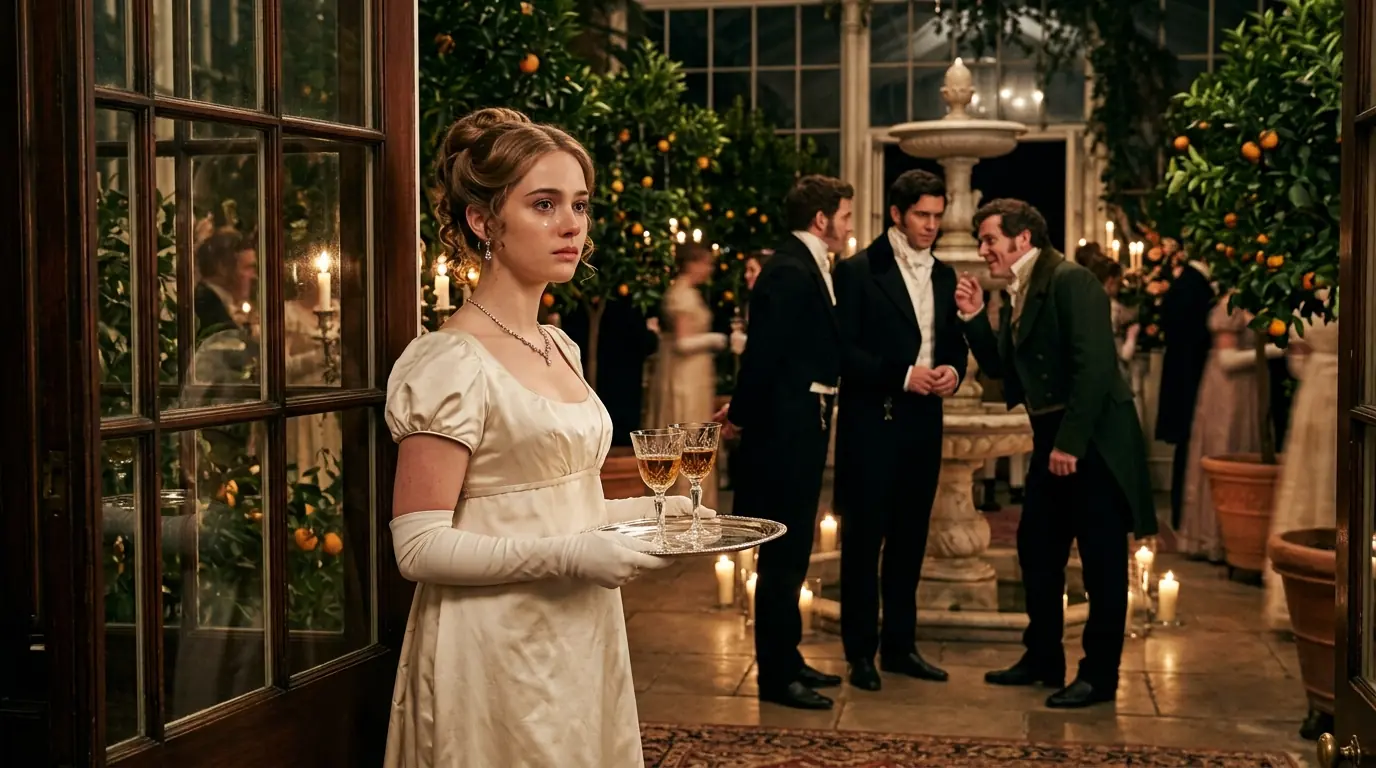
London, 1814. The chandeliers at Ashcombe House burned with 2,000 candles that night, and Lady Isolde Verney could count every single one of them through the haze of tears she refused to let fall. She stood just inside the orangery door, a silver tray trembling faintly in her gloved hands. On it, two glasses of hock, one for her husband, one for herself. A small domestic courtesy she had been taught at her mother's knee was the mark of a devoted wife.
“Bring him something with your own hands, darling. Let him feel looked after.” Three months married, three months of silences at breakfast, of closed study doors, of a wedding ring that sat on her finger like a borrowed thing. Through the half-open glass, she could see him. Adrian Halcourt, the Duke of Ravenmore, was broad-shouldered in black superfine and still laughing with three other gentlemen beside the fountain.
He did not laugh often. She had learned to treasure the sound the way a beggar treasures coin. “Come now, Ravenmore,” Lord Brearly was saying. “Confess it. The chit bored you before the vows were cold.”
Adrian swirled his brandy. A flicker of something crossed his face—boredom, perhaps, or perhaps something worse. “I shall tolerate her,” he said easily, “until she gives me a son. After that, she may have her own wing and her own amusements, and I shall have mine.” The men chuckled.
One of them murmured something Isolde could not hear. “Oh, she is pleasant enough,” Adrian added, smiling that slow, indulgent smile she had once believed was meant for her. “But one does not marry a Verney for conversation. One marries a Verney for the womb and the name. I expect an heir inside the year.”
He lifted his glass. “After that, the woman is merely a household expense.” The tray did not fall, and that was the thing she would remember afterward: the triumph that kept her standing. She set it down instead on the marble console beside the door, very gently, both glasses still full.
Then she turned, not toward the ballroom, not toward the carriages, but toward the narrow servants' passage that ran behind the orangery. What she carried inside her now could not be allowed to cross the ballroom floor in front of 600 people, and what she carried, God help her, was not only shame. It was the secret she had been planning all evening to finally tell him. The passage was narrow, lit only by a single brass sconce, and smelled of beeswax and old stone.
Isolde walked its length with the careful, measured steps of a woman who had been trained since girlhood not to stumble, not to weep, not to make a scene. Behind the wall at her right, she could hear the muffled swell of the orchestra, a waltz of all things, as though the world had not just tilted on its axis. “A household expense.” The words followed her down the passage like a second shadow. She reached a service door, pressed her gloved palm flat against it, and for a moment simply breathed.
Beneath the heavy satin of her bodice, laced so tight that Martha, the lady's maid, had fretted over it that very afternoon, her ribs ached. Her waist had already begun to thicken in ways only she and Martha knew. She had meant to tell him tonight. She had practiced the words in the carriage. “Adrian, I have news.”
She had imagined, like a fool, that he might take her hand. Now she understood, with a clarity so sharp it was almost peaceful, that the child inside her was not a gift she could give him. It was the price of her liberty, and she had just heard him name it aloud. She would not tell him—not yet, and perhaps not ever in the way she had dreamed. She stepped out into the mews, where the night air struck her like cold water, and called quietly for the Ravenmore carriage.
By the time Adrian returned to the house on Grosvenor Square, the small hours had long since struck. He handed his hat and gloves to the night footman, asked after her ladyship with the casual disinterest of a man inquiring after the weather, and was told that the Duchess had retired with a headache. He nodded, climbed the stairs, and did not look in on her. He would remember afterward that he had not looked. And what Adrian Halcourt did not yet know, could not have known, being a man who had ordered his life according to ledger columns and parliamentary calendars, was that his wife had passed his bedchamber door without pausing, had walked the length of the corridor in her stockinged feet, and had quietly turned the key in the lock of the Duchess's apartments from the inside.
She did not weep that night. She sat at her writing desk instead until the candle guttered and composed three letters in a hand so steady it might have frightened her husband had he seen it. The first was to her eldest brother, Lord Verney, at the family seat in Wiltshire. The second was to a small country solicitor in Bath, a man who had once handled her grandmother's private estate, and who owed the Verneys a family favor of the sort that is never written down. The third letter she did not send.
She folded it instead into the lining of a traveling case, where it would remain for a very long time. By breakfast, she was the perfect Duchess of Ravenmore once again. That, as Adrian would come to understand far too slowly, was how a marriage dies: not in shouting or tears, but in the quiet rearrangement of a woman's interior furniture while her husband goes on eating his toast. The change in her was so gradual that at first Adrian mistook it for improvement. She no longer asked after his day at the breakfast table.
She no longer looked up when he entered a room. She no longer left small bouquets of hot-house violets on the corner of his desk, a habit he had found, if he was honest, faintly tiresome. Now the desk was bare, and he found himself, absurdly, looking for the violets. Still, she smiled when spoken to. She dressed exquisitely.
At the Derby Ball, at the Cartwrights' musical evening, at the interminable dinner for the Russian ambassador, she was charm itself. And she left his side so smoothly, so courteously, that he did not at first realize she was leaving it at all. “Your Grace is in great looks tonight,” Lady Brearly murmured to her at one such evening, eyes sharp over her fan. “Marriage clearly agrees with you.” “Marriage agrees with all of us, ma'am,” Isolde answered gently, “when we understand its terms.”
Lady Brearly's fan paused, then snapped shut with a small, appreciative click. By midsummer, the whole of London had begun to notice that the Duchess of Ravenmore was something remarkable. She was not loud or flirtatious, merely present in a way she had not been before. She had opinions now, delivered softly, about the corn laws and the enclosures and the state of the veterans' hospitals. She paid calls on dowagers everyone else had written off as deaf or dying, and emerged from their drawing rooms having been bequeathed, in conversation at least, with an astonishing map of who truly owned what in the south of England.
Adrian heard of it by degrees, at his club, in Parliament, from his own steward, who murmured that her ladyship had been asking very particular questions about the Ravenmore dower house in Somerset, a property Adrian had almost forgotten he owned. “The dower house?” he repeated, frowning over the month's accounts. “Whatever for?” “I could not say, Your Grace. She had the plans brought down from the muniment room.”
“And the deeds?” Adrian set down his pen. It was the first small, cold thing he had felt in months. It was not quite alarm, but something more like the shiver one feels when a clock one had relied upon stops ticking and the room is suddenly too quiet. He told himself it was nothing.
Wives were whimsical. Perhaps she wished to redecorate. He returned to his accounts. Then three weeks later, he came home to find half her wardrobe gone. It was not all of it, for that would have been a scandal, and the Duchess of Ravenmore did not traffic in scandals.
Only the traveling clothes, the plainer day dresses, the riding habit, and the small walnut case of her grandmother's pearls were gone. A neat, surgical absence, the sort a woman makes when she intends to live somewhere else for a considerable time without announcing it. He found her in the morning room, calmly writing letters. “Isolde.” “Your Grace.”
She did not look up. “Where are your things?” “At the dower house. I had them sent down yesterday.” “The dower house?”
“In Somerset.” “Yes.” Now she did look up, and he was startled, actually startled, by how composed her face was, how finished, as though she had rehearsed this moment so many times it had worn smooth. “I shall be traveling down at the end of the week. Doctor Merrick advises country air.”
“Doctor Merrick?” His brows drew together. “You have been ill.” There was a small pause, a very small one, and in it something flickered behind her eyes that he could not read, something that was not quite triumph and not quite grief.
“I am with child, Your Grace. Since May, as near as we can tell.” The room went very still. Adrian stood in the doorway in his riding coat, a man who had been commanding boardrooms and committees for 15 years, and for the first time in his adult life he did not know what to do with his hands. “Since May?” he repeated stupidly.
“Since May. And you did not—” He stopped and cleared his throat. “You did not think to tell me?” “I thought about it a great deal,” she said, and her voice was so gentle it was almost kind. “At Ashcombe House, for instance, I had meant to tell you—the chandeliers, the orangery, the silver tray.”
He felt the blood leave his face in a slow, draining wave. She saw it. Of course she saw it. She had been waiting four months to see it. “Isolde, don't.”
She set down her pen and folded her hands. “Please don't, Adrian. Not now. I'm carrying your heir, as you requested.” “I shall carry him safely, I hope, in Somerset, where the air is better and the company less...”
She searched for the word and chose it with care. “Amusing.” “When he is born, you shall have him to raise in whatever manner pleases you. That is what you wished, is it not? The son, the wing, and the separate amusements.”
“I did not—” His voice came out hoarse. “I did not mean—” “You meant exactly what you said.” And here, for the first time, did her composure crack, not into tears, but into something harder, something that had been pressed flat under four months of silence, and now sprang back into shape. “I was standing three feet from you, Adrian.”
“I heard every word. I watched you laugh, and I've been smiling at you across breakfast tables ever since because I am a Verney, and Verney women do not make scenes in orangeries. But I will not smile at you across breakfast tables forever.” She rose, smoothed her skirts, walked past him to the door. At the threshold, she paused and did not turn.
“Martha is packing the last of my things. I shall leave at dawn on Friday. You are not to follow.” Then she was gone, and Adrian Halcourt, the Duke of Ravenmore, was left standing in a morning room full of fresh flowers he had never thought to notice, holding the realization too late, and far too late, that the household expense he had so graciously agreed to tolerate was the only person in his life who had ever truly looked at him. He did not follow her to Somerset.
Not at first: pride forbade it, then confusion, and after the first dreadful fortnight of sleeping in a house that had become inexplicably echoing, something worse than either. It was a slow, creeping comprehension that the silences he had once prized were not peace. They were absence. And absence, he was learning, had a sound of its own. He read the letters she wrote to his mother.
They were formal and cheerful, offering no purchase for reply. He read the reports from the Somerset steward. “Her Grace walks in the gardens each morning. Her Grace has engaged a midwife from Bath. Her Grace is well.”
Each “well” was a small, polite door closing in his face. By October, he could bear it no longer. He ordered the carriage, wrote no letter of warning, and drove west through three days of thin autumn rain. He arrived at the dower house at dusk. It was a modest gray stone building, smaller than he remembered, with lamps already lit in the lower windows.
She was in the drawing room when the butler announced him, seated by the fire with a book and a shawl, her figure now unmistakably rounded beneath the soft wool of her gown. She did not rise. “Your Grace.” Her voice was perfectly even. “You have had a long drive.”
“Isolde.” He stood just inside the door. He had prepared a speech, but it evaporated. “I—Forgive me. I should have written.”
“Yes,” she agreed. “You should have.” Silence followed as the fire crackled. Somewhere in the house a clock struck the half hour.
“May I sit?” “If you wish.” He sat, awkwardly, lost in the chair opposite hers. His hands, those clever hands that had signed treaties and struck bargains, hung between his knees like a schoolboy's. “I have been...” he began, then stopped and tried again.
“I have been a fool, Isolde.” “I do not expect you to believe me. I scarcely believe it myself, but I came down to tell you—to tell you that I did not mean what I said that night, and at the same time I know that I did mean it. That is the part that has kept me awake. I meant it, and I did not know I meant it, and I did not know what it would cost until you were gone.”
She watched him. She did not help him. He had not earned that yet. “I ordered my life,” he went on, his voice rougher now, the practiced cadence of the House of Lords gone out of it, “the way a man orders his estates. Every person in their place, every duty accounted for.”
“I thought marriage was an arrangement, a ledger. I did not know that a woman could...” He gestured helplessly at her, at the firelight, and at the shawl across her knees. “Could become the room one lives in. I did not know that until you took yourself out of it.”
For a long moment she did not answer. Then, very quietly, she asked, “What do you want, Adrian?” “I want to be the man you thought you were marrying.” “That man,” she said with a small, sad smile, “never existed. You know that.”
“Then I want to be a man you could choose, if you had the choosing again.” Something passed across her face. The first softening he had seen in four months, and it nearly broke him. “That is a great deal of work, Your Grace.”
“I have time.” “Do you?” She looked down at her hands, folded above the rise of their child. “I've been thinking a great deal about what I want—not what I am owed. That question is simpler and crueler.”
“What I want. And I find I do not want revenge. I'm too tired for revenge. I do not even want apologies, though yours is the first that has not insulted me, and I thank you for it.” She looked up.
“What I want is to be seen—not performed for, not tolerated, but seen. And Adrian, if you cannot learn to do that, then all the speeches in Parliament and all the roads between London and Somerset will not mend this. I shall raise our son. You shall visit him. We shall be civil.”
“That is as much as I can promise tonight.” He bowed his head. He had expected no more. He had, in truth, expected less. “May I stay until morning?” he asked.
“I shall sleep in the east room. I ask nothing else.” “You may stay.” He rose to leave the drawing room. At the door he paused, some instinct he did not yet have a name for, and turned back.
“Isolde, the violets on my desk, as you used to bring them.” “Yes?” “Why did you stop?” She looked at him for a long moment, and her eyes, at last, filled. Not with the tears she had refused to shed at Ashcombe House, but with something gentler, something that might yet be salvaged.
“Because I thought no one was noticing, Your Grace.” “I was noticing,” he said. “I was only noticing too late.” He did not go back to London the next day, or the day after. He wrote to his steward, to his man of business, to the whip in the Lords, and he stayed.
He slept in the east room. He took breakfast with her each morning, and asked her, awkwardly at first, and then less so, what she had been reading, and what she thought of it, and what she thought of him. He did not always like her answers. He learned, for the first time in his life, to sit with the not liking. And in December their son was born, in a snowstorm that closed the Bath Road for three days.
Adrian, who had commanded armies of solicitors, sat on a hard chair outside her chamber for 11 hours and prayed, a thing he had not done since he was a boy, to a god he was not sure he believed in, for the life of a woman he had once called a household expense. When the midwife finally opened the door and placed the small, red, furious creature into his arms, he wept. He did not weep prettily, nor did he shed the single, decorous tear of a gentleman. He wept the way a man weeps when something he did not deserve has been given to him anyway, and he sees, finally, the size of the debt. He named the boy Thomas, for her father.
She had not asked him to. They did not move back to London that spring, nor the spring after. Grosvenor Square was let to a visiting ambassador, and the house in Somerset grew a new wing, a library, a small walled garden where Isolde planted violets. Adrian went up to Parliament when he must, and came back as quickly as he could. He became, to the astonishment of his club, rather a bore on the subject of his wife.
They were not, perhaps, the people they had been on their wedding day. They were something harder won than that. She had learned that survival did not require pretending, and he had learned, slowly, imperfectly, and at a cost he would be paying quietly for the rest of his life, that the woman he had once agreed to tolerate was, in fact, the only luck he had ever had. And sometimes, on autumn evenings, when the fire was low and their son asleep upstairs and the house had settled into that particular hush that marriages make when they have survived themselves, she would look up from her book and find him watching her, not appraising, not managing, simply looking. And she would smile, and he would remember the silver tray that had not fallen, and be grateful every single day that some women are stronger than the men who underestimate them.