Montana, 1887, had a way of making loneliness look respectable. A man could live twelve miles outside Grover, keep his fences mended, his cattle fed, his roof tight, and the town would call him steady instead of alone. Jacob Walker had learned that lesson over eleven years. He was fifty-eight years old, a widowed rancher with weathered hands, tired blue eyes, and a house that stayed too quiet after sundown.
His wife Margaret had been gone long enough that people stopped lowering their voices when they said her name. They spoke of her now as part of history, like an old winter or a bad flood. Jacob did not correct them, but he never thought of Margaret as history. She lived in the way the kitchen shelves were arranged, in the blue quilt folded at the foot of the bed, and in the silence that met him every morning before coffee.
He did not consider himself unhappy. Unhappiness sounded too active, too sharp, too full of complaint. Jacob worked, ate, slept badly, and rose before dawn because cattle did not care whether a man’s heart had gone cold. His ranch was orderly, his accounts were clean, and his dog Porter followed him from barn to fence line with the patient loyalty of a creature that understood more than people did.
Jacob rode into Grover every Thursday for supplies. He bought salt blocks, feed, coffee, lamp oil, and occasionally nails if a gate had begun arguing with him. He spoke to Tom Briggs at the hardware store, nodded to Martha Holt outside the church, and left before town conversation could hook its claws into him. That had been his pattern for years, until September brought Clara Bennett.
Clara arrived in Grover to teach school after old Mr. Hennessy retired. Within three weeks, half the town had formed opinions about her, and the other half had formed opinions about those opinions. She was twenty-nine, with long dark brown hair, steady hazel eyes, and the kind of calm beauty that did not ask for attention but received it anyway. Men noticed her face first, then discovered too late that she noticed everything.
Jacob first saw her outside the schoolhouse steps. He had just passed the church corner when she lifted one hand and called, “Excuse me.” He stopped his horse and looked down at her. She stood with a stack of books against one hip, her dark hair pinned beneath a modest bonnet, and her gaze direct enough to make a man answer honestly.
“You wouldn’t happen to know who could look at a schoolhouse stove, would you?” she asked. “It smokes badly, and the children are suffering for it.”
“Tom Briggs,” Jacob said. “Hardware store. Tell him Jacob Walker sent you, and he won’t overcharge.”
“Thank you,” she replied. “I’m Clara Bennett. I teach here.”
“I know,” Jacob said. “Jacob Walker. I ranch.”
“I know,” Clara said.
That was all. Fourteen seconds, maybe fifteen if a man counted too carefully afterward. Jacob rode on without looking back, though he thought about the stove twice before he reached the feed store. On Thursday, he asked Tom Briggs whether he had fixed it, claiming only that a smoking stove was bad for children.
Tom gave him a look too amused for Jacob’s comfort. “Already fixed.”
“Good,” Jacob said.
Tom smiled. “She asked whether you always give useful answers and leave before people can thank you.”
Jacob picked up his coffee. “Have a good Thursday, Tom.”
Clara came to the ranch in October. She was visiting the Aldridge place because young Thomas Aldridge had missed school too often, and Jacob’s gate happened to be on her way back. He was repairing a hinge when Porter lifted his head, wagged his tail, and betrayed him by acting pleased before Jacob even looked up. Clara stopped beside the fence and said, “Your dog has better manners than most men in town.”
Jacob tightened the hinge bolt. “He has fewer opportunities to speak.”
She laughed then, quick and genuine. Jacob had not expected the sound to warm the air around him, but it did. She stepped closer to the fence and looked over the ranch with thoughtful eyes. “Thomas Aldridge says you taught him to ride last summer.”
“His father asked me to.”
“He says you are patient with horses.”
“Horses are easier than boys.”
Clara smiled. “I’ll remember that next time Thomas refuses arithmetic.”
She stayed twenty minutes. They spoke of school, winter signs, cattle prices, and the way Grover seemed small until a person needed something from everyone in it. Jacob gave short answers at first, but Clara had a way of waiting without making silence feel like failure. When she finally rode away, he returned to the hinge and discovered he had already finished it.
Two weeks later, she brought him a book about cattle management from the schoolhouse shelf. Jacob had read it ten years earlier and remembered disagreeing with half of chapter four. He took it anyway and thanked her. That night, he read it again by lamplight and found himself writing comments in the margin as if Clara had asked for a report.
By November, her Tuesday visits had become a habit neither of them had formally invited. Clara would arrive after school, usually with some practical reason: a question about a student’s family, a borrowed book, a note from Tom Briggs, a jar of preserves from Martha Holt that somehow needed delivery. Jacob would make coffee. At first, he made one cup and offered her half of the pot.
The third Tuesday, he made two cups before she arrived. He did not realize what he had done until both were sitting on the table. For a moment, he stared at them as if they had accused him of something. Then Porter walked in, looked at the cups, looked at Jacob, and walked back out.
“You are not helpful,” Jacob told the dog.
Clara arrived exactly at two. Jacob handed her the coffee without comment. She looked at the two cups, then at him, then back at the cups. A smile touched the corner of her mouth, but she was kind enough not to mention it.
“Smart dog,” Clara said when Porter disappeared again.
“Yes,” Jacob replied. “He knows when to leave a room.”
The kitchen fell quiet after that, but not empty. Clara drank her coffee with both hands around the cup, listening as Jacob described how the creek ran low in dry winters. She asked questions that did not feel like polite conversation. She listened like the answer mattered.
Grover noticed by mid-November. Grover always noticed everything eventually, and often before it had any right to. Martha Holt decided the visits were wonderful and told the church sewing circle that Jacob Walker had been alone long enough to qualify for rescue. Franklin Pierce Jr., the banker’s son, decided the visits were inappropriate because he had sent Clara flowers twice and been thanked with no romantic result whatsoever.
Franklin confronted Jacob at the feed store one cold Thursday morning. “I hear Miss Bennett has been visiting your ranch.”
Jacob lifted a salt block from the stack. “She visits several families. Schoolteacher’s habit.”
“Twice a week?”
“Children need a lot of improvement,” Jacob said.
Franklin’s face tightened. “She is young.”
Jacob looked at him then. “So are you. It has not improved your manners.”
Tom Briggs coughed behind the counter in a way that sounded suspiciously like laughter. Jacob paid for his supplies and left before Franklin could decide whether he had been insulted. Porter waited outside the store, tail moving slowly as if the whole exchange had met his expectations.
Ruth Deacon at the post office repeated the scene to Clara the next morning. Clara listened carefully, then asked, “Did Jacob raise his voice?”
“No.”
“Did he explain himself?”
“No.”
“Did he leave with his salt block?”
“Yes.”
Clara nodded. “Good.”
Ruth stared. “Good?”
“That is the correct response to Franklin Pierce Jr.”
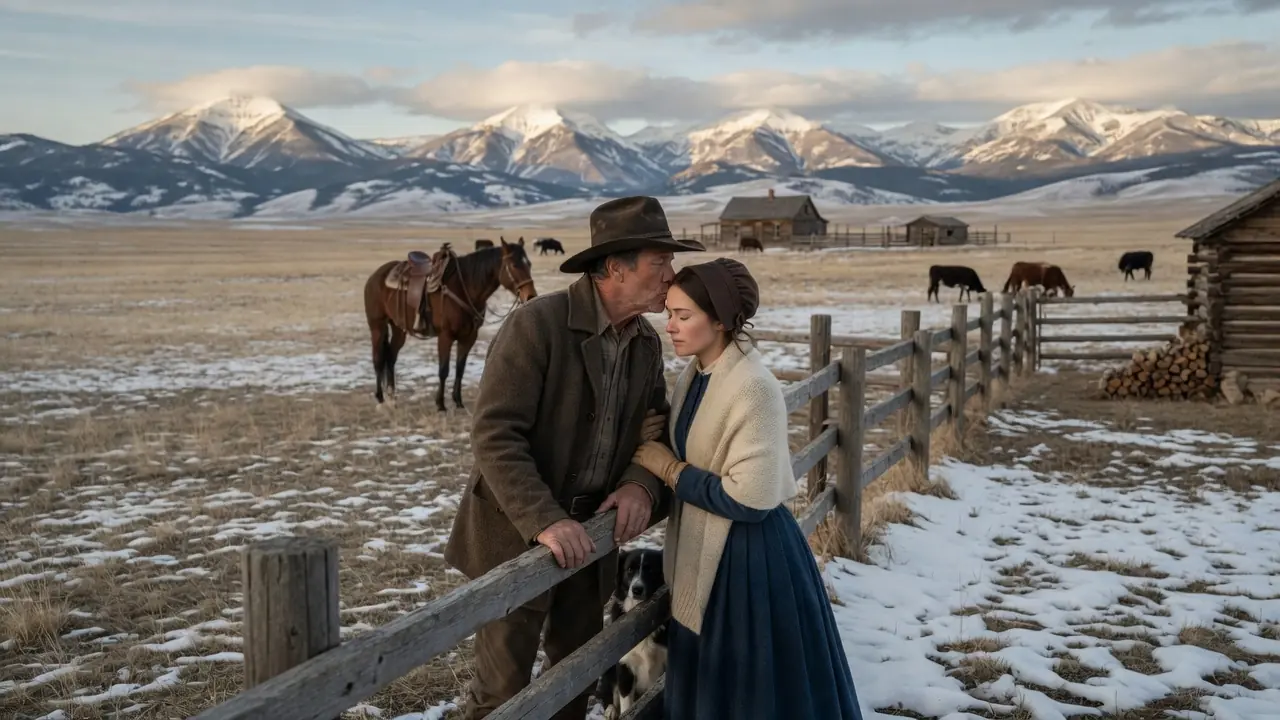
By December, winter had settled over the ranch in silver-brown grass, frost along the fence rails, and mountains standing white beneath a pale sky. Clara still came on Tuesdays, wrapped in a deep blue wool dress and cream shawl, her cheeks bright from the cold. Jacob began walking with her to the east fence after coffee, where the land opened toward the mountains. Porter usually came too, because Porter believed himself essential to every human arrangement.
One Tuesday, the sun was low, turning the snow-touched peaks pale gold. Jacob stood beside the fence with both hands on the top rail, saying nothing for so long that Clara finally turned toward him. She knew by then that his silences had different shapes. This one had been gathering for weeks.
“Clara,” he said, eyes on the mountains. “I need to say something.”
She faced him fully. “Then say it.”
“I think you should consider spending your Tuesdays differently.”
Her expression did not change, but Porter looked up sharply. Jacob kept his gaze fixed ahead, because if he looked at her, he might lose the nerve to finish what he had decided was noble. “You are twenty-nine years old. I am fifty-eight.”
“I can count,” Clara said.
“You’re too young for an old rancher.”
She stepped closer. “Jacob.”
“You deserve someone younger,” he continued. “Someone easier. Someone with less past behind him and more future in front of him. You deserve a man who has not spent eleven years learning how to live alone.”
Clara watched him with the expression she probably used on students who had given a confident wrong answer. Not unkind. Not angry. Only unwilling to pretend a false thing was true.
“Are you finished?” she asked.
Jacob looked at her at last. “No. But I suspect you are going to interrupt.”
“Yes,” she said. “Because you are about to make a decision for me and call it kindness.”
He closed his mouth.
Clara moved nearer, her gloved fingers holding the edge of her shawl. “You keep speaking as if your age is a warning label. As if grief makes you damaged goods. As if the years you lived before I came to Grover are evidence against you.”
“They are facts.”
“They are not the only facts.”
Jacob’s jaw tightened. “In ten years, I will be sixty-eight.”
“And I will be thirty-nine,” Clara said. “Still able to count, I expect.”
Porter sat down directly on Jacob’s boot, an act Jacob had learned to interpret as judgment. He looked down at the dog. “Do not start.”
Clara’s mouth softened, but she did not let the moment drift away. “I am not interested in Franklin’s age, or any other man’s smooth future, or whatever people in town think a woman like me should want. I am interested in the man who listens when I speak. The man who tells the truth plainly. The man who made coffee for two before he admitted he wanted company and never once mentioned it.”
Jacob looked at the fence rail. “You noticed that.”
“I notice most things.”
“That seems inconvenient.”
“It is,” she said. “For people trying to hide.”
The wind moved through the dry grass. Jacob felt suddenly exposed, not because Clara had embarrassed him, but because she had seen the tender places he had boarded shut and spoken to them without fear. He wanted to tell her she was wrong. He wanted to say he was protecting her. But the truth was uglier: he was protecting himself from hope.
“Clara,” he said, voice lower. “Margaret was my wife.”
“I know.”
“I loved her.”
“I know that too.”
“I do not know what it means to care for someone after burying the person I thought I would grow old beside.”
Clara’s eyes softened. “It means you are alive.”
That sentence went through him quietly and stayed. Jacob turned away from the mountains and looked at her fully. She stood close now, close enough that he could see the cold on her lashes and the steadiness beneath her tenderness.
“You deserve better than a man still learning that,” he said.
Clara took one more step and rested her gloved hand lightly against his sleeve. “To me,” she whispered, “you are perfect.”
The words did not make sense at first. Perfect was not a word Jacob would have placed anywhere near himself. He knew his temper was slow but heavy, his habits stubborn, his grief old and sometimes poorly behaved. He knew he had forgotten how to speak gently unless speaking to animals or children.
Yet Clara said it as if she had examined the matter thoroughly and reached a conclusion. Not perfect as in flawless. Perfect as in right. Perfect as in the thing that fits where something had been waiting.
Jacob’s hand lifted before his courage could retreat. He touched her shoulder lightly, a question more than a claim. Clara did not move away. Instead, she looked up at him with a trust that frightened him more than any storm.
“You make a foolish old man hope again,” he said.
“Then don’t be afraid of me.”
He lowered his head slowly, giving her every chance to step back. She did not. His lips touched her forehead in a soft, reverent kiss, tender and protective, full of everything he could not yet say. Clara closed her eyes for one brief moment, and the Montana winter seemed to hold its breath around them.
When he drew back, she was smiling through emotion. Jacob’s face had changed too, though he did not know it. Something guarded had loosened. Porter removed his weight from Jacob’s boot, apparently satisfied that progress had occurred.
“You still think too much,” Clara said softly.
“I think carefully.”
“You think slowly.”
“That too.”
She laughed, and Jacob felt the sound settle somewhere in his chest where silence had lived for years.
He did not propose that day. Jacob Walker did not move quickly even when his heart had already started moving without permission. For three days, he worked, rode fence, mended harness, fed cattle, and thought of little else. Porter followed him with an expression of exhausted patience.
“I am considering the matter,” Jacob told him on the second day.
Porter sat down.
“I know you believe I am taking too long.”
Porter looked toward town.
“That is not helpful.”
Jacob thought about Margaret without the old stab of guilt he had feared. He remembered her practical hands, her sharp humor, her habit of calling him stubborn when he needed it most. Margaret had once told him that suffering was not holy just because a person could endure it. He had forgotten that, or pretended to.
On Saturday morning, he saddled his horse and rode the twelve miles into Grover. He carried no supplies list, no excuse, and no message from a neighbor. Porter followed until Jacob told him to stay, then followed anyway at a distance that suggested technical obedience. When Jacob reached the schoolhouse, Clara was inside grading papers.
She looked up as he appeared in the doorway, hat in both hands. “It is Saturday.”
“I know.”
“You have never come on Saturday.”
“I know.”
She set down her pen. “You had better come in then. It is cold in the doorway.”
Jacob stepped inside. The schoolroom smelled of chalk, stove smoke, and ink. Children’s slates sat stacked near the wall, and a map of the United States hung crookedly behind Clara’s desk. Sunlight came through the windows in clean winter lines.
“I have been thinking,” Jacob said.
“I assumed so.”
“I think carefully.”
“Yes,” Clara said. “We have established that.”
He looked at the hat in his hands, then at her. “I have concluded that I was operating under several assumptions that need revision.”
Her eyes warmed. “Such as?”
“Such as the assumption that my age and my history form a reasonable argument against asking you to marry me.”
The schoolroom became very quiet. Even the stove seemed to settle. Clara looked at him, and Jacob knew that if she laughed, he would deserve it, because no man had ever begun a proposal more like a land contract. But Clara did not laugh.
“And have you revised that assumption?” she asked.
“With difficulty,” Jacob said. “Yes.”
He reached into his coat pocket and took out a small ring. It had been Margaret’s once, plain gold, worn smooth by years of work and love. Jacob had kept it on a chain in his dresser for eleven years, not as a shrine, but as proof that something sacred had existed. That morning, he had held it in his palm and understood it did not need to remain still forever.
“I would very much like it,” he said, voice rougher now, “if you would be my wife. Knowing the age, the ranch, the winters, the memories, the dog, and all the inconveniences that come with me.”
Clara came around the desk slowly. She looked at the ring, then at him. “Jacob Walker, you are the most deliberate man I have ever met.”
“Is that a yes?”
“It was always going to be yes,” she said. “I was waiting for you to think it through.”
He let out a breath he had not realized he was holding. Clara offered her hand, and he slid the ring onto her finger. It fit as if time itself had been less careless than he feared. She looked at it not like a replacement for something dead, but like a living promise that had crossed through grief and arrived whole.
Outside, Porter barked once at a passing cat and then returned to his post with great dignity. Clara glanced toward the door. “Your dog approves.”
“He approves of anything that proves him right.”
They were married in February at the Grover church. The whole town came, partly out of affection and partly because Grover had been discussing the matter for months and wanted the satisfaction of seeing how it ended. Clara wore deep blue instead of white, because she said she had no intention of dressing like a symbol when she could dress like herself. Jacob stood at the altar and watched her come toward him with the full knowledge of how close he had come to refusing joy out of habit.
Martha Holt cried from the second pew. Tom Briggs smiled like a man who had known the ending since the stove. Franklin Pierce Jr. attended with stiff politeness, and his father looked as though the wedding had personally offended the banking profession. Porter waited outside and greeted the couple afterward with the enthusiasm of a dog who believed he had arranged the entire affair.
The ranch changed that spring. Not the fences or barns or cattle, but the feeling inside the house. Clara brought books, laughter, ink stains, questions, and an ability to make silence feel shared instead of abandoned. Jacob built her a shelf from good wood, measured exactly to fit the books she had brought from Billings and the ones she kept acquiring in Grover.
“That is the most romantic thing you have done,” Clara told him.
Jacob looked at the shelf. “It is a shelf.”
“You built it without being asked. You measured it to fit my books. You used the good wood.”
“That makes it sturdy.”
“It makes it romantic.”
Jacob considered this for a long moment. “I will accept the correction.”
She kissed his cheek. “You are learning.”
Years passed in the ordinary miraculous way years do when a house is full. Their son Henry was born when Jacob was sixty-one, and Jacob spent months worrying he was too old to be a father until Clara put an end to it. “Can you teach him to ride?” she asked. “Can you teach him to keep his word? Can you teach him patience?”
“Yes,” Jacob said.
“Then you are exactly what he needs.”
Their daughter May arrived two years later, small, loud, and certain that the world was made of arguments she could win. Clara said May had Jacob’s stubbornness. Jacob said May had Clara’s directness. Porter, older by then and more opinionated than ever, seemed to believe both children belonged partly to him.
On summer evenings, Jacob sat on the porch with Clara beside him and listened to the children in the yard. Their voices moved through the ranch the way wind moved through grass, constant and alive. Sometimes Jacob thought of the old silence and could hardly believe he had mistaken it for peace. Peace, he learned, was not the absence of sound.
It was the presence of things worth hearing.
Ten years after the day at the east fence, Jacob and Clara stood there again. The mountains held the last gold of evening, and the fence rail beneath Jacob’s hand had been replaced twice since that December. Clara’s hair was pinned back, a few strands loose around her face, and the ring on her finger had grown familiar in the best possible way. Porter’s son slept near the gate, carrying forward the family tradition of silent judgment.
“I was wrong,” Jacob said.
Clara looked at him. “About many things, or something specific?”
He smiled. “About saying you were too young for an old rancher.”
“I told you that at the time.”
“You did.”
“I was very clear.”
“You were.”
She leaned against the fence beside him. “But I appreciate the admission.”
Jacob reached for her hand and held it on the rail between them. He thought of the man he had been that winter, counting years like they were debts and grief like it was proof he had nothing left to give. He thought of Clara stepping closer instead of away. He thought of a kiss on her forehead, soft as a question, and her whisper answering before he had learned how to ask.
“Thank you,” he said quietly.
“For what?”
“For counting differently than I did.”
Clara rested her head against his shoulder. “Someone had to.”
The children shouted somewhere behind them, and the dog lifted his head before deciding the matter did not require him. The sky deepened over Montana, turning pink, then violet, then blue. Jacob stood beside his wife, feeling every one of his years and not resenting a single one, because somehow they had carried him here.
He had once believed love had passed him by.
Clara had known better.
And in the end, that had made all the difference.