The words “CONDEMNED VEHICLE” dripped down the side of my 1965 Rolls-Royce Silver Cloud II like paint from a fresh wound. The chemical smell caught in my throat as I stood there in my pajamas staring at eight months of work destroyed in thirty seconds. But it wasn't random vandalism. Tucked under my windshield wiper was an official HOA notice: “Vehicle condemned for code violations. Contact Brenda Kensington for retrieval information.”
My car. On my property. It was a car I had restored from a rust bucket into a $200,000 masterpiece. And my HOA president had just spray-painted it like abandoned junk and was trying to steal it with paperwork.
The wet paint was still tacky against my fingertip. She had done this maybe an hour earlier thinking I'd never fight back. Six months earlier, I was just Marcus Holloway, a 58-year-old retired Boeing machinist trying to figure out how to fill the days after my wife Elena died. Cancer took her in March.
By October I was drowning in silence. That's when I found the Rolls-Royce, 1965 Silver Cloud II, buried under thirty years of dust in my neighbor's garage. The poor man had died intestate, leaving estate-sale buyers to pick over his life. $8,000 for what looked like a metal coffin on wheels.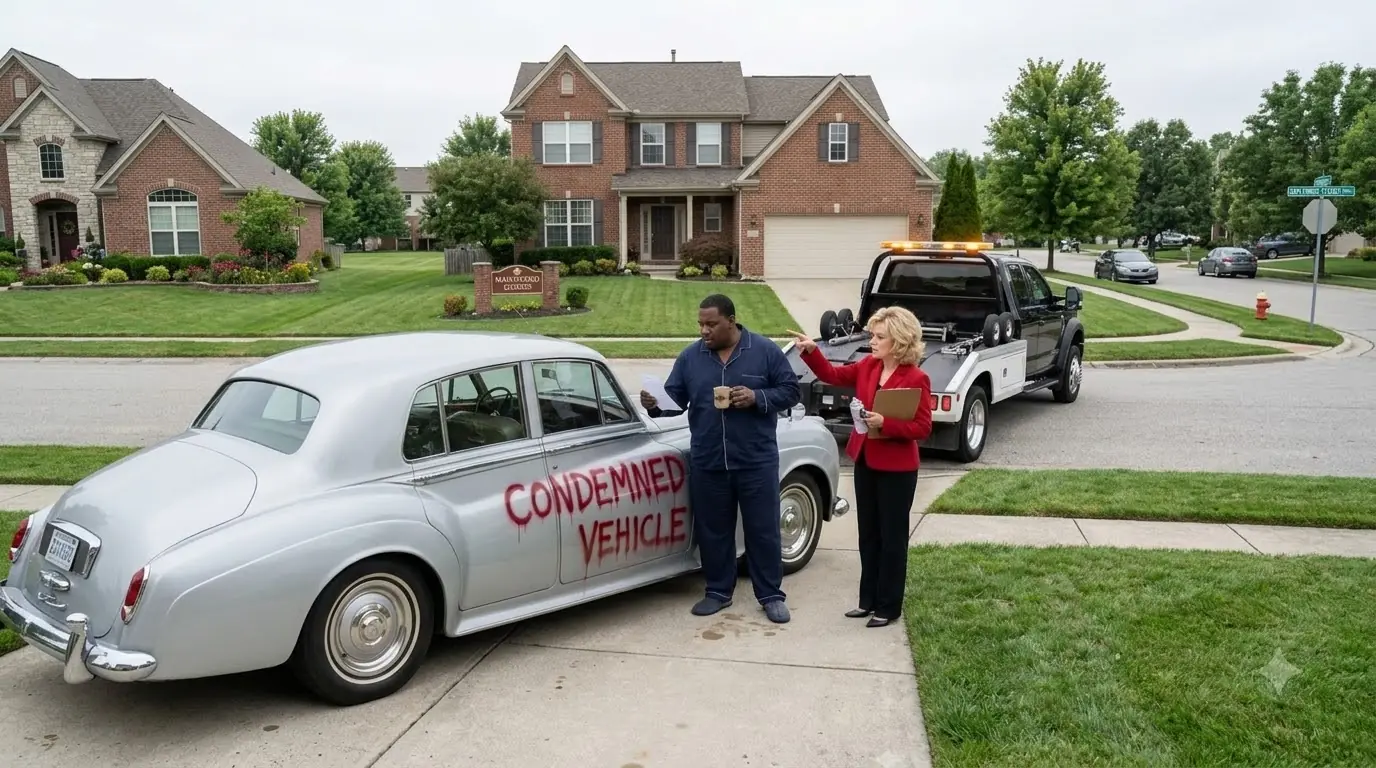
Engine seized tighter than a miser's wallet. Mice had turned the leather interior into a five-star hotel. The smell hit you like a punch. Mildew, rust, and decades of neglect.
But God, those lines. Even covered in filth, you could see the aristocracy underneath. I'd moved to Maplewood Estates for peace and quiet. Decent neighborhood, reasonable HOA, the kind of place where people wave and mind their business.
A flatbed dropped my project car on a Tuesday and I was already planning my attack when I heard heels clicking up my driveway. “Excuse me, are you the new owner?” Brenda Kensington looked like she'd stepped out of a real estate magazine. Perfectly blown out hair, business casual armor, smartphone and clipboard like weapons of mass regulation.
Everything about her seemed to say, “I peaked in high school, and now I’m everyone’s problem.” “That depends. Are you selling something?” “HOA compliance.”
She was already photographing my car. “I’m Brenda, the neighborhood president.” “That vehicle is in violation of our aesthetic standards.” “It has been here twenty minutes.”
“It doesn’t matter. Inoperable vehicles aren’t permitted in visible areas.” Click, click, click went her phone camera. “You have seventy-two hours.”
Here's the thing about HOA covenants. Most are copy-paste jobs from 30 years ago that nobody's actually read. The first lesson was simple: always demand the complete original documents, not just the summary they hand you. Half these violations are unenforceable garbage, but I was still playing nice.
“Look, I’m restoring it. It’s a hobby.” Nevertheless, she handed me a pre-written citation. Daily fines begin Thursday.
That's when I noticed her lingering. A normal neighbor would have left after delivering the bad news. Brenda stood there studying the rules like she was memorizing every detail. Her eyes weren't showing disgust.
They showed something else. Recognition, perhaps. Maybe even desire. “Beautiful car,” she said quietly.
“It’s a shame to see it abandoned.” “It’s not abandoned. It’s a project.” “Of course.”
That fake smile appeared again. “Well, seventy-two hours, Mr. Holloway.” She walked away, but I watched her in my security camera feed. Three slow circles around the block in her white BMW, pausing each time to stare at my driveway.
Not checking for violations, studying, planning. That night I researched Brenda Kensington. A real estate agent for twelve years and HOA president for eight, specializing in luxury estate management. Her LinkedIn read like a resume for professional meddling.
Citation three, noise violations from excessive automotive repair activities on a day I hadn't even opened the garage. Citation four, improper waste disposal. For the cardboard box my parts came in. By week’s end, I owed $400 in fines for basically existing.
But the real red flag, every evening that white BMW made its rounds. Slow, deliberate, like a shark circling wounded prey. And every time, Brenda would sit there staring at my Rolls for just a little too long, like she was waiting for something. Week two, Brenda declared war.
Monday brought citation number five, improper vehicle orientation. Apparently, my Rolls was facing the wrong direction. I'd parked it nose out like every other car on the block, but somehow mine violated aesthetic harmony standards. Tuesday, unauthorized commercial delivery acceptance.
Because UPS dropped off engine parts, you know, the same way they deliver everything from dog food to personal items to every other house in America. Wednesday, noise violation during designated quiet hours. For starting my Honda Civic at 2:00 p.m. to buy groceries, in broad daylight, on a Wednesday. By Thursday, I had racked up $400 in fines for basically existing while owning a project car.
But here's where Brenda got sloppy. My neighbor Jerry knocked on my door that morning, scratching his head like he just witnessed something supernatural. “Strangest thing, Marcus.” “I got a call yesterday from your HOA lady asking whether you had been running some kind of auto shop.”
“She had all these detailed questions about noise and commercial vehicles.” He paused. “The thing is, she already seemed to know my answers, as though she were reading from a script.” That's when it clicked.
Brenda wasn't just making up violations, she was manufacturing witness statements, building a case file like some suburban prosecutor planning my automotive execution. Time to fight back with actual facts instead of her fiction. I spent that weekend diving into Washington State vehicle codes, something I should have done the moment I moved here. Turned out most of Brenda's citations referenced regulations that had been updated or completely abolished years ago.
Even better, I discovered Washington’s hobby-restoration exemption. You get 180 days to restore a vehicle on private property without any permits or restrictions, as long as you're not running a business. I'd read about this kind of thing in classic car forums. I had read about people being harassed by HOAs until they learned to fight back with real law instead of neighborhood politics.
The state legislature actually protects restoration projects because they recognize the historical and economic value. Monday morning, I filed formal appeals for every single citation, complete with legal references, photos proving compliance, and copies of the state exemption statute. I sent the whole package to every board member, the property management company, and just for fun, Brenda's real estate broker. Her response arrived by dinner.
Citation number eight. Unauthorized hazardous material storage. The alleged violation concerned one quart of Valvoline stored in my garage. But I was done playing defense.
Tuesday morning, I wheeled my engine hoist out of the garage for the Rolls’ first real surgery. The metal wheels scraped against concrete like nails on a chalkboard, announcing to the neighborhood that something serious was about to happen. The moment I cracked the first bolt on that seized V8, thirty years of automotive history came pouring out. Sweet, thick motor oil mixed with rust and the sharp chemical bite of penetrating fluid.
Smells that took me back to weekend projects with my dad, when fixing things meant more than just therapy. Within an hour, I had an audience. Jerry from next door, Tom from across the street, even Mrs. Patterson dragging her ancient poodle over to investigate. Word travels fast in suburbia when someone's doing something more interesting than mowing grass in perfect diagonal lines.
“Jesus, Marcus.” Tom whistled peering into the engine bay. “That's more chrome than a Harley convention.” That's when I spotted the white BMW making its fourth pass of the morning.
Brenda wasn't just checking on me anymore. She was documenting everything with her phone. Every tool, every part, every neighbor who stopped to look. But Wednesday brought the game-changer I never saw coming.
City code enforcement showed up at my door. Official badge, serious clipboard, the whole intimidation package. My heart dropped. Had Brenda actually gotten the city to shut me down?
“Mr. Holloway? We’re here about complaints concerning a commercial automotive operation.” I was ready to lawyer up when I saw his expression. Pure bureaucratic exasperation.
“Look, I’ll be straight with you.” We've gotten nineteen calls about this address in two weeks. 19. That's more than most actual auto shops generate.
He gestured at my obviously hobby-level setup. “This is clearly personal restoration, not commercial activity.” “Whoever is calling this in is wasting taxpayer money.” “Any idea who?”
“It’s the same number every time—a woman who identifies herself as a concerned neighbor named Brenda.” She's actually costing us money processing these bogus reports. After he left, I realized Brenda had just handed me a gift. She'd escalated to filing false government reports.
That wasn't HOA overreach anymore. That was harassment with a paper trail, all documented in city records. The amateur was about to learn why you don't pick fights with someone who spent 30 years reading technical manuals. Brenda's next move hit me where it hurt most.
My wallet. Thursday morning, 7:00 a.m. phone call from my homeowner's insurance. “Mr. Holloway, we need to clarify some concerns about automotive business activity at your residence.” “Business activity?”
“An anonymous report claimed you’re operating an unlicensed repair shop.” If that's true, your current policy doesn't cover commercial liability. I could practically hear Brenda's voice behind those words. She'd found my weak spot.
Mess with a man's insurance and you mess with his financial security. It took three hours on hold to convince them I was restoring one car, not running Jiffy Lube out of my garage, but the damage was done. My policy was now flagged for review. That afternoon brought the real gut punch.
I was adjusting valve clearances when my neighbor Jerry wandered over, beer in hand and confusion written across his face. “Strangest thing, Marcus.” Your HOA lady stopped by asking questions about your house. What kind of questions?
Real estate stuff. How long you'd lived here, what you paid, whether you seemed financially stable. Jerry's expression darkened. Asked if the car project looked expensive, whether I thought you were overextending yourself.
The wrench went cold in my hand. She asked about my finances? Yeah, and here's the creepy part. She already knew the answers, like she was confirming information she already had.
That's when the pieces clicked. The constant documentation, the harassment campaign, the financial probing. Brenda wasn't trying to enforce HOA rules. She was conducting reconnaissance, but for what?
Saturday's mail brought my answer. A glossy real estate flyer featuring recent sales in your neighborhood. Every property listed had sold 15 to 20% above asking with glowing descriptions of community stability and maintained property values. Buried in the small print was the kicker.
Avoid problematic properties that can affect your home's value. Contact Brenda Kensington for a free market analysis. She was using my restoration project as a scare tactic to drum up business. But the real revelation came Sunday morning when I was polishing chrome trim.
The sweet smell of metal polish mixing with coffee from my kitchen window. Mrs. Patterson shuffled over with her ancient poodle looking like she had something stuck in her throat. Marcus, dear, I probably shouldn't tell you this. What's up, Mrs. P?
That HOA president came by yesterday asking about you, but the questions were odd. She glanced around like she was sharing state secrets. Wanted to know if you seemed mentally stable after your wife's passing, whether the car project was healthy grieving or concerning obsession. My blood pressure spiked.
She asked about my mental health? Said she was worried about neighborhood safety. Asked if I'd noticed any erratic behavior or signs of instability. Mrs. Patterson's voice dropped to a whisper.
I told her you were the most normal person on the block, but Marcus, she was taking notes. That's when I realized this wasn't about property values or “HOA compliance.” Brenda was building a psychological profile, laying groundwork to question my competency. In Washington state, HOAs can force property sales if they can prove owners are creating ongoing disturbances due to mental instability.
She was trying to steal my house. Monday morning brought the mini twist that changed everything. I was replacing spark plugs, the satisfying click of each one seating properly, when a black SUV pulled up. Two guys in suits stepped out, looking like they'd rather be anywhere else.
Mr. Holloway, we're from King County Adult Protective Services. My heart stopped. Protective Services? We received a report expressing concern about your welfare.
Anonymous caller suggested you might be experiencing difficulties following your wife's death. The taller one looked embarrassed. Look, we can see this is obviously You're clearly fine. Your property's well maintained and frankly, whoever called this in wasted everyone's time.
Any idea who made the report? Can't say officially, but he glanced at his partner. Female caller, identified herself as a concerned neighbor. Very detailed information about your concerning automotive obsession and financial instability.
After they left, I stood in my driveway staring at the Rolls, its chrome bumper reflecting my face like a funhouse mirror. Brenda had escalated from harassment to character assassination. She'd tried to get the government to declare me mentally unfit, but she'd made a crucial mistake. Every false report, every malicious call, every attempt to destroy my reputation was now documented in official records.
The retired machinist was about to teach the real estate agent what precision engineering looked like when applied to evidence. Tuesday brought Brenda’s nuclear option, actual lawyers. The certified letter was thick as a phone book and twice as threatening. Cease and desist.
Residential covenant violations stamped across legal letterhead that probably cost more per page than most people make in a day. Twenty-seven alleged violations and $3,200 in fines. 10 days to comply or face property lien and potential foreclosure proceedings. But what made my coffee taste like battery acid wasn't the legal threats, it was the attached photos.
Professional surveillance shots of my Rolls taken with telephoto lenses, including pictures through my garage windows, and detailed close-ups of my tool setup. Someone had been stalking my property like I was running an illegal operation instead of restoring a classic car. Elena used to handle all our legal stuff. Sitting alone at my kitchen table reading lawyer speak felt like drowning in alphabet soup.
Time to call in my own professional. Jim Martinez had been Elena's estate attorney, knew my situation. “Marcus, this is textbook harassment.” Half these violations cite regulations that don't exist.
The other half are procedural garbage. “Can they really take my house?” “Not for violations this flimsy.” Paper rustled through the phone.
But I'm seeing a pattern here. Someone's building toward bigger action, forced sale, maybe property seizure claims. While Jim dissected the legal threats, I threw myself into the one thing that still made sense, finishing my Rolls. Wednesday morning, she finally came alive.
Three months of weekends, 60,000 in parts, and more cursing than a sailor convention, but when I turned that key, twelve cylinders fired in perfect harmony. The rumble echoed through my garage like mechanical thunder, deep and satisfying as a perfect golf shot. Fresh exhaust mixed with new oil smells, the scent of resurrection. For exactly 30 seconds, I forgot about HOA presidents and legal threats.
Then I spotted the white BMW making its morning surveillance run. Except this time, Brenda had brought back up. A guy with a professional camera taking pictures through my open garage door. That evening, my neighbor Tom wandered over with the expression of someone delivering bad news about a terminal diagnosis.
Marcus, Brenda's been making house calls. He cracked open a beer, the hiss of carbonation sharp in the evening air. Going door-to-door with some story about your restoration releasing toxic chemicals. Toxic chemicals?
Claims automotive paint fumes are dangerous to children, that engine fluids are contaminating ground water. Tom shook his head. Showed people close-up photos of your parts storage. Made it sound like you're running Chernobyl out of your garage.
The real gut punch came Thursday when I checked my security footage. There, clear as day at 11:23 p.m., was Brenda herself walking up my driveway with a flashlight, testing my garage door handle, peering through windows like she owned the place. Not sending someone, doing it herself. I rewound the footage three times, unable to believe the sheer audacity.
This wasn't HOA enforcement, it was criminal trespassing. But the mini twist that nearly gave me a heart attack came Friday morning. My doorbell rang at 6:00 a.m. Two King County Sheriff’s deputies stood on my porch looking like they'd rather be arresting actual criminals. Mr. Holloway, we need to ask about reports of illegal dumping on your property.
Illegal dumping? Anonymous caller reported automotive waste disposal, possible ground water contamination. The younger deputy looked embarrassed. We're required to investigate environmental complaints.
They spent 20 minutes examining my perfectly legal parts storage, oil recycling setup, and EPA-compliant fluid disposal system. Found exactly nothing because there was nothing to find. Sir, whoever called this in either doesn't understand automotive restoration or deliberately wasted our time, the senior deputy said. Your setup's cleaner than most professional shops.
After they left, I stood in my driveway staring at the Rolls, its perfect paint job reflecting morning sunlight like liquid metal. Brenda had escalated to filing false police reports. That wasn't harassment anymore. That was criminal fraud.
But here's what she didn't know. I'd spent 30 years documenting every bolt, gasket, and procedure in aircraft engines where one mistake could kill people. I had receipts for every part, photos of every step, compliance records for every fluid disposal. While she was playing amateur detective, I'd been building an evidence file that would make the FBI jealous.
That afternoon, Jim called with news that made me literally punch the air. Marcus found something in the original 1987 HOA documents. “Automotive restoration is explicitly protected for vehicles over twenty-five years old.” Not just allowed, protected as a grandfathered right.
Every citation she's issued violates the HOA's own founding rules. She's been threatening you for activities that are legally protected under the very document she swore to enforce. The irony was beautiful. Brenda had spent months building a case against someone whose activities were bulletproof legal under her own organization's charter.
Time to show her what precision looked like. Jim's follow-up call Monday morning dropped a bomb I never saw coming. “Marcus, I’ve been digging into Brenda’s finances. I found something that explains everything.”
Papers rustled through the phone. “She’s leveraged to her eyeballs.” Three investment properties, all mortgaged against expected property value increases in your neighborhood. “What does that have to do with me?”
“Everything.” She's been using her HOA position to artificially inflate property standards, driving up home values to secure her loans. Jim's voice carried the satisfaction of solving a puzzle. Your restoration project threatens that narrative.
My coffee went cold as the implication sank in. She needs the neighborhood to look perfect. More than that, she needs it to look expensive. Classic cars suggest blue-collar hobbies.
That conflicts with the upscale image she's been selling to banks and buyers. But the real revelation came from an unexpected source. Tuesday evening I was polishing chrome when Tom from across the street wandered over with a beer and a guilty expression. Marcus, I need to tell you something about Brenda’s campaign.
He took a long drink, choosing his words carefully. “She offered me money.” “Money for what?” “To sign a petition complaining about your car.”
“Five hundred dollars to put my name on a document saying your restoration was lowering property values.” Tom's face reddened. I told her to go to hell, but Marcus, three of our neighbors took the deal. The metallic taste of anger filled my mouth.
She's buying signatures? Gets worse. She's been telling potential home buyers that the neighborhood has strict automotive standards to maintain property values. Your car contradicts her sales pitch.
That explained the professional photography, the constant documentation. Brenda wasn't just harassing me. She was gathering evidence to prove her enforcement standards to clients and lenders. Wednesday brought the smoking gun I needed.
My mailman Steve knocked on my door with an expression like he'd just witnessed a crime. “Mr. Holloway, I probably shouldn’t tell you this, but…” he glanced around nervously. “That HOA lady intercepted your mail yesterday.” Said she was investigating postal violations related to your automotive parts deliveries.
“She intercepted my mail?” Took photos of packages, return addresses, everything. When I told her that was illegal, she claimed HOA authority over commercial deliveries. Steve shook his head. twenty years delivering mail, never seen anything like it.
Mail tampering was a federal crime. Brenda had escalated from local harassment to federal violations. But the final piece came Thursday when I was testing the Rolls’ electrical system. The sweet smell of new wiring mixing with old leather.
My phone rang, Jim again, but this time his voice carried pure excitement. “Marcus, jackpot. I found Brenda’s real estate-license investigation files.” Documents rustled.
She's been investigated twice for questionable property acquisition practices. Both cases involved using her HOA position to pressure homeowners into selling below market value. “What happened to those cases?” “ ” “They were settled out of court with nondisclosure agreements.”
But here's the beautiful part. The state's been watching her. Your situation triggered a third investigation. My hands went steady on the wire strippers as everything clicked into place.
The harassment campaign, the false reports, the financial pressure, it wasn't personal vindictiveness. It was business strategy. Brenda had been running a property manipulation scheme using HOA authority to create artificial emergencies that forced homeowners to sell. She had done it before, gotten away with it, and thought I'd be just another easy mark.
But she'd picked the wrong retired machinist to swindle. The woman who thought she could steal my car with paperwork was about to learn what happened when you tried to defraud someone who'd spent 30 years reading fine print for a living. Time to show her what precision engineering looked like when applied to justice. Thursday night I turned my dining room into mission control.
Legal documents spread across Elena's antique oak table like pieces of a jigsaw puzzle. Citation copies, security footage timestamps, witness statements, financial records. The room still smelled faintly of her lavender candles. A bittersweet reminder that she would have loved watching me take down a bureaucratic bully.
Time to fight fire with engineering precision. First lesson from 30 years at Boeing, documentation beats everything. Started a spreadsheet tracking every violation Brenda had committed while claiming to enforce rules. Dates, times, witnesses, photographic evidence.
By 2:00 a.m., I had 31 documented instances of procedural violations, harassment, and potential criminal activity. Most people don't realize HOAs have to follow actual legal procedures when issuing fines. You can't just make up rules and start collecting money. There's due process, proper notice requirements, appeal procedures.
I'd worked quality control long enough to spot a defective system when I saw one. Brenda's entire enforcement process was procedural garbage. Friday brought my first real ally. Tom knocked on my door with coffee and the expression of someone who'd made a decision.
“Marcus, I’ve been thinking about what that woman has been doing to you.” He settled into my kitchen chair with the weight of moral conviction. “It isn’t right. Jerry feels the same way.”
“What do you mean?” “We want to help.” Jerry's got security cameras covering part of your driveway. I've been keeping a log of her drive-bys, seventeen times in the past week.
Tom pulled out a notebook that looked like something from a detective show. Mrs. Patterson's been documenting the harassment calls to other neighbors. Turned out half the block had been watching Brenda's campaign with growing disgust. Nobody likes a bully, especially one who weaponizes paperwork.
Saturday morning, I took the Rolls for her maiden voyage around the neighborhood. Three months of work, and she drove like royalty returning from exile. The engine purred with mechanical satisfaction, chrome gleaming in morning sunlight, leather interior filling with that new car smell that actually smelled like pride. But, the real magic happened at the first stop sign.
Mrs. Isla from two streets over pulled up beside me in her Prius, rolled down her window, and smiled wider than a kid on Christmas morning. Marcus, that car's absolutely gorgeous. Is that the one that woman's been complaining about? Word travels fast in suburbia.
By the time I completed my victory lap, I'd gotten thumbs up from six neighbors, three horn honks of approval, and one teenager asking if he could take selfies next to the cool old car. The public opinion war was shifting in my favor. But Sunday brought the tactical breakthrough I needed. Jim called with news that made me literally pump my fist.
Marcus found something beautiful in Washington State HOA law. If an HOA president files demonstrably false reports with government agencies, homeowners can petition for emergency leadership removal. What does that mean? It means Brenda's false police reports, fraudulent environmental complaints, and harassment documentation could get her thrown out of office before any property liens go through.
Papers rustled through the phone. Better yet, you can recover legal fees and damages. That afternoon, I implemented the knowledge I'd gained from years of reading technical manuals. When you find the fatal flaw, you exploit it systematically.
Started calling every neighbor Brenda had harassed over the past two years. The Hendersons remembered being cited for unauthorized mailbox color modification. They'd painted it from beige to slightly different beige. The Islas got fined for excessive seasonal decorations when they put up Christmas lights in December.
Each conversation revealed the same pattern: arbitrary enforcement, made-up violations, and immediate escalation to legal threats when questioned. By Monday evening, I had signed statements from eight families documenting systematic harassment. More importantly, I had documentation that Brenda's enforcement was selective. She only targeted properties she wanted to affect for real estate purposes.
The final piece came Monday night when I was adjusting the Rolls’ headlight alignment, the satisfying click of perfect adjustment echoing in my garage. My phone buzzed with a text from Tom. Check the neighborhood Facebook group now. Someone had posted a photo of my restored Rolls with the caption, “Beautiful classic car in our neighborhood. Love seeing history preserved.”
The post had forty-seven likes and comments such as, “Gorgeous restoration work,” “I wish my neighbor were this talented,” and “This is exactly the kind of craftsmanship that makes our neighborhood special.” Even better, someone had replied to every positive comment with bitter complaints about rule violations and property value damage. The replies used the same writing style, the same talking points, and the same manufactured concern. Brenda had been trolling her own neighborhood Facebook group arguing with residents who supported my project.
She had just provided written evidence of her personal vendetta documented for the world to see. Tuesday night's HOA meeting was going to be very educational. Tuesday morning brought Brenda's most desperate move yet. She tried to have my car towed as abandoned property.
I was eating breakfast when the tow truck rumbled up my driveway at 7:30 a.m. The driver looked confused, staring at my pristine Rolls-Royce like he'd been sent to remove the Hope Diamond from a jewelry store. “Are you Marcus Holloway?” “Yes. What’s the problem?”
“I have a work order for vehicle removal.” “A woman said this car had been sitting here broken for months.” He scratched his head, clearly embarrassed. “But this thing looks as though it just rolled off a showroom floor.”
I showed him my registration, insurance, and the key starting the engine on the first turn. He tore up the work order and apologized for wasting my time. “Between you and me, whoever called this in either needs glasses or needs to reconsider what she is doing.” But the mini twist came when he handed me a copy of the original request.
Brenda hadn't just ordered a tow, she'd requested immediate removal and impoundment pending owner notification. She'd tried to steal my car with paperwork while I slept. That afternoon I was adjusting the carburetor mixture when Jerry jogged over looking like he just witnessed a hit-and-run. “Marcus, you’re not going to believe this. Brenda just offered to buy my house.”
“What?” “She knocked on my door an hour ago with a purchase contract already filled out—twenty percent over market value, a cash offer, and a thirty-day closing.” Jerry's hands were shaking. “When I said no, she became hostile. She claimed property values were about to collapse because of the ongoing neighborhood dispute.”
The smell of high-octane fuel mixed with my growing rage. Brenda was trying to panic my supporters into selling before her scheme collapsed. But her biggest mistake came Wednesday morning. I was polishing chrome when my phone rang.
It was Elena’s oncologist, Dr. Sara Martinez. “Marcus, I received the strangest call yesterday. Someone claiming to be from your HOA asked about your mental health after Elena’s death.” My blood turned to ice.
“What kind of questions?” “Whether the grief counseling was working and whether you had shown signs of erratic behavior or poor judgment. The questions were very specific about your emotional stability.” Her voice carried professional concern.
“I told them patient confidentiality prevented any discussion, but Marcus, this felt like someone building a case against you.” Brenda had escalated to trying to prove I was mentally unfit to own property. In Washington state, HOAs can force property sales if they can demonstrate owners are creating ongoing disturbances due to diminished mental capacity. She was trying to have me declared incompetent.
That evening I implemented a strategy Elena would have been proud of. I got organized. Called every person Brenda had contacted about me and asked them to document the conversations. Dr. Martinez, my insurance agent, the code enforcement officer, my neighbors.
Everyone had received suspicious inquiries about my mental state, financial stability, or property management. The pattern was clear. It was a systematic effort to damage my character and justify a forced property seizure. Thursday brought the surveillance escalation that made my hands shake with fury.
I was testing the Rolls’ electrical system when Tom came sprinting across the street as though his house were on fire. “Marcus, she’s in your backyard.” I grabbed my phone and ran outside to find Brenda standing next to my garbage cans photographing the contents with professional equipment. She was not merely taking pictures; she was documenting every automotive part box, every oil-stained rag, every piece of evidence that someone had been working on cars.
“Ma’am, you’re trespassing on private property.” “I’m conducting an environmental assessment for potential groundwater contamination.” She didn't even look embarrassed. “HOA authority supersedes individual property rights in cases of community-health concerns.”
“Get off my property now.” “Or what? You’ll threaten me like you did at the grocery store?” She kept photographing.
“Everyone knows you’ve been unstable since your wife died.” That's when I realized she was trying to provoke me into doing something stupid, get me angry enough to make threats, maybe get physical, create the erratic behavior evidence she needed for her mental incompetency case. But 30 years of aerospace quality control had taught me patience. Instead of getting mad, I got methodical.
“Tom, call the police. Report trespassing and harassment.” “I’m leaving.” Brenda packed up her camera equipment.
“This neighborhood deserves better than automotive junkyards run by grief-stricken widowers.” The cruelty of that line hit me like a punch to the gut. She wasn't just attacking my property or my car, she was weaponizing Elena's death against me. After she left, I stood in my backyard staring at the garbage cans she'd been photographing.
The afternoon light cast long shadows across my perfectly maintained lawn. That's when it hit me. Brenda had just committed criminal trespassing while creating evidence of her harassment campaign. She documented her own crime while trying to frame me for mental instability.
The retired machinist was about to show the desperate real estate agent what precision counterattack looked like. Friday morning, Brenda went completely nuclear. I was drinking coffee and reading the local paper when my phone started ringing like a fire alarm. First call, King County Environmental Services asking about hazardous waste disposal violations at my property.
Second call, the Washington State Department of Ecology inquiring about unauthorized automotive fluid storage. Third call, the fire marshal wanting to inspect my unlicensed chemical storage facility. All from anonymous tips filed within the past hour. Brenda had flooded multiple regulatory agencies with false reports, trying to trigger simultaneous investigations that would overwhelm my ability to respond.
Smart strategy if you're completely insane and don't mind committing multiple serious offenses before breakfast. But her master stroke came at noon. A certified letter from something called Maplewood Property Values Protection Committee demanding I appear at an emergency community hearing to address my ongoing violations of neighborhood standards and community safety protocols. The return address was a PO Box.
The letterhead looked expensive. The committee members listed were all people I'd never heard of. Brenda had invented an entire fake organization to give her harassment campaign official legitimacy. The mini twist that made my coffee taste like battery acid came when I called the PO Box facility.
The postal clerk laughed when I read the return address. “Oh, yes. That box was rented yesterday. The woman paid six months in advance, in cash. She said she needed it for official neighborhood business.”
Keys jingled in the background. “She seemed nervous about privacy and did not want to give her real address.” Brenda had committed mail fraud by using fabricated legal documents. But Saturday brought the escalation that made me question her sanity.
I was in the garage fine-tuning the Rolls' timing. I listened to the satisfying mechanical precision of twelve cylinders firing in sequence when Jerry pounded on my door like the house was burning down. “Marcus, someone slashed your tires!” I ran outside to find all four tires on my Honda Civic cut with deliberate precision.
It was not random vandalism. It was deliberate sabotage designed to strand me at home while keeping the cuts clean enough to avoid insurance coverage for malicious damage. But the real message was written in sidewalk chalk on my driveway. Last warning.
She'd escalated from harassment to threats, from legal manipulation to actual property damage. The situation was no longer merely petty. Brenda was now committing crimes that could send her to prison. That afternoon, I did what any reasonable Boeing retiree would do.
I called my insurance company, filed a police report, and installed enough security cameras to make Fort Knox jealous. If Brenda wanted to play criminal, I'd document every second of it in high definition. But Sunday brought the revelation that made everything click into place. I was polishing the Rolls chrome, that meditative process of making something beautiful perfect, when Tom jogged over with his phone and an expression like he just discovered buried treasure.
“Marcus, you need to see this.” He pulled up the county assessor's website. “I’ve been researching property values as you suggested. Look at your lot.”
The screen showed my property assessment had increased forty percent in the past year. The increase came not from improvements, but from a zoning reclassification. My residential lot had quietly been redesignated as having mixed-use development potential. “What does that mean?”
“It means your property could be worth three times what you paid if someone wants to build commercial space.” Tom scrolled through development permits. “Look at this. Someone has already filed preliminary paperwork for a small shopping center. Guess who is listed as the real-estate representative? Brenda Kensington, licensed commercial-property specialist.”
The final piece of the puzzle snapped into place with mechanical precision. Brenda hadn't been harassing me to protect property values. She'd been trying to force me to sell so she could flip my lot to developers for a massive commission. Every citation, every false report, every harassment campaign had been calculated moves to acquire valuable development property at residential prices.
But her desperation Sunday night revealed just how much money was at stake. I was setting the Rolls’ final ignition timing when my security system started chiming like a casino jackpot. Motion sensors, camera alerts, all at once. Brenda was back in my yard, but this time she wasn't alone.
A man with professional tools was measuring my property lines, taking photos of my garage, documenting everything from angles that suggested architectural survey work, not HOA enforcement, development assessment. They spent forty minutes cataloging my property like they were planning a demolition, measuring setbacks and easements with the precision of people who knew exactly what they intended to build. When they finished, Brenda looked directly into my security camera and smiled. Not the fake HOA president smile, the genuine expression of someone who thought they'd already won.
She had no idea that tomorrow night's HOA meeting would be her last performance as neighborhood dictator. The retired machinist was about to show the corrupt developer what happened when you tried to steal someone's home with fake paperwork. Monday night, 7:00 p.m. Maplewood Community Center buzzed like a hive about to swarm. 137 homeowners packed into a room designed for 50.
It was standing room only, with folding chairs borrowed from the Methodist church, the smell of coffee and tension thick enough to cut with a knife. Local news cameras were set up in the back corner, drawn by Tom’s tip about explosive HOA corruption revelations. I sat in the front row with my presentation folder watching Brenda at the head table looking like she'd rather be anywhere else. Her usual confidence had curdled into something that resembled panic poorly disguised as authority.
“Ladies and gentlemen, we’re here for emergency discussion of ongoing enforcement challenges.” Brenda began, her voice tight as overwound piano wire. “Recent violations of community standards have threatened our neighborhood’s stability and property values.” Mrs. Patterson raised her hand.
“Brenda, dear, before we discuss violations, shouldn’t we address the elephant in the room?” “I’m not sure what you mean.” “The police investigation into falsified government reports, the mail-tampering allegations, and the trespassing incidents.” Mrs. Patterson’s voice carried seventy-three years of taking no nonsense from anyone.
“Perhaps we should discuss your violations of the law.” The room seemed to grow ten degrees colder. “Those are baseless accusations from disgruntled homeowners who refuse to follow community standards.” Brenda shuffled papers like armor.
“Tonight’s focus should be on Mr. Holloway’s persistent automotive violations and their impact on our neighborhood’s reputation.” That's when I stood up and walked to the front of the room. “Actually, let’s talk about reputation, violations, and what happens when someone uses authority to commit crimes.” I opened my presentation folder, the satisfying snap of metal rings echoing through suddenly silent air.
“I have forty-three documented instances of harassment, twelve falsified government reports, and evidence of a conspiracy to manipulate property values for personal financial gain.” The first slide went up on the community center's projector, a timeline of every citation, every false report, every harassment incident, cross-referenced with dates and witness statements. “Mrs. Kensington has been using her HOA position to identify valuable properties, pressure owners into selling, and then profit from sales to developers.” Brenda's face went white as fresh snow.
“That’s completely false.” “Mr. Holloway is clearly experiencing mental-health issues following his wife’s tragic death.” Wrong move. The room erupted in angry murmurs.
You don't weaponize grief in front of people who've buried their own loved ones. “Mental-health issues?” I clicked to the next slide, documentation of my restoration project complete with professional appraisal. “Does this look like the work of someone experiencing mental-health issues?”
The photo showed my completed Rolls-Royce in all its pristine glory, followed by the professional appraisal: a $185,000 valuation for a car I had bought for $8,000. “Or perhaps this looks like mental illness.” Next slide. The next slide displayed the 1987 HOA founding documents, which explicitly protected automotive-restoration projects.
“Mrs. Kensington has been issuing violations for activities that are legally protected under this organization’s own charter.” Tom stood up from the audience. “Tell them about the development permits, Marcus.” “Gladly.”
I advanced the slide. County records showed my property's quiet rezoning for commercial development with Brenda listed as the real estate representative for the prospective buyers. “Mrs. Kensington has been trying to force me to sell my home so she can transfer it to developers for a shopping center.” The room exploded into shouting.
Neighbors demanded explanations, board members looked shocked, and local news cameras captured every second of Brenda’s public collapse. But the mic drop moment came when Jerry stood up in the back of the room. “There’s something else everyone should know.” He held up his phone.
“I have a recording of Mrs. Kensington offering me twenty percent over market value for my house in a cash deal if I signed a statement saying Marcus was mentally unstable.” Dead silence. “That’s taken out of context,” Brenda stammered. “I was simply trying to help a neighbor concerned about property values.”
“Really?” Jerry pressed play on his phone. Brenda's voice filled the room, crystal clear. “If you help me document his mental instability, I can guarantee your property sells quickly and profitably. These situations create opportunities for neighbors who understand the bigger picture.”
The community center erupted like a volcano. Homeowners shouted, board members demanded Brenda’s immediate resignation, and news cameras captured the collapse of an official caught by her own evidence. That's when the King County Sheriff’s deputies walked through the back doors. “Mrs. Brenda Kensington, you are under arrest for mail tampering, filing false police reports, and conspiracy to commit real-estate fraud.”
The handcuffs clicked with the same precision as perfectly adjusted engine timing. Brenda's face cycled through denial, rage, and finally acceptance as she was led through a crowd of neighbors she'd spent years bullying. The last thing she said before the deputies closed the car door was, “This neighborhood deserved better than automotive junkyards.” Even in defeat, she couldn't stop being petty.
The retired machinist had just taught an entire community what precision justice looked like. Six months later, I was adjusting the Rolls’ carburetor when Tom jogged over with a grin wider than a Montana highway. “Marcus, you’re going to love this. Brenda just pleaded guilty to everything.”
The wrench went still in my hand. “Everything?” “Mail tampering, filing false reports, and conspiracy to commit real-estate fraud. She received eighteen months of probation, $50,000 in restitution, and permanent revocation of her real-estate license.”
Tom's satisfaction was contagious. “The judge called it an egregious abuse of community trust for personal financial gain.” Justice tasted better than Elena’s Sunday-morning pancakes, but the real victory wasn't legal. It was what happened to our neighborhood.
The new HOA board, led by Jerry as president, had rewritten the covenants to protect homeowner rights instead of restricting them. Mrs. Patterson started weekend coffee gatherings where neighbors actually talked instead of filing complaints about each other. My restoration project had accidentally created something Elena would have loved, genuine community. The Rolls became our neighborhood's unofficial ambassador.
Weekend car shows in the community center parking lot drew enthusiasts from across the county. Kids asked questions about engine rebuilding while their parents shared stories about their own project cars gathering dust in garages. Last month, I started teaching basic automotive repair at the community center. Nothing fancy.
Oil changes, brake jobs, simple maintenance that saves people money and builds confidence. Elena had always said the best therapy was teaching someone else to fix something. My YouTube channel documenting the restoration had grown to 45,000 subscribers. The channel was not internet-famous, but it generated enough revenue to help fund my next project.
The advertising revenue, combined with Brenda’s settlement money, let me establish a small scholarship fund at the local technical college. The fund provided $2,000 annually for students who want to learn trades but can't afford tools. Elena's memory helping kids learn to build instead of just consume felt like the right kind of legacy. The sweetest moment came three weeks ago when I was polishing chrome in the driveway.
A young couple with two kids had moved into Brenda's old house and the husband wandered over carrying a beer and looking sheepish. “Mr. Holloway, I’m Dave Isla.” “We bought the house down the street.” He gestured toward his garage with the door cracked open.
“I inherited my grandfather’s 1967 Camaro, but it has been sitting for twenty years. Is there any chance you would take a look?” That Saturday, I spent the afternoon in Dave's garage. The familiar smell of old motor oil and possibility filled the air like incense.
The Camaro was rough but salvageable, with the kind of solid bones that made restoration worthwhile. Teaching Dave basic engine diagnostics while his eight-year-old daughter handed me tools felt like Elena was smiling from somewhere just out of sight. She'd always believed the best way to honor the dead was to help the living create something meaningful. Yesterday marked one year since I bought the Rolls.
I took her for a sunset cruise through Maplewood Estates, twelve cylinders purring like mechanical contentment. The chrome reflected golden light that made everything seem possible. At the stop sign where this whole adventure started, I noticed Dave in his driveway with the Camaro's hood up, his daughter helping by organizing wrenches in perfect size order. Tom was washing his pickup truck while Jerry fine-tuned a motorcycle that had been gathering dust since his divorce.
A neighborhood of people fixing things instead of just complaining about them. Elena would have called it beautiful. Dave’s daughter ran over when she saw me stopped, fearless eight-year-old curiosity in full display. “Mr. Marcus, Daddy got the engine to turn over yesterday. It sounded like thunder.”
“That’s wonderful, kiddo. Pretty soon you’ll be helping him with the real work.” “I can’t wait. Daddy says fixing cars is like solving puzzles, except the puzzles can take you places when you’re done.”
Smart kid, smart dad. The experience taught me that people facing this kind of abuse are not alone. There's a Brenda in every neighborhood hiding behind fake authority and manufactured rules, thinking they can bully people into submission. Don't let them win.
Document everything, know your rights, and remember that the best revenge is living well despite their efforts to stop you. There is always another broken thing that needs fixing, and another bully who needs to learn that real community comes from building people up, not tearing them down. Keep creating, keep building, and never let small minds tell you that your dreams violate their small rules.