The second time I wore a wedding dress, there were only thirty-eight people watching.
No television crews waited outside.
No politicians sat in the front row.
No business partners whispered about mergers during the ceremony.
There were no crystal chandeliers, no string orchestra, and no six-tier cake designed to impress people who did not know me.
I stood barefoot in a small garden behind a weathered Connecticut house while spring sunlight moved through an arch covered in climbing roses.
The dress was cream-colored and simple.
It had no train.
No hand-sewn crystals.
No family diamonds fastened at my throat.
I had purchased it myself with money earned from a job I had chosen.
Charlie stood beside me in a pale blue dress, holding a small wooden box containing our rings. She was ten years old then, serious about her responsibilities and equally serious about making sure her father did not lose anything important.
Will waited beneath the roses.
His suit fit imperfectly across his shoulders. He had tied his own necktie three times that morning and still managed to make it slightly crooked.
I loved him for that.
I loved him for the nervous way he looked toward his daughter before looking at me.
I loved him because he never spoke as though my decision to stay belonged to him.
Behind Will, attached to a chair in the first row, was a small framed photograph of Sarah Harrison.
His first wife.
Charlie’s mother.
The woman whose garden surrounded us.
Some guests had worried the photograph might feel uncomfortable.
It did not.
Sarah was not my competition.
She was part of the life that existed before I arrived, and pretending otherwise would have been another kind of dishonesty.
Beside her photograph stood a glass vase filled with her favorite white roses and the lavender Charlie and I had planted together.
The officiant asked whether we had written our own vows.
Will unfolded a small sheet of paper.
His hand trembled.
“I’m not asking you to complete my life,” he began.
I smiled.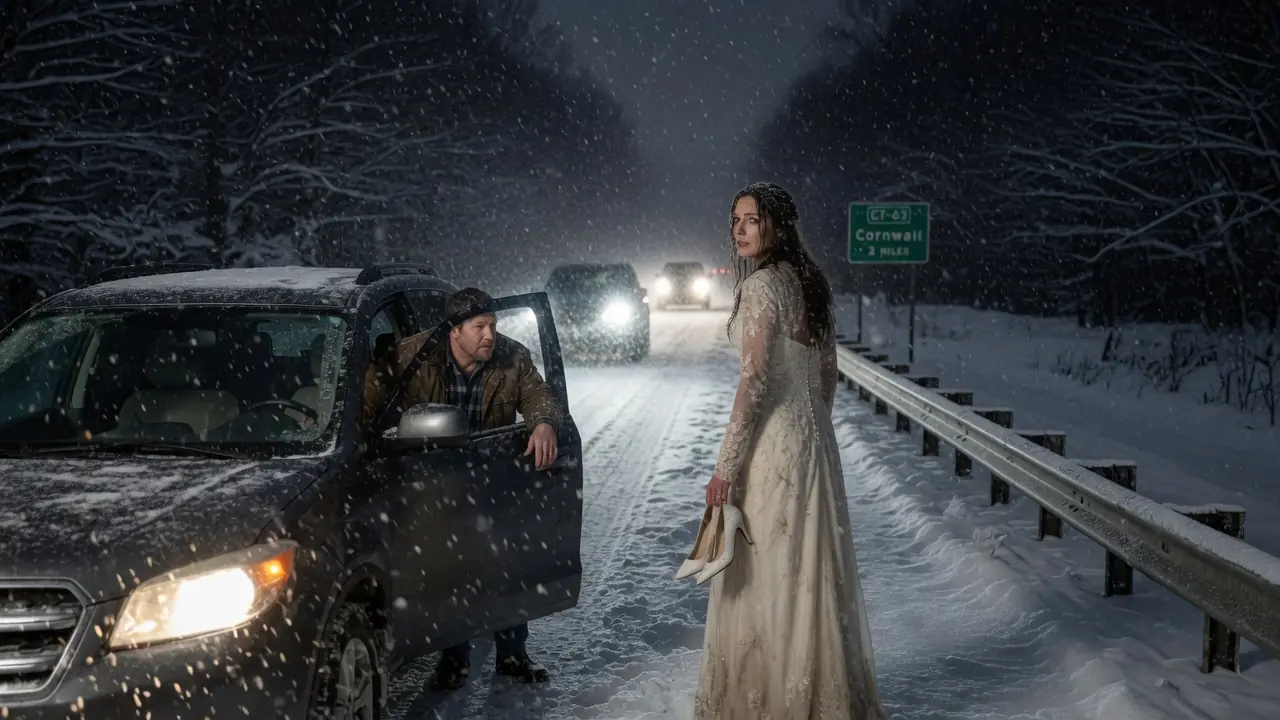
He had said those words before, on the afternoon he proposed beneath the window where Sarah once watched birds.
“I’m asking whether you want to keep building one with us.”
His voice became rough.
“With all the memories already here. All the mistakes. All the things we don’t know yet.”
He looked toward Charlie.
“Not as a replacement for anyone.”
Then back at me.
“As yourself.”
My prepared vows disappeared from my mind.
For a moment, all I could see was snow.
A dark highway.
A ruined white dress dragging behind me.
Headlights slowing in the distance.
And a stranger opening his passenger door.
I took Will’s hands.
“The first time I wore a wedding dress,” I said, “everyone in the room believed they knew what my life should become.”
The guests became very quiet.
“I was surrounded by five hundred people, and I had never felt more alone.”
Will held my gaze.
“The night I ran, you did not ask who I was, what I owned, or what trouble I might bring into your life.”
I looked toward Charlie.
“You gave me a warm seat, a child’s blanket, and enough silence to hear my own voice again.”
My eyes filled.
“I do not promise to need you.”
Will smiled faintly.
“That sounds promising.”
A few guests laughed.
“I promise to choose you,” I continued. “Not because I am afraid to be alone. Not because anyone arranged it. Not because comfort requires obedience.”
I squeezed his hands.
“I choose the life we have built because it allows all three of us to remain who we are.”
Charlie wiped one eye quickly and pretended she had something in it.
The officiant pronounced us married beneath the roses.
Will kissed me.
No applause had ever sounded more honest.
People later described our story as romantic.
A runaway bride.
A snowstorm.
A widowed father.
A lonely child.
A warm house.
They spoke as though the pieces had been placed carefully by fate.
That was not how it felt.
It felt frightening.
Messy.
At times humiliating.
There was no music playing when I fled my first wedding.
No beautiful orchestral swell as I pushed open the church’s side door.
I did not run gracefully.
My heel caught in the hem of the gown before I reached the parking lot, and I nearly fell onto the wet pavement.
Theodore Blackstone shouted my full name behind me.
“Victoria!”
It sounded the way it always did when he said it.
Not like my name.
Like an order.
I had been standing at the rear of the church less than a minute earlier.
Five hundred guests had risen.
My father waited beside me in a formal black suit, his expression stern enough to resemble concern from a distance.
My mother leaned toward my ear.
“Shoulders back.”
That was what she said.
Not Are you ready?
Not Are you happy?
Shoulders back.
Ahead of me, Theodore stood beneath thousands of white flowers.
He was handsome.
Powerful.
Perfectly composed.
He came from a family with more money than most institutions and enough influence to make unpleasant truths disappear beneath polite statements.
He smiled when he saw me.
Every person in the church saw devotion.
I saw certainty.
He was certain I would walk forward.
Certain I would become Mrs. Theodore Blackstone.
Certain I would move into his house, leave the work he considered unnecessary, attend the events he selected, and smile when photographed.
The life ahead of me was beautiful from the outside.
That was what made it so difficult to reject.
There would be travel.
Jewelry.
Homes in three states.
A charitable foundation bearing my married name.
Newspapers would describe me as elegant and supportive.
No one would ask whether I was alive inside it.
The first note of the processional began.
My father offered his arm.
I looked toward the aisle.
For years, I had mistaken obedience for love.
My parents chose my schools because they wanted the best for me.
They selected my friends because certain families were appropriate.
They encouraged my engagement because Theodore was stable, respected, and able to protect the Ashford name.
Each decision arrived wrapped in concern.
Each one removed something from me.
Theodore had never needed to shout often.
He controlled through certainty.
When I accepted a marketing position after university, he called the work charming.
When we became engaged, he asked why I continued wasting time at an office when his wife would have responsibilities.
He did not order me to resign.
He simply made remaining seem embarrassing.
So I left.
He chose the house.
The guest list.
The wedding planner.
The dress designer.
Even the name that would appear on our invitations.
I had begun introducing myself as Tori years earlier.
Theodore always called me Victoria.
He said Tori sounded childish.
At the end of the aisle waited a man who loved the person he had designed.
The realization did not arrive dramatically.
It felt almost quiet.
If I took the first step toward him, I would spend the rest of my life trying to remember the woman who had refused to move.
My father whispered, “Everyone is waiting.”
That was the final sentence.
I gathered the skirt in both hands.
Then turned away from the aisle.
At first, the guests did not understand.
My mother said my name.
The wedding planner moved toward me.
Theodore called out again.
I pushed through a side door and ran.
Outside, sleet struck my face.
A storm had moved in earlier than predicted, covering the estate grounds with a thin white layer.
I crossed the reception hall while workers carrying champagne trays stared.
A photographer lifted his camera automatically.
I covered my face and kept moving.
My mother caught up near the parking area.
“Victoria, stop this.”
“I can’t do it.”
“You’re frightened. Every bride is frightened.”
“No.”
My breath came sharply.
“I don’t want this life.”
Her expression hardened.
“Do you understand what you are doing to us?”
Not to yourself.
To us.
I removed the engagement ring and placed it in her hand.
She looked at it as though I had handed her something dead.
“Do not leave this property,” she warned.
For the first time in my life, I disobeyed without explanation.
I walked toward the main road.
There were cars everywhere, but most belonged to guests or staff. I had no handbag, telephone, or coat. My wallet remained in the bridal suite.
I wore thin shoes designed for photographs, not distance.
Snow gathered on my hair.
Behind me, voices moved across the estate.
Someone started a vehicle.
I climbed over a low stone wall and entered the trees beside Route Nine.
For nearly an hour, I walked.
My feet began bleeding before I removed the shoes.
The expensive dress absorbed snow and road water until the hem became heavy and gray.
Passing cars slowed occasionally.
None stopped.
I did not wave.
I had spent my life being rescued by people who then claimed ownership of the result.
I would rather freeze than ask another person to decide what should happen to me.
That was what I told myself.
The truth was that I had no plan.
My old apartment had been surrendered after I moved into Theodore’s house.
Most of my friends were sitting inside the church or preparing the reception I had ruined.
My parents would return me to the wedding if they could.
I had money in accounts I could not access without identification or a phone.
The storm thickened.
I walked because stopping would force me to understand how alone I was.
Headlights appeared behind me.
The car slowed.
I kept walking.
A window lowered.
“Do you need help?”
The man’s voice was gentle but cautious.
I stopped and looked toward him.
He was perhaps forty, wearing a dark sweater beneath an old winter coat. His hair needed cutting. Exhaustion showed around his eyes.
The car was practical, slightly worn, and far less expensive than my wedding dress.
“I’m fine,” I said.
He looked at my bare feet.
“Just out for an evening walk?”
I almost smiled.
“When you describe it that way, it does look unusual.”
“In a wedding dress.”
“Yes.”
“During a snowstorm.”
“I have noticed the snow.”
“On a rural highway.”
I looked at the road behind me.
“I did not plan particularly well.”
The man shifted the car into park.
He did not get out.
That mattered.
He left distance between us.
“I don’t know what happened,” he said. “You don’t have to explain it.”
I waited.
“No judgment. No questions you don’t want to answer. Just a warm car.”
He opened the passenger door.
“And a destination of your choice.”
The door remained open.
The heater sent a small wave of warmth into the snow.
“I don’t have a destination.”
The stranger rested one hand on the steering wheel.
“Then we can start with getting you off the road.”
I looked inside.
A child’s blanket lay across the back seat beside a school backpack, several crayons, and one glitter-covered shoe.
The ordinary disorder reassured me more than a spotless luxury vehicle would have.
I climbed inside.
The dress filled most of the passenger area.
I fastened the seat belt over layers of damp silk.
The man returned to the road.
“I’m Will.”
“Tori.”
I did not give my surname.
He did not ask.
Snow moved across the windshield.
For several minutes, we drove without speaking.
My hands shook.
Will turned the heater higher.
“There’s a blanket behind you.”
I pulled it forward.
Faded cartoon animals covered the wool.
“It belongs to my daughter,” he explained.
I wrapped it around my shoulders.
The blanket smelled faintly of laundry detergent, crayons, and something sweet.
I looked down at the combination of ruined couture and cartoon elephants.
“I must look ridiculous.”
“You look cold.”
That was all.
He did not tell me I was beautiful.
He did not ask whether I had abandoned someone at the altar.
He did not make my distress entertaining.
“Where should I take you?” he asked after several miles.
“My apartment is gone.”
“Hotel?”
“I don’t have my bag.”
“Friend?”
“Not one I can call tonight.”
“Family?”
I looked through the window.
“They are the reason I was wearing the dress.”
Will nodded as though that explained enough.
His house was several miles away.
He told me it had a guest room and that his daughter was staying with a friend.
“You don’t know me,” I said.
“That is true.”
“I could be dangerous.”
He glanced at the gown filling the car.
“You are concealing weapons very effectively.”
A laugh escaped before I could stop it.
It surprised both of us.
“Why would you let a stranger into your home?”
Will looked toward the road.
“Because you look like you’re trying to escape something.”
“That is not your responsibility.”
“No.”
He was quiet for a moment.
“But I remember what it feels like to be lost.”
The house stood behind a modest wooden fence.
It was larger than I expected but imperfectly maintained. Snow covered the front garden. A porch light illuminated boots, a child’s sled, and a pot containing the remains of a dead plant.
Will unlocked the door.
Warm air surrounded me.
Family photographs covered the living room.
Will with a woman whose smile reached every part of her face.
The same woman holding a newborn baby.
A little girl on her first day of school.
Birthdays.
Christmas mornings.
A picnic beneath summer trees.
The photographs were not formal.
People looked away from the camera, laughed with mouths open, and held one another without considering posture.
“What is her name?” I asked.
Will followed my gaze.
“Sarah.”
“Your wife?”
“My late wife.”
The words landed gently but heavily.
“I’m sorry.”
“Thank you.”
He offered coffee.
We sat in the living room until nearly three in the morning.
At first, I told him only what was necessary.
I had left a wedding.
The groom was Theodore Blackstone.
My family had arranged much of the match.
I had no place to go.
Will knew Theodore’s name.
Most people in Connecticut did.
Yet he showed no excitement at discovering who sat in his living room.
He did not ask whether I could repay him.
He asked why I had run.
“I stood at the back of the church,” I said, “and realized that if I walked forward, I would disappear.”
Will did not tell me I was overreacting.
He did not defend Theodore.
He simply listened.
In return, he told me about Sarah.
She had worked as a pediatric nurse.
Cancer took her two years earlier.
Their daughter, Charlie, had been six.
Will had learned to pack lunches, braid hair badly, remember dance lessons, and carry grief while pretending he knew what he was doing.
“I think I’m failing her,” he admitted.
“Why?”
“Her teacher says she’s withdrawing. She rarely plays with other children. She doesn’t talk about Sarah.”
“Do you?”
“Not enough.”
He looked toward the photographs.
“I’m afraid saying Sarah’s name will make Charlie sad.”
“She’s already sad.”
He looked back at me.
The sentence had escaped before I could soften it.
“I’m sorry.”
“No.”
Will nodded slowly.
“You’re right.”
That night, I slept in the guest room wearing Sarah’s green sweater.
Will had left several pieces of her clothing outside the door.
The sweater smelled clean and faintly of cedar.
I felt guilty wearing it.
Yet the warmth allowed me to sleep.
I woke to a child’s voice in the kitchen.
Charlie had returned early because her friend became ill.
I found her sitting at the table in a winter coat, studying me without embarrassment.
Her dark hair was messy.
She looked at Sarah’s sweater.
“That was my mom’s.”
I froze.
“I’m sorry. Your father said—”
“It’s okay.”
She looked toward my bare feet.
“Are you the lady from the road?”
Will must have offered a brief explanation.
“Yes.”
“Why were you wearing a wedding dress?”
“I decided not to get married.”
“Did you not like the man?”
“I didn’t like who I became around him.”
Charlie considered this carefully.
Then asked, “Do you know how to make pancakes?”
That was how our friendship began.
I cooked breakfast.
Will’s pancakes, according to Charlie, were thick enough to repair roofs.
Mine were acceptable.
Charlie told me about school, her friend Emma, and a girl who copied her drawings.
She mentioned Sarah twice.
Each time, Will became very still.
But he did not change the subject.
Later, Charlie showed me the neglected garden.
Sarah had planted it.
After her death, Will stopped caring for it because every dying plant felt like another failure.
We stood beside snow-covered beds.
“What if we plant it again?” I asked.
Charlie looked alarmed.
“Would that erase Mom’s garden?”
“No.”
I crouched beside her.
“It would be a garden that remembers hers.”
She thought about that.
“Can we have sunflowers?”
“Yes.”
“Strawberries?”
“Yes.”
“Flowers for butterflies?”
“Those too.”
When Will returned from a meeting, he found us drawing plans.
He looked toward the overgrown beds with an expression I could not read.
“We’re only imagining,” I told him. “Nothing has to change yet.”
He nodded.
But he kept the drawings.
Will invited me to stay for several days.
The invitation frightened me more than the storm.
I had just escaped a life where comfort required surrender.
Will’s house offered warmth, food, and safety without conditions.
I did not know how to receive kindness that did not become debt.
Three days after I arrived, Theodore came.
Two black SUVs and a silver Bentley entered the driveway.
Will met him outside.
I watched from the hallway while Charlie stood behind me.
Theodore looked exactly as he had at the church.
Controlled.
Immaculate.
Angry beneath perfect manners.
“I believe you have something that belongs to me,” he told Will.
Will’s posture changed.
“People do not belong to people.”
“Victoria is experiencing an emotional crisis.”
“She has a name she prefers.”
Theodore’s jaw tightened.
“She is not thinking clearly.”
“She seemed clear.”
“You know nothing about her.”
Will looked toward the house.
“She said no. I understand that part.”
Theodore called me outside.
For a moment, the old obedience returned.
My hands trembled.
I wanted to disappear into the house and let Will solve everything.
Then I remembered the aisle.
Five hundred people standing.
The first step I had refused to take.
I walked onto the porch.
Theodore smiled with visible relief.
“Come home.”
“No.”
“Your parents are worried.”
“They are worried about appearances.”
“We can handle this privately.”
“Nothing is wrong with me.”
He lowered his voice.
“You are humiliating yourself.”
“No.”
I stood beside Will.
“I humiliated myself every time I pretended this was what I wanted.”
Theodore looked toward the house.
“You intend to stay here?”
“For now.”
“With a widower and his child?”
“Do not speak about them as though they are beneath you.”
His expression sharpened.
“You have no money without your parents. Your trust is controlled. Your accounts can be frozen. What exactly do you think this man can give you?”
Will answered before I could.
“Nothing.”
Theodore looked surprised.
“I’m not buying her,” Will continued. “I’m giving her room to decide.”
Theodore turned toward me.
“When reality arrives, you will come back.”
“Maybe.”
My voice shook, but the word held.
“I might fail.”
“You will.”
“But it will be my failure.”
He stared.
“I would rather struggle as myself than live comfortably as your possession.”
The sentence ended whatever remained between us.
Theodore left.
My parents froze access to nearly every account they controlled.
For the first time in my adult life, I had no financial safety net.
It was terrifying.
It was also clean.
I found a part-time position at a local nonprofit, helping with marketing and fundraising.
The salary was modest.
On my first payday, I opened a bank account in my own name.
I stared at the balance for a long time.
The amount was small.
Yet every dollar belonged to a choice I had made.
I bought groceries for Will’s house.
He objected.
I ignored him.
Charlie and I began restoring the garden as winter ended.
We did not recreate Sarah’s design exactly.
We preserved her roses and added lavender, vegetables, strawberries, and a section of wildflowers for butterflies.
Will struggled at first.
He watched each change as though memory itself might be damaged.
One afternoon, he found me moving a stone border.
“Sarah placed those.”
I stopped immediately.
“We can leave them.”
He looked toward the uneven stones.
“She spent an entire afternoon trying to make them straight.”
“They aren’t straight.”
“She was terrible at measuring.”
He smiled.
The tension eased.
We kept them exactly where they were.
Sarah became part of our conversations.
Charlie showed me where her mother hid chocolate.
Will told stories about Sarah burning dinner and insisting the smoke detector was overly sensitive.
I never claimed not to feel jealousy.
At times, I wondered whether Will loved only the safety I brought to Charlie.
At other times, I feared I was occupying a life built for another woman.
But Sarah’s memory did not diminish me.
It demanded honesty.
Will had loved before.
Deeply.
That was not evidence that he had less love available.
It was proof that he understood what love cost.
One evening, he asked whether I believed he would ever love again.
I turned the question back.
“Do you?”
“I used to think loving someone new meant replacing Sarah.”
“And now?”
He looked toward the garden.
“Now I think love makes room.”
The possibility frightened both of us.
We did not kiss that night.
We sat beside one another until the porch became cold.
Our relationship developed through ordinary things.
School pickups.
Grocery lists.
Charlie’s art projects.
A leaking pipe.
Arguments about whether the television should remain on during dinner.
Will sometimes withdrew without explanation when grief returned.
I sometimes panicked when kindness felt too much like dependence.
Neither of us handled everything well.
Once, after he paid for a repair to my car without asking, I accused him of trying to control me.
Will looked genuinely hurt.
“I was trying to help.”
“I know.”
“Then why are you angry?”
“Because I don’t always know the difference yet.”
We sat with that truth.
The next morning, I transferred the money back to him and arranged my own payment plan.
He understood.
Months later, when I became ill, I allowed him to bring medicine without treating the gesture like a trap.
That was progress.
Charlie changed too.
She began speaking about Sarah openly.
She made a memory box filled with photographs, hospital badges, handwritten recipes, and a small bottle of her mother’s perfume.
One evening, she asked whether I was trying to become her mother.
“No.”
The answer came quickly.
Charlie looked relieved and disappointed at the same time.
“I could never become your mother.”
I sat beside her.
“But I can love you as myself.”
She thought about this.
“Is that like being a stepmother?”
“Maybe someday.”
“Would you leave if you and Dad had a fight?”
The question revealed what she had been carrying.
“I might need space after a fight.”
I chose each word carefully.
“But I would not disappear without telling you.”
“People say that.”
“You’re right.”
I looked toward the garden.
“So you shouldn’t believe me only because I say it. You can watch what I do.”
Charlie nodded.
That was how trust worked in our house.
Not through promises alone.
Through repetition.
Spring became summer.
The garden grew.
Will continued consulting from home.
I received more responsibility at the nonprofit and created a fundraising campaign for women rebuilding their lives after leaving controlling relationships.
The work felt personal without becoming confession.
For the first time, I understood that freedom was not a single dramatic act.
Leaving the church had been the beginning.
Freedom was learning to pay bills.
Choosing where to work.
Opening my own mail.
Buying inexpensive shoes because I liked them.
Refusing invitations without inventing excuses.
Making mistakes no one else had approved.
One evening, Charlie entered the kitchen holding a drawing.
Three people stood in front of the house.
Will.
Charlie.
Me.
Behind us was the garden.
At the bottom, she had written:
MY FAMILY IS GROWING.
I stared at it.
In the drawing, Sarah was not erased.
Her photograph appeared in one of the windows.
Charlie had found a way to hold both realities.
The family that had existed.
The family that was forming.
“Can we put it on the refrigerator?” she asked.
Will attached it beside school notices and grocery lists.
Something settled inside me.
Not certainty.
Belonging.
Later, Will and I stood on the porch.
“Charlie asked whether we’re getting married,” he said.
I looked toward him.
“What did you tell her?”
“That I had not asked you.”
My heart began beating faster.
“Tori, I know what marriage means to you.”
“I know what the first one nearly meant.”
“I would never ask you to enter another life you didn’t choose.”
“What are you asking?”
Will took my hand.
“I love you.”
The words were quiet.
“I love who you are when you are certain and when you are afraid.”
Tears filled my eyes.
“I love you too.”
“But?”
“I am terrified.”
“So am I.”
“What if I make another mistake?”
He smiled faintly.
“Then at least it will be yours.”
I laughed through the tears.
“That is a terrible proposal.”
“It isn’t a proposal.”
“What is it?”
“Information.”
He lifted my hand.
“I love you. You are free to do whatever you need with that.”
For three months, we did nothing.
We continued living.
That mattered.
No countdown began.
No families negotiated.
No venue was reserved.
When Will finally proposed, he did not surprise me before an audience.
He asked Charlie to hide nearby with the ring because she insisted on participating.
He stood beneath the living-room window overlooking the garden.
“I’m not asking you to complete my life,” he said.
“I’m asking whether you want to keep building one together.”
“What happens if I say no?”
“We keep respecting each other.”
“What happens if I say I need time?”
“We wait.”
“What happens if I say yes?”
Charlie’s head appeared from behind a rosebush.
“Then I give him the ring before he loses it.”
I laughed.
Then I said yes.
My parents did not attend our wedding.
My father sent a short message wishing me well.
My mother sent nothing.
Theodore married another woman the following year.
Photographs showed a magnificent ceremony.
I felt neither triumph nor regret.
Only distance.
For a long time, I believed healing required forgiving everyone who hurt me.
Now I understand forgiveness is optional.
Clarity is more important.
My parents loved a version of me that reflected well on them.
Theodore loved a version that obeyed.
I no longer needed to hate them.
I also no longer needed to return.
Years after the snowstorm, I founded an organization helping women rebuild practical independence after leaving controlling relationships.
We offered career counseling, financial education, temporary housing, and legal referrals.
I insisted we never describe our clients as rescued.
People rescue objects from fires.
Human beings need tools, information, safety, and choices.
Will once asked whether stopping for me on Route Nine had rescued me.
“No,” I said.
He looked amused.
“You looked close to hypothermia.”
“You saved me from freezing.”
“And the rest?”
“You opened the door.”
I rested my head against his shoulder.
“I chose to enter.”
Charlie grew older.
She continued drawing.
At sixteen, she painted the garden as part of a school portfolio.
Sarah’s roses filled one side.
My wildflowers filled the other.
In the center stood the old stone border Will refused to straighten.
She titled it:
ROOM FOR BOTH.
The painting hangs in our hallway now.
People still ask how Will and I met.
When he tells the story, he describes a white figure appearing in his headlights.
When I tell it, I begin with the open car door.
The door matters more than the storm.
Will could have demanded my name.
Proof.
A full explanation.
He could have called the police or driven away.
Instead, he offered help before deciding whether I deserved it.
He did not tell me where to go.
He asked.
That distinction changed everything.
The first wedding had been built around certainty.
Everyone knew where I would live.
What I would wear.
Who I would become.
The second wedding made room for uncertainty.
Will and I did not promise never to hurt one another.
We promised not to confuse love with ownership.
We promised to speak when fear made silence easier.
We promised Charlie that Sarah’s memory would always have a place in our family.
And I promised myself never again to remain inside a beautiful life that required me to disappear.
People call my escape courageous.
It did not feel courageous while I was walking barefoot through snow.
I felt foolish.
Ashamed.
Terrified.
Courage is often described afterward by people who did not feel the cold.
The truth is that I left because staying had become more frightening than leaving.
Then a widowed father saw me beside the road.
His life was already complicated.
His daughter was grieving.
His house was full of memories.
He had every sensible reason to continue driving.
Instead, he slowed.
He opened the door.
And he said the words I had needed my entire life:
“You don’t have to explain.”
That sentence did not solve anything.
It gave me something more valuable.
Time.
Warmth.
A place where no decision had already been made for me.
Sometimes home is not the place where someone promises to protect you from every storm.
Sometimes it is the place where someone hands you a ridiculous child’s blanket, keeps both hands on the steering wheel, and lets you decide where the road goes next.