The radar gun chirped just as the dark sedan shot over the rise.
Eighty-eight miles per hour in a sixty-five zone.
I had been parked in the grassy median of Interstate 40 for less than ten minutes, drinking coffee that had gone cold and watching the afternoon traffic crawl toward downtown. It was a Tuesday, bright and dry, the kind of shift that usually passed in a blur of seat-belt warnings, stalled vehicles, and drivers insisting they had no idea how fast they were going.
Then that sedan came tearing through the left lane like the road belonged to him.
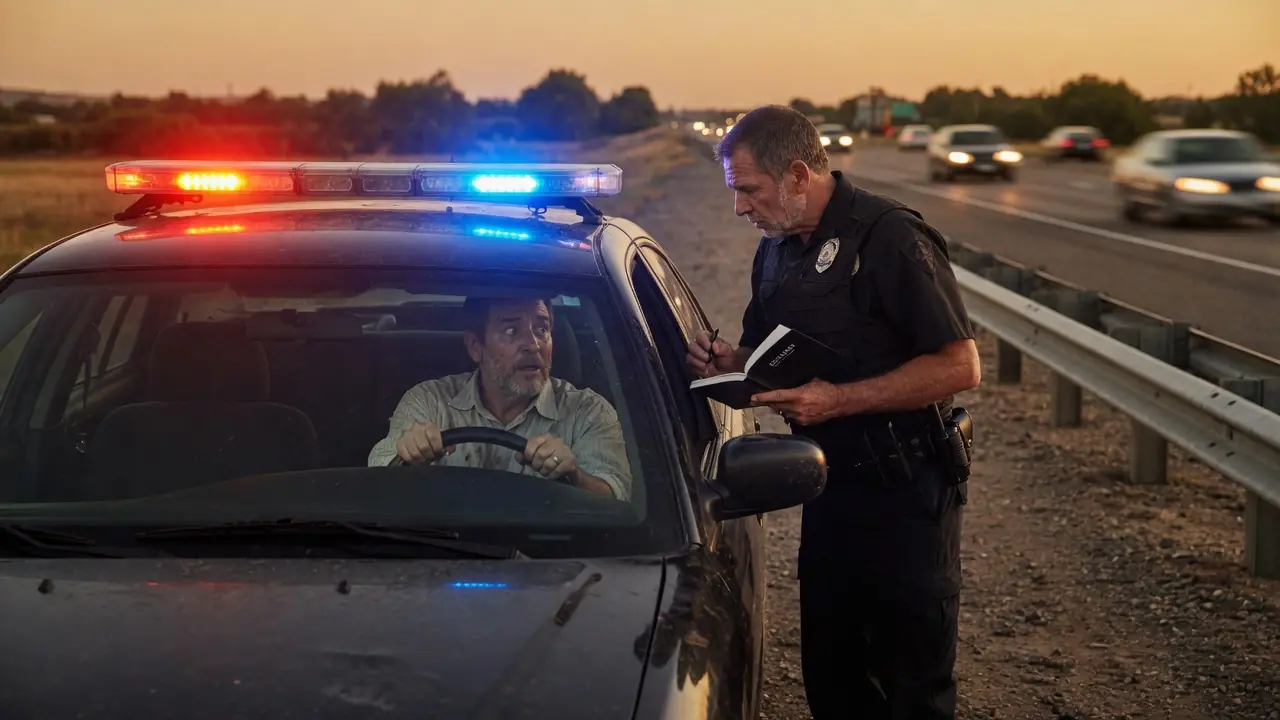
He cut around a minivan, crossed two lanes without enough space, and nearly clipped the rear bumper of a pickup before surging ahead. I set the coffee in the cup holder, shifted my cruiser into drive, and hit the lights.
Red and blue flashed across the pavement.
The sedan did not slow immediately.
For several seconds, the driver kept moving, and the back of my neck tightened. A delayed stop could mean panic, intoxication, an outstanding warrant, or someone searching for a safer place to pull over.
I activated the siren.
The sedan jerked toward the shoulder and stopped so close to the guardrail that the passenger-side mirror nearly touched the metal.
I radioed the plate number to dispatch.
“Unit Twelve conducting a traffic stop, eastbound I-40 near mile marker one-ninety-four. Dark sedan, one visible occupant.”
“Copy, Twelve.”
I reached for my citation book before stepping out.
Twenty-three miles over the limit was not an accidental drift. It was reckless, especially in afternoon traffic. My lieutenant had reminded us that morning about a series of fatal collisions on that exact stretch of highway.
I approached from the passenger side because traffic was rushing past the driver’s door. The wind from each tractor-trailer pulled at my uniform and filled the air with diesel exhaust.
The window was already lowered.
The man behind the wheel looked to be in his late thirties. His shirt collar was soaked with sweat, and his left hand trembled against the steering wheel.
“License and registration, please,” I said. “Do you know how fast you were traveling?”
He turned toward me.
The prepared speech disappeared from my mouth.
His eyes were bloodshot, wide, and empty with a kind of fear I recognized immediately. I had seen it on people standing outside burning houses and on parents arriving at accident scenes.
It was not fear of a ticket.
He fumbled with the glove compartment, dropping the registration twice before giving up.
“Officer, I’m sorry,” he said. “You can arrest me. Take my license. Do whatever you have to do.”
“Sir, put both hands where I can see them.”
He immediately placed them on the wheel.
“Is there anyone else in the vehicle?”
“No.”
“Have you consumed alcohol or medication?”
“No.”
“What’s going on?”
His face collapsed.
“My daughter is at County Medical.”
The traffic continued roaring behind me.
“She had surgery this morning,” he said. “It was supposed to be simple. Her tonsils and adenoids. The nurse called ten minutes ago and said something went wrong. Her blood pressure is dropping, and they can’t stabilize her airway.”
He wiped his face with his shoulder because he seemed afraid to remove his hands from the wheel.
“I promised her I’d be there when she woke up.”
“Why weren’t you already at the hospital?”
The question came out sharper than I intended.
Pain crossed his face.
“My ex-wife told me the surgery was next Thursday.”
He swallowed hard.
“She changed the date and didn’t tell me.”
That detail stopped me.
Not because it excused his driving.
Because it sounded rehearsed in the opposite direction—not practiced for me, but repeated to himself as though he was trying to understand how his life had reached that moment.
“What is your name?”
“Daniel Harper.”
“Your daughter’s name?”
“Emily. She’s eight.”
“Which entrance?”
“Children’s surgery wing. East pavilion.”
County Medical was approximately twenty miles away. At that hour, the interchange near downtown could take thirty-five minutes.
The man looked toward the highway.
“Please,” he whispered. “Write the ticket while I drive. Follow me. I don’t care. I just need to get there.”
I had twelve years on the state highway patrol.
I knew the policy.
Medical emergencies involving a conscious driver were generally handled by calling emergency medical services or directing the person to proceed within traffic laws. We did not provide high-speed escorts simply because a driver requested one.
There were good reasons for that rule.
Emergency escorts could create collisions. Civilians often followed too closely or panicked at intersections. If the child was already inside a hospital, no transportation emergency technically existed.
I should have asked dispatch to contact the hospital and verify the story.
I should have detained Daniel long enough to check his license and ensure he was not impaired.
I should have written the citation.
Instead, I looked at the raw panic in his face and thought of my own daughter.
Her name was Lily.
She had been seven when she died.
Not in a hospital.
Not during surgery.
She died on a road almost thirty miles west of where I stood, and for eight years I had been asking myself whether five minutes could have changed anything.
“Stay here,” I told Daniel.
I returned to my cruiser and called dispatch.
“Central, contact County Medical Children’s Surgery. Verify a patient named Emily Harper, eight years old, possible postoperative emergency.”
There was a pause.
“Stand by.”
I watched Daniel through my mirror.
He leaned forward until his forehead touched the steering wheel.
Less than a minute later, dispatch returned.
“Twelve, hospital confirms pediatric patient Emily Harper is undergoing an emergency airway intervention. Father has been requested.”
My hand tightened around the radio.
“Copy.”
I should still have followed procedure.
Instead, I made the decision that would place my badge, pension, and reputation at risk.
I stepped back to the sedan.
Daniel lifted his head.
“Listen carefully,” I said. “You will stay behind my cruiser. You will not pass me, no matter what. You will maintain enough distance to stop safely, and when we reach intersections, you move only when I clear them. Do you understand?”
He stared at me.
“Are you taking me?”
“I’m clearing the road.”
His mouth opened, but no sound came.
“Do you understand?”
“Yes.”
“If you drive recklessly behind me, I will stop the escort immediately.”
“Yes, ma’am.”
“Start the engine.”
I returned to my cruiser and radioed dispatch.
“Central, Unit Twelve initiating an emergency escort to County Medical with verified patient family member.”
The response came quickly.
“Twelve, clarify authority for escort.”
I looked toward the sedan.
“Officer discretion due to active medical crisis.”
Another pause.
“Copy, Twelve. Notify supervisor.”
I knew what that meant.
My decision was being recorded.
I called my sergeant directly.
Sergeant Paul Mercer had supervised me for five years. He was careful, fair, and completely devoted to policy.
“What have you got?” he asked.
I explained.
“You verified the patient?”
“Yes.”
“The child is already at the hospital?”
“Yes.”
“Then the father’s arrival does not change medical care.”
“I understand.”
“Do you?”
His tone sharpened.
“Because it sounds like you’re preparing to run a civilian vehicle through twenty miles of traffic.”
“He’s going with or without me.”
“Then cite him, calm him down, and direct him to proceed safely.”
“He’ll drive ninety again the second I leave.”
“Call someone to transport him.”
“Reyes, do not turn grief into policy.”
He knew exactly where my mind had gone.
My last name was Reyes. Most people called me Elena, but Mercer used surnames when he needed distance.
“This isn’t about Lily,” I said.
“It had better not be.”
I looked at Daniel again.
“Sergeant, I’m initiating the escort.”
Mercer swore quietly.
“You understand I am ordering you not to conduct an unauthorized high-speed escort.”
My chest tightened.
“Yes.”
“Reyes.”
“I heard the order.”
“And?”
I switched on my siren.
“I’ll submit the report.”
I ended the call before he could answer.
Then I pulled into traffic.
Daniel followed.
At first, I kept us below seventy-five. Vehicles ahead moved toward the shoulders as the siren approached, but several drivers froze in the lanes, forcing me to slow.
I watched Daniel constantly in the mirror.
He stayed exactly where I told him, maintaining distance and keeping both hands visible on the wheel.
The first five miles passed smoothly.
Then we reached construction.
Two lanes narrowed into one, and traffic backed up beneath an overpass. Orange barrels formed a corridor too narrow for vehicles to move aside.
I reduced speed.
Daniel’s sedan closed the gap before he corrected.
I saw his face in the mirror, panic rising again.
“Come on,” I muttered.
I activated the air horn.
Cars inched toward the shoulder, climbing partly onto the grass. A dump truck blocked half the lane ahead, its driver attempting to reposition.
I radioed the construction detail.
“This is State Patrol Unit Twelve approaching eastbound work zone with emergency escort. Clear the left corridor immediately.”
A local officer stationed near the barrels responded.
“Twelve, what’s the emergency?”
“Pediatric hospital crisis.”
The dump truck moved just enough.
I threaded the cruiser through with inches to spare.
Daniel followed.
For one terrifying second, his passenger mirror struck a barrel, sending it spinning across the lane. He swerved but recovered.
I nearly stopped the escort.
Then I remembered dispatch confirming that a child named Emily was fighting for air.
We continued.
At mile marker two-oh-three, a white SUV refused to yield.
The driver accelerated, apparently trying to stay ahead of me. I pulled alongside, pointed toward the shoulder, and saw a teenage boy filming with his phone from the passenger seat.
The driver finally moved.
Daniel passed behind me.
The video would later appear online, cut to show only a patrol cruiser forcing cars aside for a dark sedan. It would become evidence for people who believed I had abused my badge.
At that moment, I did not know anyone was recording.
I knew only that the clock was moving.
We reached the downtown interchange in twelve minutes.
Traffic there was worse than I expected.
A collision had blocked the center lane, and commuters filled every exit ramp. I requested assistance from city police.
“County Medical escort approaching from westbound connector,” I said. “Need intersection control at Franklin, Jefferson, and Medical Center Drive.”
A dispatcher answered.
“Units are tied up on a multivehicle crash.”
“I need any available car.”
“Stand by.”
I could not stand by.
The ramp ahead was nearly stopped.
I drove onto the shoulder.
Daniel followed.
Loose gravel sprayed beneath our tires. The lane narrowed near a concrete barrier, leaving no room for error.
Then a pickup truck abruptly moved onto the shoulder ahead of me.
I hit the brakes.
My cruiser fishtailed.
Daniel’s sedan swerved toward the barrier.
For one second, I saw metal, glass, and the image of Lily’s red bicycle lying beneath a guardrail.
I fought the wheel and regained control.
Daniel stopped less than six feet from my rear bumper.
The pickup driver stared at us, horrified.
I pulled beside him.
“Stay in your lane!”
He raised both hands.
I looked at Daniel.
He was shaking so violently I could see it through the windshield.
I considered ending the escort.
Then he held up one finger, asking for a moment.
He took a breath.
Then another.
Finally, he nodded.
We moved again.
A city patrol unit joined us near Franklin Avenue. Officer Tanya Brooks positioned her cruiser sideways across the first intersection, stopping cross traffic.
I drove through.
Daniel followed.
At Jefferson, the light turned red before Brooks could reach it. Vehicles began entering from both sides.
I blocked the intersection with my cruiser, siren wailing.
A delivery van stopped inches from my driver’s door.
I pointed Daniel through.
He hesitated.
“Move!” I shouted through the open window.
He accelerated.
For a moment, I was separated from him by cross traffic.
I pushed forward, forcing cars to stop, and regained position ahead of the sedan.
The hospital appeared three blocks later.
I led him into the ambulance entrance and stopped beside the sliding doors.
Daniel was out of the car before I shifted into park.
He stumbled, caught himself against the hood, and ran inside.
I stepped from the cruiser.
The sudden silence after turning off the siren felt enormous.
My hands were shaking.
I leaned against the vehicle and tried to slow my breathing.
Officer Brooks pulled in behind me.
“What the hell was that?” she asked.
I looked toward the doors.
“A father trying to reach his daughter.”
“You nearly caused three crashes.”
“I know.”
“Mercer is calling every unit in the city looking for you.”
“I know.”
Brooks lowered her voice.
“Was this about Lily?”
I turned toward her.
Everyone who had served with me knew.
Some never mentioned it.
Others used her name only when they believed I was losing control.
“No.”
Brooks studied me.
“You ran a civilian through red lights.”
“I cleared the intersections.”
“You lost him at Jefferson.”
“For four seconds.”
“Four seconds is enough.”
I did not answer.
A nurse stepped through the sliding doors.
She wore navy scrubs and a surgical cap patterned with yellow stars. Her eyes scanned the ambulance bay before settling on me.
“Officer Reyes?”
“Yes.”
She approached quickly.
“You brought Emily’s father?”
“Yes.”
The tightness in her face softened.
“You got him here just in time.”
I stared at her.
“The doctors needed emergency consent for a procedure that wasn’t covered under the original authorization. Her mother was unconscious.”
“What?”
“There was an incident in the recovery room. Emily experienced a rare postoperative hemorrhage. Her mother fainted after seeing the blood and hit her head.”
My stomach dropped.
“No other guardian was available?”
“Not until he arrived.”
I looked toward the doors.
“Couldn’t you have performed the procedure without consent?”
“In an immediate life-threatening emergency, yes. But the surgeons were trying to stabilize her while confirming a complicated allergy history. Her father knew the details.”
The nurse took a breath.
“He told them she had a reaction to a specific anesthetic during a dental procedure two years ago. It wasn’t in the electronic chart because the dental office had closed.”
“What happened?”
“They changed medications before intubation.”
“Would the other medication have hurt her?”
The nurse’s eyes became wet.
“It might have killed her.”
The words left me unable to speak.
“He arrived as her oxygen saturation was falling,” she continued. “The surgeon says those minutes mattered.”
Officer Brooks looked at me.
I stared at the hospital entrance.
The doors opened again.
Daniel emerged wearing a disposable yellow gown over his clothes. Tears covered his face, but his expression had changed.
Relief existed there.
Not complete relief.
Something fragile.
He walked directly toward me and stopped.
“She’s alive.”
I nodded.
“They stabilized her.”
“That’s good.”
“They let me hold her hand before they took her upstairs.”
His voice broke.
“I told her I kept my promise.”
I looked away.
Daniel stepped forward and hugged me.
At first, I stood rigidly.
Then I placed one hand on his back.
“Thank you,” he whispered. “I don’t know your name.”
“Elena Reyes.”
“I’ll never forget it.”
Behind him, a man in a dark suit stepped from the hospital.
He carried a phone mounted on a small stabilizer.
A reporter.
“Officer Reyes,” he called. “Can you explain why you conducted an unauthorized emergency escort?”
Brooks swore under her breath.
The reporter approached.
“Video from the interstate appears to show multiple dangerous maneuvers.”
Daniel turned.
“She saved my daughter.”
“Sir, were you driving the vehicle?”
“Yes.”
“Were you instructed to follow Officer Reyes through red lights?”
I stepped between them.
“No statement.”
The reporter continued filming.
“Officer, did your department authorize the escort?”
“No statement.”
“Is it true you disobeyed a direct supervisor order?”
Daniel looked at me.
“You could get in trouble?”
I did not answer.
My phone vibrated.
Sergeant Mercer.
I looked at Brooks.
“Stay with him until hospital security arrives.”
She nodded.
I returned to the cruiser and answered.
“Reyes.”
“Where are you?”
“County Medical.”
“Turn off your body camera and report to headquarters.”
My hand moved automatically toward the camera mounted on my vest.
“Sergeant—”
“Now.”
I looked back at Daniel.
He stood beside the nurse, watching me.
“Is the child alive?” Mercer asked.
“Yes.”
A pause.
“I’m glad.”
His voice hardened.
“Now report to headquarters.”
When I arrived, Internal Affairs was already waiting.
Lieutenant Grace Holloway sat beside Mercer in a small interview room. She had a copy of the dispatch log, my body-camera footage, and two videos downloaded from social media.
One headline read STATE TROOPER ENDANGERS COMMUTERS IN SECRET ESCORT.
Another said COP USES LIGHTS TO HELP SPEEDING FRIEND SKIP TRAFFIC.
The internet had decided Daniel was my relative before anyone knew his name.
Holloway pressed record.
“State your name and badge number.”
“Trooper Elena Reyes. Badge seven-four-one.”
“Did Sergeant Mercer order you not to conduct the escort?”
“Yes.”
“Why did you disregard that order?”
“I believed the civilian would continue driving recklessly if released without assistance.”
“Then why not detain him?”
“His daughter was in a verified medical crisis.”
“Was the child’s medical treatment dependent on his physical arrival?”
“I did not know that at the time.”
“So your decision was based on emotion.”
“It was based on risk assessment.”
Holloway slid a photograph across the table.
It showed my cruiser angled through the Jefferson intersection while a van stopped near my door.
“Does this look controlled?”
“No.”
“Did you lose visual contact with the civilian vehicle?”
“Briefly.”
“Did his vehicle strike a construction barrel?”
“Yes.”
“Were any drivers forced onto the grass?”
“Yes.”
“Did you exceed the speed limit?”
“Yes.”
“How fast?”
“Approximately eighty-five at the highest point.”
“The same speed for which you originally stopped Mr. Harper.”
“Under emergency equipment.”
“With an untrained civilian following.”
“Yes.”
Mercer sat silently.
Holloway leaned back.
“Why did you not wait for city units?”
“There was no time.”
“How did you know?”
“I didn’t.”
“That answer is important.”
“I understand.”
“Do you?”
She closed the folder.
“Because another driver could have been killed.”
The statement struck the place inside me where Lily lived.
“I know.”
“Your daughter died in a traffic collision, correct?”
Mercer looked down.
I stared at Holloway.
“Yes.”
“Did that experience influence your judgment?”
“I thought about her.”
“When?”
“During the stop.”
“So it did influence you.”
“Yes.”
Mercer finally spoke.
“Elena, be careful.”
I turned toward him.
“You asked for honesty.”
Holloway continued.
“What happened to your daughter?”
The question was not necessary to establish policy violation.
It was necessary to establish motive.
I took a breath.
“She was riding with my ex-husband. A drunk driver crossed the median.”
“How old was she?”
“Seven.”
“Were you present?”
“No.”
“Did you receive a call?”
“Yes.”
“How long did it take you to reach the hospital?”
“Forty-two minutes.”
“And she died before you arrived?”
My throat tightened.
“Yes.”
“Did you make a promise to her before the collision?”
Mercer stared at Holloway.
“That is enough.”
She looked at him.
“It is relevant.”
“No,” he said. “It is invasive.”
I answered anyway.
“I promised I would attend her school play.”
The room became silent.
“What does that have to do with the hospital?” Holloway asked.
“I missed the play because I took an overtime shift. My ex-husband was driving her home.”
Mercer closed his eyes.
I continued because once the truth began, stopping felt impossible.
“Lily called me from the car. She was upset. I said I would meet her at home and read the script with her.”
The drunk driver struck them eleven minutes later.
Lily suffered internal bleeding. My ex-husband survived with broken ribs and a head injury.
I had been assisting at another crash scene when dispatch tried to contact me. My radio reception failed beneath an overpass.
By the time I reached the hospital, Lily was gone.
Holloway’s expression softened slightly.
“You believed getting Mr. Harper to his daughter would correct something.”
“No.”
“Then why mention the promise?”
“Because he did.”
Mercer looked at me.
“What promise?”
“He promised his daughter he would be there when she woke up.”
The interview room felt smaller.
“I knew exactly what it meant to be late,” I said.
Holloway stopped the recording.
“You’re suspended pending investigation.”
“How long?”
“Until the review board meets.”
Mercer placed my service weapon inside an evidence envelope.
That hurt more than I expected.
My badge remained with me, but without the weapon and uniform it felt ceremonial.
“Go home,” Mercer said.
“I have reports to complete.”
“They can wait until tomorrow.”
“I don’t want them to.”
“Elena.”
I looked at him.
“If you write tonight, every sentence will sound like a defense.”
“Maybe I need one.”
“No. You need an accurate record.”
He drove me home because department policy prohibited a suspended officer from operating the cruiser.
My house stood in a quiet subdivision outside Raleigh. It was too large for one person and too full of unopened boxes from a life that ended eight years earlier.
Mercer sat in the driveway after turning off the engine.
“You disobeyed me.”
“Yes.”
“I should be furious.”
“You are.”
“Yes.”
He rubbed both hands over his face.
“You also got lucky.”
“I know.”
“If the sedan had crashed, Daniel would have been injured or killed.”
“I know.”
“If another driver had entered that intersection—”
“I know.”
“Stop saying that like knowing is enough.”
I looked through the windshield.
“It isn’t.”
“Then why do I feel like you’d do it again?”
I had no answer.
Mercer shook his head.
“You saved a child today.”
“The doctors saved her.”
“You got her father there with information they needed.”
“Yes.”
“And you endangered everyone between the highway and the hospital.”
“Yes.”
“Both are true.”
“I know.”
He almost smiled.
“That time, you sounded like you meant it.”
Inside the house, I found a message from Daniel.
Emily is stable. Doctors say the next twenty-four hours are critical. I told them what you did. Please let me know how I can help you.
I did not respond.
The local news led with the escort.
One station praised the “hero trooper who broke the rules to save a child.” Another interviewed a driver who claimed my cruiser forced her into a ditch.
She had not entered a ditch.
Her tires touched grass for approximately three seconds.
That distinction did not matter on television.
The police union called and assigned me an attorney named Robert Chen.
“We need you to avoid interviews,” he said.
“I wasn’t planning one.”
“Do not post online.”
“I don’t use social media.”
“Good. The department may discipline you for insubordination, reckless operation, and misuse of emergency equipment.”
“Termination?”
“Possible.”
“What about the hospital statement?”
“It helps explain outcome, not decision.”
I knew that.
An action does not become wise simply because it ends well.
Two days later, Emily’s condition improved.
Daniel sent a photograph.
She lay in a hospital bed wearing an oxygen tube and holding a stuffed rabbit. Her face was pale, but she was smiling.
Beneath it, he wrote:
She asked whether the police officer is a superhero.
I stared at the message for several minutes.
Then I replied.
Tell her I am a person who made a difficult choice. Superheroes do not have review boards.
Daniel called immediately.
“I’m sorry,” he said.
“For what?”
“For getting you suspended.”
“You did not.”
“I was speeding.”
“Yes.”
“You could have written the ticket.”
“Yes.”
“Why didn’t you?”
I looked toward a framed photograph of Lily on the bookshelf.
She wore a paper crown from her school play.
“Because I believed the safest way to stop you from continuing at eighty-eight was to keep you behind me.”
“That’s not the whole reason.”
“No.”
He waited.
I did not tell him about Lily.
Not yet.
“I’ll testify,” he said.
“The department knows what happened.”
“I’ll explain that I would have driven faster if you let me go.”
“That may make things worse for you.”
“I don’t care.”
“You should.”
“My daughter nearly died.”
“So could someone else’s.”
Silence.
Daniel finally said, “You regret helping me.”
“No.”
“You regret how.”
“Yes.”
That difference mattered.
The review board scheduled my hearing for the following week.
Before then, the story changed.
The woman who claimed I forced her into a ditch appeared on national television. She said her six-year-old son had been in the car and could have died.
Public opinion turned.
The department released only a short statement confirming an internal investigation.
Then someone leaked details about Lily.
A reporter appeared outside my house and shouted questions about whether my daughter’s death had caused “an emotional breakdown on duty.”
I closed the blinds.
My ex-husband, Tom, called that evening.
We had spoken only a few times a year since Lily died.
“You used her,” he said.
I gripped the phone.
“What?”
“You turned Lily into an excuse.”
“I did not release anything.”
“Her name is on television.”
“I know.”
“They showed the school photograph.”
“I did not give it to them.”
“You should issue a statement.”
“No.”
“Then people will think you’re unstable.”
“Maybe they already do.”
Tom became silent.
“You could have caused another accident.”
“I know.”
“You know what it is to receive that call.”
“Yes.”
“And you drove eighty-five through traffic anyway.”
His anger was deserved.
It also contained eight years of unfinished grief.
“You were speeding when Lily died,” I said.
The words escaped before I could stop them.
Tom’s breathing changed.
“I was six miles over.”
“You were arguing with her.”
“She wanted to call you.”
“You told her to wait.”
“Do not do this.”
“You blame me for missing the play.”
“You blame yourself enough for both of us.”
The line went silent.
I covered my mouth.
“I’m sorry.”
“No, you’re not.”
“I am.”
“You wanted me to feel responsible because the department may punish you.”
“That isn’t true.”
“It is exactly what you did.”
He ended the call.
I sat on the floor beside the sofa.
For years, I had believed my grief made me more compassionate.
Sometimes it only made me dangerous.
The next morning, I drove to the cemetery.
Lily’s grave sat beneath a maple tree. Her headstone carried a carved butterfly chosen by Tom.
I had never liked it.
Lily preferred frogs.
I sat on the damp grass.
“I helped a father reach his daughter,” I said aloud.
The cemetery offered no judgment.
“I almost hurt other people doing it.”
Wind moved through the branches.
“I don’t know whether I was helping him or trying to reach you.”
A voice behind me answered.
“Probably both.”
I turned.
Sergeant Mercer stood several feet away holding two coffees.
“How did you know I was here?”
“You come every year on the accident date.”
“This isn’t the date.”
“You also come when you’re avoiding me.”
He handed me a cup.
“Cream, no sugar.”
I accepted it.
Mercer sat beside me.
“I reviewed the full footage.”
“And?”
“You remained under control most of the time.”
“Most.”
“The shoulder maneuver was bad.”
“Yes.”
“The Jefferson intersection was worse.”
“Yes.”
“You gave clear instructions to Harper.”
“Yes.”
“Dispatch confirmed the hospital emergency before you moved.”
“Yes.”
He looked toward Lily’s headstone.
“Still unauthorized.”
“I know.”
“The board may suspend you for thirty days.”
“That’s all?”
“Could be more.”
“Termination?”
“Unlikely now.”
“Why now?”
“Hospital counsel submitted a report. The father’s arrival changed treatment.”
I looked at him.
“Did you ask them to?”
“No.”
“Who did?”
“Dr. Evans.”
The surgeon who treated Emily.
Mercer continued.
“He documented that Harper’s information prevented administration of an anesthetic associated with Emily’s previous severe reaction. The medication change likely prevented cardiac arrest.”
I exhaled slowly.
“That doesn’t make the escort safe.”
“No.”
“Why do you keep agreeing with me?”
“Because you’re waiting for someone to declare you right or wrong.”
He drank his coffee.
“You were both.”
“That is not how discipline works.”
“No. But it is how living works.”
At the hearing, the board consisted of three command officers, a civilian safety representative, and one union observer.
Daniel attended with his attorney.
So did the woman from the SUV, Melissa Grant.
She sat behind the civilian representative, holding her son’s hand.
I had not expected to see her.
The department presented traffic-camera footage, dispatch recordings, Mercer’s order, and my body-camera video.
The construction barrel struck by Daniel’s car rolled across the road but caused no collision.
At Jefferson, the delivery van stopped less than four feet from my door.
Watching it from a fixed camera made the maneuver look worse than it had felt.
Melissa Grant testified first.
“I saw the cruiser approaching,” she said. “Cars moved onto the shoulder. I tried to move too, but there was a ditch.”
There was no actual ditch visible in the video, only a drainage slope.
“My son screamed,” she continued. “The officer came beside me and pointed aggressively. I felt trapped.”
Her son looked about six.
He held a toy fire truck.
The civilian board member asked, “Were you forced off the paved surface?”
“My right tires crossed onto grass.”
“Was your vehicle damaged?”
“No.”
“Were you injured?”
“No.”
“That does not mean the action was safe,” Melissa said.
She looked directly at me.
“I’m glad the child survived. But mine was in the car too.”
The statement landed cleanly.
“I’m sorry,” I said.
My attorney touched my arm.
The chair frowned.
“Trooper Reyes, you will have an opportunity to speak.”
“No,” Melissa said. “I wanted to hear that.”
She turned toward me.
“Do you understand why I’m angry?”
“Yes.”
“Would you do the same thing again?”
The room waited.
“I would help him,” I said. “But I would request additional units earlier, maintain lower speeds, and stop if a safe corridor could not be established.”
“That’s not an answer.”
She was right.
I looked at her son.
“I don’t know.”
Melissa nodded.
“That’s more honest than television.”
Daniel testified next.
He admitted speeding and accepted responsibility.
“I was not thinking about anyone else,” he said. “I believed my daughter might die before I got there.”
The board chair asked, “Would you have continued speeding if Trooper Reyes issued a citation and released you?”
“Yes.”
“Even after being warned?”
“Yes.”
“Why?”
“Because fear makes you selfish.”
He looked toward Melissa.
“I am sorry I endangered your family.”
Melissa’s expression softened slightly.
Daniel continued.
“Officer Reyes did not tell me to drive dangerously. She told me to keep distance and stop if I lost sight of her. I followed because she was the only person who made me feel like the road might not swallow me.”
His voice broke.
“When I reached the hospital, doctors asked about Emily’s previous reactions. Her mother was being treated for a head injury. I gave them information they did not have.”
The surgeon’s report was entered into evidence.
Then I testified.
My attorney had prepared a careful statement.
I set it aside.
“I stopped Mr. Harper because he was driving recklessly,” I said. “My first responsibility was to protect the public from him.”
The board listened.
“I verified the medical emergency. I believed releasing him without intervention would lead to continued speeding. I chose an escort because I thought directing his movement behind an emergency vehicle reduced the risk.”
“Did it?” the chair asked.
“In some ways. It increased risk in others.”
“Why did you disregard Sergeant Mercer?”
“Because I believed delay would matter.”
“You did not know his medical information was necessary.”
“No.”
“So you acted without knowing the benefit.”
“Yes.”
“Was your daughter’s death part of the decision?”
“Yes.”
My attorney shifted beside me.
I continued.
“Mr. Harper said he promised his child he would be there. I had made a promise to my daughter before she died, and I was not there.”
The room became silent.
“That history affected me. I do not believe it entirely controlled me, but I cannot honestly say it played no role.”
The civilian board member leaned forward.
“Does that make you unfit for highway duty?”
“No.”
“Why not?”
“Because grief does not automatically destroy judgment. But unexamined grief can distort it.”
“What have you done to examine yours?”
“Not enough.”
“Will you?”
“Yes.”
The board recessed for two hours.
I sat in the hallway between Daniel and Melissa.
No one spoke at first.
Then Melissa’s son rolled his toy truck along the bench.
Daniel watched him.
“How old is he?”
“Six,” Melissa said.
“My daughter is eight.”
“I heard.”
“I’m sorry.”
“You already said that.”
“I know.”
The boy looked at Daniel.
“Was your kid sick?”
“Yes.”
“Is she dead?”
Melissa closed her eyes.
“Evan.”
“It’s okay,” Daniel said. “No. She’s alive.”
The boy nodded.
“My fish died.”
“I’m sorry.”
“It jumped out.”
Melissa touched his shoulder.
“Why don’t you play near the window?”
He moved away.
She looked at me.
“My brother was killed by a speeding driver.”
I had not known.
“He was nineteen,” she continued. “The driver claimed his wife was in labor.”
Daniel looked down.
“The baby was born safely. My brother was still dead.”
“I’m sorry,” I said.
Melissa nodded.
“That’s why the escort made me furious. Emergencies don’t make everyone else disposable.”
“No,” I said. “They don’t.”
Daniel pressed both hands together.
“I was wrong to drive that fast.”
“Yes,” she replied.
He accepted it.
“I don’t know what I would have done in your position,” Melissa added. “I hate that too.”
The board returned.
They suspended me without pay for forty-five days, required remedial emergency-driving certification, psychological evaluation, and six months of supervisory review.
A formal reprimand would remain in my record.
I was not terminated.
The board chair addressed me directly.
“Your decision contributed to a positive medical outcome. It also created unjustified risk. The department will not reward misconduct simply because the result was favorable.”
“I understand.”
“Do you?”
“Yes.”
“This is not a commendation.”
“No.”
Outside headquarters, reporters waited.
I declined to speak.
Daniel stood beside me.
“You kept your job.”
“Yes.”
“Forty-five days is still a lot.”
“It should be.”
He looked confused.
“You think they’re right?”
“Yes.”
“But Emily—”
“Emily’s survival does not make every decision safe.”
He nodded slowly.
“Can I do anything?”
“Pay your citation.”
He almost smiled.
“You’re giving me one?”
“I wrote it before the hearing.”
“How much?”
“Enough to remind you that panic does not suspend traffic law.”
“I deserve that.”
“Yes.”
His court appearance resulted in a large fine, mandatory defensive-driving classes, and a temporary license suspension. The judge allowed restricted travel for work and medical appointments.
Daniel accepted every condition.
Emily returned home two weeks later.
He invited me to visit.
I almost refused.
Then I remembered promising the board I would examine what had happened rather than hide from it.
Emily sat on a sofa surrounded by balloons and stuffed animals. A faint bruise marked her throat, and she spoke in a soft, raspy voice.
“You’re the police lady.”
“I am.”
“Daddy says you made all the cars move.”
“Some of them.”
“Are you a superhero?”
“No.”
She studied me.
“Do you have powers?”
“Paperwork.”
Daniel laughed from the kitchen.
Emily held out the stuffed rabbit from the hospital photograph.
“This is Captain Bun.”
“That is a strong name.”
“He was scared too.”
“Was he?”
“Yes. But I told him brave means scared and doing it.”
I looked at Daniel.
He lowered his eyes.
“Sometimes brave means stopping,” I said.
Emily considered that.
“Did you stop?”
“Eventually.”
She seemed satisfied.
Then she pointed toward a framed photograph on the side table.
It showed Daniel, Emily, and a woman standing beside a lake.
“Mommy is still mad at Daddy,” she said.
Daniel froze.
“Emily.”
“She says he lies.”
I looked at him.
The story about the changed surgery date returned.
Later, when Emily fell asleep, Daniel and I sat on the porch.
“What did she mean?”
He rubbed both hands over his face.
“My ex-wife didn’t change the date without telling me.”
I felt cold.
“You lied during the traffic stop.”
“Yes.”
“Why weren’t you at the hospital?”
“We had a custody hearing that morning.”
“Where?”
“Downtown.”
“Why did you leave?”
“I lost.”
“What does that mean?”
“The judge gave her primary custody.”
He stared toward the yard.
“I was angry. I shut off my phone and drove.”
“How long?”
“Three hours.”
“Your daughter was in surgery, and you turned off your phone.”
“I thought it was routine.”
“You promised to be there.”
“I know.”
“The nurse called ten minutes before I stopped you?”
“She left messages earlier. My phone was off.”
The betrayal was not mine, but anger rose anyway.
“You allowed me to believe her mother deceived you.”
“I was ashamed.”
“You gave me a story that made your recklessness sympathetic.”
“My daughter was dying.”
“When I stopped you, yes. But you were absent because you chose anger over her.”
He stood.
“You think I don’t know that?”
“I think you know it now.”
“I knew it then.”
His voice broke.
“That’s worse.”
He sat again.
“I didn’t plan to lie. You asked why I wasn’t there, and I said the first thing that made me sound less terrible.”
I looked toward the window where Emily slept.
“You manipulated me.”
“Yes.”
“If I had known the truth, I might not have escorted you.”
“I know.”
“Do you regret lying?”
“Yes.”
“Or only telling me?”
He covered his face.
I stood to leave.
“Elena.”
I turned.
“You still saved her.”
“No. Doctors saved her after I transported a man who gave me incomplete information.”
“You think the lie erases what you did?”
“No.”
“Then what changes?”
“Why I did it.”
I drove home furious.
Not only with Daniel.
With myself.
I had seen what I wanted to see: a devoted father trapped by circumstances. His story fit the wound I carried, so I stopped examining it.
At the psychological evaluation, I told Dr. Miriam Bell everything.
She was a former military psychologist who wore bright scarves and asked questions like she already knew which answer I was avoiding.
“You are angrier about his original absence than his lie,” she said.
“He left his child during surgery.”
“You missed your daughter’s play.”
“That is not the same.”
“No.”
I waited.
“But it lives in the same room.”
I looked away.
“You wanted Daniel to be a better parent than you believe you were.”
“I was working.”
“So was his ex-wife.”
“I was providing.”
“So was she.”
I hated the comparison.
“He turned off his phone because he lost custody.”
“You took an overtime shift after Lily asked you to attend her play.”
“I had no reason to expect an accident.”
“Neither did Daniel expect a hemorrhage.”
I stood.
“This is ridiculous.”
“Sit down.”
“I did not abandon my daughter.”
“I did not say you did.”
“It’s what you mean.”
“It’s what you fear.”
The room became silent.
I sat.
Dr. Bell leaned forward.
“You have spent eight years telling yourself that if you had arrived sooner, Lily might have known you kept your promise.”
“Yes.”
“What would reaching her have changed medically?”
“Nothing.”
“Would she have been conscious?”
“No.”
“Then what are you trying to repair?”
“Myself.”
The answer came before I could stop it.
Dr. Bell nodded.
“That is why the escort felt necessary.”
I began crying.
Not the controlled tears I permitted at the cemetery.
The kind that bent my body and emptied my lungs.
“I left her waiting,” I said.
“You missed one play.”
“I missed others.”
“You loved her.”
“I worked too much.”
“Yes.”
“I thought there would be time.”
“Yes.”
“She died believing I chose work.”
“You do not know what she believed.”
“I know she was angry.”
“Children can be angry and still know they are loved.”
I pressed both hands against my face.
“I can’t ask her.”
“No.”
“What am I supposed to do with that?”
“Stop asking strangers to give you the ending you wanted with her.”
Daniel had done exactly that.
He gave me a chance to keep a father’s promise, and I took it as if his daughter were waiting for me too.
My forty-five-day suspension became the longest stretch of unstructured time I had experienced since joining the patrol.
I attended therapy twice a week.
I repaired the fence.
I opened boxes containing Lily’s school papers and clothing.
Inside one box, I found a video recording of her final play.
Tom had mailed it years earlier. I never watched it.
I placed the disc into an old laptop.
The image was grainy.
Lily stood on a painted cardboard castle wearing a paper crown. She forgot one line, looked toward the audience, and laughed.
Then she found Tom in the second row and waved.
She did not look devastated.
She looked alive.
At the end, the teacher asked children to thank their families.
Lily stepped toward the microphone.
“My mom is a police officer,” she said proudly. “She catches bad drivers. She couldn’t come because people need her.”
My body folded over the kitchen table.
All those years, I had imagined her final public thought of me as disappointment.
Instead, she defended me.
That did not erase my absence.
But it changed the story I had built around it.
I called Tom.
“I watched the play.”
He became silent.
“I wondered when you would.”
“Why didn’t you tell me what she said?”
“I did.”
“No.”
“The week after the funeral. You said you couldn’t hear it.”
I remembered him standing in our kitchen holding the disc. I had shouted that no recording could give her back.
“I’m sorry.”
“So am I.”
“I used your guilt against you.”
“Yes.”
“I was angry.”
“So was I.”
“Did Lily know I loved her?”
Tom began crying.
“Yes.”
“How can you be sure?”
“Because she never doubted it until you started doubting it for her.”
The sentence stayed with me.
When I returned to duty, Mercer assigned me to administrative patrol for the first month. No solo highway enforcement.
I resented it.
I also understood.
My first day back, a letter waited inside my locker.
It was from Melissa Grant.
I still believe the escort endangered my son. I also believe the truth is more complicated than the video. I hope the department learns from what happened instead of making you either a hero or a villain.
Beneath the note, her son had drawn a patrol car beside a hospital. The vehicles were enormous. The people were tiny.
I placed the drawing inside my locker.
A week later, Daniel came to the station.
He carried an envelope containing payment confirmation for the citation and a handwritten letter.
“I told Emily the truth,” he said.
“All of it?”
“That I left the hospital because I was angry. That I turned off my phone. That I lied to you.”
“How did she respond?”
“She asked whether I was still her dad.”
I looked at him.
“What did you say?”
“Yes.”
“She told me not to do it again.”
“That is reasonable.”
Daniel looked toward the patrol vehicles outside.
“My ex-wife and I started family counseling.”
“That is good.”
“She still doesn’t trust me.”
“That is also reasonable.”
He handed me the letter.
“I wrote an apology.”
“You already apologized.”
“This is different.”
I opened it later.
He did not praise me.
He did not call me a hero.
He wrote:
I used your compassion to protect myself from shame. You made a dangerous decision based partly on a lie I gave you. I cannot change that. I can only tell the truth now and accept what it costs.
That apology mattered.
Not because it absolved me.
Because it stopped asking me to absolve him.
Months passed.
Emily recovered fully.
The department revised its medical-escort policy. Officers were instructed to verify emergencies, request supervisory authorization, and involve emergency communications in determining whether a family member’s arrival affected care.
The new policy also allowed controlled escorts when a civilian was likely to continue reckless driving and no safer transportation option existed.
Mercer showed me the draft.
“You changed policy,” he said.
“I violated the old one.”
“Sometimes those are related.”
“Are they naming it after me?”
“Absolutely not.”
“Good.”
“You’d hate the acronym.”
I returned to highway enforcement under supervision.
The first time my radar gun showed eighty-eight, my body reacted before my mind.
A red pickup sped past.
I initiated the stop.
The driver was a woman crying over a phone call from her mother. Her husband had collapsed at work.
I verified that paramedics were already present.
She begged me to escort her.
For several seconds, the old impulse returned.
Then I called for another unit, arranged for an officer closer to the hospital to update her, and asked whether she was calm enough to drive safely.
She was not.
I had her park at a gas station.
Her sister came to transport her.
It took fifteen minutes longer than an escort might have.
Her husband survived.
Perhaps the delay did not matter.
Perhaps it did.
I would never know.
That uncertainty was part of the job.
Two years after the incident, I received an invitation to Emily’s tenth birthday.
I attended in plain clothes.
Children ran through Daniel’s backyard carrying water balloons. Melissa and Evan were there too.
The surprise stopped me.
Daniel noticed.
“Our counselor suggested we meet,” he explained. “Melissa agreed.”
She approached holding lemonade.
“No lights today?” she asked.
“No.”
“Good.”
Evan ran past us.
He had grown taller.
Emily followed wearing a plastic police badge.
“You came!”
She hugged me.
I looked at Daniel.
He smiled.
Emily pulled me toward a table.
“I want to show you something.”
A school poster stood beside the cake. The assignment title read: A PERSON WHO HELPED MY FAMILY.
Her poster included photographs of doctors, nurses, her mother, Daniel, and me.
I was not centered.
I was one person among many.
That felt right.
Emily pointed toward a paragraph she had written.
Officer Reyes helped my dad get to the hospital, but she says helping can still be dangerous if you don’t think about everybody. My dad says being scared does not make bad choices okay. My mom says telling the truth is part of getting better.
I read the words twice.
“What do you think?” she asked.
“I think your family has excellent editors.”
She laughed.
At the bottom, she had written one final sentence.
A hero is not someone who is always right. It is someone who tells the truth about what happened and tries to do better next time.
My eyes filled.
“Did your teacher help you with this?”
“No. Daddy wanted me to write that you saved my life, but Mom said that was too simple.”
Daniel raised both hands.
“I accepted the edit.”
Emily took my hand.
“Did you have a little girl?”
I looked at her.
“Yes.”
“Daddy told me.”
“Her name was Lily.”
“Was she nice?”
“She was funny.”
“Did she like police?”
“She liked frogs.”
Emily considered that.
“I like frogs too.”
For a moment, grief moved through me without crushing anything.
It simply passed.
Later, Melissa and I stood near the fence watching the children.
“I still hate that video,” she said.
“So do I.”
“People send it to me whenever the story comes back online.”
“They send it to me too.”
“Some call you brave. Some call you reckless.”
“Both are easier than the truth.”
“What is the truth?”
I watched Emily chase Evan across the grass.
“I made a choice that helped one family and endangered others. I would not repeat it the same way.”
Melissa nodded.
“That is close enough for me.”
When I returned to the highway that evening, the sun was dropping behind the trees. Traffic moved in long silver lines beneath the orange light.
I parked near the same median where I had stopped Daniel.
Cars passed.
Some too fast.
Some too slow.
Each vehicle held a life invisible from the road.
A parent racing toward a hospital.
A child returning from practice.
A widow carrying groceries.
A tired worker trying to reach home.
The badge did not give me the power to know which story mattered most.
It gave me the responsibility to remember that all of them did.
For years, I believed the lesson of that Tuesday was simple: sometimes rules must bend for humanity.
That was only half the truth.
Humanity also requires restraint.
It requires seeing the frightened father in one car and the frightened child in another. It requires understanding that urgency is real without assuming it grants ownership of the road.
I did not save Emily alone.
Doctors, nurses, dispatchers, officers, and a father who remembered a medical detail all became part of the chain.
I was one link.
An imperfect one.
The escort changed my career, but not in the way news stories suggested. It did not restore my faith in the badge or prove instinct was always wiser than policy.
It taught me that compassion without judgment can become recklessness, and judgment without compassion can become cruelty.
The work lives between them.
My radar gun chirped.
Seventy-nine in a sixty-five.
A gray SUV passed in the left lane.
I pulled into traffic and activated my lights.
The driver stopped safely on the shoulder.
I approached from the passenger side.
A middle-aged man lowered the window.
He looked embarrassed but calm.
“License and registration, please.”
“Officer, I’m sorry. I didn’t realize—”
I raised one hand.
“Before we discuss the speed, is there an emergency?”
He blinked.
“No.”
“Anyone sick or injured?”
“No, ma’am.”
“Good.”
I looked at the traffic rushing behind us.
“Then we have time to do this safely.”
He handed me his license.
I walked back to my cruiser beneath a sky turning purple over Interstate 40.
For once, no one was racing against death.
No promise depended on a flashing light.
It was an ordinary stop on an ordinary evening.
I had learned what ordinary things were worth.