Some men go their whole lives never knowing what it feels like to be invisible inside a room they paid for. I am not one of those men anymore. My name is David Morgan, and I was fifty-three years old when my son’s wife taught me the difference between being generous and being used. It happened at Thornwood Estate, during the most beautiful wedding reception my money had ever bought.
I had paid for the venue, the flowers, the food, the music, the photographer, the rehearsal dinner, and half a dozen expenses nobody remembered once the lights came on. The final number was $58,240, though everyone rounded it down to $58,000 because apparently even humiliation sounds cleaner when simplified. I knew the exact number because I had written the checks myself, each one with the same quiet thought. This is for Caleb.
Caleb was my only son, twenty-eight years old, stubborn, kind, and still too trusting for his own good. His mother Elizabeth and I raised him to work hard, say thank you, and call when he got home safe. He was not perfect, but he had a good heart, and for most of his life, that had been enough. Then he met Lily Chen.
Lily was beautiful in the way some people are beautiful because they know how to weaponize it. She had long dark hair, sharp eyes, perfect posture, and a smile that arrived before warmth did. The first time she came to our house, she complimented the kitchen, then asked if we had renovated recently or if it was just “vintage.” Elizabeth laughed because she is kinder than I am, but I heard the tiny blade hidden inside the word.
Caleb adored her. When he looked at Lily, he looked like a man who thought he had won something rare. I wanted to be happy for him, so I ignored the way she studied our house like an appraiser and the way she asked questions that sounded friendly but landed like financial inventory. What did I do for work? How long had we owned the house? Did Caleb have student debt?
Eight months after they started dating, Caleb proposed. Elizabeth cried when he told us, and I hugged him so tightly he laughed. Lily showed us the ring with perfect surprise, though something about the way she tilted her hand made me think she had chosen it months earlier. Still, I told myself that suspicion was an ugly thing to bring into a wedding.
The planning began almost immediately. Lily arrived at our house with a color-coded binder, tabs, printed inspiration pages, and the confidence of someone who had already made every decision before inviting opinions. She wanted Thornwood Estate outside Dallas, a full weekend package, two hundred eighty guests, imported flowers, a string quartet, and a photographer whose fee made me blink twice. Each time I hesitated, Caleb looked uncomfortable, Elizabeth touched my arm, and Lily smiled like patience was something she extended to difficult relatives.
I paid the first deposit because fathers do things like that. Then the second. Then the catering installment, the florist, the venue insurance, the upgraded linens, the rehearsal dinner reservation, the cocktail hour musicians, and the lighting package Lily said would make the evening feel “elevated.” By the third month, I had spent $41,000, and the wedding still felt like a train gaining speed downhill.
Lily never asked directly after a while. She had learned that Caleb would look at me, I would look at Elizabeth, and Elizabeth would look at me with those soft eyes that said, please, David, let our son have peace. So I wrote the checks. That was how generous men become quiet machines if they are not careful.
Lily’s father, Brooks Turner, arrived the week of the wedding. He was tall, polished, and expensive-looking, a retired corporate attorney who moved through rooms like they belonged to him by default. He gave speeches, shook hands, praised the venue, and never once mentioned contributing to the cost. He checked into a room that was part of the wedding block I had paid for and carried himself like the father of the bride without any financial inconvenience attached.
“Did Brooks pay for anything?” I asked Elizabeth the night before the rehearsal dinner. She gave me that look wives give husbands when they know the answer but wish the question had not been spoken. “David,” she said softly. “Two more days.” I nodded because two more days sounded survivable.
The wedding itself was beautiful. I will not pretend otherwise. Thornwood Estate sat under late September light like it had been built for expensive photographs, with trimmed gardens, cream stone walls, and glass doors opening onto a terrace full of white roses and burgundy dahlias. Caleb looked handsome and nervous at the altar, and before the ceremony began, he squeezed my hand and whispered, “Dad, I need you to know.”
“I know,” I told him. I did not need him to finish. I knew he was grateful, I knew he was overwhelmed, and I knew he loved me even if he had become too trained to say it out loud in front of Lily. At least, that was what I believed then.
The ceremony passed without disaster. Elizabeth cried enough for both of us, Lily glowed under the flowers, Brooks gave his daughter away with a dignified expression, and Caleb looked at his bride like she was the future itself. I stood there thinking that whatever came after, I had given my son this day. Nobody could take that away from me.
Then the reception began.
At first, I thought nothing of it. Weddings are confusing, and I am not a man who needs the front row to feel respected. Then I looked at the place cards around us and saw Lily’s aunt, Lily’s uncle, Brooks, two of Lily’s family friends, and a couple I had never met. I looked up at the raised platform and saw Lily’s college friends laughing beside centerpieces twice the size of ours.
Elizabeth followed my gaze. Her expression changed before she said a word. She went to check the seating chart near the entrance, came back, and sat down very carefully. “Lily’s sorority sisters are on the platform,” she said quietly. “We’re here.”
I stood up, calm enough that even I believed it. I walked to the wedding coordinator and asked if there had been a mistake. She checked her clipboard, found my name, and smiled professionally. “Table 7 is correct, Mr. Morgan.”
I looked at the raised seating again. Then I looked back at table 7. I thanked her, because I was raised that way, and returned to my chair. Elizabeth put her hand over mine, and I said, “It’s fine.”
It was not fine.
For forty minutes, I waited for some explanation. Maybe Lily would come over and say the platform seating had been arranged for photographs. Maybe Caleb would notice and fix it. Maybe there would be a toast recognizing what Elizabeth and I had contributed, some public gesture that said we were family, not background guests.
What I got was Lily.
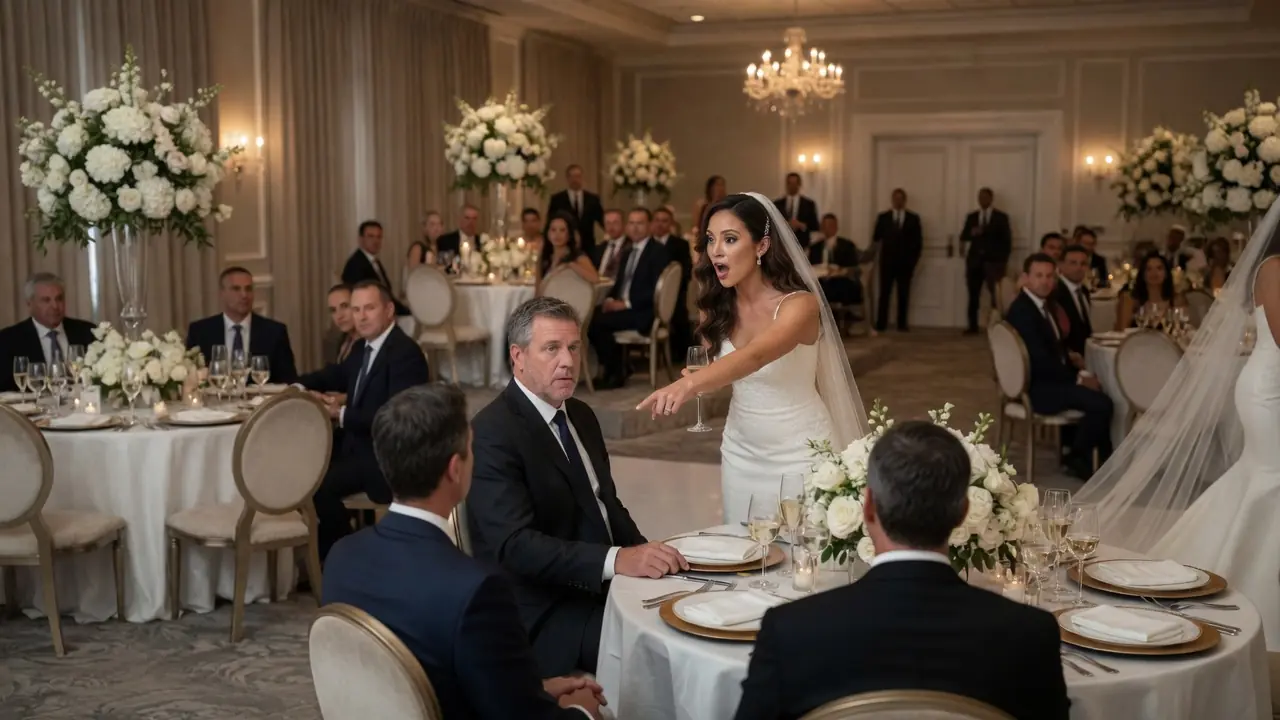
She appeared beside my chair during the salad course, radiant in her wedding gown, holding a champagne glass, her veil pinned perfectly behind her polished waves. She did not lean close like someone about to apologize. She stood over me like a woman managing an inconvenience.
“David,” she said, loud enough that nearby guests heard, “I hope you’re comfortable here.”
I looked up at her. “I was wondering about the seating.”
Her smile tightened. “The wedding party seating is reserved, and the premium area is for people central to the reception flow.” She lifted her chin slightly, as if explaining something obvious to a slow child. “So if you could just sit with the guests and enjoy the evening, that would be wonderful.”
The words hit harder than I expected.
Sit with the guests.
I heard a soft movement from the table beside us. Someone had turned their head away too quickly. Lily’s eyes remained fixed on mine, bright and unashamed. She knew exactly what she had said.
I kept my voice quiet. “I paid for this wedding because I love my son.”
Lily’s smile disappeared. In its place came something colder and more honest. “Then act like it and stop trying to make my wedding about you.”
A few guests looked down at their plates. Elizabeth’s hand went still on the table. I could feel every dollar I had spent sitting between Lily and me like evidence neither of us was willing to name aloud.
I did not shout. I did not stand. I did not embarrass Caleb on his wedding night. I looked at Lily in her beautiful gown and understood, finally, that she had never considered my generosity love. To her, it had been proof that I could be managed.
“Your wedding just showed me exactly what I paid for,” I said.
Her eyes flickered. For the first time, she looked unsure whether she had misjudged me. Then she laughed softly, turned away, and walked back toward the head table as if the matter had been settled.
I picked up my fork and ate my salad.
Elizabeth stared at me. “David.”
“Eat your salad,” I said.
“What did she say?”
“She told me I’m a guest,” I answered. “So I’m going to be a very good one.”
Something shut down inside me then, not with anger, but with precision. I had spent my life building things: a contracting company, a home, a family, a reputation. Builders know the value of structure, and they also know when something cannot be repaired because the foundation is wrong. Lily had just shown me the foundation.
For the rest of the night, I watched Caleb. He danced with his bride, laughed with friends, and accepted congratulations from people who had no idea his father was sitting at table 7 with a cold plate and a colder understanding. Twice, I caught him looking at me from across the room. The first time, he looked away quickly. The second time, I saw guilt.
That hurt almost as much as Lily’s insult.
I went outside around nine. The terrace overlooked a garden lit by soft ground lights, and the white roses seemed to glow against the dark. I stood there with a glass of whiskey, listening to muffled music through the glass doors. Behind me, $58,000 worth of celebration continued without needing me.
Brooks Turner found me ten minutes later. He stood beside me, silent for a moment, then said, “Hell of a night.” I said, “Beautiful venue.” He nodded and took a sip of his drink.
After a while, Brooks said, “Lily can be a lot.”
I looked at him. “That’s one way to put it.”
“She gets what she wants,” he said. “Her mother called it determination.”
“What do you call it?”
He looked into his glass and smiled tiredly. “Expensive.”
I laughed before I could stop myself. He laughed too, and for one moment, two fathers stood outside a wedding reception acknowledging a truth neither of them had the courage to prevent. Then Brooks said, “I should have contributed more.”
“Yes,” I said. “You should have.”
He did not argue. He nodded, turned, and went back inside.
That night, in the hotel room Elizabeth and I had paid for, I sat awake while she slept. I was not furious anymore. Fury burns too hot to think clearly. What I felt was arithmetic.
I had paid for the wedding of Lily’s dreams, and she had told me I was merely a guest. Fine. Guests do not fund the next chapter. Guests do not write checks for luxury vacations, starter homes, legal demands, or lifestyle support.
The next morning, while Elizabeth was still asleep, I called my accountant, Stephanie. She had handled my business finances for eleven years and had never once asked unnecessary questions. I told her I wanted every asset reviewed, every beneficiary arrangement examined, and every account protected. She only asked, “How quickly?”
“As quickly as possible,” I said.
The review took three weeks. The restructuring took two more. My contracting company, the thing I had built from a truck, a tool belt, and more long nights than I could count, went into a trust with very specific terms. Elizabeth became fully protected. Caleb would benefit after her, but only under conditions that prevented financial coercion or undue influence from touching what I had built.
Our home was transferred fully into Elizabeth’s name. That was not revenge. It was protection. The house with the kitchen Lily once called dated, the fence I fixed every year, the yard where Caleb had learned to throw a baseball, would never become a bargaining chip for someone who called me a guest in a room I had paid for.
Thirty-one days after the wedding, Lily called.
Not Caleb. Lily.
Her voice sounded bright and carefully sweet, the way people sound when they have already decided the answer should be yes. She said she and Caleb were grateful for the wedding, that the day had been magical, that everyone was still talking about it. Then came the pause.
“So,” she said, “Caleb and I have been going over our finances since getting back from Tuscany.”
“They paid for that trip themselves, didn’t they?” I asked.
“Yes,” she said quickly. “Of course. But we were thinking about a second trip, maybe Japan. It’s always been a dream of mine.”
“Of yours.”
“Of ours,” she corrected smoothly.
I leaned back in my office chair, the same chair where I had signed every wedding check. “And you’re asking me to contribute?”
“Just whatever feels right,” she said. “You were so generous before, and honestly, after everything, it would mean so much.”
I let the silence stretch.
“David?” she said. “Are you there?”
“I’m here.”
“Is this a bad time?”
“No,” I said. “This is actually the perfect time.”
She went quiet. I could almost hear her recalculating through the phone.
“Lily,” I said, “do you remember what you said to me at the reception?”
Another silence.
“At table 7,” I continued. “You told me to sit with the guests. You said I was there as a guest.”
“That was not what I meant.”
“You said it clearly.”
“There was a seating plan, David. You made it awkward.”
“No,” I said. “You made it clear.”
Her breathing changed.
“You were right,” I continued. “I was a guest. And guests don’t fund honeymoons.”
“David—”
“My answer is no.”
That was all. One word. No.
For the first time since I had known her, Lily had no polished response ready. The silence on the line was long enough that I thought she might have hung up. Then she said, colder now, “I’m going to tell Caleb.”
“Please do,” I replied. “I would love to talk to my son.”
She ended the call.
Caleb called that evening. I knew from his voice that Lily had told him a version of events in which I was petty, controlling, and cruel. He said I was punishing her over a seating arrangement. He said weddings were stressful. He said Elizabeth was upset, though I knew Elizabeth was standing in the kitchen, listening, and very much not on Lily’s side.
I let him talk.
When he finished, I said, “Caleb, I love you. I paid for your wedding because I love you, not because I expected repayment. But I will not be told I’m a guest in a room I paid for and then be asked to fund the next trip.”
“She didn’t mean it like that,” he said.
“She said it twice.”
He went quiet.
“I need you to understand something,” I said. “I am not cutting you off. I am cutting off the open wallet. Those are different things.”
That sentence changed the conversation. He did not apologize, not then, but something in his silence shifted. I invited him to dinner that Sunday. He showed up alone.
We grilled in the backyard. Elizabeth made corn salad. Caleb and I watched football and argued about the offensive line like we used to. We did not mention Lily once. It was the best afternoon I had had in a year.
Lily did not take the no well. She called Elizabeth twice, claiming I had used the wedding money as a weapon and had always been difficult. Elizabeth listened politely both times and then told me, “She’s trying to rewrite history.” I said, “I know.” She asked what I wanted to do, and I said, “Nothing. The truth doesn’t need my help.”
Four months later, Lily made her next move. An attorney sent a letter requesting a formal accounting of wedding expenses and implying that my contributions had created some continuing family obligation. I read the letter three times because I could not decide whether to laugh or frame it. Then I called my attorney.
He responded with copies of every check, every invoice, every signed contract, and every payment made in my name. At the bottom of the letter, he added one sentence I approved immediately. Mr. Morgan notes that as a guest of the event in question, he has no outstanding financial obligations to the couple and considers this matter closed.
Two days later, Caleb called.
“Dad,” he said quietly.
“Hey, bud.”
A long silence followed. Then he said, “I didn’t know she sent that letter.”
“I figured.”
“I’m sorry.”
The two words sat between us gently. I did not rush to fill the space. Apologies need air, especially when they arrive late.
“You don’t have to apologize for someone else,” I said. “But I appreciate it.”
“She’s not who I thought she was,” he whispered. “I think I’m starting to see that.”
I wanted to say I told you so. Every father knows that temptation. It sits on the tongue like a coin. But I swallowed it because my son did not need victory from me. He needed somewhere safe to land.
“I’m here,” I said. “Whenever you need me.”
Seven months after the wedding, Caleb came to Sunday dinner alone again. He had been doing that more often, but this time something was different. Halfway through the meal, he set down his fork and said, “I think I made a mistake.”
Elizabeth looked at him with pain in her eyes. I stayed still.
“I married someone who saw me differently than I saw her,” he said. “And I let things happen that I should have stopped.”
“Like what?” I asked.
He looked at me. “The seating. I knew it was wrong. I saw where you and Mom were sitting, and I did nothing.”
“Why?”
His face tightened. “Because I thought if I kept the peace long enough, she would come around.”
“Long enough for what?”
He had no answer.
I picked up my fork, then set it down again. “You know what I’ve learned about keeping the peace? It’s not peace. It’s just quiet.”
Eleven days later, Caleb filed for separation.
I will not pretend I mourned Lily’s exit from our lives. I mourned Caleb’s pain, because he was my son and divorce is not easy even when it is necessary. I sat with him through late-night calls, legal meetings, apartment hunting, and the strange grief of realizing the person you married was not the person you believed in. But I did not miss Lily.
Brooks Turner called after the separation became official. We had not spoken since the terrace. He said, “I heard.” I said, “I’m sorry.” He said, “Don’t be. My daughter made her choices.”
Then he paused. “For what it’s worth, David, I should have written a check.”
“Yes,” I said. “You should have.”
We both laughed, not because it was funny, but because sometimes honesty arrives too late to be useful and still feels better than silence.
Fourteen months after the wedding, Caleb came over on a Saturday to help me repair the garage roof. We worked from morning until late afternoon, sweating, measuring, lifting shingles, and arguing about whether my old ladder was still safe. Elizabeth brought sandwiches at noon. The dog tried to climb the ladder twice and failed both times with great dignity.
At sunset, Caleb sat beside me on the tailgate of my truck. He held a beer, looked across the yard, and said, “Thanks for not saying I told you so.”
“I thought about it,” I said.
He smiled. “How many times?”
“Approximately four hundred.”
He laughed then, a real laugh, the first one I had heard from him in months. “I should have listened.”
“Yes,” I said. “But you got here.”
We sat quietly after that. The yard belonged to Elizabeth now, legally and safely. The house no one could take from us stood behind us, ordinary and sturdy, with its dated kitchen and its repaired fence and all the things Lily had once inspected like they were beneath her.
I thought about table 7. I thought about Lily’s voice telling me to sit with the guests. I thought about the $58,240 that bought her the most beautiful day of her life and earned me a seat where she thought I belonged.
Then I thought about the word no.
It had cost me nothing and returned everything. My peace. My boundaries. My son’s clarity. My own sense of worth.
Lily wanted a guest.
She got one.
And from that day forward, David Morgan never funded another dream for someone who confused generosity with weakness.