The giant mountain man slammed his fist on the counter so hard the jars of peaches rattled on the shelves.
“I need a wife by tomorrow,” he said.
Every customer inside Elyra Voss’s general store froze as if the cold autumn wind had followed him through the door and turned their bones to ice. Boon Mercer stood in the entrance, filling the frame like a storm made human, his coat damp from the mountain air, his boots muddy, his dark hair streaked with gray, and his steel-colored eyes burning with something no one in Redemption Ridge had ever expected to see from him.
Fear.
Elyra had heard every story about Boon Mercer. Everyone had. Mothers lowered their voices when they spoke his name, fathers warned their sons not to wander near his trail, and the old men at the blacksmith shop claimed he had lived alone in the high country so long that he had forgotten how to speak to people.
He came to town only twice a year for flour, salt, coffee, cartridges, and kerosene. He never lingered. He never joined church suppers, never drank at the saloon, never smiled at anyone who dared greet him, and never looked like a man who needed another soul on earth.
But that afternoon, he looked like a man who had reached the end of every road.
Elyra slowly set down the tin of coffee she had been pricing. She was thirty-two years old, the owner of a quiet face and a quieter life, a woman who ran the general store alone and slept in the small room above it. She had built a living out of discipline, routine, and silence.
People thought she was calm because she had always been calm.
They did not know calm was something she had constructed after leaving behind a past that could still wake her in the night.
“What did you say, Mr. Mercer?” she asked.
Boon’s eyes locked on hers. “I need a wife by tomorrow morning.”
Mrs. Henderson clutched a spool of thread to her chest. Young Tommy Bradford stopped with one hand inside the pickle barrel. Two miners near the back shelf exchanged looks, but neither laughed. No one laughed at Boon Mercer.
Elyra came around the counter, her expression steady. “That is not a request a man usually makes in public.”
“I know.”
“Then explain yourself.”
Boon swallowed hard. His huge hand tightened around a crumpled telegram. “A train arrives at 10:15 tomorrow morning from Denver. On that train is a seven-year-old girl named Ivy Mercer.”
The name changed the room.
Elyra saw it happen. Curiosity faded. Suspicion sharpened. Boon’s voice dropped, but somehow every person heard him.
“She is my daughter,” he said. “A daughter I did not know existed until two weeks ago.”
Elyra did not move.
Boon looked down at the telegram like it might burn through his palm. “Her mother, Catherine Walsh, is gone. Before the end, she told the lawyer where to find me. She told him Ivy was mine.”
A murmur passed through the store.
Boon’s jaw tightened. “Judge Morrison says a child cannot be placed with an unmarried trapper who lives alone in the mountains. He says if I cannot show proof of a stable family home when that train arrives, Ivy will be sent away. I may never see her again.”
Elyra studied him.
She should have turned him out. Any sensible woman would have. She should have told him that no amount of desperation gave a stranger the right to walk into her store and ask for marriage like he was asking for a sack of flour.
Instead, she saw his eyes.
They were not the eyes of a man trying to trick her. They were the eyes of a man drowning under the weight of every wrong choice he had ever made.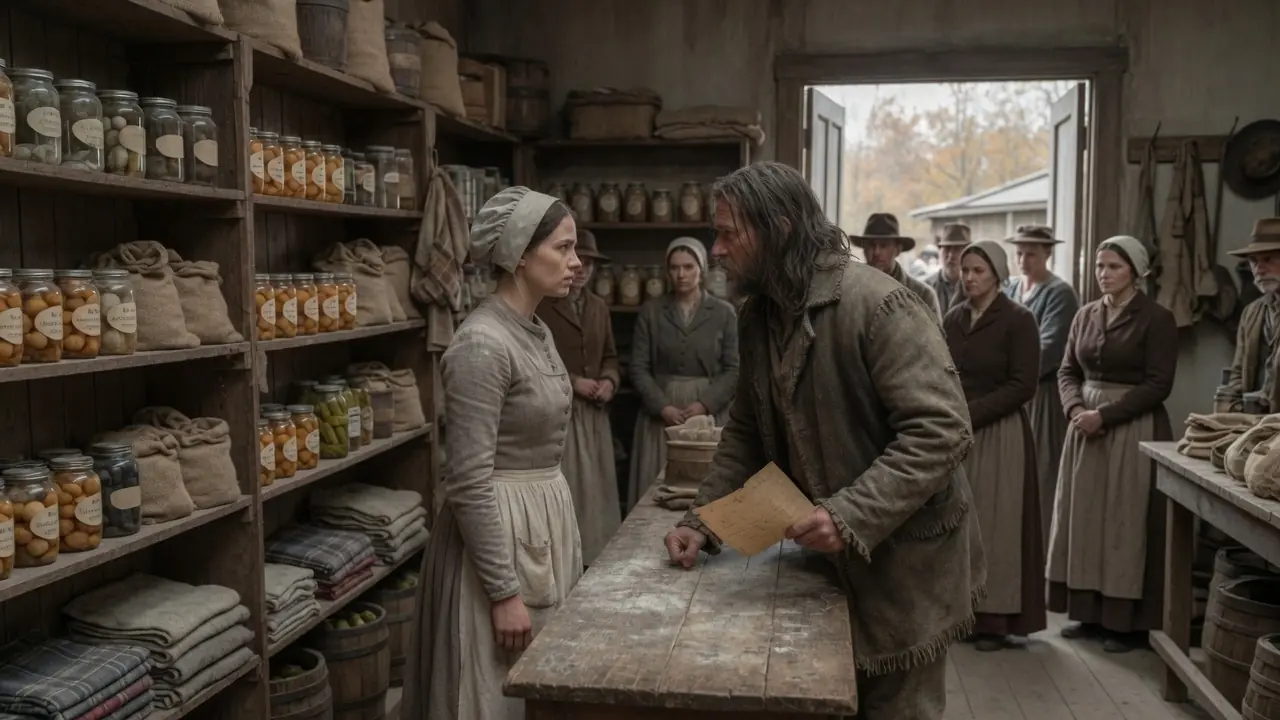
“Mrs. Henderson,” Elyra said quietly, “would you mind watching the counter for five minutes?”
The older woman’s face went pale. “Elyra, dear, you cannot go alone with him.”
“Five minutes,” Elyra repeated.
Her voice was soft, but it left no room for argument.
She led Boon into the back room, where flour sacks leaned against the wall and a small lamp burned on a worktable. The space seemed to shrink around him. He had to duck beneath the doorway, and his shoulders nearly touched both sides of the room.
“Now,” Elyra said, turning to face him. “Tell me everything.”
His hands were shaking.
“I knew Catherine before the mine collapse,” he said. “Back then, I was different. I had plans. I meant to marry her. I meant to build a house in the mountains and bring her there when I had enough saved.”
He drew a rough breath. “Then the collapse happened, and I came out wrong. I could not sleep inside walls. I could not stand crowds. I could not hear stone shift or wood creak without thinking the dark was closing over me again.”
Elyra said nothing.
“Catherine wrote to me,” he continued. “Letters came to the assay office for months. I never picked them up. I told myself she was better without me. I told myself staying away was mercy.”
His voice broke around the next words.
“She was trying to tell me she was carrying my child.”
Elyra felt something cold open in her chest.
Boon looked at her, and the desperation in him deepened. “She raised Ivy alone. Worked herself thin doing it. And now Ivy is coming here, to a father she has every right to hate, and the judge will take her unless I have a wife and a home ready.”
“You need someone to pretend,” Elyra said.
“No,” Boon answered, pulling folded papers from his coat. “Legal marriage. Real in the eyes of the law. Judge Morrison already knows. I told him this morning I was engaged.”
Elyra stared at him. “To whom?”
Boon’s face tightened with shame. “I did not have a name yet.”
The audacity of it should have made her angry.
It did make her angry.
But beneath the anger was the image of a child stepping off a train with no mother, no home, and no choice.
“Why me?” Elyra asked.
Boon lowered his gaze. “Because you are alone, too.”
The words struck harder than they should have.
He continued quickly, as if afraid she might throw him out before he finished. “You work this store every day. You smile at customers, but you keep the world at arm’s length. You live upstairs. No family. No gentleman callers. No one waiting for you when you close the door.”
“That is my choice.”
“I know,” Boon said. “That is why I came to you. I am not offering romance. I am not asking you to love me. I am asking for a business arrangement that saves a child.”
Elyra folded her arms. “What kind of arrangement?”
“You marry me tomorrow morning before the train comes. We show Judge Morrison a lawful marriage and a cabin ready for Ivy. You help me keep her for one year, long enough for the judge to see she is safe. After that, you may leave. I will not stop you. I will give you every cent I have saved.”
He placed a leather pouch on the table.
It landed with a heavy sound.
“Fourteen hundred dollars,” he said. “And the deed to this building.”
Elyra’s breath caught. “This building?”
“I own it,” Boon admitted. “Bought it five years ago when the widow of the last owner needed cash. I had the land agent rent it back to you so you would never feel beholden to me.”
She stared at him, stunned.
“I did not mean harm,” he said. “One winter morning, years ago, I sat outside your store half frozen and half out of my mind. You opened the door, looked at me, and asked if I needed coffee. You did not scream. You did not call anyone. You just gave me a cup and left me alone until I could breathe again.”
Elyra remembered that morning faintly.
A broken-looking man on the porch. A cup of coffee. Nothing more.
“I bought the building because you were kind,” Boon said. “And I wanted you to be secure, even if you never knew why.”
Silence pressed between them.
Elyra should have refused.
Yet the money was not what held her there. The building was not what made her hands curl against her skirt. It was the child. It was always the child.
“What is her name again?” she asked.
Boon’s face changed. “Ivy. Ivy Katherine Mercer.”
“Does she know you exist?”
“Yes. Catherine told her before the end. Told her I was her father. Told her I had made terrible mistakes but that I was once a good man.”
“Were you?”
The question broke him a little.
Boon closed his eyes. “I loved Catherine. I still do. That is what makes it worse. I loved her enough that I should have been brave enough to stay.”
Elyra turned away and looked at the small photograph hanging on the far wall.
It showed a schoolhouse back east and a row of children standing in front of it. In the second row was a little girl with dark braids and a gap-toothed smile. Clara. The girl who had needed help. The girl Elyra had suspected was unsafe at home. The girl Elyra had waited too long to protect.
Clara had run out into a winter storm, trying to reach the schoolhouse where she believed her teacher might save her.
By morning, it was too late.
Elyra had left Pennsylvania within a week.
For six years, she had told herself she wanted peace. In truth, she had wanted punishment. A small room above a store. No family. No attachments. No child looking to her for safety.
Now a child was coming on a train.
Elyra turned back to Boon. “I have conditions.”
Relief crashed across his face so violently he almost looked younger. “Anything.”
“First, Ivy comes before everything. Before your pride, before my comfort, before this arrangement.”
“Agreed.”
“Second, if I ever believe you are a danger to her, I will take her somewhere safe. I will not ask permission.”
Boon’s eyes hardened, but not with anger. “If I ever become a danger to my daughter, I will leave myself.”
“Third, you tell her the truth one day. Not now, not while she is raw with grief, but someday. Children know when adults are lying.”
He nodded slowly. “Agreed.”
“Fourth,” Elyra said, her voice lowering, “do not ever assume this makes us more than what we are. We marry for the child. Nothing else.”
Something flickered in Boon’s face, but he bowed his head. “Understood.”
“Then tomorrow morning,” Elyra said, “we marry.”
Boon stared at her like he had not believed mercy could still exist.
“Thank you,” he whispered. “You are saving her life.”
“No,” Elyra said. “I am giving her a chance. What you do with that chance is up to you.”
By nightfall, the whole town knew.
Elyra closed the store early and packed her life into two carpet bags and one small trunk. Dresses, books, ledgers, a shawl, her mother’s sewing kit, and the photograph of the schoolhouse. It startled her to see how little she owned after six years in Redemption Ridge.
Mrs. Henderson came at sunset, wringing her hands. “Tell me it is not true. Tell me you are not marrying that mountain man.”
“It is true.”
“Why would you do this?”
“For a child.”
Mrs. Henderson’s expression softened, then twisted with old worry. “You cannot save every child, dear.”
Elyra’s hand tightened around a folded dress.
“I know,” she said. “But I can try to save this one.”
She did not sleep that night.
At dawn, she dressed in dove-gray wool with a white collar. It was not a bride’s gown. She was not entering a romance. She was entering a promise, and promises were heavier than lace.
At the church, Reverend Walsh stood on the steps with a face full of discomfort.
“Miss Voss,” he said, “I must ask if you enter this union freely.”
“I do.”
“And you understand the sacred nature of marriage?”
“I understand a seven-year-old girl needs a safe home,” Elyra answered. “And I understand that sometimes doing the right thing looks strange to people who are not the ones being asked to do it.”
The reverend fell silent.
Then Boon appeared.
For a moment, Elyra almost did not recognize him. His beard had been trimmed, his hair tied back, and he wore a borrowed dark suit that pulled at the shoulders and sat short at the wrists. He still looked like a mountain man, but now he looked like one trying, desperately, to become worthy of a child’s trust.
“You look presentable, Mr. Mercer,” Elyra said.
A faint, nervous breath escaped him. “Borrowed the suit.”
“I noticed.”
They married quickly.
The vows were plain. Boon promised to provide, protect, and honor her as long as their arrangement stood. Elyra promised to help him build a home, care for Ivy, and honor the agreement they had made.
There was no kiss.
Boon saw the panic in her eyes before Reverend Walsh could suggest it and said, “That will not be necessary.”
They signed the certificate.
Two names side by side.
Elyra Voss became Elyra Mercer in ink before her heart had time to understand what her hand had done.
Afterward, they went to Judge Morrison’s office. The judge read the marriage certificate with thick brows climbing toward his hairline. He looked from Boon to Elyra and back again, clearly unconvinced that a marriage born in a morning could hold a child safely.
“This looks like desperation,” he said.
“It is,” Boon answered. “A father’s desperation.”
Judge Morrison’s gaze turned to Elyra. “Mrs. Mercer, do you understand what you have agreed to? An isolated cabin. A man with a difficult reputation. A grieving child you have never met.”
“I understand perfectly.”
“And you are prepared for the hardship?”
Elyra thought of the empty room above her store. The silent suppers. The years spent living like a ghost because she was afraid to fail anyone again.
“I have been isolated for six years, Judge,” she said. “At least now I will have a purpose.”
That seemed to reach him.
He signed the necessary papers, but not without warning them. “I will check on this family. If I find neglect, cruelty, or instability, I will remove the child immediately.”
“Understood,” Elyra and Boon said together.
The train came early.
Its whistle cut through the cold morning air while they sat in the café near the station. Boon had been staring at the photograph of Ivy, the one sent with the telegram. A small girl with dark braids, serious gray eyes, and a mouth that looked too sad for seven years old.
When the whistle sounded, Boon went still.
Elyra stood. “Come on.”
“I am not ready,” he said.
“No parent ever is.”
They reached the platform as steam rolled across the boards.
Passengers stepped down with trunks and bags, families greeting families, strangers calling for porters. Then Elyra saw the child. Ivy Mercer stood alone in a black dress too large for her thin frame, clutching one battered carpet bag like it contained the whole world.
Boon made a sound deep in his throat.
Then he moved.
He crossed the platform and dropped to one knee in front of her. His huge body seemed to fold around his shame.
“Ivy,” he said, his voice breaking. “I am your father.”
The little girl looked at him with eyes exactly like his.
“I know who you are.”
The coldness in her voice cut cleanly through the platform.
“Your mother told you?” Boon asked.
“She told me you left.” Ivy’s chin trembled, but she held it high. “She told me you did not want us.”
Boon flinched like she had struck him.
“I was broken,” he said. “I was wrong. I cannot excuse it.”
“But you did not come back.”
“No.”
“My mother said people who leave always leave again.”
Elyra saw Boon’s hands curl against his knees.
“I am asking for one chance to prove I will not,” he said.
“I do not need a father,” Ivy snapped. “I took care of Mama. I can take care of myself.”
Judge Morrison stepped forward with his papers, but Elyra moved first.
She knelt beside Boon, putting herself at Ivy’s eye level.
“Hello, Ivy,” she said gently. “My name is Elyra.”
Ivy looked at her with suspicion. “Who are you?”
“I am your father’s wife. As of two hours ago.”
The child’s eyes widened. “You married him? Why?”
Elyra did not soften the truth.
“Because he asked for help. Because you needed a safe home. And because a long time ago, I failed a little girl who needed someone brave enough to act. I will not fail another.”
Ivy stared at her.
Something in the child’s face shifted. Not trust. Not yet. But recognition. Pain recognizing pain.
“You do not have to forgive him today,” Elyra said. “You do not have to call him father. But you should have a choice. You can come with us to the mountain cabin and see whether we can build something safe, or you can tell Judge Morrison you want another path.”
The judge objected, but Elyra silenced him with one look.
Ivy clutched her carpet bag tighter. “Mama’s things are in here. Her brush. Her book. Her locket.”
“You keep them,” Boon said hoarsely. “Everything that was hers stays with you.”
Ivy looked at him for a long time.
Finally, she whispered, “I want to see where we are going before I decide.”
“That is fair,” Elyra said.
They left town in Boon’s wagon.
Ivy sat in the back, silent and stiff, while Elyra rode beside Boon. The road climbed into the mountains, past pines and stone and narrow turns where the land dropped sharply away. The air grew colder with each mile. The world of Redemption Ridge disappeared behind them until only the creak of wheels and the horse’s steady steps remained.
Boon did not speak much.
Elyra could feel his tension beside her.
Behind them, Ivy stared at the forest with hollow eyes.
At a stream, they stopped to water the horse. Elyra brought Ivy bread, cheese, and dried apples, but the child refused at first.
“Your body needs food,” Elyra said quietly. “Even when your heart does not want it.”
Ivy’s eyes flashed. “Do not talk about my heart.”
Elyra nodded. “Fair enough. Then eat because the road is long, and fainting would be inconvenient.”
For the first time, something almost like surprise crossed Ivy’s face.
She took the bread.
It was a small victory, but Elyra had learned that small victories could keep a person alive.
The cabin came into view near sundown.
It stood in a valley beneath tall pines, solid and plain, smoke rising from the chimney. A stream ran nearby, and the roof looked strong enough to hold against winter. It was not a grand home, but it was warm, prepared, and real.
Boon stopped the wagon.
“This is it,” he said, uncertainty roughening his voice. “It is not much.”
“It is quiet,” Ivy interrupted.
Boon blinked.
“Mama and I lived in a boarding house,” Ivy said. “There were always people yelling through the walls.”
Boon’s face tightened. “There is no yelling here.”
Ivy climbed down and stepped onto the porch.
Inside, the cabin smelled of pine, smoke, and fresh bread. A fire burned in the stone fireplace. The floor was swept, the shelves cleaned, and the small bedroom had been prepared with a quilt, a table beneath the window, and a low shelf for books.
But what stopped Ivy was the bed.
On it sat dozens of carved wooden animals.
A deer with delicate antlers. A rabbit mid-leap. A fox with a curled tail. An owl with tiny feathers carved into its wings.
Ivy picked up the deer with shaking hands. “You made these?”
Boon stood in the doorway, looking terrified. “Your mother’s letter said you liked animals. And drawing.”
“She said I got that from you,” Ivy whispered. “She said you had gentle hands for such a big man.”
Boon closed his eyes.
Then Ivy looked at him fully for the first time. “Why did you never read her letters?”
The question hollowed the room.
Boon knelt again, slow and careful. “Because I was a coward. Because I thought if I did not see her words, I could pretend staying away was kindness.”
“But she loved you,” Ivy said, tears slipping down her face. “She kept your picture by her bed. She told me stories about you. She said you promised to build her a house in the mountains where she could see the stars.”
Boon’s face crumpled. “She remembered that?”
“She remembered everything,” Ivy said. “And she forgave you. Even when she was sick, she said you were probably suffering somewhere and wished she could help you.”
Then her grief broke open.
“But I hate you,” Ivy cried. “I hate that you left. I hate that she worked so hard alone. I hate that you were not there when she needed you. I hate that I am here with strangers instead of with her.”
Boon looked lost.
His large hands hovered uselessly, as if he did not know whether he had the right to comfort the child whose pain he had helped create.
Elyra made the choice for him.
She stepped forward and pulled Ivy into her arms.
The girl resisted for one second, then collapsed against her, sobbing so hard her small body shook. Elyra held her and stroked her hair, whispering that it was all right, that anger was allowed, that grief did not need manners.
Slowly, Boon placed one hand on Ivy’s back.
The child stiffened.
But she did not pull away.
The three of them stayed there in the little bedroom while the fire cracked in the other room and evening settled over the mountain valley.
When Ivy finally slept, Elyra and Boon stepped into the main room.
Boon stood by the fireplace, his face pale with exhaustion. “She hates me.”
“She is grieving.”
“There is a difference?”
“Yes,” Elyra said. “And you had better learn it.”
He looked at her.
“I am not here to comfort your guilt,” she continued. “You hurt people. You cannot undo it. All you can do is become the kind of man who does not run from the consequences.”
Boon lowered his head. “Fair enough.”
The first weeks were hard.
Ivy had nightmares almost every night. She woke crying for her mother, and Elyra sat beside her until she slept again. Boon stayed near the door, never forcing closeness but never leaving either. He carved more animals, cooked breakfast, chopped wood, and tried to speak gently even when fear made his voice rough.
Elyra began teaching Ivy at the table by the window.
The girl was bright, stubborn, and hungry for books. She could read better than most children twice her age, and she asked questions that cut straight to the truth. Sometimes she challenged Elyra. Sometimes she ignored Boon. Sometimes she sat on the porch and stared toward the road as if waiting for the life she had lost to come back.
But slowly, the cabin changed.
Ivy started leaving her bedroom door open. Then she began sitting closer to the fire. Then she asked Boon how to carve an elk after seeing a herd move through the snow-covered meadow one morning.
Boon nearly dropped his knife.
“Yes,” he said carefully. “I can teach you.”
The lesson went poorly at first. Ivy cut her palm on the carving knife, and Boon’s panic came out as anger. He snapped at her, and she snapped back, and he stormed outside before he could make the moment worse.
Elyra cleaned Ivy’s hand.
“He was angry,” Ivy said.
“He was scared,” Elyra corrected.
“He has a funny way of showing it.”
“Yes,” Elyra said. “So do most people who have been hurt badly enough.”
Later, Ivy went outside alone and found Boon near the woodshed. Elyra watched through the window as the small girl approached the massive man. She could not hear the words, but she saw Boon drop to his knees in the snow.
Then Ivy stepped forward and allowed him to hug her.
Only for a few seconds.
But enough.
By winter, they had become something almost like a family.
Not a smooth family. Not an easy family. They argued, misunderstood each other, and stumbled through grief like travelers learning a language no one had taught them. But they also ate together, read together, worked together, and survived storms together.
When Judge Morrison came to inspect the cabin, Elyra feared the worst.
He examined everything. The clean bedroom, the shelves of books, the carved animals, the stocked root cellar, the warm fire, the lessons written in Ivy’s careful hand. Then he spoke to Ivy alone.
Those minutes felt endless.
When the judge emerged, he looked at Boon and Elyra with a seriousness that made the cold air feel colder.
“I expected to find trouble,” he said. “I did not.”
Boon went still.
“The child is grieving,” the judge continued. “She is still angry. She told me that plainly. But she also told me she is warm, fed, educated, and safe. She said both of you are trying.”
Elyra’s eyes burned.
“I approve the placement,” Judge Morrison said. “Full custody to Boon Mercer, with Elyra Mercer as legal guardian if needed. I will return in six months, but I do not expect to remove the child from your care.”
Boon made a sound that was almost a sob.
Ivy came outside after the judge left.
“I told him the truth,” she said.
Boon knelt in the snow before her. “Thank you.”
“Mama said promises are easy,” Ivy whispered. “Actions are harder. So do not promise me. Just do it.”
Boon nodded. “Then I will do it.”
That night, Ivy asked to sleep in the loft between them.
“I do not want to be alone,” she said.
So they made her a little bed between their two spaces. She fell asleep clutching the wooden deer. In the darkness, Boon whispered across her sleeping form, “Thank you for staying.”
Elyra looked toward him.
“Where else would I go?” she whispered. “This is home now.”
The words surprised her because they were true.
Months passed.
Christmas came with a crooked pine tree, carved ornaments, and popcorn strings. Ivy cried while remembering her mother’s apple cake, but she also laughed when Boon carved a bird so badly it looked like a potato with wings. She gave them drawings as gifts: Elyra reading by the window, Boon carving by the fire.
“This is how I see you,” Ivy told him. “You look less sad when you work.”
“I am less sad,” Boon said softly. “Because you are here.”
Ivy did not answer, but she placed his portrait beside the drawing of her mother.
That was answer enough.
Spring came slowly.
The snow began to melt, the stream ran strong, and new grass showed in the meadow. Ivy grew healthier, louder, and more impossible by the day. She called Boon “Papa” once by accident, then pretended she had not.
Boon did not mention it.
But that night, Elyra saw him sit alone on the porch with tears in his eyes.
By then, the arrangement had changed in ways neither of them had planned.
Boon and Elyra still slept separately, but their conversations lasted late into the night. He told her about Catherine, about the years alone, about the morning he had first sat outside her store and received coffee from a woman who asked no questions. Elyra told him about Clara, about guilt, about running west because she had not known how to keep living beneath the memory of one child she could not save.
“You are not broken,” Elyra told him one night.
Boon gave a tired laugh. “You have seen enough of me to know that is not true.”
“You are healing,” she said. “There is a difference.”
He was quiet for a long time.
Then he said, “When the year is over, you do not have to leave.”
Elyra’s heart stilled.
“If you wanted to stay,” Boon continued, “not for the arrangement. Not only for Ivy. For this family.”
She looked toward the sleeping child’s room, where the door was open just a crack.
“I am not planning to leave,” she said.
The silence that followed felt like the first green shoot after winter.
One afternoon in early spring, they stood outside near the chopping block while Ivy rested inside after a lingering fever. Boon looked tired, thinner from worry, but his eyes were clear.
“I need to tell you something,” he said.
Elyra waited.
“When I asked you to marry me, I thought I only needed someone to help me keep Ivy. I thought that was all this could ever be. But somewhere along the way, you became essential to me.”
Her breath caught.
“Not as her teacher,” he said. “Not as my legal wife. As you. The woman who puts flowers on the table because beauty matters. The woman who speaks truth even when it hurts. The woman who looked at the worst parts of me and still believed I might become better.”
Elyra’s eyes filled.
“I know what I am choosing,” she said. “You and Ivy are not a duty anymore. You are my life.”
Boon stepped closer, slow enough that she could move away.
She did not.
His hand rose to her cheek, rough and warm. “I do not deserve you.”
“That is not for you to decide.”
“I love you,” he whispered. “I did not mean to. I did not think I still could. But I do.”
Elyra smiled through tears. “I love you, too.”
When he kissed her, it was gentle, careful, and nothing like the bargain that had begun them.
From the cabin window came a small gasp.
Boon sighed without looking away from Elyra. “Ivy, stop spying.”
“I am not spying,” Ivy called. “I am observing.”
Elyra laughed.
The sound startled her. For years, laughter had felt like something that belonged to other women, women without ghosts following them. But here, in a mountain valley with a broken man and a stubborn child, laughter had found her again.
Six months later, Judge Morrison returned.
This time, he found not a desperate arrangement, but a real family. Ivy was healthy, studying hard, and proud to show him her carved elk. Boon stood beside Elyra with quiet confidence instead of panic. Elyra answered every question without fear.
The judge closed the case.
Then he offered to formalize the marriage as a genuine partnership, removing any future question about their original arrangement.
Boon looked at Elyra.
Elyra looked at Ivy.
“Yes,” she said.
Boon’s hand found hers. “Yes.”
Ivy burst from the bedroom where she had been pretending not to listen and wrapped her arms around them both.
“Good,” she said. “Because you are both stuck with me.”
Years later, Ivy would ask them to tell the story again and again.
The story of the day Boon Mercer stormed into a general store and said he needed a wife by tomorrow. The story of the woman who asked him the one question that broke his pride and opened his heart. The story of a child who arrived angry, grieving, and brave enough to demand the truth.
It was never a neat story.
Healing rarely is.
But it became theirs.
A mountain man who learned that love meant staying. A storekeeper who learned that solitude was not the same as safety. A little girl who learned that loving new people did not mean forgetting the mother she had lost.
Together, they built something stronger than the past.
Not perfect.
Not painless.
But real.
And sometimes, that is the greatest miracle a broken heart can ask for.