A 74 year old man sits alone in a dark kitchen, gripping a cold coffee mug with the only hand that still works. His house is collapsing around him. The city is fining him for falling apart. His son has not visited in 2 years, and tonight he has just told a stranger, a tattooed biker covered in leather and scars, the words, "No one should ever have to say, 'I lost even my will to fight.'"
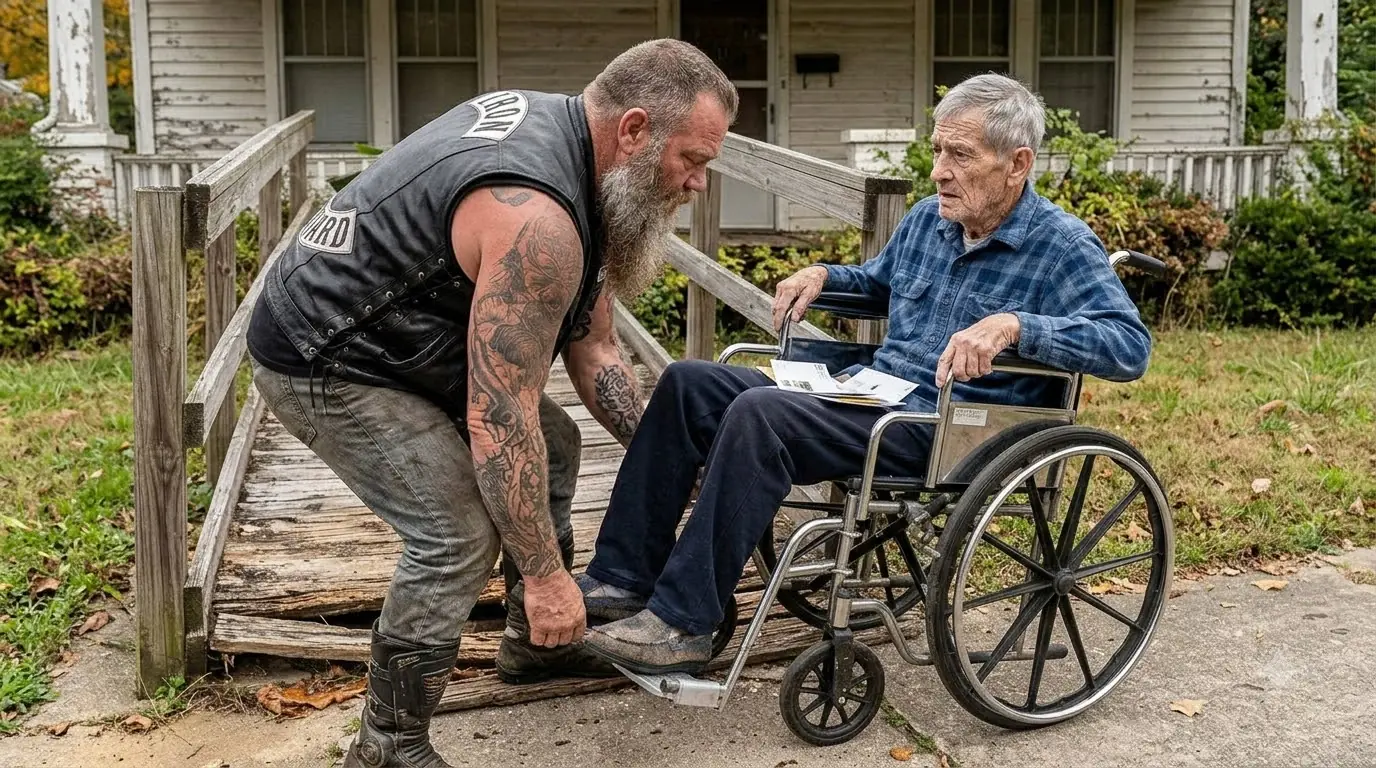
What happens next will begin with the roar of 100 engines on a quiet street. But it will not end there because what these bikers did was not charity. It was something this town never saw coming and something this man will never forget. The house at 412 Chestnut Lane had once been the kind of place that made neighbors slow their cars just to admire the garden.
Caroline Hensley had planted hydrangeas along the front walk every spring for 31 years, choosing different varieties each season, lace caps near the mailbox, mop heads under the kitchen window, oak leaves along the fence where the afternoon light was softest. The wooden shutters had been painted twice. Once when they moved in, a cheerful colonial blue that Caroline picked from a hardware store catalog, and once the summer before she got sick, when Walter had climbed the ladder himself, despite the pain in his knees, and painted them the same shade, because she said the color reminded her of their honeymoon in Charleston.
Now the hydrangeas were dead. The shutters hung at angles like broken arms, and the only thing that moved behind the clouded front window was the slow mechanical rocking of a wheelchair rolling back and forth across warped hardwood. Walter Hensley was 74 years old, and he had stopped counting the days sometime around February. It was now late September and the Blue Ridge Mountains surrounding Asheville, North Carolina had begun their annual transformation.
The maples shifting from green to amber, the air thinning into something sharp and clean that used to make him want to step outside and breathe until his chest ached with gratitude. He did not step outside anymore. He had not left the house in 5 months, not since the second stroke took what the first one had only threatened: the use of his left leg, most of the strength in his left arm, and whatever remained of his belief that things might still get better.
The kitchen smelled like instant coffee, and something stale he could not identify. Walter sat at the table with both hands wrapped around a mug that had gone cold an hour ago. The mug had a faded American flag on it and the words proud to serve in chipped red letters. He had bought it at a gas station outside of Fort Bragg in 1972, the week he came home from his second tour of duty.
Carolyn had told him it was ugly. He had told her it was the most beautiful thing he had ever held because he was holding it in America, and she had laughed and kissed the side of his face. And that was the kind of memory that could split a man open if he let it. He did not let it. Not anymore.
He had learned to close the doors inside himself the way a man boards up windows before a hurricane. Not because the storm would not come, but because watching the damage happen was worse than just hearing it. A thick envelope sat on the counter behind him, unopened. It was from the city of Asheville code enforcement division and it was the third one this month.