Jack Callaway did not think a chicken could change a man’s life, but that was before May Whitfield’s most determined hen crossed his fence for the third time in one week. The hen stood on Jack’s side of the property line, pecking at the dry Montana ground as if she had purchased the land herself. Jack stood with his hands on his hips, staring at the bird with the kind of irritation he usually reserved for broken wagon wheels and late cattle shipments. Across the fence, May Whitfield rested one hand on the top rail and looked entirely too amused.
“She’s trespassing,” Jack said. May tilted her head, considering the hen as if the matter required serious legal attention. “I believe she is exploring,” she replied. Jack looked at May, then at the chicken, then back at May, already knowing this was not going to be a simple conversation.
Ridgeback, Montana, was the kind of place where everyone knew whose fence was leaning, whose crop had failed, and whose heart was involved before the person carrying it knew for himself. Jack was thirty-two, broad-shouldered, dark-haired, and stubborn enough that people often mistook his silence for certainty. He ran the Callaway cattle ranch, three hundred acres of grazing land, a weathered barn, a house with a porch that needed repair, and enough responsibility to keep most softer men from sleeping well. He had never thought much about marriage because cattle, weather, taxes, and broken fences already gave him more than enough to manage.
May Whitfield was twenty-eight and ran the neighboring homestead alone since her father’s death two years earlier. She had forty acres, a kitchen garden that made every woman in Ridgeback ask careful questions about soil, and a mare named Duchess who behaved as if she were the owner of the property. May could mend a fence, bargain with merchants, grow squash in stubborn soil, and smile sweetly while telling a man he was wrong. Jack had known her for years, but knowing someone and seeing them were two different things.
“I’ll build the fence higher,” Jack said, pointing toward the hen. May smiled, and Jack had come to distrust that particular smile because it usually meant she had already won. “You may build it to the heavens if you like,” she said. “But if the fence is four feet too far to the right, that is really a moral problem, not a chicken problem.”
Jack narrowed his eyes. “The fence has stood here for twenty years.” May folded her arms. “That does not make it correct. It only makes the mistake well established.” The hen clucked once, as if offering testimony.
Jack should have been annoyed. In truth, he was annoyed. But May laughed then, not politely, not gently, but with real delight, and something in Jack’s chest shifted before he had time to brace against it. He found himself smiling, and when he noticed he was smiling, that annoyed him even more.
The chicken incident should have ended there, but it did not. Over the next months, it became one of many little disputes between the Callaway ranch and the Whitfield homestead. There was the matter of South Creek water rights, which required a visit to the county office and ended with the clerk looking uncertain whether Jack and May were fighting or enjoying themselves. There was also the afternoon Jack’s horse wandered into May’s kitchen garden and ate a painful amount of squash.
May sent him a handwritten note listing the damages in exact detail. Jack rode over the next morning with payment, and because he knew the horse had been entirely at fault, he paid double. “That is more than the squash was worth,” May said, taking the coins. Jack shrugged. “My horse has expensive taste.”
May stared at him for a moment, then looked away because she was trying not to laugh. Jack noticed that. He noticed more than he meant to. He noticed how her hair slipped loose near her cheek when she worked in the garden, how her eyes changed color in different light, and how the sound of her voice at the fence made an ordinary day feel less ordinary.
The town noticed too. Martha Dear, who ran the dry goods store and collected gossip with more efficiency than the telegraph, told anyone who would listen that Jack Callaway was a man already gone and too stubborn to admit it. Tom Fletcher, Jack’s closest friend, was less poetic. “You spend a remarkable amount of time at the Whitfield fence,” he said one afternoon.
“We share water rights,” Jack replied. Tom leaned against the barn post and looked unimpressed. “You have visited that creek eleven times in two months. Unless the water has learned to speak, I am going to assume there is another reason.” Jack told him there was nothing to assume, which was the kind of answer a man gives when he is determined not to think.
May knew the town was watching, but she did not much care. Running a homestead alone had taught her that other people’s opinions were usually loudest when they were least useful. Still, she knew something was growing between her and Jack, even if he seemed determined to treat it as weather, fence work, and neighborly conversation. He argued with her honestly, listened even when he disagreed, and never once spoke to her as if she needed to be smaller to be acceptable.
That mattered to May more than flowers would have. Men had brought her flowers before, usually with speeches too polished to be trusted. Jack brought fence wire, repaired loose boards, challenged her reasoning, and remembered that Duchess disliked being tied near the west gate. Somehow, that felt far more intimate.
By October, the Harvest Social had arrived, and all of Ridgeback gathered at the Grange Hall. Lanterns hung from the rafters, fiddle music scraped and sang, tables sagged beneath pies and roasted meats, and the air carried the smell of coffee, floor dust, and nervous courtship. May came with her neighbor Ruth, wearing a soft cream blouse and a green skirt, her hair pinned carefully though one curl had already escaped by the time she entered. Jack arrived with Tom, wearing his cleanest shirt and the expression of a man who had been forced into society for his own good.
They found each other without meaning to, as they always did. Jack stood near the side wall watching the dancers, and May came beside him with a cup of cider. “That chicken has behaved all week,” she said. Jack looked down at her. “That only means she is planning something.”
“Almost certainly,” May replied. “I would watch the south section.” He smiled before he could stop himself. The room was noisy, but around them, conversation settled into the familiar rhythm they had built over months of arguments that had never truly been arguments.
Then Carter Bell approached. He was new to town, polite, handsome in a clean and eager way, and entirely unaware of the invisible fence line around May Whitfield that half of Ridgeback had already learned to respect. He removed his hat and asked May to dance. May glanced at Jack, just once.
Jack felt something sharp under his ribs. It was unreasonable, which made him dislike it immediately. He had no claim on May. He had never asked for one, never spoken one clear sentence that would give him the right to object.
So he smiled in the careless way men smile when pretending not to care. “Go ahead,” he said. “At this rate, you’ll never get married, May. You should take every opportunity that presents itself.” He meant it as a joke, the kind of teasing they traded easily, but the words changed her face.
May looked at him, and for one brief second the room behind her disappeared. Her smile returned slowly, softer and more dangerous because it was real. She stepped close enough that only Jack could hear her. “Only if you ask me,” she whispered.
Then she turned to Carter with perfect calm and said, “Thank you, but I think I will sit this one out.” After that, she walked toward the refreshment table as if she had not just overturned Jack’s entire understanding of the world. Carter stood awkwardly for a moment, then looked at Jack. “Was that…”
“Go dance with someone else,” Jack said, without looking away from May. Carter wisely left. Jack stayed where he was, holding a cup he had forgotten how to drink from.
Only if you ask me. The words followed him for the rest of the evening. They followed him while Tom tried to make conversation, while the fiddle changed tunes, while May laughed with Ruth near the food table and never once looked as unsettled as Jack felt. He walked home under the cold Montana stars because riding seemed too quick for thoughts that large.
He reached the middle of the road and stopped. The valley lay quiet around him, the mountains black against the sky, the Milky Way spread overhead like spilled salt. He thought of the chicken, the squash, the water rights, the eleven visits to South Creek, and the way he had begun checking whether May’s lamp was lit across the fields each evening. He thought of Carter asking her to dance and the strange, hard feeling that had risen in him before he had made that foolish joke.
That feeling had a name. Jack was not a coward with storms, cattle, debt, or hard labor, but he had been a coward with May. He had hidden behind banter because banter was safe, and he had called his fear practicality because that sounded better. Standing under those stars, he understood he had almost let another man ask the question he had been too slow to speak.
He did not sleep much that night. By morning, he had a plan, though even he admitted it was not a particularly romantic one. He did not bring flowers because flowers felt like a performance, and May Whitfield would see through a performance before the petals settled. He brought a new fence post, a post-hole digger, and the courage he had nearly misplaced for months.
May was in her kitchen garden when he arrived. She saw the fence post over his shoulder and raised one eyebrow. “Southeast corner?” she asked. Jack nodded. “It has been soft since July.”
“I know,” she said. “I have been meaning to fix it.” “I know,” Jack replied. “I am doing it.” May’s mouth curved slightly because those were often her words returned to her, and Jack knew she recognized them.
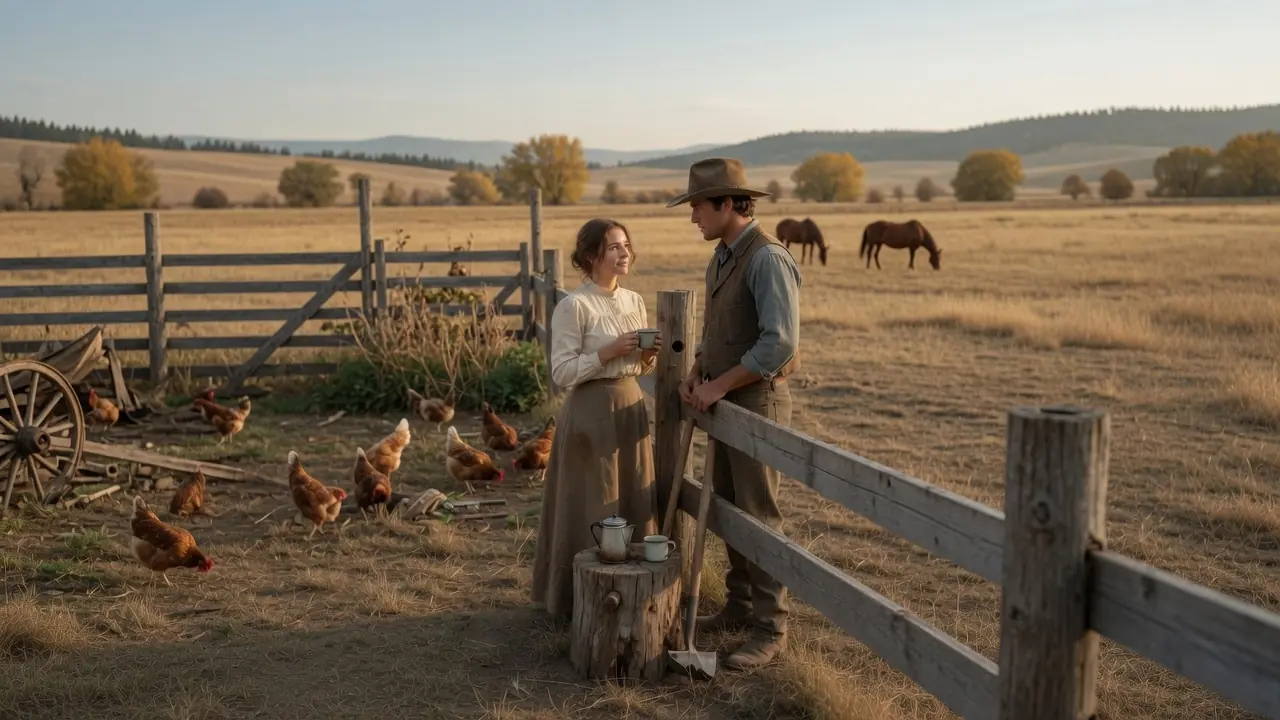
He worked for nearly an hour while she weeded the garden nearby. He dug the old post free, packed the new one into place, tightened the line, and set the rail properly. May brought coffee in two enamel cups and set them on a stump beside the fence. The morning was clear and cool, the kind of autumn morning where every sound carried farther than expected.
When Jack finished, he leaned the post-hole digger against the rail and took the coffee she offered. Their fingers brushed around the cup, and both pretended not to notice. May sat on the low fence rail, and after a moment, Jack sat beside her. The silence between them was not empty; it was waiting.
“I have been thinking about what you said last night,” Jack began. May looked ahead at the garden, her expression composed. “Have you?” “Yes.” He took a breath and set his coffee down carefully. “I was slow.”
May nodded once. “Several months slow, if we are being accurate.” Jack glanced at her, and despite the tightness in his chest, he almost smiled. “Several months,” he agreed. “I considered giving reasons, but most of them are poor, and you have a reliable instinct for poor reasoning.”
“That is true,” May said. Her fingers tightened around her cup, though her voice remained light. Jack noticed. That gave him courage.
“What I mean to say,” he continued, “is that I would like to come calling on you properly, if you are willing.” May turned then, and the morning light caught her eyes, making them look green and gray at once. Jack forced himself not to look away. “Not as the man arguing about chickens. Not as the neighbor fixing a fence. As a man who wants a place in your life.”
For once, May did not answer immediately. Her smile trembled at the edges, and Jack saw the emotion she was trying to manage. That did something to him deeper than any grand speech could have. He stepped off the rail and stood in front of her, not crowding her, only close enough to show he meant to stay.
“Jack Callaway,” she said softly, “that is the least romantic confession I have ever heard.” His stomach dropped. “Was it wrong?” May looked at him for a long moment, then smiled the smile he had learned was only his. “No. That is why I have been waiting for it.”
He let out a breath that sounded almost like a laugh. She set down her cup, and when her hand lowered, his hand found it with careful uncertainty. May did not pull away. Her fingers fitted against his work-worn palm as if they had been practicing for this without knowing it.
“I do not want to waste more time,” Jack said. “I have already wasted enough.” May looked down at their joined hands, then back at him. “Then do not start by making another speech.” “What should I do instead?” he asked.
She tilted her head, still teasing, but her eyes were bright. “Ask me to supper.” Jack nodded solemnly. “May Whitfield, will you have supper with me this week?” “I will,” she said. Then, after a pause, “And Jack?”
“Yes?” “If you try to discuss fence placement the entire evening, I will send you home before dessert.” He considered that. “That seems fair.” She laughed, and the sound moved through him like sunlight across a cold room.
Their courtship began with supper and very nearly became an argument over pickled beets. May claimed they had a place at the table. Jack claimed their place was outside the house, preferably far away. She told him this was an early warning about the difficulty of his nature, and he said a woman who defended pickled beets had limited room to judge anyone.
It was the best supper he had ever had. Not because the food was perfect, though it was good, and not because the evening was smooth, because it was not. It was because the conversation refused to end. They talked about the ranch, the homestead, winter feed, her father, his father, the loneliness that came after death, and the strange comfort of a neighbor who did not pity you.
By the second week, the entire town knew. Martha Dear said “finally” when May came into the dry goods store, then refused to explain herself because the explanation was apparently unnecessary. Tom bought Jack a drink and said nothing at all, which was worse than a speech. Carter Bell danced with another young woman and never again asked May.
May and Jack rode out together on Sundays. Sometimes they visited the creek, sometimes the ridge, sometimes the far pasture where the grass turned gold under late autumn light. They argued often, but the arguments had changed. They were no longer a way of circling what neither dared say; they were a way of building the shape of a life together.
One Sunday in November, they sat above the valley with the horses grazing behind them. The air was sharp, and the mountains stood blue and still in the distance. Jack had been quiet longer than usual, which May noticed at once. “If you are thinking about the south fence again, I will leave you here.”
“I was thinking about you,” he said. That stopped her. Jack looked uncomfortable but determined, which May had come to understand was his most sincere expression. “You never let me be lazy about thinking,” he said. “About land, about people, about myself. I did not know I needed that until you.”
May looked at him, and the teasing answer she might have given softened before it reached her tongue. “You listen,” she said. “Even when you disagree, you listen first.” She looked down at the valley. “That is rarer than you think.”
He reached for her hand, and this time there was no hesitation. Their fingers joined easily now. The wind moved through the grass, and for a long while they said nothing, because the silence between them had become one of the many languages they shared. May rested her shoulder lightly against his, and Jack sat very still, as if the trust of that small movement deserved reverence.
In December, the first snow touched the mountains. Jack began carrying a ring in his vest pocket, wrapped in a square of cloth. It had belonged to his mother, plain gold, worn smooth by years of ordinary love. He carried it for twelve days, waiting for the right moment and rejecting every moment that seemed too polished.
Finally, he went to May’s porch on a cold evening when the sky was fading into pink and violet. They sat in the two chairs that had become theirs without either admitting it. May held tea, and Jack held coffee, an arrangement they had already debated more than once. The fence line lay quiet beyond the yard, and the chickens had settled near the coop.
“May,” Jack said. “I need to ask you something.” She did not look up from her cup. “You need to ask me several things regularly. Be specific.” He smiled despite himself. “I need to ask you to marry me.”
May went still. Slowly, she lifted her eyes. Jack held her gaze because after months of being slow, he would not be cowardly now. “I will not be poetic about it,” he said. “You would see through that anyway.”
“That is true,” she whispered. He took the ring from his pocket. “What I know is that I want coffee on this porch, and arguments about grain, and your chickens invading my property, and fifty years of you telling me when I am wrong.” May’s eyes shone. “Fifty percent of the time,” she said.
“Forty,” Jack replied automatically. May stared at him. “Did you just negotiate the terms of your own proposal?” “I am establishing an accurate baseline,” he said. Then her laugh broke free, bright and delighted, the same laugh that had started everything.
“Yes,” she said, before he could ruin the moment by explaining anything else. “Obviously, yes. It took you long enough.” Jack slipped the ring onto her finger with hands rough from work and unsteady from joy. “I was thinking it through,” he said.
“You always are,” she replied. Then her voice softened. “But here you are.” He touched her cheek carefully, giving her time to turn away if she wanted. She did not. When he kissed her, it was gentle, honest, and full of every unsaid thing that had been waiting at fences, creeks, dances, and porches for months.
They married in April when the valley turned green. The church was small, the flowers were simple, and everyone in Ridgeback attended partly out of affection and partly because they had been watching the story unfold since the chicken. May wore a cream dress her mother had made years earlier, and Jack stood at the front looking like a man trying very hard not to cry. Tom later claimed Jack failed, though Jack denied this for the rest of his life.
Their marriage was not quiet. They argued about land management, winter grain, whether coffee was appropriate after supper, and how many chickens a sensible woman truly needed. Jack lost more disagreements than he expected and fewer than May claimed. Their children later learned that an argument in the Callaway house did not mean anger; it often meant their parents were enjoying themselves enormously.
The ranch grew stronger after their properties joined. May’s accounts were better than Jack’s had ever been, a fact he admitted once and then never repeated because she reminded him often enough. Jack repaired every fence post on the Whitfield side as if paying off an old debt. May kept the kitchen garden thriving and named one particularly stubborn hen “Boundary,” which Jack considered unnecessary.
Years passed, as years do, quietly and all at once. Children were born, barns were repaired, droughts came and passed, and the porch chairs were replaced several times though they were always considered the same chairs. Jack’s hair silvered at the temples, and May’s hands grew lined from work, but their conversations never lost their rhythm. They still disagreed about pickled beets.
In the summer of 1931, fifty years after the chicken first crossed the fence, Jack and May sat on the porch in the late afternoon. He was eighty-two, she was seventy-eight, and the valley below them looked both changed and exactly the same. The mountains held the last sunlight along their high ridges. Jack had coffee, and May had tea.
“You know,” Jack said, looking at the mountains, “coffee is objectively the better evening choice.” May did not even glance at him. “You have been saying that for fifty years.” “It has not become less true,” he said. “It has not become more true either,” she replied.
Jack looked at her then. Her hair was silver, her face lined by weather and laughter, and her eyes still shifted green-gray depending on the light and what she was thinking. She was still the most interesting person he knew. Still the one he wanted to talk to about everything, argue with about everything, and sit beside when words had done enough.
“May,” he said. “I have been thinking.” She smiled faintly. “Dangerous.” He ignored that. “I was right at the Harvest Social when I said you would never get married at that rate.”
She turned her head slowly. “Are you about to claim credit for our entire marriage on a technicality?” Jack lifted his cup. “I am establishing an accurate historical record. You were not going to get married unless I asked.” May stared at him for one second, then laughed.
It was still the same laugh. Older, softer perhaps, but the same bright sound that had once risen across a fence because a chicken did not respect property law. She reached over and took his hand on the armrest between them. His fingers closed around hers with the ease of a motion practiced ten thousand times.
The valley turned gold around them. The mountains did what they always did. The porch held their silence, their teasing, their years, and the love that had never needed to be grand to be true.
Their story had not begun with a rescue in a storm or a letter under moonlight. It had begun with a chicken, a fence, and two people who learned that banter could become intimacy when both hearts were brave enough to listen. Jack had joked that May would never marry at that rate. May had whispered the truth and walked away.
Only if you ask me.
So he did.
And for the rest of their lives, he was grateful he had finally been smart enough to understand the answer before it was too late.