I got a call from a number I didn’t recognize on a Saturday morning.
A woman’s voice said, “Is this Karen?”
I said yes.
There was a pause, followed by a shaky breath.
“I’ve been sleeping with your husband for six years.”
For several seconds, I couldn’t speak. I stood barefoot in the kitchen, staring at the coffee dripping into the pot as if I had forgotten what it was.
Then she said something even stranger.
“And I’m sorry. But you need to know because he just did the same thing to me.”
I hung up.
My hands were shaking so badly that I nearly dropped the phone. I told myself she had the wrong Karen. It was a cruel prank. Some unstable woman was trying to destroy a stranger’s marriage.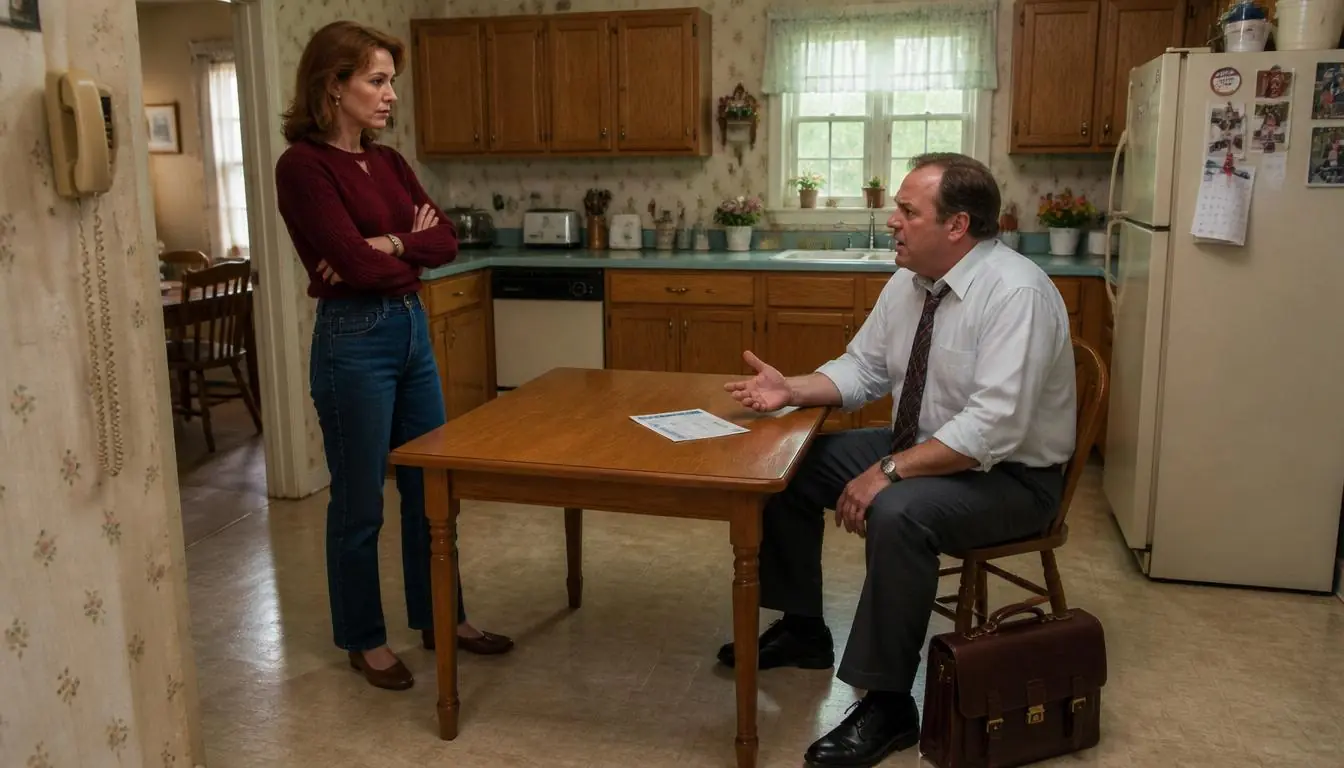
My husband, David, and I had been married for twenty-two years. We had raised two children, survived layoffs, cared for aging parents, and spent countless ordinary nights discussing bills across the kitchen table.
Ordinary marriages did not receive calls like that.
I called him.
He didn’t answer.
I called again.
Nothing.
He had told me he needed to stop by his office that morning to finish some reports. I grabbed my keys and drove there, rehearsing explanations the entire way.
Maybe his phone was on silent.
Maybe he was in a meeting.
Maybe the woman had confused him with someone else.
David’s car was in the company parking lot, but the building seemed unusually quiet. When I entered, the receptionist looked up and immediately looked away.
That was when I knew something was wrong.
“Is David here?” I asked.
Her eyes filled with something that looked like pity.
“He left about an hour ago.”
“With whom?”
“No one. He had boxes.”
I walked past her before she could stop me.
His office door was open. The desk had been cleared. The computer was gone. The framed photographs of our children had disappeared. Even the coffee mug I had bought him for Father’s Day was missing.
It looked as if he had never worked there.
“What happened?” I asked.
The receptionist appeared behind me.
“I think you should talk to David.”
People say that when they already know the truth but do not want to be the one who tells you.
I drove home with both hands gripping the steering wheel. I don’t remember stopping at traffic lights. I only remember the pressure in my chest and that woman’s words repeating inside my head.
Six years.
He just did the same thing to me.
When I arrived, David was sitting at the kitchen table.
Calm.
Almost unnaturally calm.
His packed briefcase rested near his feet. A glass of water sat untouched in front of him.
He looked at me and said, “We need to talk.”
“No,” I replied. “You need to listen.”
Then I pulled out what I had found in his jacket pocket three weeks earlier.
A bank receipt.
Not just any receipt. It came from an account I didn’t know existed, and the balance was larger than everything we had in our joint savings.
For three weeks, I had carried it in my purse, telling myself there had to be an innocent explanation. Maybe it was connected to his work. Maybe it belonged to his brother. Maybe the bank had printed the wrong balance.
I had wanted so desperately to believe him that I had invented explanations he had never bothered to give me.
I unfolded the receipt and placed it on the table.
His face changed instantly.
The calm disappeared.
The confidence vanished.
For the first time that morning, he looked afraid.
“Where did you get that?” he asked.
“In your jacket.”
He leaned back and closed his eyes.
I laughed, but there was no humor in it.
“Six years?” I asked. “Was she telling the truth?”
He didn’t answer.
I didn’t need him to.
His silence was louder than any confession.
“Six years,” I repeated.
Outside, someone was mowing a lawn. A dog barked. A car passed our house with music playing through an open window.
Normal sounds from a normal world.
Meanwhile, mine was collapsing.
“I’m sorry,” David finally said.
Those two words made me angrier than anything else.
Sorry.
As if that could erase six years of lies. As if it could return all the anniversaries, birthdays, holidays, and family vacations that now felt contaminated.
I remembered the conference in Denver when he was gone for four days. The Saturday afternoons he supposedly spent golfing with coworkers. The late-night messages he claimed were from his supervisor.
“How many?” I asked.
His eyes widened. “What?”
“How many women?”
He looked away.
That was my answer.
More than one.
My stomach turned as I finally understood what the caller had meant. David had cheated on her too. She had believed she was the exception, the woman he truly loved, only to discover she had been one more person in a long chain of deception.
The man across from me wasn’t the person I thought I had married.
He was a stranger.
A very convincing stranger.
“I lost my job yesterday,” he said.
“What?”
“They found out.”
“Found out about the affair?”
He shook his head.
“The company audit.”
I looked at the receipt on the table.
The emptied office. The missing computer. The boxes. The fear in his eyes.
“What did you do?”
He was silent for so long that I heard the refrigerator turn off behind us.
“I borrowed money,” he finally said.
“Borrowed from whom?”
“From company accounts.”
“No.”
“It started small.”
“No.”
“I thought I could replace it before anyone noticed.”
I stood so quickly that my chair nearly toppled over.
This wasn’t simply an affair anymore. It wasn’t only betrayal.
It was a criminal disaster.
“How much?”
He rubbed both hands over his face.
When he told me the number, I couldn’t breathe.
It wasn’t thousands. It wasn’t even tens of thousands.
It was enough to destroy everything we had built over two decades—the house, our savings, our retirement, and perhaps our children’s financial security.
I sank into the chair.
“What happens now?”
“The police will probably come.”
That was when I realized he wasn’t sitting there because he wanted to confess. He was there because he had run out of places to hide.
His employer had found the missing money. His office had been cleared. One of his mistresses had discovered the other women. The walls were finally closing in.
He had said, “We need to talk,” not because he had suddenly become honest, but because he needed my help.
For twenty-two years, I had fixed his problems. I remembered bills, scheduled appointments, apologized when he hurt someone, and covered for him when he forgot important promises. Whenever life became difficult, I carried the weight until he could stand straight again.
He was counting on me to do it one more time.
“I need you to say you knew about the account,” he whispered.
I stared at him.
“What?”
“It’s in both our names.”
The room went cold.
“That isn’t possible.”
“I had access to your information. I handled the taxes and paperwork.”
My eyes moved to the receipt.
I had only noticed the account number and the balance. I had not looked closely at the names printed beneath them.
Now I did.
David Miller.
Karen Miller.
My name was there.
He had opened the account using my identity.
“You forged my signature?”
“If you say you knew, they may treat it as a marital asset issue instead of—”
“Instead of theft?”
“I was going to fix everything.”
“You put my name on stolen money.”
His voice became impatient, as though I was refusing to understand a reasonable request.
“We have to stay together on this. If you turn against me, we could lose everything.”
“We’ve already lost everything.”
A loud knock interrupted us.
Three sharp knocks at the front door.
David’s face turned white.
Neither of us moved.
The knock came again, harder this time.
He lowered his head, and I knew he had expected them.
I walked to the door on trembling legs. Two investigators stood on the porch.
One asked, “Karen Miller?”
I nodded.
“We need to speak with your husband. We’ll also need to ask you some questions about accounts bearing your name.”
For one terrible moment, I understood the full extent of David’s plan.
He hadn’t simply hidden the money from me.
He had prepared to hide behind me.
I looked back at the man I had loved for more than half my life—the father of my children, the person whose hand I had held beside hospital beds and at graduations.
He looked smaller than I had ever seen him.
Not because investigators were at the door, but because the lies had finally fallen away. There was nothing left to make him appear larger.
I stepped aside.
“He’s in the kitchen,” I said.
The months that followed were the hardest of my life.
At first, the investigators treated me as though I might have been involved. My name appeared on two accounts. Electronic documents showed what looked like my signature. Some of the stolen money had even been used to make payments on our mortgage.
David had built his protection carefully. If he was caught, he wanted the evidence to suggest I had benefited too.
Friends disappeared. Neighbors whispered. People who had eaten at our table crossed the street to avoid speaking to me.
I cried in grocery store parking lots. I woke before dawn with my heart racing, afraid that I might lose not only my home but my freedom.
Then the woman who had called me came forward.
Her name was Lisa.
I met her for the first time in a lawyer’s office. She was not the glamorous, heartless woman I had imagined. She was fifty-three, recently divorced, and looked just as exhausted as I felt.
“I thought he was leaving you,” she said through tears. “He told me your marriage had been over for years.”
I wanted to hate her. Part of me did.
Then she placed a small recording device on the table.
After discovering that David had been seeing another woman, Lisa had confronted him. During that confrontation, he admitted that he had moved money through accounts opened under my name. He even told her that if the company found out, he would say I had managed the finances.
“He said no one would believe you didn’t know,” Lisa whispered. “He said wives always know.”
The recording changed everything.
It proved that David had used my identity deliberately and intended to blame me if his crimes were discovered. It also led investigators to another account he had opened using Lisa’s personal information.
That was the twist none of us had expected.
When she said he had done the same thing to her, she hadn’t been talking only about cheating.
He had stolen her identity too.
David hadn’t seen either of us as partners. We were shields—women whose trust he could use as camouflage.
Lisa’s evidence cleared me of criminal involvement, but it couldn’t restore what had been taken. Our house was sold. Most of our savings disappeared into legal fees, debts, and restitution claims. The marriage ended before his trial.
At sentencing, David turned and looked at me.
For a second, I saw the man I remembered—the young father holding our newborn daughter, the husband dancing badly with me in our first apartment, the person I had spent decades believing in.
Then he said, “I never meant for this to happen.”
That sentence finally released me.
He still could not say, “I chose this.”
He spoke as if his actions were weather, as if betrayal had simply blown into our lives and destroyed us while he stood helplessly nearby.
I walked out of the courtroom without answering.
People later asked how I survived.
The truth is, I didn’t survive all at once.
I survived one morning, one afternoon, and one evening at a time. Sometimes I survived only one minute.
There were days when I couldn’t get out of bed. Days when I felt humiliated by how completely I had trusted him. Days when I replayed our marriage, searching for the moment I should have known.
My therapist asked me a question that changed something inside me.
“Why are you ashamed of having loved honestly when he is the one who used that love dishonestly?”
I had no answer.
Slowly, I stopped treating my trust as evidence of stupidity.
Trust had not been my crime.
His exploitation of it had been his.
I moved into a small apartment with thin walls and an unreliable heater. At first, I hated it. Every room reminded me of what I had lost.
Then, one evening, I hung a photograph exactly where I wanted it without asking anyone’s opinion. I painted the bedroom blue. I bought a yellow chair David would have called impractical.
Those small choices felt like pieces of myself returning.
I took accounting classes because I never wanted another person to control my financial life. I learned to read every statement, check every account, and ask questions without apologizing.
Eventually, a community legal center asked me to help with workshops for spouses recovering from financial abuse. I sat beside women who believed they should have known sooner. I told them what I had needed someone to tell me:
“You are not foolish because someone worked hard to deceive you.”
Lisa and I never became close friends. Our history was too painful and complicated for that. But once a year, usually near the anniversary of the phone call, she sent me a short message.
Still rebuilding.
I always replied with the same words.
So am I.
Three years later, my phone rang on a Saturday morning.
The number was unfamiliar.
For a moment, my stomach tightened. My body remembered what my mind had learned to survive.
Then I answered.
A young woman introduced herself. She was completing a research project on resilience after financial and personal loss. Someone from the legal center had recommended me.
“Would you be willing to share your story?” she asked.
I looked around my apartment—the blue walls, the yellow chair, the financial certificates framed above my desk.
Years earlier, a stranger’s voice on the phone had destroyed the life I thought I had.
Now another stranger’s voice was opening a new chapter.
“Yes,” I said. “I think I’d like that.”
After the call, I sat on my small balcony with a cup of coffee and watched the sun rise between the buildings.
For years, I had believed losing my marriage meant losing my future.
I was wrong.
I had lost a house, savings, friendships, and the story I had told myself about the man beside me. But I had not lost the part of me capable of beginning again.
Sometimes the end of the life you planned becomes the beginning of the life you finally get to choose.
I wasn’t grateful for what happened.
I would never romanticize the pain or pretend betrayal had been a gift.
But I was grateful for the woman who picked up the phone.
I was grateful for the woman who opened the door.
And most of all, I was grateful for the woman I became after both of them.
THE END.