The rain had turned the whole city silver by the time I pulled the black company SUV beneath the covered entrance of Evelyn Lawson’s mansion. Water streamed down the windshield in crooked lines, blurring the mansion lights until they looked like they were melting into the driveway. My hands stayed tight on the steering wheel even after I shifted into park because I already knew the ride should have ended there. I should have said goodnight, stepped out, opened the rear door, and let Mrs. Lawson walk back into the life that belonged to her.
Instead, she did not move. Evelyn Lawson sat in the back seat, still wearing the navy evening dress from the charity event, her diamond earrings catching faint pieces of dashboard light. Her chestnut hair had softened from the damp air, and her green eyes looked brighter than they should have in the dim car. She held her clutch in her lap, but her fingers were not still. They kept brushing over the silver wedding ring on her left hand like she was trying to remember it was there.
“Mrs. Lawson,” I said, keeping my voice professional. “We’re here.” She looked up slowly, and in the rearview mirror, our eyes met for a second too long. That had been happening more often lately. A second too long, a smile too soft, a silence too heavy.
“Please don’t call me that tonight,” she said. Her voice was low enough that the rain almost swallowed it. “Not when it’s just us.” I swallowed and looked away from the mirror. “Evelyn, you should go inside.”
Her name had become dangerous in my mouth. The first time she told me to use it, I thought it was kindness. Rich people often liked to seem relaxed when the social distance was still perfectly clear. But Evelyn did not use kindness the way other wealthy people did. She made you feel seen, and after enough long days of being invisible, being seen can feel like warmth even when it is a warning.
My name is Daniel Mercer, and at thirty-two, I was supposed to know better. I was a company driver for Lawson Global, the kind of man who wore a black suit, opened doors, carried bags, and disappeared the moment important people stopped needing transportation. My boss, Richard Lawson, owned the company and half the skyline, or at least it felt that way when he walked through the lobby. His wife was supposed to be part of that world, far above mine, far beyond reach.
The first time I drove Evelyn home, she surprised me by noticing my name. Most executives and their spouses treated drivers like furniture with steering wheels. Evelyn said, “Thank you, Daniel,” and asked whether the long hours wore me down. I laughed because I did not know how to answer honestly. Nobody with her last name usually wanted an honest answer from someone like me.
That night, traffic stopped near a bus shelter during a storm. Evelyn saw a homeless father standing in the rain with a little girl clutching a stuffed rabbit. She asked me to pull over, then stepped into the rain with an umbrella and grocery gift cards from her purse. No cameras, no assistants, no charity photographers. Just a woman doing something kind when no one was watching.
That was how it began. Not with desire. Not with betrayal. With admiration.
After that, she remembered things. She remembered that my mother lived in Ohio, that I sent money home, that I worked extra shifts when hospital bills came in. She asked about my shoulders after long drives, about whether I ate dinner before late events, about whether I had ever wanted something bigger than the company garage. I told myself she was simply lonely and kind. I told myself listening was not a sin.
Months passed that way. I changed a tire for her in the company garage. I drove her to charity lunches and late fundraisers. Sometimes she sat in silence, and sometimes she talked about her life as if the mansion waiting at the end of every ride was a beautiful room with no air inside it. Richard was always in meetings, always on calls, always expected somewhere more important than wherever she was.
The first line we crossed did not look like a line at all. It was a hand on my sleeve after I pulled over outside the house one night. She thanked me for listening and left her fingers there for one heartbeat too long. I felt it all the way through my arm. I did not move away fast enough, and that was my first real failure.
After that, the rides changed. She sat closer to the partition, asked me to take longer routes, and sometimes told her assistant she needed me specifically. Once, she asked me to stop near the river because she did not want to go home yet. We sat in the parked SUV listening to rain tap the roof while she told me she had not felt understood in years. I should have told her that understanding did not belong to me. Instead, I said I knew what loneliness felt like.
Loneliness is a poor excuse, but it is an honest trap. Mine came from long workdays, unpaid bills, and the feeling that life was passing by a man nobody had chosen first. Hers came from a marriage filled with money, rooms, events, and silence. We met in that dangerous middle place where two people confuse being needed with being loved. Every conversation made the next one easier.
The first time she touched my face, we were parked outside a hotel after a gala. She had been crying quietly in the back seat, careful not to ruin her makeup before stepping into the house. I turned around to offer a tissue, and she leaned forward before either of us could pretend it was accidental. Her fingers brushed my jaw, and I froze like a fool.
“Daniel,” she whispered, and I hated how much I wanted to hear my name like that again. I said, “This is wrong.” She said, “I know.” Neither of us moved away immediately. That was the second failure.
By the time the real affair began, we had already betrayed Richard in every way that mattered. We had private jokes, private routes, private stops, private silences. She texted me from charity events when Richard was beside her, and I answered when I should have deleted the messages. Nothing explicit at first. Nothing that could not be explained if someone glanced over too quickly.
Then came the night she kissed me. It happened behind a closed parking garage level after a donor dinner ran late. She stepped from the back seat, turned back as if she had forgotten something, and pressed her mouth to mine before I could speak. It was brief, desperate, and devastating. When she pulled away, she looked terrified of herself.
I could have ended it then. I could have resigned, asked for a transfer, told Richard, or blocked her number. I did none of those things. Instead, I drove home with her lipstick faint on my shirt cuff and shame burning in my throat. I washed the cuff in my apartment sink until the fabric looked raw.
But guilt does not always stop desire. Sometimes it only teaches people how to hide better. Evelyn began sitting behind me with her hand resting near the gap beside the console. I began turning the mirror down so I could not see her eyes. She began leaving notes folded into event programs. I began keeping them in a drawer like evidence I was too weak to destroy.
Richard did not notice at first. Powerful men often believe their homes are secure because they control everything outside them. He was polite to me in the way people are polite to reliable staff. “Good work, Daniel,” he would say, barely looking up from his phone. He had no idea that the man driving his wife home knew what perfume she wore when she was sad.
Then came the restructuring. The company began cutting costs, and drivers were expected to be among the first departments reduced. I told myself losing the job might be a blessing because it would force distance. Evelyn heard about the layoffs before I did and called me from a private number. “Richard can’t fire you,” she said.
“He can do whatever the company decides,” I replied. “No,” she said, and her voice trembled. “I can’t lose you too.” That sentence should have frightened me more than it did.
The layoffs came two weeks later. I was called into a conference room expecting paperwork and a final check. Instead, Richard Lawson sat behind the table with a folder in front of him. He looked calm, unreadable, and too powerful for the small room. I stood there suddenly aware of every secret I had carried in his cars.
“You’re not being laid off,” Richard said. I stared at him. He opened the folder and slid a document across the table. “We’re creating an employee relations department. I want you to move into a leadership role.”
I could not speak. The salary was nearly double. Benefits, training, a real future. Richard said clients had praised me, employees had praised me, and Evelyn had spoken highly of my character. Character. The word sat on the table between us like a knife.
I should have refused. I should have told him he was wrong about me. Instead, I thanked him because fear, ambition, and shame can turn a man into someone he does not recognize. Richard shook my hand, and I remember thinking that his grip was strong, confident, trusting. That trust made me feel dirtier than any insult could have.
Evelyn asked me to drive her home one last time before I moved into the new role. It was raining again, as if the weather itself had decided to repeat our first night. She sat in the back seat without speaking for most of the drive. I told myself this would be the end. No more private rides, no more late-night conversations, no more chances to fall deeper.
When we reached the mansion, I parked beneath the covered entrance and said, “This has to stop.” Evelyn’s face changed in the mirror. “Don’t say that.” “I have to. Your husband just gave me a promotion.” My voice almost broke on the word husband.
She leaned forward. “Richard doesn’t know me.” I closed my eyes for a second. “That doesn’t make this right.” “No,” she whispered. “But it makes it real.” Her hand reached over the console and closed around my wrist.
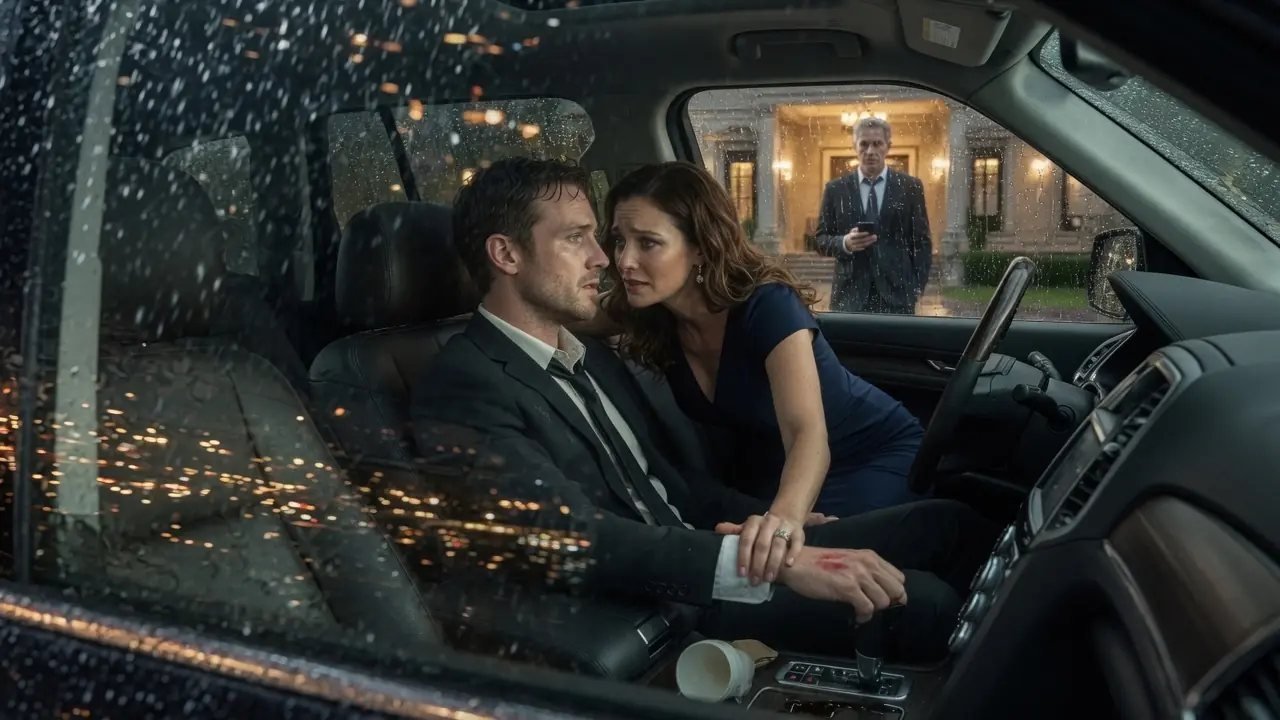
That was the moment the world seemed to narrow to rain, breath, and the heat of her fingers. Her wedding ring pressed cold against my sleeve. She was close enough that I could see where her makeup had softened near one eye. My hand stayed frozen on the steering wheel.
“I think about you more than I think about him,” she said. The words were quiet, but they filled the entire car. “Don’t,” I said. “Evelyn, please don’t.” But I did not pull away. I hated myself for that most of all.
She moved closer until her face was only inches from mine. “Tell me to go inside,” she whispered. “Tell me you don’t feel it.” I turned halfway toward her, and my silence answered before I could form words. Her fingers tightened on my wrist, and I saw the lipstick mark on my white cuff from when she had touched me earlier that evening.
Then her eyes shifted past me. Her face drained of color. I followed her gaze and saw Richard standing outside near the mansion entrance, partly shielded from the rain, his phone lowered in one hand. He was not shouting. He was not moving. He was simply looking through the wet window at his wife leaning over the console toward his driver.
For one second, nobody breathed. Richard’s face did not twist with rage the way I expected. It went still. Cold. Final. That was worse.
Evelyn pulled back first. “Richard,” she said, but the door was still closed and the rain swallowed her voice. I reached for the driver’s door handle and stepped out into the wet air because there was nowhere left to hide. Richard’s eyes moved from me to Evelyn and then to the lipstick mark on my cuff. He understood enough.
“Inside,” he said to her. One word. No shouting. No performance. Evelyn opened the rear door slowly and stepped out, her heels clicking against the wet stone. She looked at me once before walking toward the entrance, and in that look was fear, regret, and something worse than both: the realization that she had wanted the secret to stay beautiful, and discovery had made it ugly.
Richard waited until she disappeared through the front door. Then he turned to me. “How long?” The question was simple, but my mouth went dry. I could have lied. I could have said nothing happened, that he had misunderstood, that it was emotional and complicated and not what it looked like.
Instead, I said, “Too long.” His jaw tightened once. “Did you sleep with my wife?” The rain struck my shoulders and ran down the back of my collar. I looked at the ground because cowardice still had its claws in me. “Not tonight,” I said.
Richard laughed once, without humor. “That is the kind of answer guilty men give when they want credit for timing.” I deserved that. Every word. He stepped closer, not threatening, just close enough that I had to look at him. “I trusted you in my cars, in my company, and near my family.”
“I’m sorry,” I said. It was the smallest, most useless sentence in the world. Richard studied me for a long moment, and I could see him deciding whether I was worth more words. Finally, he said, “Return the vehicle to the garage. You are suspended effective immediately. Do not contact my wife.”
I nodded. There was nothing else to do. He walked inside without looking back, leaving me in the rain beside the SUV that had carried every secret to his front door. I drove away shaking, not because I had been caught, but because getting caught had ended the lie that I was still a decent man caught in a complicated situation. I had made choices. Richard had only witnessed the consequences.
The next morning, security escorted me into the office to collect my belongings. Nobody said much, but everyone knew enough to look away. My promotion document was gone from my desk, replaced by an envelope from human resources. Suspended pending investigation, breach of conduct, misuse of company vehicle, violation of trust. Every phrase sounded formal, but beneath them was the truth: I had destroyed my own future.
Evelyn called me seven times that day. I did not answer. She texted once: I never meant for him to see it that way. I stared at the message until anger finally rose through the guilt. That way? There was no better way for him to see betrayal.
I deleted the message, then blocked her number. It did not make me noble. It only made me late. I had already taken what did not belong to me, already accepted comfort from a married woman, already let my hunger for being seen turn me into someone willing to wound another man.
Richard’s lawyers contacted me two days later. I was terminated, not sued, though the company required the return of all devices and documents. I later learned Richard and Evelyn separated within a month. The news came through company gossip that reached me through an old colleague. People said she moved into a penthouse downtown and that Richard stayed in the mansion alone.
For weeks, I barely left my apartment except to search for work. Nobody in the executive transportation world wanted to hire a driver dismissed from Lawson Global under “confidential conduct concerns.” I took warehouse shifts, then night deliveries, then anything that paid enough to keep money going to my mother in Ohio. My fall was not dramatic from the outside. It was quieter than that.
That is how consequences usually arrive. Not as one explosion, but as a series of locked doors.
Months later, I saw Evelyn once by accident. It was outside a downtown hotel, where she stood beneath an awning wearing sunglasses though the sky was gray. She looked thinner, harder, and less untouchable than before. For one moment, I thought she might speak.
She did not. Neither did I. We stood on opposite sides of the sidewalk like two people who had survived a wreck they caused together and did not know what to do with the memory of impact. Then her car arrived, and she left.
I wish I could say the story made me wiser quickly. It did not. Shame is not wisdom by itself. It only becomes wisdom when you stop using pain as an excuse and start telling yourself the truth.
The truth was this: Evelyn was lonely, but she was married. I was struggling, but I was not helpless. Richard was distant, but that did not make him deserving of betrayal. Every excuse we used was just a softer name for selfishness.
A year later, I found steady work coordinating transportation for a hospital network. It paid less than Lawson Global would have, but it was honest. I drove less and managed more, helping patients get rides after appointments and making sure elderly people did not wait alone outside in bad weather. It was not glamorous, but it felt clean.
Sometimes, on rainy evenings, I still remember the SUV beneath the mansion lights. I remember Evelyn’s hand around my wrist, her wedding ring pressing against my sleeve, Richard’s silent face beyond the wet glass. Most of all, I remember the moment before discovery, when I still had one last chance to pull away and chose not to. People think betrayal happens when someone gets caught. That is not true.
Betrayal happens in the private second when you know what is right and move closer anyway.
That rainy night did change my life forever, but not in the way I once imagined. It did not lead to love, power, or rescue. It stripped away every lie I had used to make myself feel innocent. And when the storm finally passed, I was left with the one lesson I deserved to learn the hard way.
A secret can feel like comfort in the dark.
But when the lights come on, it only shows you who you became while hiding.