Bushwhackers had been through here. That much was plain from 30 yards out. Philippa Gauld pulled her wagon horse to a halt in the center of the back road and studied the churned dirt, the scattered cartridge casings catching the afternoon sun like copper teeth, and the still shape lying half in the drainage ditch along the eastern verge. Three horses had come in fast from the look of the tracks. They'd left in a hurry heading south.
Whatever they'd wanted from the man in the ditch, they'd taken or abandoned it. She sat a long moment on the wagon seat, the lines loose in her gloved hands, and she thought about driving on. She'd thought about worse things in the three years since Marshall Cassius Driskoll of Dust and Swords had put her in a jail cell for harboring a man he called a fugitive. The man had been her cousin, a 20-year-old boy named Pell Gauld who'd mouthed off to a deputy and run when the deputy drew on him. Driskoll had been within his legal rights or close enough that arguing hadn't helped her.
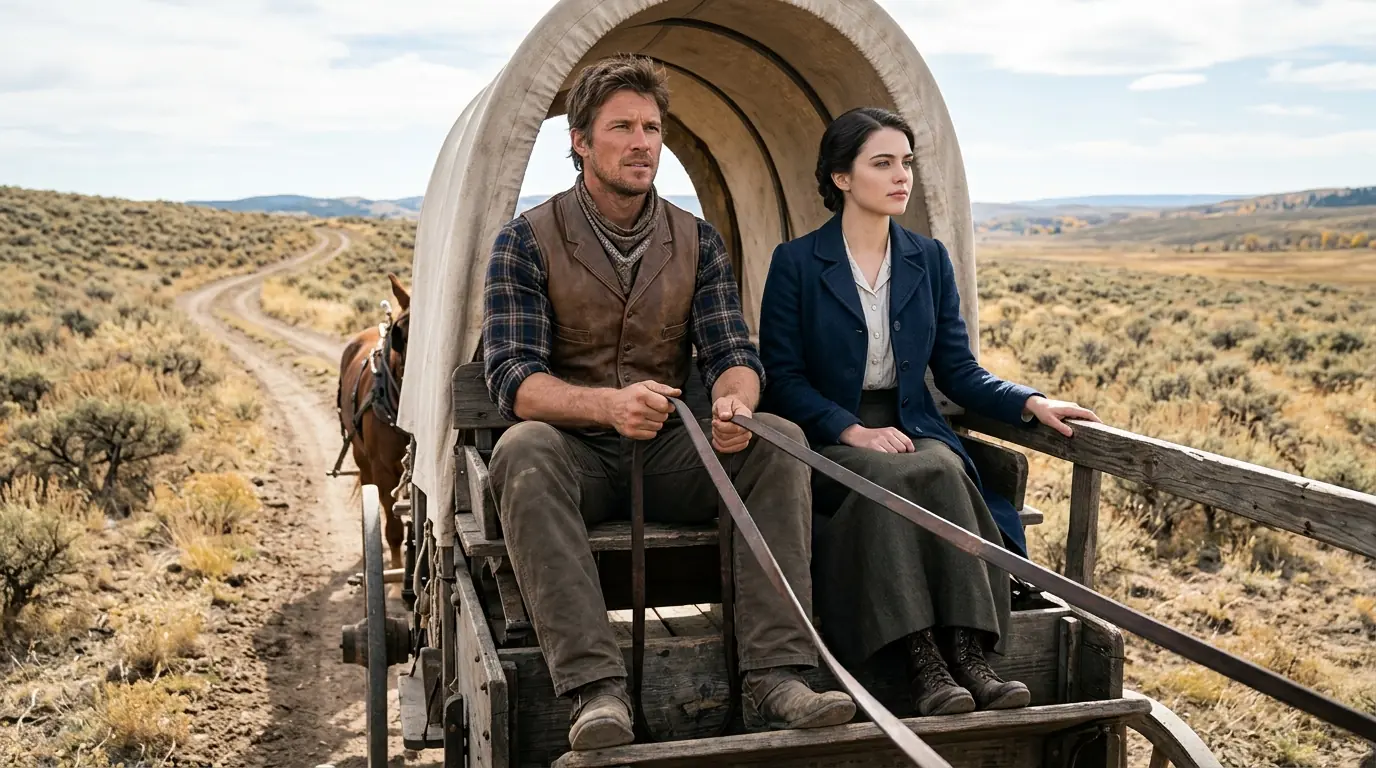
She'd spent four days in that cell, four days of tin cups and a single high window and the slow, clarifying burn of injustice, and come out with a different understanding of what the law protected and what it chose to look away from. But she'd also come out alive, which the man in the ditch might not be by nightfall if she drove on. She set the brake, tied the lines to the rail, and climbed down. Up close he was bad. Not as bad as she'd first feared.
His chest was rising, faint but present, but bad enough. He lay on his side in the muddy crease of the ditch, one arm stretched above him, his shirt dark across the left shoulder where something had grazed or caught him. She couldn't tell how deep without looking. His hat was gone. She could see his face clearly, the jaw she'd memorized with fury across a jail cell door, the hard planes of a man used to being obeyed.
He looked smaller now. He looked like what he was, a man badly hurt and left behind. "Driscoll," she said, not gently but clearly. He moved, a slight contraction of the hand above him, a slow blink. His eyes found her and she watched him try to place her, saw the exact moment it landed.
"Philippa Gaunt," he said. It came out rough and barely a voice. "The very same. " She crouched and opened her kit bag. "Can you tell me where else you're hurt? " He was quiet a moment, taking stock. "Left side, ribs.
One of them hit me with a rifle stock before they rode out and my head. " He stopped, uncertain how bad it was. She checked the back of his skull, a cut shallow, scalp wounds bled badly. This one had, not dangerous on its own. The ribs concerned her more. A cracked rib could be endured.
One that had shifted into something vital could not. She pressed carefully along his side through his shirt and he pulled a slow controlled breath. "Two, maybe three," she said. "Cracked, I think not broken through. I'll know more in the light. " "Your assessment or a doctor's? " "My grandmother was a midwife and bone setter," she said.
"You can wait for a doctor's if you prefer, but the nearest one is 6 miles. " "Your assessment will do," he said. "I need to move you to the wagon. That's going to hurt. " "I imagine it will. " "You're going to let me do it without fighting me. " A pause. "Yes, ma'am. " She hadn't expected the ma'am. She filed it away and got to work.
Getting him up and into the wagon bed took the better part of 20 minutes and left them both breathing hard. He didn't cry out, which she suspected cost him considerably. She'd wedged rolled canvas against the side of the wagon for him to brace against and had him lying as flat as the supply crates would allow, and she spread her second blanket over him and climbed back to the seat. The road to Dustin's Ford was 6 miles. She could make town by dark.
She made it in an hour and a half, keeping her pace slow over the rough stretches. In the wagon bed behind her, she could hear his breathing, labored but steady. She talked occasionally, not to comfort him, but because silence over 6 miles felt like something she ought to fill. She told him the road conditions ahead, where the ruts were bad, when she was slowing. Practical things, things he could follow without effort.
Once after a long silence, he said her name. "Still here," she said. "You could have left me. " "Yes," she agreed. He didn't say anything else for a mile. Then, "I'm aware I don't have a claim on your good conduct after what I did. " She watched the road.
"Is that an apology? " "It's a recognition. " "I'll allow that," she said. "We can talk more once Doc Haney's had a look at you. " Doc Haney's lamp was lit in his front window when she pulled up, and she called his name until he appeared at the door in his shirt sleeves with his glasses pushed up on his forehead. He took one look at the man in the wagon bed and the other at her face and said, "Bring him in. " They got Driscoll into the examination room, and Haney made her wait in the parlor. She sat in a horsehair chair with her coat still on and listened to the house settling and thought about the ditch road. She was still thinking about it when the parlor door opened and a woman came in young, well-dressed by Duston's Ford standards, with a look on her face that was difficult to read.
"You're the one who brought him in," the woman said. "I am. " "That's Cassius Driscoll in there. " She said it as though the name might mean something different to Philippa. "I know who it is," Philippa said. The woman absorbed that. "He arrested my brother 2 years ago.
Charges were eventually dropped. " "Then he let him go when the truth came out," Philippa said. "That's something, even if it isn't enough. " The woman was quiet, something shifting behind her eyes. She put out her hand. "Nan Colby. My brother tends bar at the Two Bells. " "Philippa Gault," she said, and shook it.
In the meantime, she discovered something she hadn't expected from a week in Duston's Ford. The town itself had an opinion about Cassius Driscoll, and it was more complicated than she'd allowed herself to assume from the outside. At the dry goods store, Mrs. Pembridge told her without preamble that Driscoll had sat with her husband through every difficult night of a hard illness the previous winter and never mentioned it to anyone. At the barbershop, she overheard two men agreeing that the marshal had been hard but fair, that the man who'd taken a swing at him and ended up in a cell last August hadn't had a friend in town afterward.
At the boarding house, Honey's daughter Cora said plainly, "He's not a comfortable man to disagree with, but he's straight. I'll give him that. " Philippa filed all of it in the careful way she filed things. She told herself she was simply learning the dimensions of a situation she'd stumbled into. She didn't know what she was building toward. Doc Haney came out at half past seven.
Two ribs cracked, not displaced. Her assessment had been right. The shoulder wound was a graze, messy but shallow. The head cut was what it was. Rest.
No riding for a week and lucky given the alternatives. "He'd like to speak with you," Haney said. Driscoll was propped on the examination table with the careful posture of a man protecting damaged ribs. His left shoulder bandaged, a strip of clean cloth around his head. He looked at her directly when she came in.