“I need to tell you something.”
That was how I destroyed my twenty-fifth anniversary.
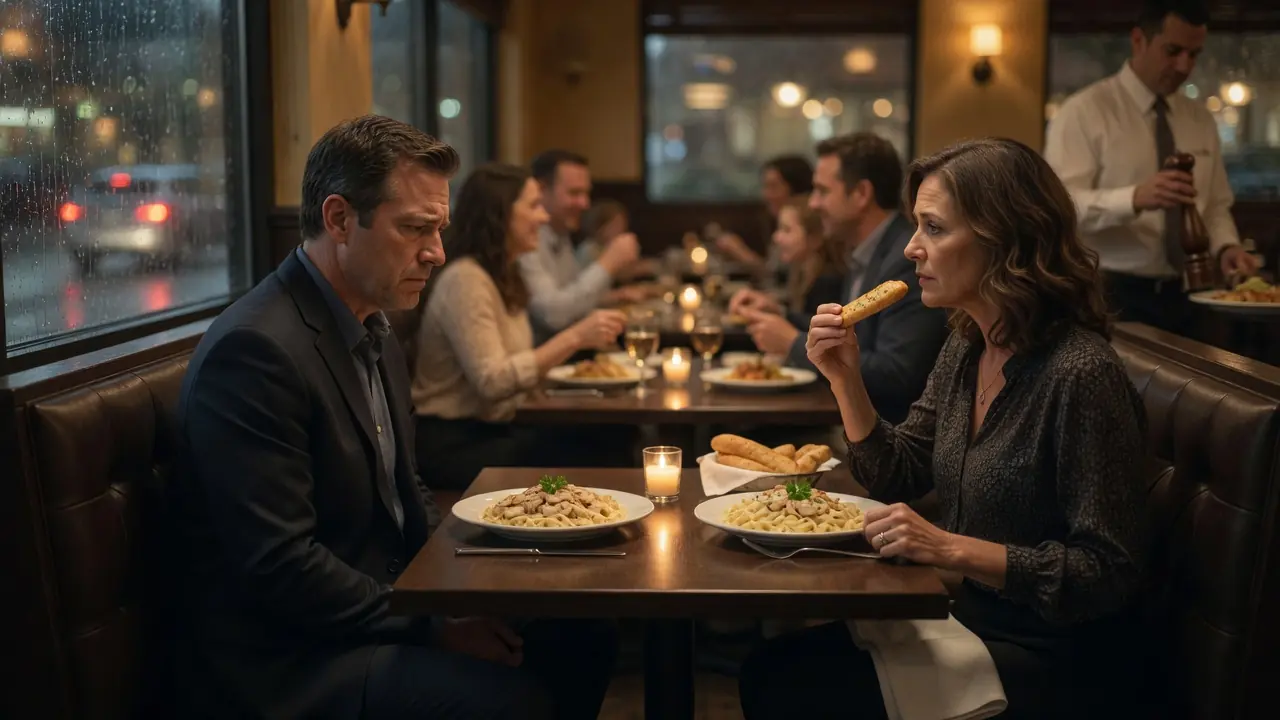
Carol and I were sitting in the corner booth at the Olive Garden off Route 9, the one she always requested because she said the lighting there was kinder. She had ordered chicken Alfredo, as she had nearly every time we’d eaten there since our boys were small, and she was holding a breadstick halfway to her mouth when I spoke.
She lowered it slowly.
“What happened?” she asked.
Her voice was calm, almost distracted, as if she expected me to say the dishwasher had broken again or that I had forgotten to renew the car insurance. That ordinary expression nearly stopped me.
I had rehearsed the confession in my car for three days. I had a beginning, an explanation, and several carefully arranged sentences that were supposed to make me sound remorseful without sounding pathetic.
The moment she looked into my eyes, every prepared word disappeared.
“In 2011, I had an affair.”
I said it flatly, like I was reading the total from a receipt.
Carol did not move.
“It lasted four months,” I continued. “I ended it.”
The restaurant kept functioning around us. A child laughed near the hostess stand. Plates clinked in the kitchen. At the table behind Carol, an elderly couple argued cheerfully about whether they needed dessert.
My wife placed the breadstick on her plate.
“Who?”
“Her name is Dana.”
Carol’s face revealed nothing.
“I met her through work. She was helping with the Carter account. We started talking, and then—”
“I know how affairs work, Paul.”
Her voice was quiet enough that no one nearby turned around.
I stopped.
Carol had always been better at silence than I was. For twenty-five years, whenever we argued, I filled every gap with explanations until the original subject disappeared beneath a pile of reasons.
That night, she left me nowhere to hide.
“Why now?” she asked.
That was the question I had feared most, because the honest answer made the confession even uglier.
I had not told her because guilt finally became unbearable. I had learned to live with guilt. I carried it through birthdays, Christmas mornings, graduations, and thousands of ordinary evenings without dropping it once.
I was telling her because Dana had called our house six days earlier.
“She has a daughter,” I said.
Carol’s eyes narrowed slightly.
“Twelve years old.”
The waiter arrived with a wooden pepper grinder.
“Fresh pepper?” he asked.
Neither of us answered immediately.
Carol looked up at him with perfect composure.
“No, thank you.”
He smiled and moved to the next table.
I stared at my plate.
“Dana says the girl might be mine.”
Carol leaned back against the booth.
Her face remained still, but one hand had closed around the cloth napkin in her lap.
“She says the girl has my birthmark.”
“What birthmark?”
“The one behind my left ear.”
Carol knew it well. She had touched it while cutting my hair during the months when salons were closed. It was small and reddish brown, shaped a little like a bent leaf.
“My father had the same one,” I added. “Dana says her daughter has it too.”
“How convenient.”
“She needs surgery.”
Carol’s expression changed for the first time.
“What kind?”
“Something involving her heart. A congenital defect they’ve been monitoring. Dana says the doctors want to repair it before it gets worse.”
“And Dana called you after twelve years because she suddenly remembered you might be the father?”
“She needs forty-seven thousand dollars.”
Carol looked toward the window.
Cars moved through the wet parking lot beneath the yellow glow of the restaurant sign.
“Did you ask for a paternity test?”
“Yes.”
“And?”
“She said there isn’t time to wait. The surgery is scheduled in three weeks.”
I heard how foolish that sounded as soon as I said it.
Carol reached for her purse.
“I’m sorry,” I whispered.
She stood.
I expected her to slap me, throw her water, or announce my betrayal loudly enough for the entire restaurant to hear. Instead, she put the strap over her shoulder and looked down at me with a calmness that frightened me more than rage.
“I knew about Dana.”
My mouth went dry.
“What?”
“Since 2012.”
The room seemed to shrink around us.
“How?”
Carol’s eyes held mine.
“I never confronted you because I had a secret too.”
A cold pressure formed behind my ribs.
She took a slow breath.
“In 2011, while you were downstairs at that hotel with Dana, I was upstairs with your brother.”
For several seconds, the sentence had no meaning.
I recognized each word individually, but my mind refused to assemble them.
“My brother?”
“Mark.”
“You’re lying.”
Carol gave me a tired look.
“You chose an interesting night to accuse me of dishonesty.”
Mark had been my best man. He had held my shoulders in the funeral-home parking lot after our father died. He had coached our sons’ baseball teams, helped repair our roof, and carried Carol’s mother’s coffin with me.
He was the person I called when life became too heavy to carry alone.
“How long?” I asked.
“It doesn’t matter anymore.”
“It matters to me.”
Carol’s mouth tightened.
“That is almost funny.”
She walked toward the exit.
I left enough cash on the table to cover the meal and followed her into the parking lot.
The anniversary dinner remained untouched behind us.
Outside, the air smelled of rain and hot pavement. Carol stood beside our silver Honda with the keys in her hand, and for one desperate moment, I thought she would drive away and leave me there.
Instead, she unlocked the passenger door.
“Get in. We are not doing this in front of strangers.”
The twenty-one-minute drive home felt longer than the twenty-five years that had brought us to it.
Carol kept both hands on the steering wheel. Streetlights moved across her face, illuminating her in brief, disconnected pieces.
I waited for her to yell.
She did not.
“Was it really Mark?” I finally asked.
“Yes.”
The word was clean as a knife.
“How long?”
She kept her eyes on the road.
“Long enough to destroy something in me. Short enough for both of us to pretend it had never happened.”
“Once?”
“Why does the number matter?”
“Because he’s my brother.”
“And you were my husband.”
The answer left me with nowhere to stand.
When we reached home, the porch light was on. Our sons had long since moved out, and the house looked exactly as it had when we left—quiet, warm, and built around a history neither of us understood anymore.
Carol went directly to the kitchen.
She opened the cabinet above the refrigerator and pulled down an old shoebox I had not seen in years. Dust marked the lid.
She placed it on the table and opened it.
Inside were hotel receipts, printed emails, and a photograph of Dana and me walking from a conference center. My hand was resting against the small of her back.
I remembered that moment.
I had told myself the gesture meant nothing.
Beneath the photograph was another picture.
Carol stood in a hotel hallway beside Mark. His hand rested on her shoulder, and her eyes were swollen from crying.
I looked up.
“I followed you.”
The refrigerator hummed behind us.
“You had been distant for weeks,” she continued. “You started carrying your phone into the shower. You bought shirts you never wore around me. You suddenly had evening meetings twice a week.”
I sat down.
“You followed me to the hotel?”
“Yes.”
“Why didn’t you confront me?”
“I planned to.”
She picked up the photograph of Dana and me.
“I saw you in the lobby. You touched her face.”
Her voice cracked.
“The way you used to touch mine.”
I closed my eyes.
“I went upstairs because I couldn’t breathe. I sat beside the vending machines crying like an idiot. Then the elevator opened, and Mark stepped out.”
“What was he doing there?”
“A real estate conference.”
I remembered Mark mentioning a conference that week. I had barely listened because I was inventing explanations for my own absence.
“He saw me,” Carol said. “He knew immediately.”
“And then you slept with him?”
Her eyes flashed.
“He held me while I was falling apart.”
“That doesn’t answer the question.”
“No, Paul. Not immediately.”
I hated the relief I felt.
It lasted less than a second.
“He took me to his room because I didn’t want to walk through the lobby again. We talked for hours. He told me he had suspected something between you and Dana.”
“How?”
“He saw you together weeks earlier.”
“He never said anything to me.”
“He tried.”
Carol removed a folded envelope from the shoebox.
My name was written across the front in Mark’s handwriting.
“He wrote you this. You never opened it.”
“I never saw it.”
“He told me he put it in your desk at work.”
I unfolded the letter.
Paul,
I saw you with the woman from Carter Medical. I hope I misunderstood what I saw, but if I didn’t, end it before you destroy your family. Carol trusts you. Your boys worship you. Whatever this is, it is not worth what it will cost.
Mark
The date was three weeks before Carol followed me to the hotel.
I stared at the page.
“How did you get this?”
“Mark kept a copy.”
“Of course he did.”
“Don’t do that.”
“Do what?”
“Turn him into the villain because it hurts less than looking at yourself.”
Anger rose in me despite my shame.
“He slept with his brother’s wife.”
“And you slept with someone while your wife was upstairs crying.”
“I know what I did.”
“Do you?”
I placed the letter on the table.
“What happened in the room?”
Carol sat across from me.
“I told him I wanted to leave you. He said I shouldn’t make a permanent decision while I was in shock. He brought me water. He sat on the floor while I cried.”
She looked down.
“Then I kissed him.”
“Did he stop you?”
“At first.”
“At first.”
“He said we would regret it.”
“He was right.”
“Yes.”
“But he did it anyway.”
“So did I.”
“How many times?”
Carol’s face hardened.
“Three.”
I stood so quickly that the chair fell backward.
“Three times?”
“Over two months.”
“You said it was short.”
“It was.”
“You kept seeing him.”
“Yes.”
“While coming home to me.”
Her eyes filled with tears.
“Now you understand.”
I wanted to call Mark. I wanted to drive to his house, drag him into the yard, and hit him until twenty-five years of brotherhood no longer existed.
Every time the anger gathered, another image stopped me.
Dana laughing in the hotel bed.
Carol crying beside a vending machine.
My own hand touching another woman’s face.
“You knew about Dana for fourteen years,” I said.
“Yes.”
“Why stay?”
“Our sons were eight and eleven. Your mother had cancer. I had been out of the workforce for almost a decade.”
“You could have told me.”
“And said what? That I had followed you, discovered your affair, and responded by sleeping with your brother?”
“Yes.”
She laughed bitterly.
“I hated myself too much.”
I stared at the contents of the shoebox.
“You let me believe we were happy.”
“We had happy moments.”
“That is not the same thing.”
“No.”
“Every Christmas, every vacation, every anniversary—”
“Were real.”
“Built on lies.”
“So was tonight before you started talking.”
My phone vibrated on the table.
Dana’s name appeared on the screen.
Carol looked at it.
“Answer.”
“I’ll call her later.”
“Put it on speaker.”
“Carol.”
“Answer the phone.”
I accepted the call and activated the speaker.
“Hello?”
Dana sounded breathless.
“Did you tell her?”
I looked at Carol.
“Yes.”
Silence filled the line.
Then Dana whispered, “Good.”
Carol leaned closer.
“Why is that good?”
Dana inhaled sharply.
“Is that Carol?”
“Yes.”
“I’m sorry.”
“No, you aren’t.”
“I am now.”
Carol’s mouth tightened.
“What else haven’t you told him?”
Dana began crying.
“The girl wants to meet her father before the surgery.”
My stomach twisted.
“I told you I’m willing to meet her after a paternity test.”
“There may not be time.”
“The surgery is in three weeks.”
“It was moved.”
“To when?”
“Friday morning.”
Four days away.
“Why?”
“Her condition got worse. She fainted at school, and the cardiologist found increased pressure.”
I gripped the edge of the table.
“Where is she?”
“At Saint Matthew’s Children’s Hospital.”
Carol remained very still.
Dana continued.
“There’s something else.”
“Of course there is,” Carol said.
Dana’s crying became louder.
“Mark already met her.”
The room went silent.
I thought I had misheard.
“My brother?”
“Yes.”
“When?”
“Six months ago.”
I looked at Carol.
She appeared as shocked as I was.
“Why would you contact Mark?” I asked.
“I didn’t.”
“Then how did he know about her?”
“He found me.”
“How?”
“He said he had been looking for me since 2012.”
Carol’s hand closed around the table.
“Why?”
Dana hesitated.
“Because he knew I was pregnant.”
The air left my lungs.
“How could he know?”
“He came to my apartment after you ended things.”
“Why?”
“He wanted to make sure I stayed away from your family.”
I could picture Mark doing it. Calm, reasonable Mark arriving to clean up the disaster his younger brother had created.
“What happened?” Carol asked.
Dana went quiet.
“Dana,” I said. “What happened between you and Mark?”
“We talked.”
“That is not an answer.”
“I was angry. You had ended everything and gone back to your life. He acted like I was some dangerous person threatening his family.”
“What did he do?”
“He offered me money.”
“To leave town?”
“To sign an agreement saying I would never contact you.”
“Did you sign it?”
“No.”
“Why not?”
“Because I didn’t know yet whether I was pregnant.”
My vision narrowed.
“And Mark knew?”
“Yes.”
“Did he tell you to terminate it?”
“He said it would solve everything.”
Carol covered her mouth.
“I told him to get out,” Dana continued. “He came back the next night to apologize.”
A terrible possibility entered my mind.
My father had the birthmark.
I had it.
Mark had one too.
Not behind his ear.
On the left side of his neck, partly hidden beneath his collar. As boys, we had joked that Dad marked us like cattle.
“Dana,” I said slowly, “did you sleep with Mark?”
She did not answer.
Carol looked at me.
The truth entered the kitchen before Dana found the courage to speak.
“Once,” she whispered.
My entire body went cold.
“When?”
“About two weeks after you ended things.”
“You told me the girl might be mine.”
“She might.”
“You slept with both of us within the same month.”
“Yes.”
Carol stood and walked away from the table.
I pressed my fingers against my forehead.
“Why did Mark meet her?”
“He saw a photograph online. He noticed the birthmark.”
“Does he know she may be his?”
“Yes.”
“Did he take a test?”
“No.”
“Why not?”
“He refused.”
“Then why meet her?”
Dana’s voice broke.
“Because I told him she was sick.”
“And what did he say?”
“That knowing the truth would destroy too many people.”
I looked toward Carol.
She stood beside the sink with her back to me.
“Did he give you money?” she asked.
“Yes.”
“How much?”
“Thirty thousand over six months.”
“For the surgery?”
“For tests, appointments, and insurance deductibles.”
“Where is the money now?” I asked.
“Gone.”
“On medical care?”
“Most of it.”
“Most?”
Dana began speaking quickly.
“I missed work. I was behind on rent. I had to replace my car because I couldn’t keep driving Hannah to the hospital in something that broke down every month.”
“Hannah,” I repeated.
My possible daughter had a name.
“She knows about us?” I asked.
“She knows there are two possible fathers.”
Carol turned.
“You told a twelve-year-old that?”
“She found the messages on my phone.”
“Does she know their names?”
“Yes.”
I closed my eyes.
“What did Mark tell her when they met?”
“That he was an old friend.”
“Did she believe him?”
“No.”
“Where is he now?”
“I don’t know. He stopped answering me yesterday.”
I ended the call and dialed my brother.
He rejected the first call.
The second rang until voicemail.
On the third, he answered.
“Paul.”
His voice sounded tired.
“Come to my house.”
“Not tonight.”
“Carol told me.”
Silence.
“All of it?” he asked.
“She told me about you and her. Dana told me about you and Hannah.”
He exhaled slowly.
“I can explain.”
“Come here and try.”
“I’m in New Jersey.”
“You live fifteen minutes away.”
“I left this afternoon.”
“For what?”
“Work.”
“Send me your location.”
“No.”
“Is Hannah your daughter?”
“I don’t know.”
“Did you sleep with Dana?”
“Yes.”
Carol closed her eyes.
“Did you meet the girl?”
“Yes.”
“Why didn’t you tell me?”
Mark’s voice hardened.
“Because look at what happened the moment the truth came out.”
“You knew about my affair and slept with both women involved.”
“I didn’t plan either situation.”
“You keep falling into beds accidentally?”
“That is rich coming from you.”
“I told my wife.”
“Fourteen years late.”
“You never intended to tell anyone.”
“No. I intended to protect our families.”
“By paying Dana?”
“By keeping her from blowing up everyone’s lives.”
“She has a sick child.”
“I know.”
“She might be yours.”
“I know.”
“Or mine.”
“I know, Paul.”
“Then come back.”
“I can’t.”
“Why?”
A long pause followed.
“I’m not in New Jersey for work.”
“Where are you?”
“I’m at Saint Matthew’s.”
My chest tightened.
“What are you doing there?”
“Hannah was admitted an hour ago.”
Dana had not told us.
“Is she all right?”
“No.”
The word stripped away everything else.
“She collapsed at home,” Mark continued. “Her heart rhythm became unstable. They’re preparing for emergency surgery tonight.”
“Why did Dana call me instead of going with her?”
“She’s here.”
“Then why did she say you disappeared?”
“Because I told her not to contact you.”
I nearly crushed the phone in my hand.
“You had no right.”
“I was trying to manage the situation.”
“Stop managing my life.”
Carol took her coat from the hook.
“We’re going to the hospital.”
I stared at her.
“You don’t have to.”
“Yes, I do.”
“Why?”
“Because there is a twelve-year-old girl waiting to find out which one of you cowards is her father.”
She walked toward the door.
I told Mark we were coming.
The hospital was an hour away.
Carol drove because my hands would not stop shaking.
Neither of us spoke for the first twenty minutes.
Then she said, “Did you love Dana?”
“No.”
“Did you tell her that?”
“I told her I cared about her.”
“That isn’t what I asked.”
“No.”
The windshield wipers swept rain from the glass.
“Did you ever plan to leave me?”
“No.”
“That does not make it better.”
“I know.”
“Stop saying that.”
“What do you want me to say?”
“I don’t know.”
Her voice broke.
“I have spent fourteen years imagining this conversation. In every version, you begged, I screamed, and somehow I finally felt free.”
“And now?”
“I feel tired.”
I looked at her profile.
“Did you love Mark?”
Carol tightened her grip on the wheel.
“No.”
“Are you sure?”
“I loved that he saw what you had done and believed my pain was real.”
“That isn’t the same as loving him.”
“No.”
“Did he love you?”
“He said he did.”
My stomach turned.
“When?”
“The last time we were together.”
“What did you say?”
“That it had to end.”
“Because of me?”
“Because I looked at him and realized we were turning your betrayal into permission for our own.”
The honesty hurt.
“Did he want you to leave me?”
“Yes.”
“Why didn’t you?”
“Our sons.”
“Only them?”
She took a long breath.
“No.”
I waited.
“I still loved you.”
The words should have comforted me.
They did not.
They made the years of silence seem sadder.
When we reached Saint Matthew’s, Mark stood in the surgical waiting room wearing the same blue shirt he had worn to work that morning. His collar was open, exposing the birthmark on his neck.
I had never hated that mark before.
Dana sat several chairs away, crying into both hands.
She looked older than I remembered. Gray threaded through her dark hair, and exhaustion had hollowed her face.
Mark stood when he saw us.
Carol stopped beside me.
For several seconds, the four of us stared at one another beneath the fluorescent lights.
Four adults connected by an old series of selfish decisions.
Dana approached first.
“I’m sorry.”
Carol raised one hand.
“Please stop saying that unless you plan to explain what it means.”
Dana stopped.
A nurse opened the doors and called for Hannah’s parents.
All three of us moved.
The nurse looked confused.
“Which of you is her legal guardian?”
“I am,” Dana said.
“We need a family medical history before surgery. The cardiologist found an additional structural abnormality that may have a genetic component.”
Mark and I exchanged a look.
Dana explained the paternity uncertainty.
The nurse’s professional expression held, but only barely.
“Both potential fathers need to provide blood samples immediately. The genetic lab can perform rapid relationship testing alongside the cardiac screening.”
“How long?” I asked.
“Several hours.”
“Will the surgery wait?”
“No. The results may help guide follow-up treatment, but the surgical team needs to proceed now.”
“Can we see her?” Mark asked.
The nurse looked at Dana.
She nodded.
Hannah lay in a preoperative room surrounded by monitors.
She was small for twelve, with pale skin and dark hair tied loosely behind her head. A reddish-brown mark curved behind her left ear.
My mark.
Mark’s mark.
Our father’s mark.
Her eyes moved from me to Mark.
“So you both came.”
Her voice was weak but direct.
Neither of us knew what to say.
“I’m Paul,” I finally managed.
“I know.”
She looked at Mark.
“And you’re Mark.”
He nodded.
Dana stood near the wall.
Hannah’s eyes settled on Carol.
“Who are you?”
“My name is Carol.”
“Are you his wife?”
“Yes.”
The girl studied her.
“I’m sorry.”
Carol’s face crumpled.
“No, sweetheart. None of this is your fault.”
Hannah looked toward the ceiling.
“My mom says that too.”
“Your mother is right about that.”
“Are your kids mad?”
Carol glanced at me.
“They don’t know yet.”
“I don’t want to ruin another family.”
I stepped closer to the bed.
“You didn’t ruin anything.”
Hannah looked at me with unsettling intelligence.
“Somebody did.”
No one answered.
A surgical technician entered and said it was time.
Dana kissed her daughter’s forehead.
Mark touched her hand.
When my turn came, I hesitated.
Hannah extended her fingers toward me.
I held them.
“Will you be here when I wake up?” she asked.
My throat closed.
“Yes.”
“You promise?”
“Yes.”
She looked at Mark.
“You too?”
He nodded.
“I promise.”
The team rolled her away.
The four of us returned to the waiting room.
A phlebotomist collected blood from Mark and me. Then we waited.
Hours passed.
Dana paced.
Carol sat apart from us reading the same page of a magazine over and over.
Mark stared at the operating-room status board.
At midnight, our older son, Jason, called Carol.
She walked into the hallway to answer.
When she returned, her face was pale.
“What happened?” I asked.
“He saw our car location on the family app. He asked why we were at a children’s hospital.”
“What did you tell him?”
“The truth.”
“All of it?”
“Enough.”
My phone rang immediately.
Jason’s name appeared.
I answered.
“You have another daughter?”
His voice shook with rage.
“I don’t know yet.”
“You cheated on Mom.”
“Yes.”
“And Uncle Mark did too?”
I looked toward my brother.
“That is more complicated.”
“Mom said he slept with her.”
Dana stopped pacing.
Mark lowered his head.
“Jason, this is not a conversation for the phone.”
“You’ve had fourteen years to plan the conversation.”
The sentence sounded like Carol.
“Where is Tyler?” I asked.
“I told him.”
Our younger son was twenty-two and finishing graduate school two states away.
“What did he say?”
“He doesn’t want to talk to either of you.”
“Either?”
“You or Uncle Mark.”
Jason ended the call.
Mark rubbed both hands over his face.
“My daughter is going to hear too.”
“You should tell her before someone else does,” Carol said.
Mark looked at her.
His expression contained the remains of something intimate.
I saw it.
So did Dana.
“Do you still love her?” Dana asked him.
Mark’s head snapped toward her.
“What?”
“Carol.”
“No.”
“You kept her photograph.”
Carol went still.
“What photograph?” I asked.
Dana seemed to regret speaking.
“When Mark visited me, he had an old picture in his wallet. Carol and the boys at a lake.”
I looked at my brother.
“Why?”
Mark stood.
“I forgot it was there.”
“For fourteen years?”
“It was a family photograph.”
“Of my family.”
“You’re my family too.”
“Do not say that.”
My voice rose enough that a nurse glanced toward us.
Mark stepped closer.
“You want to hit me?”
“Yes.”
“Go ahead.”
“Stop,” Carol said.
Neither of us moved.
She stood between us.
“If you turn this waiting room into a fight, Hannah will wake up to proof that none of you learned anything.”
The surgery lasted nearly five hours.
At three in the morning, the surgeon entered.
We rose together.
“The repair was successful,” she said.
Dana began sobbing.
The surgeon continued.
“Hannah’s heart function is stable. The next twenty-four hours remain important, but the procedure went as well as we could have hoped.”
I closed my eyes.
Carol touched my arm.
The gesture was automatic. Familiar.
Then she seemed to remember everything and withdrew her hand.
“The genetic lab also completed the relationship analysis,” the surgeon said.
The room became silent.
She looked at Dana.
“Would you prefer to receive that information privately?”
Hannah’s mother shook her head.
“No more secrets.”
The surgeon opened the file.
“Mr. Mark Collins is not Hannah’s biological father.”
Mark exhaled.
Relief and disappointment crossed his face at the same time.
The surgeon turned toward me.
“Mr. Paul Collins is also not her biological father.”
For several seconds, no one reacted.
Dana stared at the doctor.
“That’s impossible.”
“The testing excludes both men.”
“But the birthmark—”
“It appears to be coincidental or inherited through another branch of her family.”
“No,” Dana whispered.
“I was not with anyone else.”
The surgeon looked uncomfortable.
“Genetic testing is conclusive regarding these two individuals.”
Mark sat down heavily.
I stared at Dana.
“Who else was there?”
“No one.”
“Think.”
“I know who I slept with.”
Carol watched Dana’s face.
Then something changed in her expression.
“What about their father?” she asked.
Dana looked confused.
“Whose father?”
“Paul and Mark’s.”
My skin went cold.
“Our father died in 2009.”
Dana’s face emptied.
“No.”
I stepped toward her.
“Did you know our father?”
She shook her head too quickly.
“Dana.”
“I met an older man once.”
“When?”
“Before you.”
My legs felt weak.
“His name?”
“He called himself Jack.”
Our father’s name had been John Collins.
Friends called him Jack.
Dana covered her mouth.
“It was one night. At a hotel bar. Months before I met you.”
“How many months?”
“Eight or nine.”
“That wouldn’t match Hannah’s age.”
“No.”
She began breathing rapidly.
“Unless the dates are wrong.”
Mark stood.
“What does that mean?”
Dana pressed both hands against her temples.
“I changed her birth year on the first records.”
The room seemed to tilt.
“Why?” Carol asked.
“My divorce.”
“What divorce?” I demanded.
“I was still legally married when she was born. My husband was violent. If he knew she might not be his, he would have used it to take her or hurt us.”
“How old is Hannah?” Mark asked.
“Thirteen.”
I stared through the glass doors leading toward intensive care.
Our father had died fourteen years earlier.
He had traveled constantly for sales work.
The affair Dana had with me began less than two years after his death.
“Did he know you were pregnant?” I asked.
“No.”
“Are you sure?”
“He gave me a fake number. I never saw him again.”
Carol sank into a chair.
Mark looked physically ill.
The girl we had both feared was our daughter was likely our half sister.
Our father’s daughter.
Jason and Tyler’s aunt.
The truth was so absurd that laughter tried to rise inside me, but it became something closer to a sob.
“We need another test,” Mark said.
Dana nodded numbly.
The hospital arranged a comparison using stored DNA from a genealogy account Mark had created years earlier. He had submitted a sample while researching our family tree.
The result came the following afternoon.
Hannah was our half sister.
Our father’s child.
The birthmark had told the truth.
We had simply asked the wrong question.
Hannah woke late that evening.
Dana told her carefully.
Mark and I stood near the window.
Hannah listened without interrupting.
“So neither of you is my dad.”
“No,” I said.
“You’re my brothers.”
“Yes.”
She looked between us.
“That’s weird.”
Despite everything, Mark laughed.
Hannah smiled weakly.
“Is my real father dead?”
“Yes.”
“Was he a good person?”
The question silenced us.
Our father had been generous, funny, and proud of his sons. He had taught us to fish, attended every school concert, and remained married to our mother until his death.
He had also lied.
At least once.
Perhaps more.
“We loved him,” I said.
“That isn’t what I asked.”
Carol’s eyes filled.
Hannah had a talent for asking the questions adults spent their lives avoiding.
“I don’t know how good he was,” I admitted. “I know he did some good things and some harmful things.”
“Did he know about me?”
“We don’t think so.”
“Would he have wanted me?”
I looked toward Mark.
He had no answer.
Carol stepped closer to the bed.
“You deserved to be wanted whether he was capable of it or not.”
Hannah nodded slowly.
“Will you both still visit?”
Mark answered first.
“Yes.”
I took her hand.
“If you want us to.”
“I do.”
She looked toward Carol.
“You too?”
Carol hesitated.
Then she said, “Yes.”
The weeks following Hannah’s surgery dismantled every remaining illusion in our family.
Jason refused to speak to me for nearly a month.
Tyler sent one message.
You and Mom lied to us our whole lives. Uncle Mark lied too. I need space from all of you.
Mark’s wife, Diane, learned about Carol and Dana on the same afternoon.
She threw Mark out.
His daughter, Emily, called me crying because her father would not explain why he was living at a hotel.
I told Mark he had twenty-four hours to speak to her before I did.
“You don’t get to threaten me,” he said.
“I’m giving you the courtesy we never gave anyone else.”
He told her.
Diane filed for separation.
Carol moved into our guest room.
We lived together like two careful strangers sharing the scene of an accident.
Some evenings, we spoke about practical matters. Other nights, we sat at opposite ends of the kitchen table and excavated the past.
“Were you ever going to tell me?” I asked once.
“No.”
Her honesty still hurt.
“Would you have told me if Dana hadn’t called?”
“No.”
“Then we would have died married and ignorant.”
“Yes.”
“Does that make you sad?”
Carol thought for a long time.
“It makes me wonder whether peace built on silence is really peace.”
I looked around the kitchen where we had raised our sons.
“We had good years.”
“Yes.”
“Do they count?”
“Yes.”
“Then what are we now?”
“I don’t know.”
We began marriage counseling.
Our therapist, Dr. Elaine Foster, refused to let either of us use the other person’s affair as a shield.
“Paul, you repeatedly say Carol’s relationship with Mark happened because of your betrayal,” she told me.
“It did.”
“It influenced it. It did not make the decision for her.”
Carol looked down.
Dr. Foster turned to her.
“And you describe Paul’s affair as the moment the marriage broke. Yet you remained silent and helped preserve a false version of the relationship for fourteen years.”
“I was protecting our children.”
“Partly.”
Carol’s jaw tightened.
“What else?”
“You were protecting yourself from accountability.”
The room became silent.
Dr. Foster asked us a question neither of us could answer.
“Do you want to save the marriage, or do you want to avoid being the person who ends it?”
Those were different things.
For twenty-five years, Carol and I had understood marriage as endurance.
Stay through financial stress.
Stay through illness.
Stay through grief.
Stay for the children.
We had never asked whether staying required honesty.
Hannah recovered slowly.
Mark and I visited every Sunday, though rarely together at first. She enjoyed watching us struggle to explain the family connections.
“So your sons are my nephews, even though they’re older than me?”
“Yes,” I said.
“And Carol is nothing to me.”
“Technically.”
Hannah looked at her.
“You feel like something.”
Carol smiled sadly.
“Families are sometimes larger than the words available.”
Dana remained guarded around us.
She had spent thirteen years surviving alone, and she did not trust our sudden sense of responsibility.
One afternoon, I offered to pay the remaining surgery debt.
She shook her head.
“You don’t owe it.”
“Hannah is my sister.”
“You didn’t know that when you came.”
“No.”
“If she had belonged to someone else, would you still care?”
The question embarrassed me.
“I don’t know.”
“That’s the problem.”
“What do you want me to say?”
“The truth is enough.”
“I want to help now.”
Dana studied me.
“Then help without using money to make yourself feel like a good man.”
I eventually paid part of the medical debt through a formal family agreement. Mark paid the rest.
Neither payment purchased forgiveness.
Our sons met Hannah three months after surgery.
Jason came reluctantly. Tyler flew home but stayed in a hotel.
Hannah sat between them at a diner, looking delighted by the absurdity of being their teenage aunt.
“So do I give you advice?” she asked.
Jason stared at her.
“You’re thirteen.”
“I’m still your aunt.”
Tyler laughed for the first time since learning the truth.
The laughter did not heal everything.
It opened a small door.
After lunch, Jason asked to speak with me alone.
We stood beside my car.
“Mom told me why she slept with Uncle Mark.”
I looked down.
“She shouldn’t have involved you in details.”
“I asked.”
“What do you think?”
“I think all three of you acted like being hurt gave you permission to hurt someone else.”
His words sounded painfully adult.
“You’re right.”
“I used to think you and Mom were the stable couple.”
“We wanted you to think that.”
“Why?”
“Because we believed the appearance of safety would protect you.”
“It made finding out worse.”
“I know.”
Jason crossed his arms.
“Are you staying together?”
“We haven’t decided.”
“You should divorce.”
The certainty surprised me.
“Why?”
“Because every time I see you together now, I wonder which part is another performance.”
I absorbed the words.
“Your mother and I have to make that decision.”
“I know.”
He walked away.
Six months after the Olive Garden confession, Carol and I returned to the same restaurant.
Not for dinner.
We sat in the corner booth during a quiet afternoon and ordered coffee.
The manager recognized us and asked whether we wanted the anniversary special.
Carol almost laughed.
“No, thank you.”
When we were alone, she placed two folders on the table.
One contained divorce papers.
The other contained a written plan for a one-year separation with continued counseling.
“Which do you want?” I asked.
“I don’t know.”
“Neither do I.”
She looked toward the seat where she had held the breadstick halfway to her mouth.
“I loved you before all this.”
“I loved you too.”
“I think part of me still does.”
“Same.”
“Is that enough?”
“No.”
The answer surprised us both.
Carol nodded.
“No, it isn’t.”
Love had kept us in the same house.
Fear, shame, children, money, and habit had done the rest.
She touched the divorce folder.
“I don’t want to spend the next twenty-five years punishing you.”
“I don’t want to punish you either.”
“But I also don’t know how to trust you.”
“I don’t know how to trust you.”
She smiled sadly.
“At least we finally agree.”
We chose the separation.
Not because we were certain reconciliation was possible.
Because for the first time, we wanted to make a decision without panic controlling it.
Carol moved into a small apartment near her sister.
I remained in the house.
The silence felt different after she left. It was not the old silence filled with secrets.
It was the silence of consequences.
Mark returned from his hotel to an empty house after Diane moved into a rental with their daughter. He and I stopped speaking except about Hannah.
Our old brotherhood could not survive what we had done to each other.
Perhaps a different relationship could emerge eventually.
It would not be the one from before.
One Sunday, while sitting beside Hannah at a park, she asked why Mark and I barely spoke.
“We hurt each other.”
“How?”
“In ways you don’t need to carry.”
She considered that.
“Adults always say that when they don’t want kids knowing they’re messy.”
I smiled despite myself.
“That is sometimes true.”
“Are you mad at him because he might have been my dad?”
“Partly.”
“But he isn’t.”
“Knowing the result does not erase what we did while uncertain.”
She kicked at the grass.
“Mom lied about my age.”
“Yes.”
“Are you mad at her?”
“Yes.”
“Do you still like her?”
“Yes.”
“That’s confusing.”
“It remains confusing when you’re old.”
She looked at me.
“Do you think Grandpa would have liked me?”
I thought about our father teaching Mark and me to skip rocks, repairing bicycles in the garage, and lying to our mother about at least one night in a hotel bar.
“I think he would have loved your questions.”
“That isn’t the same as liking me.”
“No.”
I took a breath.
“I think he would have liked you very much.”
Hannah smiled.
A year after the confession, Carol and I met again at Olive Garden.
This time, the corner booth was occupied, so we sat near the window.
She ordered soup.
I ordered nothing until she told me I was making the waiter nervous.
Our separation had changed both of us.
Carol found part-time work at a library and began handling her own finances for the first time in decades. She had also confronted Mark without me present.
“What did you say to him?” I asked.
“That what happened between us was not love.”
“How did he respond?”
“He said he knew.”
“Did that help?”
“No.”
I had spent the year attending therapy, rebuilding my relationship with our sons, and learning that apologies offered repeatedly can become demands.
Jason did not owe me immediate closeness.
Tyler did not owe me an answer every time I called.
Carol did not owe me reassurance because guilt felt uncomfortable.
“What do you want?” I asked her.
She looked through the window.
“I want to stop living as though one wrong decision means every decision afterward belongs to it.”
“What does that mean for us?”
“I don’t know.”
I waited.
She turned back.
“Do you want to come home?”
The question nearly stopped my heart.
“Yes.”
“That was too fast.”
“Yes.”
“What would be different?”
“No secret phones. No unexplained money. No using the boys as reasons to stay. No treating forgiveness as something either of us can demand.”
“And Mark?”
“He is my brother, but he will never again be part of our marriage.”
“Dana?”
“She is Hannah’s mother. I will remain connected to her, but only openly.”
Carol nodded.
“And if we fail?”
“Then we end it honestly.”
She reached across the table.
Her hand stopped halfway.
I placed mine near it without touching.
She closed the final distance.
Returning home did not create a happy ending.
It created work.
There were nights when Carol dreamed about the hotel and woke furious with me. There were moments when Mark’s name appeared on my phone and I felt the old rage return.
Sometimes one of us asked a question the other had already answered ten times.
We answered again.
Trust did not return as a feeling.
It returned through repeated evidence.
Where are you?
Who called?
Why did you spend this?
What are you afraid to tell me?
The questions were not romantic.
They were necessary.
Two years later, Hannah celebrated her fifteenth birthday in our backyard.
Her cardiologist had cleared her for normal activity. She arrived carrying a cake because Dana said she no longer trusted our family to organize anything without a committee.
Jason and Tyler came.
Diane allowed Emily to attend.
Mark arrived last.
For several minutes, he stood near the gate, uncertain whether he was welcome.
Hannah walked toward him.
“You’re late.”
“I know.”
“You brought a gift?”
He held up a bag.
“Yes.”
“Then come in.”
It was not forgiveness.
It was an invitation with conditions.
That seemed to be the shape of our entire family.
During dinner, Hannah looked around the table.
“So let me make sure I understand this.”
Everyone groaned.
She pointed at me.
“You had an affair with my mom.”
“Yes.”
She pointed at Carol.
“You had an affair with Mark.”
Carol closed her eyes.
“Yes.”
She pointed at Mark.
“You had an affair with both my mom and Carol.”
Mark looked miserable.
“Yes.”
“And none of that is how I’m related to any of you.”
Jason began laughing.
Then Tyler did.
Soon everyone except Mark was laughing, even Carol.
The truth was too absurd to remain solemn forever.
Hannah lifted her glass of lemonade.
“To Grandpa Jack, who caused problems from beyond the grave.”
Carol nearly choked.
I raised my glass.
“To Hannah, who survived all of us.”
Later that evening, Mark and I stood beside the garage.
“I’m sorry,” he said.
He had apologized before, but this sounded different.
Not polished.
Not designed to restore the old relationship.
“I wanted to be the better brother,” he continued. “When I found out about Dana, I judged you. Then I made worse choices because judging you felt like permission.”
“I hated you because it was easier than hating myself.”
He nodded.
“Do you think we’ll ever be close again?”
“No.”
Pain crossed his face.
I continued.
“But I don’t think that means we have to remain enemies.”
He looked toward the backyard, where Hannah was forcing our sons into photographs.
“I can live with that.”
“So can I.”
Carol joined me after everyone left.
The patio lights glowed above empty plates and crumpled napkins.
She rested her head against my shoulder.
“Did you ever imagine this?” she asked.
“No.”
“Do you regret telling me at Olive Garden?”
I thought about the instinctive answer.
Yes.
I regretted hurting her. I regretted losing our sons’ trust, destroying Mark’s marriage, and turning a sick child’s surgery into a family reckoning.
But the truth had not created those things.
Our choices had.
“No,” I said.
Carol lifted her head.
“Really?”
“I regret waiting fourteen years.”
She nodded.
“So do I.”
We sat quietly.
The house behind us was no longer built on the belief that nothing terrible had happened.
It stood on the more difficult truth that terrible things had happened, and the people inside had chosen to stop hiding them.
Our marriage did not become innocent again.
Neither did our family.
Innocence was no longer the goal.
Honesty was.
Years later, when people asked how Carol and I stayed married for so long, I stopped giving the easy answer.
I used to say communication, patience, or commitment.
Those words sounded respectable and revealed nothing.
Now I tell them that staying is not always proof of strength, just as leaving is not always proof of failure. A marriage can survive for years on habit, fear, children, and carefully maintained silence.
Ours did.
Then it nearly died from the truth.
What saved it was not love alone.
Love had existed throughout the betrayal.
What saved us was finally understanding that love without truth becomes a room where everyone learns to hold their breath.
Dana’s call opened the door.
Hannah forced us to walk through it.
The twelve-year-old girl I feared was my secret daughter became my sister instead. The brother I trusted had betrayed me, but only after trying to warn me about the betrayal I began.
My wife had known my secret almost as long as I carried hers.
No one was innocent.
No one was only guilty.
That was the hardest part to accept.
The last time we ate at Olive Garden, Carol ordered chicken Alfredo again.
She broke a breadstick in half and placed one piece on my plate.
“You know,” she said, “the lighting is not actually kinder here.”
“No?”
“No. We were just younger.”
I smiled.
“Should we find a darker restaurant?”
She looked at me for a long moment.
“No.”
Then she reached across the table and took my hand where everyone could see it.
“We’ve spent enough time in the dark.”