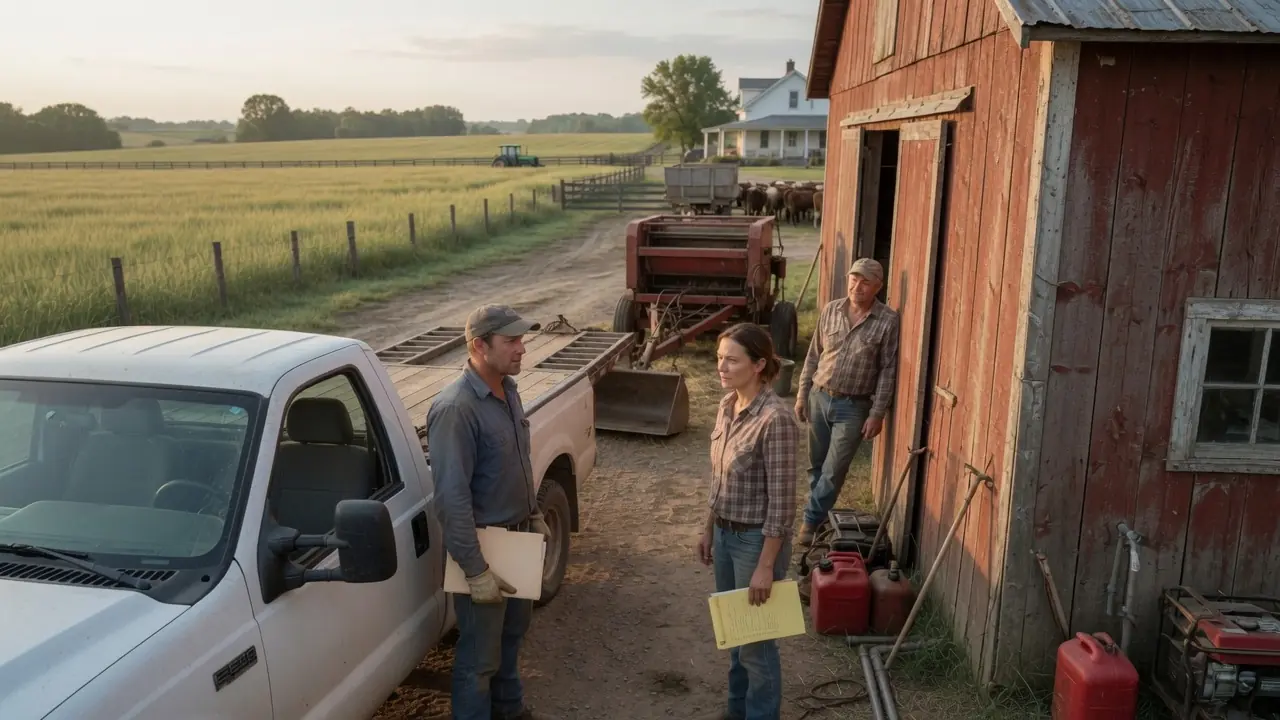
I had my flatbed backed halfway across the Roark farmyard before Tessa Roark came out of the barn and put a loader in my way. Not beside the trailer, not near the trailer, but directly in front of the ramps with the bucket dropped low enough to make her meaning plain. The old red hay baler sat behind the machine shed, faded and dusty, exactly where Dale Roark had left it after borrowing it from me under a signed agreement and paying exactly nothing. I eased the truck into park, looked at the chains in the bed, then looked at the woman standing between me and the machine I had come to reclaim.
My name is Clay Mercer, and I make my living the way small farm contractors do, one repair, one rental, one custom job, one late payment at a time. I owned a little equipment yard outside Canton, Missouri, with three tractors that needed more attention than pride, two hay tools I rented out when I could, and enough unpaid invoices to make sleep feel like something rich men enjoyed. Dale had signed for the baler in March, promised thirty days, then two more weeks, then another week after the calf sale. By early summer, I had run out of patience and had come to take back what was mine.
Tessa climbed down from the loader like she had been waiting for me since before sunrise. She wore dusty jeans, worn boots, a faded plaid shirt, and gloves tucked under one arm. Her brown hair was pulled back tight, and there was nothing soft or pleading in her face. “You’re not taking that baler today,” she said.
“Morning to you, too,” I answered, stepping out of the truck.
“I mean it, Clay.”
“So do I.” I reached into the cab and pulled out the folder with Dale’s signature on every page that mattered. “Your husband owes me for that machine, and every promise he gave me is two months stale.”
Tessa looked at the folder, then past me toward the north field. The hay stood high and ready behind the fence, thick enough to make a farmer count bales before the first pass was cut. “If you take that baler today,” she said, “this farm dies before the month is over.” I expected excuses after that, but she did not give me any.
“That isn’t my fault,” I said.
“No,” she replied. “It isn’t.”
That stopped me longer than I liked. Most people gave me weather, banks, sick cousins, broken trucks, bad checks, and stories that got shinier the less money they had. Tessa gave me the truth and let it sit there in the gravel between us. I looked at the baler again, then at the loader, then at the field that was probably the only clean money standing on that place.
“I can’t keep being the easy guy,” I said. “I’ve got payments too. That baler needs work, and while it sits here unpaid, it costs me twice.”
“I know.” She pulled a folded yellow legal pad from her back pocket and walked toward me. “I know what Dale owes you, what he owes Miller Feed, what’s late at County Ag Bank, and what the tire shop won’t extend anymore.” She tapped the paper with one gloved finger. “And I know the only real money coming in this month is standing in that hay field.”
I did not take the pad right away. “What is this?”
“A work plan,” she said. “Not mercy. Not charity. A plan.”
I almost laughed, but her face made me stop. She had written the numbers in neat columns, the way people do when pretending calm is the same as control. North field first, horse hay buyer in Rusk, delivery window Friday, fuel estimate, twine, bearing replacement, cattle moved off the south lot before the weak fence failed, auction next Saturday for the old grain drill and spare feed trailer. At the bottom, circled twice, was my first payment from the first hay check.
“You want me to do more work for people who haven’t paid me for the last work,” I said.
“I want you to deal with me,” Tessa answered. “Not him.”
The barn door creaked open before I could answer, and Dale Roark finally appeared. He was nearly sixty, heavy around the middle, gray-haired under a loose cap, moving like the morning had inconvenienced him. He gave me the smile of a man who believed every mess could be softened with enough charm. “Clay, come on now. No need for all this.”
“Market came in low,” Dale said.
“You told me the bank transfer had already been sent.”
“Clerical thing.”
“You told me you’d bring cash to my place last Friday.”
He spread his hands. “Got tied up.”
Tessa’s jaw tightened, but she did not step back. Dale looked at the loader, then at my trailer, then at his wife like she was a hired hand who had parked something wrong. “Honey, move that thing. Let me handle him.”
“No,” Tessa said.
Dale’s smile slipped just enough to show what lived under it. “Tessa.”
“No,” she repeated, calmer this time. “You handled it long enough.”
The yard went quiet except for the loader engine rattling and a cow bawling somewhere near the south lot. I looked down at the yellow pad again. The numbers were ugly, but they were real. Ugly numbers are better than pretty lies on a farm, because at least ugly numbers can be worked with.
I folded the paper and slid it into my folder. “I write it up. You sign it. He doesn’t.”
Dale stepped forward. “It’s my farm.”
Tessa looked at him. “Then start acting like it.”
I wrote the agreement on the hood of my truck with the kind of care I usually reserved for bank forms and legal warnings. Thirty days. Written payment schedule. No side deals through Dale. I would have access to the baler, the spare feed trailer, the tools required for repairs, and field access until the first cutting and delivery were finished. If the first payment missed, I took the baler immediately.
Tessa signed without her hand shaking. Dale paced near the barn, muttering about disrespect, but he did not come close enough to stop it. When I loaded the chains back into the truck and drove away without the baler, I kept glancing at the signed plan on the passenger seat. I was not sure if I had made the smartest business decision of the summer or just stepped into the hardest thirty days of my year.
By six the next morning, Tessa was already at the north field with a grease gun in one hand and her phone in the other. I came in my service truck instead of the flatbed, and she noticed before I even shut off the engine. “No trailer today,” she said. “Don’t make me regret it,” I answered.
The first problem showed itself before we got the haybine to the field. One irrigation line along the lower strip had split, spraying water sideways into the lane and soaking a patch that needed to dry. Tessa shut the pump down, stepped into the mud, and crouched beside the break like she had been fixing worn-out systems her entire life. “Clamp’s bad,” she said.
“Pipe’s worn too,” I said, kneeling beside her.
“I know. Clamp is what we can afford.”
That sentence described the whole first week. Not what was perfect, only what could hold. We patched pipe, checked belts, greased fittings, tightened chains, and debated whether the baler’s pickup teeth were bent enough to matter. Tessa did not hover, did not play helpless, and did not waste time proving she knew things; she simply handed me the right wrench before I asked for it.
By noon, we were cutting hay. Tessa drove the tractor like someone listening to a language most people only heard as engine noise. She knew where the field dipped, where the ground stayed soft after rain, where rocks still hid near the old fence line, and where Dale had once cut too close and torn up the edge. I followed behind, checking the cut and pretending not to notice how steady she looked with dust on her shirt and sun on her face.
Two days later, the south fence gave out. Tessa called while I was fueling my own tractor at home. “Cattle are pushing through the lower corner,” she said. “If they get into McBride’s soybeans, I’ll never hear the end of it.”
“I’m ten minutes out.”
“Bring wire.”
When I arrived, she was already in the lot, moving the lead cows away from the weak corner with a sorting stick and a voice that did not waste energy. Dale was nowhere around, and Tessa did not mention him. We spent the afternoon setting temporary posts, pulling wire, and pushing the herd into the west pasture. By the time we got the last gate chained, my shirt was soaked through and Tessa had mud up one boot.
A calf slipped past me near the creek lane. Tessa jumped into the side-by-side and yelled, “Get in or start running.” I got in. She drove like every rut on that farm had personally insulted her, and I bounced in the passenger seat trying not to lose my hat.
We cut the calf off near the lower crossing, and I hopped out waving my arms like a scarecrow with loan payments. Tessa eased it back toward the gate, calm as a Sunday school teacher with a student who had disappointed her. When the calf finally rejoined the herd, she killed the engine and leaned back, breathing hard. “You always that graceful?”
“Advanced livestock strategy,” I said.
“You looked like a mailbox trying to scare a cow.”
I laughed harder than I meant to. She almost smiled, which felt like a bigger victory than fixing the fence. That was how it started between us, not flirting exactly, not sweet talk, just two tired people working hard enough that their guards got too heavy to carry all day. We learned each other in broken parts and field decisions.
At the feed store, the town reminded us what it liked to do with stories. We were buying twine, hydraulic fluid, and a bearing I knew the baler would need before the week was out. Chuck, the owner, leaned on the counter and looked between us with a grin too small to be friendly. “Seeing a lot of your truck out at Roark’s place, Clay.”
Tessa went still. I kept my eyes on the receipt. “They’ve got hay to cut.”
“That all you’re working off?”
The store got quiet in that ugly small-town way, where nobody says anything but everybody hears it. I set my pen down and looked straight at Chuck. “Put the bearing on my account. Put the twine on hers. And don’t talk cheap about a woman standing three feet from you.”
Chuck’s grin died. Tessa did not thank me inside the store. She carried the twine out and loaded it harder than necessary.
“You didn’t have to do that,” she said.
“Yeah, I did.”
“I can handle Chuck.”
“I know.” I shut the tailgate. “That wasn’t me saving you. That was me not letting him make your name smaller while I stood there.”
She looked at me for a long second, then nodded once and got into the truck.
The baler jammed on day nine, because of course it did. We finally had clean windrows, a weather window holding, and the buyer in Rusk ready to take the first load if we delivered by Friday. Then the machine started knocking wrong, the pickup clogged, and the whole thing sounded like it wanted to retire in the middle of the field.
I killed the PTO and climbed down. Tessa was already there, gloves on. “Bearing?”
“Plug first. Bearing after.”
We worked side by side in the heat, pulling packed hay loose by hand. Dust stuck to the sweat on my arms. Tessa had grease across one cheek and did not know it, and I almost told her before deciding there was something nice about seeing one thing she had not managed to control. She caught me looking anyway.
“What?”
“You’ve got grease on your face.”
“So do you.”
“Mine’s professional.”
“Yours looks expensive.”
We cleared the plug, replaced the bearing, and lost three hours by dark. Tessa stood at the gate staring at the field like she could bully daylight into staying. “East strip first tomorrow,” she said. I shook my head. “Northwest dries faster. Bale that first, then circle back.”
“The east is cleaner.”
“The northwest is ready.”
She turned on me with tired anger. “If we send dusty hay, Larkin docks us.”
“If we wait too long, he docks you anyway.”
She looked ready to argue for ten more minutes, then pulled out her notebook, flipped two pages, and checked her own moisture notes. “Fine,” she said. I raised an eyebrow. “Fine?”
“Don’t enjoy it.”
“I’m trying not to.”
“You’re failing.”
The first load was stacked by Friday morning. It was not pretty, but it was real: square bales tight enough to travel, straps checked twice, delivery papers sealed in a plastic sleeve, and my invoice copy tucked where Tessa could reach it. She stood beside the loaded trailer with both hands on her hips, staring at it like she did not trust good news yet. Dale came out of the house right when we were checking the lights.
“Well,” he said, sunglasses on, coffee cup in hand, “looks like my farm still knows how to work.”
Tessa did not answer. Dale looked at me, then back at her. “Guess you two have been getting along fine.”
There was poison under the sentence, quiet but deliberate. I hooked the safety chains and stood up. “We’ve been working.”
“That what we’re calling it?”
Tessa’s face went cold. “The first load is ready because Clay showed up. I showed up. You didn’t.”
Dale’s smile fell. For a moment, I thought he might yell, but Dale was not built that way. He got smaller when cornered, then meaner in sideways language. “Just remember who owns this place,” he said.
Tessa stepped closer. “I remember who almost lost it.”
Nobody spoke after that. I climbed into the truck, and Tessa got into the passenger seat with the delivery papers on her lap. As we rolled out of the yard, the baler sat behind us, still dusty and still the center of everything. But the first hay load was moving, and the thirty-day plan finally felt like more than paper.
Halfway to Rusk, Tessa started going through the folder again. At first, I thought it was nerves. Then she stopped moving completely. “The buyer agreement isn’t here.”
“You had it yesterday.”
“I know.” She checked the folder again, then looked toward me. “It was on the kitchen table. Dale asked where we were delivering this morning.”
I kept my eyes on the road. “You think he took it?”
“I think Dale doesn’t ask questions unless he already has a plan.”
She called Larkin on speaker. Her voice stayed calm, but her knuckles went pale around the phone. “Mr. Larkin, it’s Tessa Roark. We’re on the road with the first load. Has anyone contacted you about changing the payment account?”
The pause on the other end told us enough before the buyer spoke. Tessa closed her eyes for one second. “No,” she said. “Do not process that change. I handled the cutting, baling, and delivery. The original agreement lists the farm operating account, and that is the only account authorized.”
After she hung up, she stared out the windshield. “He sent his own routing number.”
I tightened my grip on the wheel. If Dale pulled the payment, I did not get paid, Tessa lost the deal, and the farm took another step toward the ditch. The worst part was that he had not touched the hay. He had waited until she made something worth taking.
“We still deliver?” I asked.
She sat up straighter. “Yes. Then we go to the bank.”
Larkin’s warehouse sat off a county road beside metal bins and a loading dock that smelled like feed dust and diesel. He was a square-built man with a gray beard, careful eyes, and a clipboard that made him look like he did not want to be in the middle of a marriage problem. Tessa stepped out before I had the truck fully in park.
“Before we unload,” she said, “I want the agreement confirmed under my name and the farm operating account.”
Larkin glanced at me, then back at her. “Dale said he was handling financials.”
“Dale did not cut this field,” Tessa said. “Dale did not bale it. Dale did not call you when moisture ran high. I did.”
The hay passed inspection. Payment would hold until morning because of the dispute, but Larkin signed the delivery receipt and kept the original account on file. We left with less hay and more trouble. At the bank, Dale was already there.
That told me everything.
He stood near the front desk talking too warmly to a woman behind the counter. When he saw Tessa walk in with me behind her, his face changed from surprise to anger, then slid back into charm. “Tessa,” he said, “you didn’t need to come all the way in.”
“Yes,” she said. “I did.”
His eyes cut to me. “And you brought him.”
“I’m here about my payment,” I said.
Dale laughed shortly. “Your payment. Sure. That’s what this is.”
Tessa stepped between us. “I need to freeze all new farm sale payment changes unless they carry my signature.”
The woman behind the counter looked from Tessa to Dale. “Mrs. Roark, that may require documentation from the co-op depending on how the sale authorization is listed.”
“Then we go there next,” Tessa said.
Dale’s cheeks reddened. “You’re embarrassing both of us.”
“No,” she said. “You did that when you tried to move the hay money before the trailer left the yard.”
He lowered his voice. “You think he’s helping for free?” Then he pointed at me. “He’s been at my farm every day. You think people aren’t talking?”
I felt heat rise in my neck, but Tessa turned her head slightly, stopping me without a word. Dale leaned closer and said the thing that made the whole room feel smaller. “You should have just kept him sweet until we got through this.”
Tessa went still, not weak, not shaken, still like a gate locking. I looked straight at Dale. “I don’t take payment through someone’s wife.”
His mouth opened, then closed.
The bank manager brought us into his office, and Tessa laid everything on the desk: buyer agreement, delivery receipt, unpaid equipment contract, work plan, auction list, and the routing change Dale had tried to make. She spoke clearly, without dressing anything up. “I want all new farm sale deposits held to the operating account unless I sign the change. I want no new equipment advances approved off projected hay or cattle income without my written approval. And I want Clay Mercer’s debt documented as first payment from the Larkin hay sale.”
Dale sat across from her with his jaw working. “You’re choosing him over me.”
Tessa looked tired then. “You chose debt over the farm first.”
At the co-op, Dale tried one more time, telling the clerk it was his family name on the land. Tessa put both hands on the counter. “It’s my name on the operating account. It’s my signature on the buyer agreement. And it’s my work in that field.” The clerk checked the papers, made two calls, and stamped the update before closing.
The stamp hitting paper sounded bigger than it should have.
The next morning, my first payment hit at 9:14. I know because I was under my own tractor changing a hydraulic hose when my phone buzzed on the concrete floor. I wiped my hand on a rag, looked at the deposit, and just sat there staring. It was not everything Dale owed me, not close, but it was real money from real hay sent the way Tessa had written it.
I called her right away.
“You see it?” she asked.
“I see it.”
“Good.”
There was metal noise behind her, engines and men talking. “Where are you?” I asked.
“Auction yard.”
I sat up too fast and hit my shoulder on the tractor frame. “You went without me?”
“You had your own work.”
“That grain drill has a cracked hitch. Don’t let them talk you down like it’s falling apart.”
She went quiet for half a breath. “Then get over here and look mean beside it.”
By the time I reached the auction yard, Tessa was standing near the old grain drill with a clipboard tucked under her arm. She looked like she had slept four hours and still planned to win the day. The spare feed trailer was parked in the next row, and three men were already circling it, kicking tires like rust was a personal insult. She saw me and tipped her chin toward the drill.
“Worst thing they can use against it?”
“Paint looks bad. Hitch crack. Left tire’s older than it should be.”
“That all?”
“That’s enough.”
The drill sold lower than she wanted but higher than Dale expected. The feed trailer sold clean, and the auction receipt went straight into the folder. Dale showed up halfway through, of course, standing near the coffee stand with his hands in his pockets, watching like the money still had his name on it. When the trailer sold, he walked over with a tight smile.
“Well,” he said, “that’ll help us breathe.”
Tessa held the receipt against her clipboard. “It’ll help the farm breathe.”
“That what we’re calling it now?”
“The auction money goes to repairs and Clay’s second payment. You saw the bank papers.”
Dale glanced at me. “Always Clay.”
“No,” Tessa said. “Always the work. You just stopped recognizing it.”
He did not yell. He looked around, saw who might be watching, then walked away like leaving had been his idea. Tessa watched him go with no triumph in her face. Only exhaustion, and a little bit of grief for something that had probably been gone long before I showed up with a flatbed.
The last hay delivery nearly broke us. The baler slipped timing again, my truck ran hot on the county road, and one stack leaned enough that I made us reload it. Tessa argued with me for five full minutes, then climbed up and helped fix it anyway. At Larkin’s warehouse, the buyer checked three bales, signed the receipt, and said, “Good hay.”
Tessa did not smile until we were back in the truck. Then she leaned her head against the seat and closed her eyes. “Say it,” I said.
“Say what?”
“That I was right about restacking.”
“No. You’re thinking it.”
“I’m thinking you’re expensive.”
“That’s close.”
The final payment from that month did not make anyone rich. It did not erase the bank note, fix all the machinery, or turn the Roark place back into what people remembered from ten years before. But it kept the farm alive. Miller Feed got paid down, my equipment debt got written correctly, the bank locked Tessa’s signature onto every new farm sale, and the co-op listed her as authorized contact.
Dale could still walk around calling it his place. He just could not sign tomorrow away without her seeing it. For the first time since I had backed into that yard, Tessa had more than a plan. She had control.
Dale moved out the following week. Not far, just to his brother’s empty room outside Canton, taking two bags, his fishing rods, and what little pride he could carry. He told Tessa she would come begging when the place got too heavy. She stood on the porch and said, “No. I’ll call a mechanic.”
I stayed away after that. Not because I wanted to, because I did. There is a difference. For thirty days, Tessa and I had been shoulder to shoulder in fields, barns, trucks, offices, and sale yards, and I had learned too much about the way she counted under her breath when numbers got tight.
She had learned that I went quiet when I worried about money. We had shared gas station sandwiches, bad coffee, late evenings, early mornings, and enough trouble to make strangers feel like partners. But she was coming out of a marriage, and I was still the man she had owed money to. Clean lines mattered.
When she called about a loose belt on the baler, I sent the part number. When she asked about a fair custom cutting rate, I gave the county average. When she texted one evening, “You don’t have to vanish,” I stared at the phone for ten minutes before answering. “I’m not vanishing. I’m keeping it clean.”
Her reply came a minute later.
“I know.”
A few weeks passed before I drove back onto the Roark farm. No flatbed behind me this time, just my service truck, a replacement part on the seat, two coffees in the cup holders, and a printed work order clipped to a board. Tessa met me at the gate with sleeves rolled up, boots dusty, hair pulled back the same way it had been the morning she blocked me with the loader. Only now the yard did not feel like it was holding its breath.
I stepped out and handed her the coffee. “Official job,” I said, holding up the work order.
She read the rate. “You brought paperwork.”
“Always.”
“And coffee?”
“That’s not on the invoice.”
She looked toward the machine shed where the baler sat with one panel open. The same old red baler I had come to take now stood like a test we had both passed. “Still need it running by Friday?” I asked. Tessa looked back at me, and this time the smile came easy.
“Only if you’re charging full price.”
I picked up my toolbox and walked beside her through the gate. The north field was already greening for the next cutting, the cattle were behind a better fence, and the loader was parked properly by the barn instead of blocking my trailer. The farm was not saved forever, because farms never are. They are saved one repair, one field, one honest check, and one stubborn morning at a time.
But that day, the Roark farm was breathing.
And so was Tessa.
I had come to collect her husband’s debt. I left with a contract, a month of hard work, and a respect I did not know could turn so quietly into something more. The farm had not needed a hero. It had needed someone willing to work beside the woman who already knew how to save it.