Three weeks. That was how long I was gone.
Not on vacation. Not hiding from my mortgage. Not abandoning my house like some rumor-hungry neighbor later claimed. I was in the hospital after an emergency surgery I never saw coming, lying under white fluorescent lights, counting the hours between pain medication, and wondering how long it would take before my body felt like it belonged to me again.
I lived alone in a quiet suburban neighborhood outside Raleigh, North Carolina, in a house I had bought eight years earlier after saving through most of my thirties. It was not a mansion, but it was mine. Brick front, narrow porch, two maple trees in the yard, and a detached three-car garage set back along the side driveway. That garage mattered to me more than most people understood. My father had helped me repair the roof on it before he passed, and over the years I had turned part of it into a workshop, part of it into storage, and part of it into a place where I could stand alone on Saturday mornings with coffee in my hand and feel like I had built a life.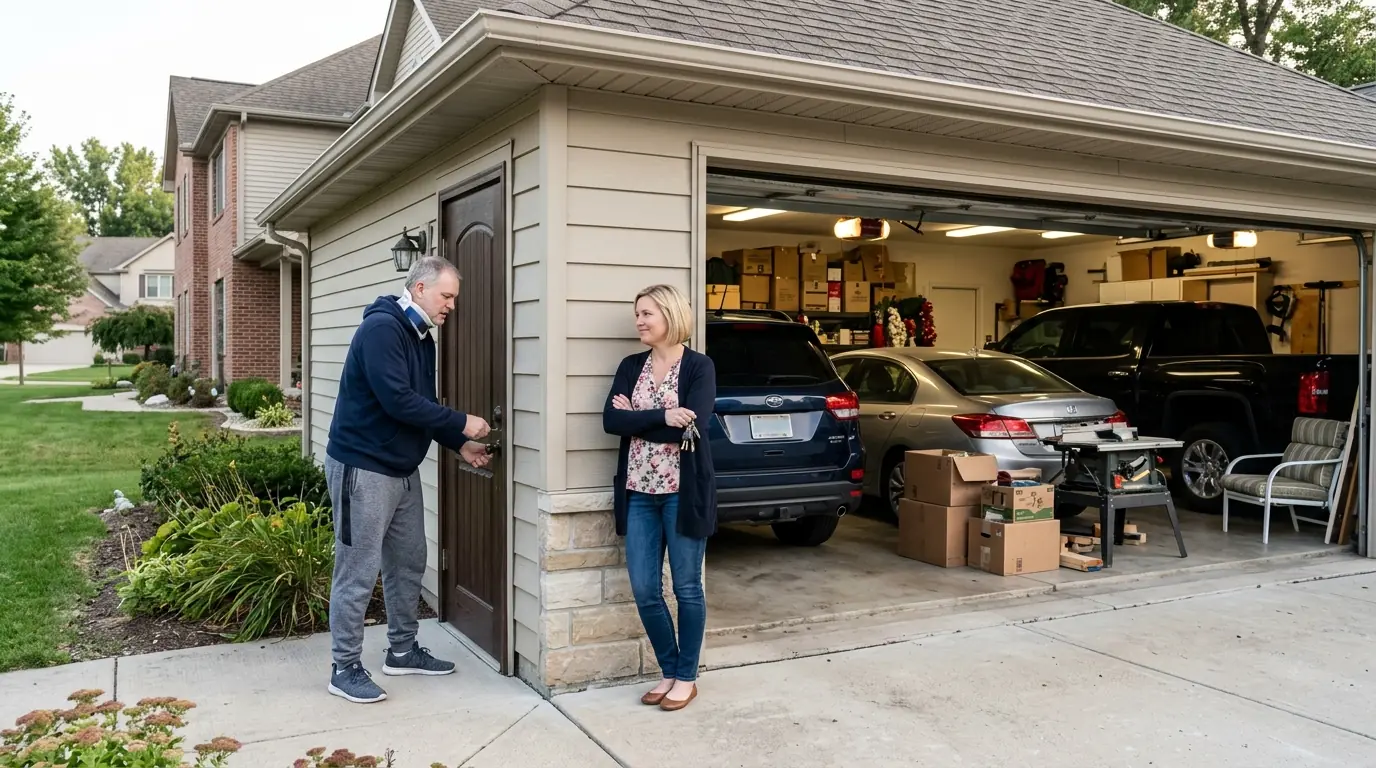
My brother, Daniel, was the only person who knew exactly where I was during those three weeks. He lived forty minutes away, and he was the one who drove me to the emergency room when the abdominal pain got so bad I could barely breathe. One minute I thought I had food poisoning. The next, a surgeon was telling me they had to operate immediately. There had been complications. Recovery was slow. I could not drive. I could barely sit upright for more than a few minutes.
Daniel checked on my house when he could. He brought in my mail twice, watered the porch plants once, and made sure the front door was locked. But he had his own family, his own job, and no reason to believe my neighborhood needed guarding from itself. My truck stayed parked in the same place in the driveway, because I obviously was not using it. The blinds stayed drawn. The porch light came on automatically at night. To a normal neighbor, that would have looked like someone was away or recovering or simply living quietly.
But Karen Miller was not a normal neighbor.
Karen lived across the street in a pale yellow house with perfect hedges and a flagpole she treated like a monument. She was in her late fifties, always dressed like she was on her way to an HOA meeting even when she was just dragging her trash bin to the curb. She had been on almost every committee our homeowners association had ever created, and if no committee existed for something she cared about, she invented one in her own head.
She called herself community-minded. Most of us called her exhausting.
Karen believed every driveway, sidewalk, mailbox, lawn ornament, trash can, and flower bed in the subdivision was part of her personal kingdom. If someone left a garbage bin out past noon, Karen photographed it. If someone planted flowers she felt were too bright, she complained. If a teenager parked on the street during a birthday party, Karen wrote down license plate numbers like she was gathering evidence for a federal trial.
The HOA board gave her small responsibilities because it was easier than arguing with her. She organized the holiday lighting contest. She monitored mailbox paint colors. She sent reminders about lawn edging. Somehow, those little jobs convinced her she had authority over everything.
So when my truck did not move for several days, Karen noticed.
When it did not move for a week, Karen started talking.
And when it still had not moved after two weeks, Karen decided she knew the truth.
She told people I had abandoned the house.
A neighbor named Mark later told me she came to his door one afternoon with a clipboard tucked under her arm, the way she always did when she wanted to seem official. She told him, with total confidence, that I had moved out permanently and that the HOA was taking care of the property until things were sorted.
“The owner abandoned it,” she said. “We can’t let a vacant property become an eyesore.”
That was the first lie.
The second lie was worse.
Karen decided my detached three-car garage was being wasted.
I wish I were exaggerating. I wish I could say she only peeked through the windows or complained about the dust on the side door. But Karen did not stop at gossip. Once she convinced herself I was gone, she began acting as if my property had become available for community use.
She told two of her friends that the HOA had authorized temporary storage in my garage. She said it was better than letting the space sit empty. She claimed my house was in transition, that I was gone for good, and that the association had a duty to keep the property useful and secure.
She had no permission from me. She had no permission from the HOA board. She had no legal authority to touch a lock, enter my garage, or invite anyone else inside. But Karen had learned that if she used the words HOA authorized with enough confidence, most people stopped asking questions.
Then she called a locksmith.
The locksmith later said she introduced herself as a representative of the homeowners association and claimed she was acting on behalf of the property owner. She gave him my address. She signed the invoice herself. She watched him replace the side entry lock on my garage, then accepted the new keys as if she had every right in the world.
After that, my garage became the neighborhood storage unit.
One of Karen’s friends, a retired man named Glen, parked a classic Mustang inside. He had been keeping it under a tarp in his own driveway, and Karen told him the empty garage would protect it from rain and sun. Another neighbor, Sylvia, moved in expensive woodworking equipment that belonged to her husband. There were tool chests, saw stands, clamps, lumber stacks, and boxes of varnish. Karen herself filled the back corner with plastic bins of holiday decorations, folding lawn chairs, cracked planters, and wicker patio furniture she apparently did not want cluttering her own garage.
While I was lying in a hospital bed learning how to stand without tearing my stitches, strangers were parking vehicles and stacking boxes in a building my father had helped me repair.
No one called me.
No one called Daniel.
No one checked county records. No one sent a letter. No one waited for confirmation. Karen said I was gone, so people believed her.
Three weeks after the surgery, I finally came home.
Daniel picked me up from the hospital just after noon on a gray Saturday. I was pale, sore, and moving like every bump in the road had a personal grudge against me. He had put a pillow between my stomach and the seat belt. The discharge folder rested in my lap. I remember looking out the window at familiar streets and feeling almost emotional at the thought of sleeping in my own bed again.
“You sure you don’t want to stay with us a few nights?” Daniel asked as he turned into my subdivision.
“I’m sure,” I said. “I just want quiet.”
“You can barely walk.”
“I can walk to the couch.”
He gave me the look older brothers give when they know arguing will not help. “Fine. But I’m staying long enough to make sure you’ve got food and meds sorted.”
We pulled onto my street, and at first everything looked normal. The maple trees were still there. My truck was still in the driveway. The porch plant looked half-dead but alive enough to forgive me. Then Daniel slowed the car.
“What the hell?” he muttered.
I followed his gaze.
My garage door was open.
Not cracked. Not partially raised. Wide open.
Inside were three vehicles I had never seen before.
For a few seconds, my brain refused to understand what I was looking at. There was a red classic Mustang where my workbench should have been visible. Beside it was a black SUV. Near the third bay, the nose of a small silver sedan pointed toward the driveway. Shelves along the wall were stacked with boxes that were not mine. A folded patio umbrella leaned against a row of bins. The whole garage looked full, active, occupied.
Daniel parked in front of my house and shut off the engine. Neither of us moved.
“Are those yours?” he asked, even though he already knew the answer.
“No.”
“Maybe someone got the wrong address?”
“With three cars?”
He stared for another moment. “Stay here.”
I opened my door anyway.
“Don’t be stupid,” he snapped. “You just had surgery.”
“It’s my garage.”
The walk from the car to the driveway felt longer than it should have. Every step pulled at my incision. Daniel stayed close enough to catch me if I stumbled, and under any other circumstances I might have been embarrassed. But all I could think about was the open garage and the fact that my things were hidden behind other people’s property.
We walked to the side entry door. I pulled my key ring from my pocket, found the garage key, and inserted it into the lock.
It did not turn.
I tried again.
Nothing.
I pulled it out, checked the key, and tried a third time.
The lock was wrong.
Someone had changed my lock.
That was the moment the confusion burned away and something much colder took its place.
Daniel’s face hardened. “Someone broke in.”
Before I could answer, a voice floated across the street.
“Oh!” Karen called, almost cheerfully. “You’re back.”
She was walking toward us from her driveway with the biggest smile I had ever seen on her face. She wore white capri pants, a blue blouse, and the satisfied expression of someone who expected gratitude.
I turned slowly. “Karen.”
She clasped her hands in front of her. “Well, this is surprising. I thought you moved.”
“I’ve been in the hospital.”
For half a second, her smile flickered. Then it returned, thinner than before. “Oh. Well, everyone thought you left.”
“No,” I said. “You thought that.”
Daniel stepped forward. “Why is his garage full of other people’s cars?”
Karen’s posture changed. Her shoulders straightened. Her chin lifted. I had seen that look before at HOA meetings. It was the face she wore when she was about to pretend she had authority.
“The HOA authorized temporary community use,” she said.
I stared at her. Then, despite the pain in my abdomen, I almost laughed. “There is no HOA rule allowing you to steal someone’s garage.”
She frowned. “Nobody stole anything. We were helping the neighborhood.”
“By changing my lock?”
“It was for security.”
“Security for whom?” Daniel asked. “The people storing their cars in there?”
Karen ignored him. “Your property appeared abandoned. We couldn’t just allow an empty structure to sit unused when neighbors had legitimate storage needs.”
I looked at her as if she had started speaking another language. “Legitimate storage needs?”
“Yes.”
“It’s my garage.”
“We believed you were gone.”
“You believed that because you made it up.”
Her mouth tightened. “There is no need to be hostile. We were acting in good faith.”
I pulled out my phone with a shaking hand. “Good. Then you can explain that to the police.”
Karen rolled her eyes. “They’ll tell you this is a civil matter.”
She sounded so confident that for one second, I wondered if she had done something like this before and gotten away with it. Maybe she thought private property became negotiable when she wrapped her actions in HOA language. Maybe she had bullied enough people into silence that she believed the police would shrug and leave.
Unfortunately for Karen, she was completely wrong.
The first officers arrived twelve minutes later. Two patrol cars pulled up, and the open garage drew their attention before anyone even spoke. One officer, a woman named Diaz, walked toward me while her partner, Officer Hall, looked inside the garage.
I explained as clearly as I could. I owned the house. I had been hospitalized for three weeks. I came home to find my garage open, filled with property that was not mine, and the side lock changed. Karen admitted she believed the HOA had authorized use of it.
Officer Diaz asked for identification. I showed my driver’s license, the property tax information on my phone, and the hospital discharge papers still folded in Daniel’s car. She took notes. Officer Hall photographed the open garage, the changed lock, and the vehicles inside.
Then Officer Diaz turned to Karen.
“Do you own this garage?” she asked.
Karen folded her arms. “No, but I represent community interests.”
“That was not my question. Do you own this garage?”
“No.”
“Did the owner give you written permission to enter it or allow others to use it?”
Karen’s confidence wavered. “We believed he had vacated the property.”
“Did he give you written permission?”
“No, but—”
Officer Diaz held up one hand. “Did the HOA board provide written authorization?”
Karen looked toward the garage. “It was a temporary community decision.”
“That is not an answer.”
Officer Hall walked back over. “Who changed the lock?”
Karen did not answer quickly enough.
Behind us, Glen, the owner of the Mustang, had appeared at the edge of the driveway. He must have seen the police cars from his house. Sylvia arrived seconds later, clutching her phone and looking terrified.
Officer Hall repeated the question. “Who authorized the lock change?”
Glen pointed at Karen.
Sylvia pointed at Karen.
Karen looked betrayed. “You both knew we were acting for the community.”
Glen shook his head. “You told me the HOA had permission.”
“You said the owner abandoned it,” Sylvia added.
“I said we believed—” Karen began.
“No,” Sylvia said, her face flushing. “You said confirmed.”
The officers exchanged a look.
Officer Diaz turned back to Karen. “Ma’am, changing someone else’s lock and allowing people to occupy private property without permission is not a neighborhood management issue. Depending on the circumstances and state law, this can involve criminal trespass, unlawful entry, interference with property, and possibly fraud if false statements were made to gain access.”
Karen’s face went pale.
“It was a misunderstanding,” she said quickly.
“No,” Daniel said. “A misunderstanding is parking in the wrong driveway. This is replacing a lock.”
Officer Diaz asked everyone with property in the garage to remove it immediately. She explained that they were not being arrested at that moment because they appeared to have relied on Karen’s statements, but they needed to clear out anything that did not belong to me and provide contact information.
The next hour was one of the strangest hours of my life.
A classic Mustang backed slowly out of my garage while two police officers watched. Sylvia’s husband arrived with a pickup truck and began loading woodworking equipment, apologizing so many times I eventually stopped responding because I did not have the energy. Karen stood near the curb, silent for once, her arms locked across her chest like she was holding herself together by force.
Neighbors came outside. Some pretended to check their mail. Others stood openly on their lawns, watching the neighborhood queen get questioned beside the garage she had apparently decided to annex.
I sat on my porch steps because I could not stand anymore. Daniel brought me water and kept one eye on Karen.
“You okay?” he asked.
“No.”
“Pain?”
“Mostly rage.”
“That’ll do it.”
When the garage was finally empty enough to see inside, I realized there was damage. A shelf near the back wall had been shifted and scraped the drywall. My old workbench had been pushed sideways, and one leg was cracked. Several boxes of my father’s tools had been moved to a corner, stacked carelessly beneath someone else’s plastic Christmas bins. One cardboard box had collapsed under the weight, spilling old chisels and hand planes across the floor.
That was when the anger became personal.
Karen had not only taken space. She had treated my father’s things like junk.
Officer Hall noticed my expression and photographed everything. “Document all damage,” he said. “Every item. Every mark. Don’t throw anything away until insurance sees it.”
Karen tried one more time to explain herself.
“I genuinely believed the property was abandoned,” she said.
Officer Diaz asked, “Did you verify that with the owner?”
Karen opened her mouth.
Nothing came out.
“Did you call him?”
“No.”
“Did you call a family member?”
“No.”
“Did you check public property records?”
“No.”
“Did you receive legal notice that the home had been abandoned?”
Karen’s voice dropped. “No.”
“So you relied on an assumption.”
She looked down at the sidewalk.
Officer Diaz continued. “And then you acted on that assumption by changing a lock on property you did not own.”
Karen said nothing.
Police contacted the locksmith two days later. That was when Karen’s excuses truly fell apart. The locksmith still had the invoice. Karen had signed it. More importantly, the work order listed her as the authorized representative for the property owner.
She had not merely misunderstood. She had misrepresented her authority.
Once that invoice surfaced, everyone began backing away from her.
The HOA board called an emergency meeting the following Thursday. Daniel drove me because I still could not drive, and honestly, I would not have missed that meeting if I had to crawl there. The room was packed. People stood along the back wall. Karen sat near the front with her lips pressed together, refusing to look at anyone.
The board president, a tired man named Lewis, opened with a statement.
“The board wants to make clear that no authorization was ever given for any resident to enter, use, modify, secure, or occupy private property belonging to another homeowner. Any claims that the HOA approved temporary use of a private garage were false.”
A murmur moved through the room.
Karen stared at the table.
Lewis continued. “The board apologizes to the homeowner for the violation of his property and for the misuse of the association’s name. Effective immediately, Karen Miller is removed from all HOA committees and volunteer positions pending further review.”
Karen shot to her feet. “You can’t do that.”
Lewis looked exhausted. “We just did.”
“I acted to protect property values.”
“You acted without authority.”
“The house looked abandoned.”
“Then you should have reported a concern to the board,” Lewis said. “You should not have hired a locksmith.”
Someone in the back muttered, “Or turned a garage into a storage locker.”
A few people laughed under their breath.
Karen’s face reddened. “This community used to appreciate people who took initiative.”
Daniel stood up before I could stop him. “Initiative is organizing a block party. Breaking into my brother’s garage is trespassing.”
The room went quiet.
Karen sat down.
After the meeting, several neighbors approached me to apologize. Mark admitted Karen had told him the HOA was handling everything. Glen apologized for parking the Mustang inside and offered to pay for any damage caused by moving it. Sylvia cried, saying she never would have stored the equipment there if she had known the truth.
I believed some of them. Others, I think, were simply embarrassed they had been caught benefiting from Karen’s confidence game. Either way, the garage was mine again.
But I was not done.
My homeowners insurance company advised me to document every unauthorized entry and every damaged item. I took photographs. Daniel helped me make a spreadsheet. We listed the lock replacement, the damaged workbench, the scraped wall, the broken storage box, the cleaning costs, and the legal consultation I scheduled after the police report was filed.
The lawyer I spoke with did not laugh when I told the story. That was how I knew it was serious.
“She changed the lock?” he asked.
“Yes.”
“And signed the locksmith invoice as an authorized representative?”
“Yes.”
“And there were vehicles and personal property stored inside?”
“Yes.”
He leaned back in his chair. “That is not a harmless HOA misunderstanding.”
Within weeks, Karen’s attorney contacted mine. Apparently, once she realized there was a police report, a locksmith invoice, witness statements, HOA meeting minutes, photographs, and damage documentation, her appetite for righteous battle disappeared. She did not want criminal charges. She did not want a civil lawsuit. She did not want the story spreading any further than it already had.
So she settled.
She agreed to pay for the new lock installation, professional garage cleaning, repair of the damaged wall, replacement of the broken workbench, replacement storage boxes, and my legal expenses. She also had to sign a written statement acknowledging that she had no authority to access or authorize use of my property. The statement was not dramatic. It was not enough to undo what she had done. But seeing her signature under those words gave me a kind of peace I did not expect.
For months afterward, Karen avoided me. She stopped walking door to door with her clipboard. She stopped sending neighborhood-wide emails about trash bins. At HOA meetings, she sat in the back and said nothing. Nobody asked her to organize the holiday lights that year.
The garage took time to feel like mine again.
Daniel helped me rebuild the workbench. We repaired the wall. We bought new shelves and labeled the boxes properly. One Saturday afternoon, when my strength had mostly returned, we found my father’s old hand plane under a tarp where it had been shoved and forgotten. I cleaned it slowly, oiling the handle the way he taught me when I was seventeen.
Daniel watched from the doorway. “Dad would’ve lost his mind over this.”
“He would’ve marched across the street.”
“He would’ve marched through the garage first.”
I laughed for the first time in weeks.
The strangest thing was how the neighborhood changed afterward. People who had once treated Karen’s declarations like official announcements began asking for proof. If someone said the HOA had approved something, another neighbor would ask to see the email. If Karen hinted that she knew something about a property, people checked before believing her. The board created a rule requiring written confirmation before any HOA volunteer could contact a vendor about property concerns.
They called it a clarification policy.
Everyone knew it was the Karen rule.
A year later, a new couple moved into the house at the end of the street. I was outside washing my truck when I heard Mark talking to them near the mailbox. He was explaining trash pickup days, pool keys, and the usual neighborhood details. Then his voice dropped just enough for me to hear.
“One more thing,” he said. “If Karen tells you she has permission, ask to see it in writing.”
I smiled and kept washing my truck.
Three weeks.
That was all it took for one entitled neighbor to convince herself that my absence meant opportunity, that a quiet house meant abandonment, that a garage she did not own could become a community storage unit because she said so. She thought nobody would question her. She thought the HOA name would protect her. She thought I would never come back.
But I did come back.
I came home with hospital paperwork, a brother who refused to let me be pushed around, police officers willing to ask simple questions, an invoice with Karen’s signature, and enough evidence to make sure she never again treated another person’s property like it belonged to her.
Now my garage has a new lock, a repaired wall, and a security camera above the side door. My father’s tools are back where they belong. My workbench is stronger than before. And every time I pull into my driveway and see that garage standing closed and quiet, I remember one simple lesson.
An empty driveway is not an invitation.
A quiet house is not abandoned.
And anyone who says they have permission should be ready to prove it in writing.