I am eighty-two, and a rolling pin lies on my kitchen table, worn so pale you can nearly see through it. Two women wore it to that. One pair of hands was mine. The other belonged to a woman who had been dead for three years before her husband ever looked at me twice. The valley settled on a tidy reason that pin came to me.
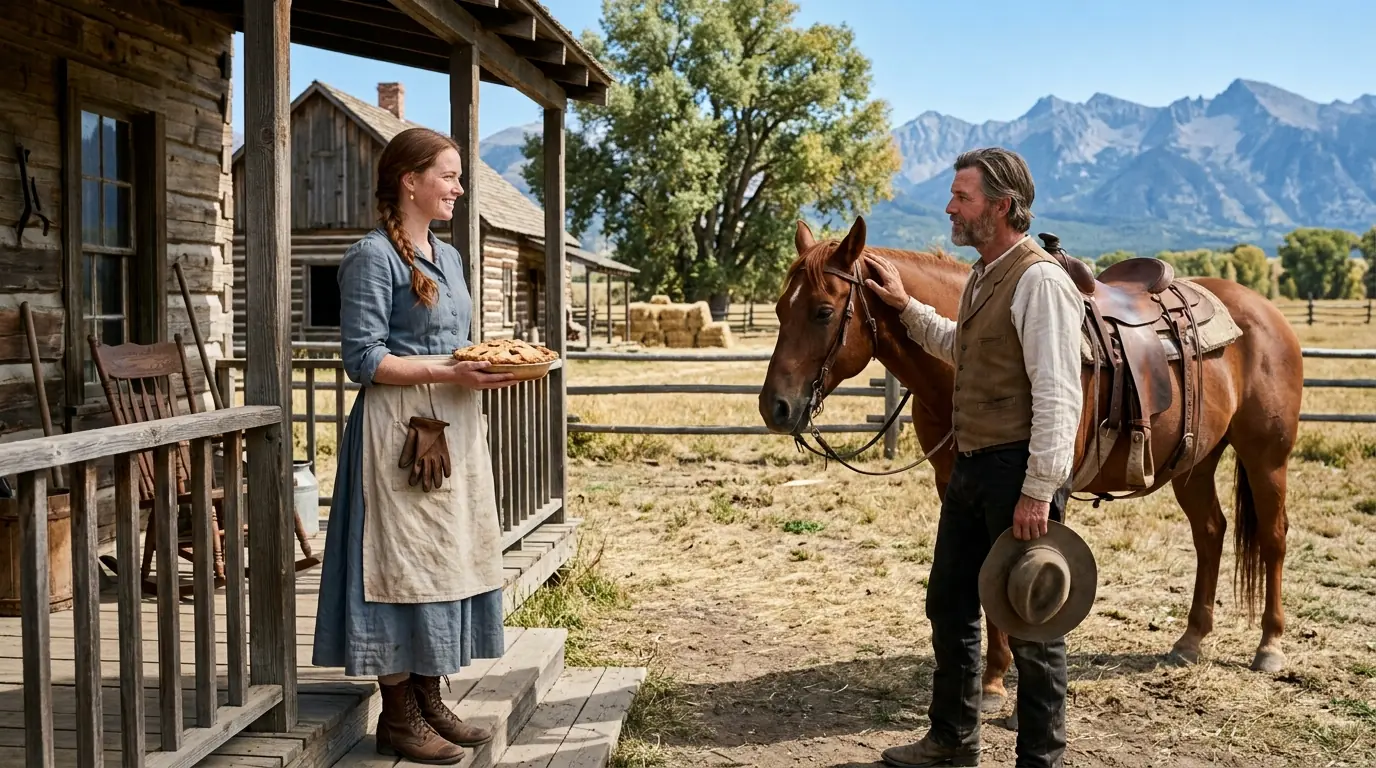
I let them keep it for forty years. It was the September of 1883, and I carried an apple pie across a hay field to a man I had no business loving. My name was Adeline Mercer then. The valley called me Addie, and it had already decided I was a woman who needed nothing from anybody. I had thirty acres deeded in my name, a sure hand with cattle, and three years of Tuesdays carrying food to my widowed neighbor that nobody had asked me to begin.
This is the story of the morning Amos Whitlock joked about being younger, and I told him the truth instead of laughing, and of all it cost us before he believed me. To know why a pie mattered, you have to know what three years of Tuesdays were made of. I was twenty-eight that September and ran the South Place alone. Thirty acres, a small herd, a barn that leaned the way old barns do and held anyway. My folks had deeded it to me and gone to Denver to be near my sister.
The law allowed a woman over twenty-one to hold land and prove a claim in her own name. That was something the valley forgot whenever it talked about me. I drove my own cattle to the railhead at Durango, where the Denver and Rio Grande had come through two years before and made a proper town of a muddy bend in the Animas. And I took better prices than men twice as seasoned because I did the figuring while they did the bragging. I had not always meant to do it alone.
There had been a man when I was twenty who let his people talk him out of me because my family's name weighed too little on their scale. He married elsewhere, sensibly. So, I learned what this country keeps teaching its women, that to be wanted you first make yourself smaller. I declined, put my hands to my own ground, and quit offering myself up to be chosen. It was a clean way to live and a quiet one.
I had loved Clara. She made a string of lonesome homesteads feel like a place a person belonged, and when she went, something warm went quiet. I started carrying food north 2 weeks after the burying, never as charity because you don't hand a grieving man charity. I came on Tuesdays. I brought beans or bread or a pie when the apples turned.
He met it the same way each week. "You don't owe me this," he would say. "I know," I would answer. We said it so often it stopped being words and became a door we both leaned on and never opened. By that third autumn, the valley had a plan for me, and his name was Royce Tilden.
He was thirty, the only son of the man who held half the county's freight, and he had flowers sent down on the Denver train, the arranged kind, which in a valley that had owned no such thing five years earlier was its own loud announcement. Effie Dolan at the dry goods told me flat I could do considerably worse, and my friend Hannah asked how many times a man had to call before I gave him a chance. I said I didn't know, which was the one lie I told all season. The answer was never, and I was not ready to say why, because a thing said aloud turns real, and real things carry a cost. I made the pie on a Monday night with apples off the old tree at the bottom of my south fence, the ones that turned sweet only in September.
I made the crust the way my mother swore by, the butter kept cold and the hands kept colder. The dough never pushed past what I wanted. I crimped the edge with more care than a Tuesday called for, and I have not pretended otherwise since. I carried it across the field under a sky doing what Colorado does in September, a blue so hard and clean it shamed everything under it. Amos was on the porch as he nearly always was, as if the morning itself had gotten used to me.
I held the pie out. He took it in both hands and studied it like a letter from someone he had given up hearing from. Then he smiled, the rare slow one that took ten years off his face and showed me the man Clara had married. "If I were twenty years younger," he said, "I would marry you." He said it light, the way you say a thing built to land soft and roll on by.
A hawk crossed over. I set the pie on the top of the rail and I did not laugh. "Twenty years wouldn’t be enough," I said. Then I told him the cattle wanted seeing to and went back across the field before he could work out what I meant. I did not look back.
For three years I had carried good things to that porch and been careful never to want a thing back. And in five words I had set the whole arrangement alight. Not knowing whether I had freed something or burned it down. The reason mattered. Why a woman with her own land and her own money would set her heart on a man past fifty while a young and prosperous one sent flowers down the line.
I asked myself the same for thirty years. So I will say it plain. In that country a wife handed her husband the running of nearly everything she had and a woman who had fought to hold her own ground could see precisely how small a comfortable marriage might leave her. Royce would have rescued me. Amos had never tried to manage me.
That is not a small difference. That is the whole of it. He came to the fence line a fortnight later. Which on his clock was practically running. He did not come to my door.
He stopped at the rails between our places, set both hands on the top one, and waited the way he did when he had decided something but not yet said it. I kept mending wire because three years had taught me that prompting Amos only slowed him down. Addie, he said. I said his name back and kept working. I've been thinking on what you told me, you know the one.
I set the tool down. twenty years younger wouldn't make you 1 inch more of what I want, Amos, I said. Because you are already the whole of it and I have known it longer than I let myself say. He looked at the rail under those big cracked hands and worked a sum behind his eyes I could not read and was not asked into. Then he told me he was an old man with a leaning barn, that I had a young man with good sense calling on me, and he would not be the fool who stood in the way of my better life. He touched his hat, walked back north across his field, and left me at the fence with my whole heart in my two hands and nowhere to set it down.
What he did instead of speaking, I had to learn to read after the fact. The porch rail he had meant to fix for 2 years got fixed. The east window that had let in wind since Clara got a new frame. The spare room, shut on her things for 3 years, came open one week, swept and aired. Its weight carried gently out.
I noticed it the way you notice a field greening, a little at a time, and said nothing, and would not let myself understand it because being wrong would have cost more than I had. The harvest social came at the end of October. I went. Amos did not, and I did not need it explained. Effie Dolan said the thing out loud, "He's past fifty," she said, "and Royce is right there at thirty."
I asked if she recalled the January my well rope froze and Amos crossed in the black before I thought to ask, and never spoke of it after. "That is not nothing," I told her. "That is the whole thing." When Reverend Pruitt put the years to Amos' head on, Amos said a man could spend his last years careful or spend them well, and he had settled which. The Reverend let it be.
Royce took the turn without sulking, and inside a month was calling on a banker's daughter down from Denver. Winter came down hard off the high country, and we kept to our two banks of a frozen creek, him quietly mending a house and me pretending not to tally the repairs. I had half talked myself into the valley being right. Then the snow stacked all winter on the San Juans began in the first warm week of spring to come off the peaks at once. There is a particular quiet the evening before a creek breaks.
The water ran high but had not found its voice. I stood on my porch with a cup going cold in my hand and let myself for one evening want the thing I had sworn off. Then I went to bed. It came in the dark. I woke to a sound I felt before I heard it.
The bottom creek was over its banks and climbing. A low grinding roar with a whole winter behind it. My herd was penned in the river bottom. I went out in a coat thrown over my night clothes with a lantern the wind killed twice. Got the gate open and the cattle would not move.
Milling and bawling in water already passed their knees. I understood cold and complete that I could not do it alone. And there was no soul within two miles to send for. Then came another sound under the roar that I have never since been so glad to hear. A team coming hard through the black.
Amos had caught the wrongness across his own fields the way you do in country you have known forty years. He came into the bottom with his two draft horses and a coil of rope. And not one word put himself between the herd and the deep channel. And we worked. He went into the black water to his chest to cut a heifer loose from the drowned fence.
Came up with her and went back for the next. He did not ask whether I needed him. He did not say he had been right to come. He said nothing at all and pulled every animal I owned out of that water and only when the last one stood blowing on high ground did he turn to see that I was still on my feet. We stood in my kitchen near morning, both soaked through and shaking, the lamp throwing us huge against the wall.
He had mud to the chest and a torn hand he had not felt. I wrapped it and he let me. "You came," I said. "Heard the water," he said as if that settled it. Then the truth came, the slow way it always did with him.
"I’ve kept a sum for three years," he said, "counting what I am too old to give you. Tonight I quit counting. A man who would let you stand in that water to spare you his gray hair is the only fool worth naming. Twenty years younger, I’d have nothing to offer you but the twenty years, and I’d sooner offer the man who heard the creek." "Twenty years wouldn’t be enough," I said for the last time I ever needed to say it, and this time he understood me. "I needed exactly you—exactly this."
Outside the water was already falling. By full light it had slunk back inside its banks as though it had meant nothing by the visit and left the valley rearranged behind it. We married that October in the Durango church with half the town in the pews, the half that had spent a year sure I was making a mistake. I wore a green dress, dark as the spruce on the ridge and not a stitch of white, white being for brides who need the world to believe something, which I did not. Amos stood at the front in his good coat, steady as a fence post and only his hands gave him away.
That was the whole of his speech and I understood every word. He gave me Clara's rolling pin the week we wed. He carried it out of that shut room himself, wrapped in a flour sack, and set it in my two hands like a thing he had decided to trust me with. I had loved Clara, too, and I did not take it as a replacing of her. I took it as a door held open.
I baked in that kitchen with the dead woman's pin and my mother's recipe, and it never once felt crowded. The place became ours in the fullest meaning of the word, not his with me merely added. I kept the books and the cattle prices, which improved inside a season, and he kept the land and the weather and what forty years of watching had taught him. We split the work by who did it better and let the old notions of husband and wife fall where they pleased. Our daughter Cora came in the autumn of 1885, red-haired and already sure of her opinions, and our son Eli followed three years on, named for Amos's father.
Amos was fifty-two when Cora arrived. And the night before she came, he asked me, in the careful way he asked the things that scared him, whether he would have years enough to be any good to her. I told him a child could do far worse than the man I had watched come through a flooded creek in the dark for stock that was not even his. There came a Tuesday, years on, when I crossed that same field with Cora on my hip where the pie used to ride, and Amos opened the gate and looked at us a long moment before he spoke. I had spent three years failing to read that look.
I read it easily now. It was the look of a man who had counted himself out and been overruled. Cora runs a bigger spread now than I ever did, and Eli has his father's hands in the north place. Amos died in the winter of 1909, seventy-six years old, in the bed we had shared twenty-five years, my hand on the torn old hand that once pulled my cattle from the water.
He gave me more years than his counting ever promised either of us. I laid him beneath the same cottonwood as Clara because he asked it of me, and because I have never weighed the living against the dead. I am eighty-two now. The valley still tells its tidy story that I married the old widower out of soft-hearted neighboring.
The truth was different. The rolling pin sits on my table, worn pale by two women who loved the same kitchen, and when my hands are gone from it, I hope it stays warm in another pair. He made a joke once about being younger. I have spent fifty years glad he was exactly the age he was.