I knew there would be trouble the moment they walked into the bar.
Not physical trouble, not the kind where chairs get thrown and bottles break, but emotional trouble, the kind that makes the air tighten before anyone says a word. I had been sitting at the far end of Marge’s bar, twenty-five miles from the town where I used to have a life, nursing my fourth beer and trying to pretend six months was enough time to become a different man. Then the door opened, and three familiar faces stepped inside like messengers from a past I had already buried.
Up until a few months earlier, I would have called those people my friends.
Now, I knew better.
They had known about Becky’s affair. Maybe not all of them had helped, and maybe some of them had only looked away, but looking away was enough. When a man’s wife is betraying him and the people who smile at his table know it, silence becomes an accomplice. I had learned that lesson the hard way, in a charity gala ballroom under polished lights, while my wife stood hand in hand with another man.
My name is Jace Gooding, and I used to believe I had one of the better marriages.
Becky and I had been together long enough for our friends to treat us like a permanent fixture, the couple people pointed to when they wanted proof that marriage could still work. We had a house, a business connection, a shared circle, inside jokes, routines, and plans for children that had somehow kept getting postponed. I loved her deeply, which is why what happened did not simply hurt. It split something in me cleanly down the middle.
The first crack had happened years before we married, when I caught Becky lying about a date.
Back then, she told me she was out with girlfriends, and I found her at a club with another man’s hand too comfortably placed on her body. She apologized, cried, begged, and said she had been scared, lonely, and foolish. I loved her enough to give her another chance, but I made one rule clear: if we ever became serious, honesty was not optional. If she betrayed me again, there would be no second rise from the ashes.
For years, I believed she understood.
We built a life together, bought a house, cooked on the patio, worked too many hours, and talked about children while the economy rose and fell around us. When Becky lost her job, I comforted her. When she found work with a charity events group, I encouraged her, even though the schedule pulled her away from me more often than I liked. I told myself she needed purpose, friends, and a reason to feel valuable again.
That was my mistake.
The truth came to me through Ida, a talented woman who worked at my agency and looked terrified the day she asked to speak privately. She handed me a tablet with photos she clearly wished she had never taken. Becky was in them, smiling at a man I did not know, holding his hand, dancing too close, kissing him in corners she must have thought were private. Ida told me the pictures were from the last three charity events she had attended.
For a few seconds, I waited for the universe to correct itself.
I thought maybe Becky would burst into my office laughing, maybe someone would shout that it was a cruel joke, maybe there would be an explanation that did not require my heart to collapse. But there was no joke. There was only my wife, the woman I had forgiven once, doing exactly what I had warned her would end us. I thanked Ida, told her her job was safe, and asked her not to say anything.
I gathered proof.
A private investigator named Johnny Walker brought me the full picture two weeks later. Photos, video, statements, names, places, dates, everything. He warned me not to watch the footage unless I wanted images burned into my mind forever. I took his advice for the worst of it, but I read enough to know Becky had removed her rings at work, lied to colleagues, and let some people believe she was single.
What hurt almost as much was the red envelope.
Inside were notes about the people who had known. Cindy, my business partner’s wife, had helped Becky cover the affair. Other friends had provided alibis or looked away. Some thought they were protecting Becky from consequences. Some thought I would eventually forgive her because I had done it once before.
They had mistaken my patience for weakness.
I found a lawyer named Paul Whitfield, a calm man with an old-fashioned office and the kind of steady eyes that told me he had seen worse than rage. I told him I wanted a clean divorce and a fair split. I did not want hidden money, games, threats, or drama. Becky had broken the marriage by herself, and I would not fight to keep a woman who had already chosen someone else.
Paul approved of the clean approach, but he warned me Becky might not make it easy.
He was right.
Before the papers could become the center of everything, I made one decision that Paul later called stupid. I went to the gala where Becky and Greg would be together. I did not go because I wanted to save the marriage. I went because some part of me needed to see it with my own eyes, maybe to kill the last piece of doubt still trying to protect her.
The ballroom was beautiful that night.
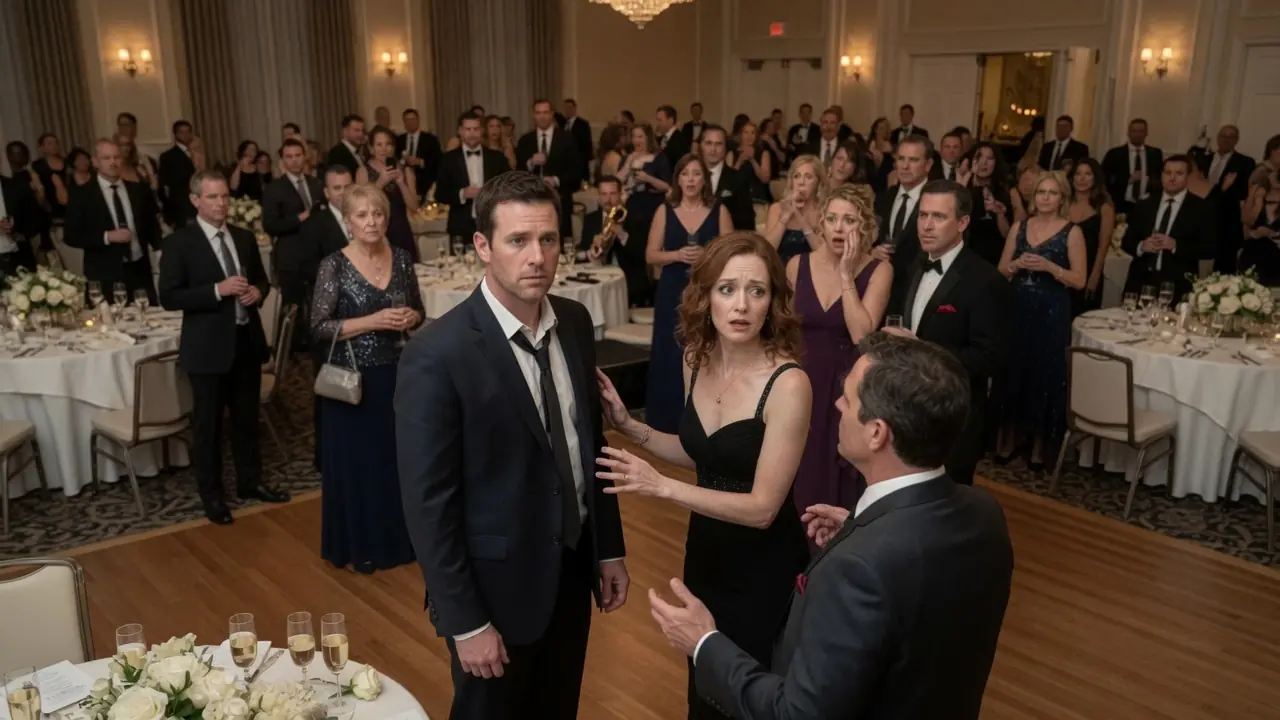
White linen covered round tables, champagne glasses caught the light, floral centerpieces softened the room, and a small band played near the dance floor. Guests were dressed in formal evening clothes, smiling over donation cards and polite conversations. I stood at the edge of the room and watched my wife hold another man’s hand like it belonged there. I watched her laugh up at him, sway against him, and kiss him in public.
Then Cindy appeared beside them.
She hugged Becky, laughed with Greg, and acted like nothing in the room was rotten. That was the moment my anger went cold. Until then, I had known Cindy helped, but seeing her stand there in the flesh made the betrayal complete. She had eaten at my table, celebrated in my house, smiled at me across rooms, and still helped my wife make a fool of me.
I moved through the crowd like people were parting before a storm.
Becky noticed the movement before she noticed me. When she turned and saw my face, every bit of color drained from hers. Her hand was still in Greg’s, and she let go too late. Greg gave me a happy, stupid smile, the kind a man wears when he has no idea judgment is standing right in front of him.
“Friend of yours, honey?” he asked her.
“No,” I said. “Husband.”
His face changed instantly.
Becky reached for me, already saying my name, already trying to pull the scene somewhere private. “Jace, honey, it’s not what it looks like.”
I stared at her and heard myself answer with a calm that scared even me. “Give it up, Becky. It is exactly what it looks like.”
The music faltered, and conversations died around us.
Greg tried to step away, but I called him out loud enough for half the room to hear. I asked where he thought he was going and whether he had the guts to stand beside the woman he had been sleeping with now that things were no longer easy. Becky begged me to stop, but I pulled my arm free and kept my eyes on her. I told her we were done, right there, in front of everyone.
Then I turned to Cindy.
She looked terrified.
I told her never to speak to me again. Then I asked the one question that mattered: did Alan know? Alan was my business partner, her husband, and one of the few men I had trusted with both my livelihood and my friendship. Cindy’s silence told me everything. I told her to tell Alan we were finished as partners.
That night ended my marriage, my business partnership, and most of my friendships in the space of five minutes.
Afterward, Becky called. Alan called. Cindy called. Everyone called. I did not answer. I let my lawyer handle the divorce, kept my regular phone locked away for business only, and moved through the following months like a man living behind glass.
The paperwork was eventually filed, and my offer was more than fair.
I proposed an even split, no cruelty, no public war, no unnecessary destruction. Becky still fought hard. She wanted counseling. She wanted meetings. She wanted chances to explain, apologize, cry, and rebuild something that no longer had a foundation. I refused because forgiveness without trust is just surrender wearing a nicer name.
The judge asked if I was truly certain the marriage could not be saved.
I told him yes.
I said I would not live with Becky again, would not have a relationship with her again, and would not pretend there was still a marriage when the vows had already been broken. Becky tested that resolve more than once, and I paid for it in ways I had not expected. But the longer she pushed, the more certain I became that the woman I loved was gone, or maybe she had never existed exactly as I believed.
Six months after that gala, I found Marge’s bar.
It was in another town, quiet enough that nobody knew my story unless I chose to tell it. Marge owned the place with her husband, and she had the sharp eyes of a woman who had watched men drink themselves through heartbreak for decades. She never pushed, never judged, and never gave advice unless I invited it. That was why I liked her.
One night, after enough beers, I told her almost everything.
She listened, wiped the bar, and finally said I had probably done the right thing by leaving. Then she added that hearing Becky’s side might help me understand how it all went wrong, even if it did not change anything. I told her I would think about it. Then she gave me the next beer on the house and took my keys, because she was the kind of bartender who would let a man drink but not let him kill himself driving home.
That was where I sat when the old crowd arrived.
Todd came first, looking uncomfortable. Behind him were two other men, and at a table sat the women who had clearly dragged them there. I could see the mission in their faces. They had come to talk sense into me, which meant they had already decided I was the unreasonable one.
Todd stood beside me and said, “Hey, Jace. How you doing?”
“I’m fine,” I said. “The family’s fine. Everybody is fine. Cut to the chase, Todd. What do you want?”
That shook him.
He said the women were upset because Becky was miserable. He said none of them wanted to get involved, but Becky had been crying, and everyone thought I was being too hard over something she regretted. He spoke like regret repaired broken trust automatically, like sorrow erased choice. I let him finish because sometimes people reveal more when you allow them to keep talking.
Then I asked him one simple question.
“If it was your wife cheating, would you let it go?”
He smirked and said that would never happen because his wife loved him. I looked at him and almost laughed. Becky had said the same thing. Love, apparently, did not stop people from lying when desire became more exciting than loyalty.
I told Todd I would give the women ten minutes.
No more.
I also told him that if I talked to them, we were done afterward. No friendship, no check-ins, no pretending this was a bridge that could be repaired. He nodded, angry but cornered, and went back to the table. I watched in the mirror as heads snapped up and arguments started before I even left my stool.
Sandy came over first.
He apologized, said I did not deserve any of it, and admitted he was ashamed they had come. He told me Tina had insisted, but he was done meddling. I shook his hand because I had always liked Sandy. Some people make mistakes because they are weak, not because they are rotten. There is a difference.
Then I walked to the table.
The women stared at me like I was the problem to be solved. I sat down, took out my phone, and set a ten-minute timer. That irritated them immediately, which was good. I wanted them to understand they were not in control of this conversation.
“You’re on the clock,” I said. “Go.”
Carrie was the spokesperson.
She began with the usual phrases. It was none of their business, but they cared. Becky was sorry. She never meant for it to happen. She was miserable, her parents barely spoke to her, and her boss had her on probation. Carrie said it was time for me to swallow my pride and take Becky back.
That was when I slammed my hand down on the table.
They nearly jumped out of their seats.
“Finally,” I said. “Somebody understands. You’re right. It was none of your business. So why are you here?”
The bar went quiet around us.
I asked where their concern had been when Becky was cheating. I asked why none of them had warned me. I asked why their compassion only appeared after the truth came out, after Becky was suffering consequences, after I was already humiliated. One word from any of them could have saved me months of lies, but they had chosen silence.
Carrie tried again.
She said Becky made a mistake. She said everyone deserves forgiveness. She said love should matter more than pride, and I almost admired how confidently she used words she had not earned. The others nodded because that was easier than looking at what they had done.
So I let them walk into their own trap.
I asked Carrie if she would forgive George if he cheated on her. She shifted uncomfortably but said that in time, if he was truly sorry, she hoped she could. Then I asked if she would forgive the woman too, especially if that woman was someone she knew, someone close, maybe even a friend. That made the table tense.
All at once, their faces changed.
They knew where I was going before Carrie did.
I smiled without warmth. “That’s good,” I said. “Because Jan and George have been cheating for about eight months.”
The silence was absolute.
Carrie’s face went white. Jan stared at the table like the wood grain had become fascinating. George stiffened in his chair, his hand frozen halfway around his glass. Tina’s mouth opened, but nothing came out. The people who had come to teach me forgiveness suddenly looked like students who had never studied their own lesson.
I leaned back and let the truth spread through them.
I told Carrie that when I first heard the rumor, I did not believe it. Then other things demanded my attention, and eventually I stopped caring enough to warn anyone. I told her maybe she deserved to find out the way I had, surrounded by people who knew and chose silence. That was cruel, but it was also honest.
Then I turned to the rest of the table.
“So let the healing begin,” I said.
No one moved.
I told Carrie to forgive Jan right there, since forgiveness was so easy when they were preaching it to me. I told Jan that in four months she could promise not to cheat again, and then everybody could say the marriage was stronger than ever. I told them maybe we could get Todd and George over too and do a blanket healing ceremony for the whole table.
The sarcasm cut deeper because every word echoed what they had tried to sell me.
Then I warned Carrie not to throw too many stones because Becky had told me things when she was drunk. Secrets, weekends, names, details. I did not need to use them all. I only needed enough to remind that table that hypocrisy has a memory.
The explosion came after that.
Carrie began crying. George started denying. Jan snapped at him for denying too quickly. Tina covered her face with both hands. Someone cursed. Someone else stood so fast a chair scraped backward across the floor. The righteous little intervention became a collapse of accusations, shame, panic, and betrayal.
Marge walked over and told them to quiet down or leave.
She did not ask what happened.
She did not need to.
I stood slowly and looked around the table one last time. “We’re finished talking about me and Becky,” I said. “Looks like you all have plenty to discuss without me.”
Then I left them there.
That was my unexpected revenge.
I did not swing a fist. I did not chase Greg through parking lots. I did not beg Becky to understand what she had done. I simply took the mirror they had pointed at me and turned it back toward them. They came to call me bitter, stubborn, and cruel, but they left with their own homes cracking beneath the weight of truth.
Later, Tina came to me with her head down.
She apologized quietly. She said they had thought Becky and I were the best of them, that our marriage had seemed so strong she refused to believe it could really be over. She said no one had expected my reaction. I told her that was the problem with betrayal: no one gets to decide how badly another person is allowed to bleed.
Then she asked if I was really done with Becky.
“Yes,” I said. “I am.”
I told her she and Sandy still had a chance to be better than the others, but only if they learned from what had happened. I told her to go home, love her husband, and remember that no one can ever be certain how someone will react to cheating. Sandy came over, apologized again, and they left holding hands. I hoped they made it.
The rest of that group did not look like they would.
Marge watched them go and said the divorce court in my old town was probably about to get busier. I handed her my keys and money for a cab, then switched from beer to whiskey. I was surprised by my own reaction. Part of me felt guilty for detonating the truth like that, but another part felt strangely clean.
For months, they had told themselves my pain was excessive.
Now they knew pain was only unreasonable until it moved into their own house.
The divorce did not become easy after that, but something in me settled. I still loved Becky in a place I could not reach without hurting myself, but love was not enough anymore. Trust was the issue, and trust had been murdered twice. Once when she cheated, and again when everyone around us tried to convince me the murder was survivable.
Eventually, Becky and I sat in counseling because I wanted the fight to end.
She apologized beautifully. She cried, admitted she had ruined a good marriage, and said she would spend the rest of her life proving she could be trusted again. But every time she said trust, I saw Greg’s hand holding hers at the gala. I saw Cindy laughing beside them. I saw all those friends sitting at Marge’s table telling me to swallow betrayal like medicine.
I told Becky the truth as gently as I could.
I still loved her, but I would never trust her again.
A marriage without trust is not a marriage. It is a locked room where one person spends the rest of his life checking windows. I told her I did not want to become a jailer, and I did not want her to become a prisoner. She deserved the consequences of her choices, and I deserved a life where I did not have to investigate the person sleeping beside me.
She cried when I walked out.
I cried later, where no one could see.
The final hearing ended the marriage, but not the damage. My business partnership collapsed because Alan and Cindy had helped Becky cover the affair, and clients started backing away when the story spread. I lost friends, the house, and the version of myself that had believed loyalty was common if you gave it first. For a while, I thought losing all of it meant I had failed.
Then I moved.
Three states away, I found a small cottage near the mountains, a job at a smaller agency, and a quiet place where nobody knew Becky’s name. I rode my motorcycle on weekends and slowly learned how to breathe without anger sitting on my chest. I met people who had no reason to lie to me. I found a bar where strangers became friends because they judged a man by how he acted in front of them, not by old gossip.
Eventually, I met Amanda.
She was younger, fierce, wounded, loud, and kinder than she knew. She had survived more than anyone should, and somehow she still knew how to give loyalty without turning it into a performance. She did not save me because people do not save each other that neatly. But she gave me reasons to stop living like my whole future had ended in one ballroom.
Years later, at an advertising awards event, I saw Becky again.
She was still beautiful, though time had softened and sharpened her in different places. She congratulated me, noticed my wedding ring, and asked the question I think had been waiting inside her for years. Did I ever think about her late at night? Did I ever wonder what would have happened if I had forgiven her?
I told her the truth.
I used to think about her a lot.
Then I met Amanda, and Becky became a distant memory. Not erased, not hated, just far away. Sometimes a song or a smell or a phrase would bring back a good moment, but it never lasted. The life I had now was built from honesty, and I would not trade it for a memory of someone who had already proven she could break me.
Becky grabbed my hand and said we could start over.
She said she would leave her husband in a minute if I would take her back.
I pulled my hand away gently, and for the first time, I felt more sadness than anger. “No, Becky,” I said. “If we were meant to be, you would never have cheated. And if you had never cheated, I would never have found the life I have now.”
Then Amanda appeared beside me and slipped her hand into mine.
She smiled politely and asked who my friend was. I introduced Becky as someone I used to know. The words sounded cruel, but they were not. They were simply true. Becky belonged to a chapter I had finally stopped rereading.
That night, Amanda told me she was pregnant.
A boy.
The only thing that mattered in that moment was the woman in front of me, the life we had built, and the future I had almost believed was no longer available. I held her and cried without shame. Becky stood behind us somewhere, but for once I did not feel the pull of the past. I felt only release.
Betrayal took my marriage, my friends, and the life I thought I wanted.
But it also revealed every false face around me.
My revenge was not destroying Becky. It was refusing to let her betrayal define the rest of my life. It was exposing the friends who preached forgiveness while hiding their own sins. It was walking away from people who only valued truth after it wounded them personally.
And in the end, the best revenge was not anger.
It was building a life so honest that the old lies had nowhere left to live.