The Old Man Walked Into a Luxury Hotel — Then the Manager Turned Pale Reading His Name
The storm arrived over Manhattan just before seven in the evening.
Rain struck the tall glass entrance doors of the Imperial Palace Hotel in hard silver sheets. Wind pushed water across the sidewalk, bending umbrellas and forcing even the wealthiest guests to hurry beneath the hotel’s wide brass canopy.
Inside, the lobby glowed beneath crystal chandeliers.
Polished marble reflected the light. Velvet sofas stood beneath tall flower arrangements. Guests in evening gowns and tailored suits crossed the floor toward private dinners, business meetings, and a charity gala taking place in the ballroom upstairs.
At 7:18, the revolving door turned slowly.
An elderly man stepped inside.
He was thin, perhaps seventy-six, with weathered fair skin, neatly combed silver hair, calm gray eyes, and a short white beard. Rainwater clung to his faded brown overcoat and old gray scarf.
His leather shoes were badly worn.
A scratched silver watch showed beneath one sleeve.
Beside him stood a battered brown suitcase with frayed corners and a handle repaired by hand.
The man paused just inside the lobby.
He did not appear overwhelmed by the chandeliers or the polished gold trim.
Instead, he looked around with the quiet attention of someone checking whether something remembered had remained the same.
His eyes moved toward the reception desk.
Then toward the broad staircase.
Finally, toward the brass clock mounted above the concierge station.
The clock was three minutes slow.
A faint expression crossed his face.
Not surprise.
Recognition.
Behind the front desk, Claire Bennett looked up from her computer.
At twenty-eight, Claire had worked at the Imperial Palace for four years. She was efficient, well groomed, and skilled at identifying which guests deserved immediate attention.
Her blonde hair was arranged in a neat bun.
Her black uniform fitted perfectly.
A gold name badge rested above her left pocket.
She glanced first at the old man’s coat.
Then at his suitcase.
Finally, at the muddy water gathering beneath his shoes.
The smile she gave him was professionally shaped, but not warm.
“Good evening, sir.”
The man approached the desk.
“Good evening.”
His voice was quiet and steady.
“I need a room for the night.”
Claire looked briefly toward the line of well-dressed guests waiting near the concierge.
The hotel was nearly full.
There were still rooms available, but none of them inexpensive.
She did not check the computer immediately.
“We only have suites remaining tonight.”
The meaning beneath her words was obvious.
The old man understood it.
“What suites?”
“The Metropolitan Suite and the Presidential Suite.”
“I’ll take the Presidential Suite.”
Claire stared at him.
Two employees standing behind her exchanged glances.
One of them lowered his head to hide a smile.
Claire looked at the old suitcase again.
“The Presidential Suite is twelve thousand five hundred dollars per night.”
“That will be fine.”
“That does not include taxes or additional services.”
“I understand.”
A young bellman standing nearby turned away, but not before the elderly man saw him smirking.
Claire finally entered the request.
“How will you be paying?”
“By card.”
The old man reached into his coat and removed a black payment card.
He held it between two fingers and placed it on the marble counter.
Claire picked it up.
The card was heavier than ordinary plastic, with a small silver crest stamped into one corner.
Across the front was a name.
ARTHUR WHITMORE.
Claire did not recognize it.
She inserted the card into the terminal.
The screen processed for less than a second.
APPROVED.
Claire stared at the result.
The old man waited without speaking.
She removed the card.
“There may be an authorization delay.”
“The screen says approved.”
“Yes, but for a room of this value, we require additional verification.”
The hotel required identification from every guest.
But Claire’s tone made it sound less like procedure and more like suspicion.
“I’ll need your passport.”
Arthur reached into the inside pocket of his coat and removed a dark blue passport.
He passed it across the desk.
Claire opened it.
The photograph matched.
The age matched.
The name matched.
ARTHUR JAMES WHITMORE.
She entered the name into the hotel system.
A red message appeared.
RESTRICTED EXECUTIVE PROFILE.
CONTACT GENERAL MANAGER IMMEDIATELY.
Claire frowned.
She clicked the notification.
A second message appeared.
ACCESS DENIED.
She looked toward the glass office behind the reception area.
“Please wait one moment.”
Arthur nodded.
“Of course.”
Claire carried the passport into the manager’s office.
Richard Cole stood beside a desk covered in event schedules and financial reports.
At forty-nine, Richard was tall and heavyset, with carefully styled brown hair and narrow hazel eyes. He wore a tailored navy suit, burgundy tie, polished shoes, and the gold badge of the Imperial Palace.
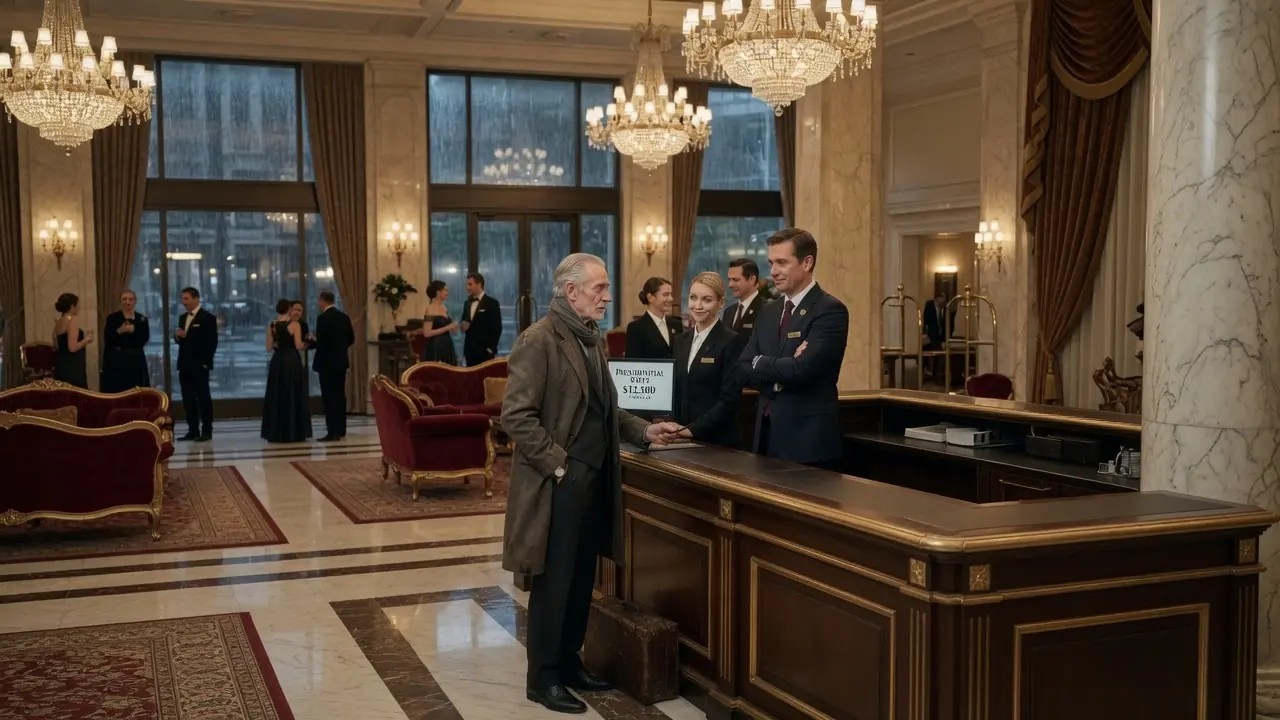
He looked up impatiently.
“What is it?”
“There’s a guest requesting the Presidential Suite.”
“Then check him in.”
“His profile says I have to contact you.”
Richard glanced through the glass wall.
He saw Arthur standing beside the old suitcase.
His expression shifted into mild amusement.
“That man?”
“Yes.”
“What did the card say?”
“Approved.”
“Whose card?”
“His.”
Claire handed him the passport.
Richard opened it.
He read the name.
Then read it again.
His face changed.
The confidence left first.
Then the color.
His fingers tightened around the passport.
Claire noticed immediately.
“Do you know him?”
Richard did not answer.
He looked through the office glass toward Arthur.
The old man stood quietly at the desk while hotel employees whispered nearby.
One employee appeared to be photographing the suitcase with his phone.
Richard’s stomach dropped.
He had seen Arthur Whitmore only twice.
The first time was in an old corporate photograph hanging at the Whitmore International headquarters in London.
The second was during a private executive conference seven years earlier.
Arthur had been younger then.
His hair had contained more silver than white.
But the eyes were unmistakable.
Arthur Whitmore was the founder and majority owner of Whitmore International Hotels.
The company owned the Imperial Palace.
More importantly, Arthur personally controlled the trust that held the hotel’s building, branding rights, and management contract.
Richard was not looking at an eccentric guest.
He was looking at the man who could remove him before breakfast.
Richard rushed from the office.
“Mr. Whitmore.”
His voice cut across the lobby.
The employees stopped whispering.
Claire returned slowly behind him.
Arthur turned.
“Yes?”
Richard extended a hand, then seemed unsure whether such familiarity was appropriate.
“Welcome to the Imperial Palace, sir.”
“I believe I have already been welcomed.”
Arthur’s eyes shifted briefly toward Claire.
Richard’s hand fell.
“I apologize that I was not informed of your arrival.”
“I did not inform anyone.”
“Of course.”
“I requested a room.”
“Yes, sir. The Presidential Suite will be prepared immediately.”
“It appears to have already been available.”
Richard swallowed.
“Certainly.”
He turned toward the staff.
“Bring fresh flowers to the suite. Champagne. Contact the executive chef. Inform security and guest relations that Mr. Whitmore has arrived.”
Arthur raised one hand.
“No.”
Richard stopped.
“I asked for a room.”
“Yes.”
“Not a parade.”
The lobby had grown quiet.
Several wealthy guests were openly watching now.
Richard lowered his voice.
“Perhaps we could speak privately.”
“We will.”
“When?”
“Tomorrow morning.”
Arthur collected his passport and black card from Claire.
She could no longer meet his eyes.
The bellman rushed forward.
“Allow me to take your luggage, Mr. Whitmore.”
Arthur rested one hand on the battered suitcase.
“No.”
“Sir, it would be my pleasure.”
“I carried it into the hotel.”
The bellman stepped back.
Arthur took the key card Claire had prepared.
Then he walked toward the elevators.
Richard followed several steps behind.
“Mr. Whitmore, may I ask the reason for your visit?”
Arthur pressed the elevator button.
“You may ask.”
Richard waited.
The elevator doors opened.
Arthur turned toward him.
“I wanted to see how this hotel treated a man whose name it did not recognize.”
Then he entered the elevator.
The doors closed.
Richard remained in the lobby.
No employee laughed now.
Arthur rode alone to the thirty-sixth floor.
He was tired.
His knees ached.
His wet coat had become heavy across his shoulders.
But none of that surprised him.
The coat had belonged to his older brother, Henry.
The suitcase had belonged to their father.
Arthur could have arrived in a chauffeured car.
He could have traveled with assistants, security officers, and hotel executives waiting beneath the canopy.
Instead, he had taken a train from Boston.
He walked the final four blocks through the rain.
He had chosen the old clothes deliberately.
Not to trick anyone.
To remove the advantages his name usually provided.
For several months, Arthur had received troubling reports about the Imperial Palace.
Guest complaints had increased.
Former employees described a culture based on fear, appearance, and status.
Housekeepers reported impossible workloads.
Maintenance staff claimed repairs were delayed unless they affected premium rooms.
Security employees said casually dressed visitors were treated as threats while wealthy guests were rarely questioned.
Richard dismissed the reports as isolated incidents.
Arthur did not.
He had built his first hotel forty-eight years earlier.
It had twenty-six rooms, mismatched carpets, and plumbing that failed almost every week.
He knew luxury was valuable.
But he also knew luxury and dignity were not the same thing.
Arthur had grown up in a small Pennsylvania town where his father repaired luggage and shoes.
His mother cleaned rooms at a roadside inn.
The family often had little money.
When Arthur was fifteen, the owner of that inn allowed a stranded family to sleep in the dining room during a snowstorm because they could not afford a room.
Arthur remembered the children sleeping beneath tablecloths.
He remembered his mother bringing them soup after midnight.
That night shaped the business he later created.
The first rule in every Whitmore employee handbook came from it.
Never measure a guest’s worth before learning what they need.
The rule still appeared in training materials.
It was printed on corporate walls.
But Arthur feared it had become decoration.
The elevator opened.
The Presidential Suite occupied the eastern side of the floor.
A supervisor waited outside with two attendants and a tray of champagne.
Arthur looked at them.
“How long have you been standing here?”
The supervisor hesitated.
“Only a few minutes.”
“Who told you to come?”
“Mr. Cole.”
“I do not drink champagne.”
“We can replace it.”
“I do not need anything replaced.”
Arthur opened the suite.
The attendants followed.
He turned.
“I would like to be alone.”
They left immediately.
Inside, the suite offered a wide view of Manhattan.
The furniture was custom made.
Fresh flowers had already appeared on the table.
A card lay beside them.
WELCOME, MR. WHITMORE.
WE ARE HONORED BY YOUR PRESENCE.
Arthur picked it up.
The ink was still wet.
He placed it facedown.
Then he inspected the room.
Dust along one air vent.
A loose drawer handle.
A faint water stain near the bathroom ceiling.
A lightbulb that flickered twice before remaining on.
None of the problems was serious.
Together, they told a story.
The hotel invested heavily in what guests saw first.
The details were being neglected.
Just like the people.
At 9:14, someone knocked.
Arthur opened the door.
Richard stood outside with Claire, the executive chef, and the director of guest relations.
“Mr. Whitmore,” Richard began, “we wanted to personally apologize.”
“I asked to speak tomorrow.”
Richard forced a smile.
“We believed it would be better to address the misunderstanding tonight.”
“There was no misunderstanding.”
Claire lowered her head.
Arthur looked at the chef and guest relations director.
“You may both leave.”
They did.
Claire remained because Richard had brought her.
Arthur looked toward her.
“Why did you laugh?”
She looked startled.
“I did not mean—”
“That is not what I asked.”
Claire glanced at Richard.
Arthur noticed.
“Answer without seeking permission from your manager.”
Her face reddened.
“I thought the request was a joke.”
“Why?”
She looked toward his coat.
Arthur waited.
“Because of how you were dressed.”
“And what did my clothing tell you?”
“That you probably could not afford the room.”
The answer came quietly.
Arthur nodded.
“Thank you for answering honestly.”
Richard stepped forward.
“Sir, Claire is a junior employee. She made an error in judgment.”
Arthur looked toward him.
“You laughed too.”
Richard’s mouth tightened.
“I may have reacted poorly.”
“You reacted according to the culture you created.”
“That is unfair.”
“Is it?”
Arthur moved toward the dining table.
He placed several printed reports on the surface.
Richard recognized the corporate markings.
“During the last eighteen months, this hotel received forty-three formal complaints involving appearance-based treatment.”
Richard frowned.
“Many of those complaints were reviewed.”
“They were dismissed.”
“Because they lacked evidence.”
Arthur looked at Claire.
“Was she trained to suspect guests based on appearance?”
Richard did not answer.
Claire did.
“Yes.”
Richard turned sharply.
“No one told you that.”
“We were told to identify potential non-guests before they disturbed premium clients.”
Arthur’s gaze returned to Richard.
“What qualifies someone as a potential non-guest?”
Claire swallowed.
“Clothing. Luggage. Behavior.”
“Skin color?” Arthur asked.
Richard stepped in.
“Absolutely not.”
Claire remained silent.
Arthur noticed.
“Thank you, Ms. Bennett. You may go.”
Claire looked toward Richard.
Arthur repeated himself.
“You may go.”
She left.
Richard waited until the door closed.
“You embarrassed me in front of an employee.”
Arthur looked toward the flowers.
“Your concern remains your own dignity.”
“I have managed this hotel successfully for six years.”
“Revenue has increased.”
“Exactly.”
“Employee turnover has nearly doubled.”
“The labor market changed.”
“Housekeeping injuries increased.”
“Those numbers are common across the industry.”
“Guest complaints regarding discriminatory treatment tripled.”
Richard’s expression hardened.
“This is a luxury hotel. Our clients expect a controlled environment.”
“A controlled environment is not the same as a hostile one.”
“We have standards.”
Arthur looked at his worn coat.
“For clothing?”
“For behavior.”
“I behaved calmly.”
Richard said nothing.
Arthur opened the old suitcase.
Inside were several folded shirts, a photograph, a leather ledger, and a small set of tools once used by his father.
He removed the ledger.
“This contains the names of every employee at my first hotel.”
Richard looked at the faded pages.
“I knew their spouses, children, illnesses, strengths, and fears.”
“With respect, sir, this property employs more than three hundred people.”
“That makes leadership more difficult.”
Arthur closed the book.
“Not less necessary.”
Richard’s posture stiffened.
“What exactly are you planning?”
“A complete review.”
“Of the hotel?”
“Of you.”
For the first time, Richard’s expression showed fear rather than calculation.
Arthur continued.
“Tomorrow morning, an independent audit team will arrive. They will review payroll, scheduling, complaint handling, security practices, staffing levels, and management communications.”
Richard’s face changed.
“You arranged this before coming.”
“Yes.”
“Then tonight was a test.”
“No.”
Arthur looked directly at him.
“Tonight was confirmation.”
At six-thirty the following morning, Arthur entered the employee cafeteria.
He wore the same faded coat.
The room fell silent.
Kitchen workers, housekeepers, porters, and maintenance staff stopped eating.
Some stood.
Arthur raised one hand.
“Please sit.”
He collected a tray and joined a table occupied by three employees.
A housekeeper named Maria.
A maintenance worker named Joel.
And a laundry attendant named Patricia.
They looked terrified.
Arthur poured coffee.
“What is wrong with this hotel?”
No one answered.
“You may speak freely.”
Still nothing.
Arthur understood.
People did not believe promises of safety from someone who could return to his suite while they returned to supervisors.
He opened the old ledger.
“My mother cleaned hotel rooms.”
Maria looked toward him.
“She worked until her hands cracked in winter. The hotel owner knew her name. When my father became sick, he changed her schedule so she could care for him.”
Arthur looked around the table.
“That did not make him generous. It made him aware.”
Joel spoke first.
“Repairs are delayed.”
“What kind?”
“Employee areas. Laundry ventilation. Service elevators. Anything guests don’t see.”
Patricia added, “One dryer overheats.”
“Has it been reported?”
“Six times.”
Arthur took out a pen.
Maria watched him.
“Will our names be included?”
“No.”
Her shoulders lowered slightly.
“How many rooms are you expected to clean?” Arthur asked.
“Sometimes eighteen.”
“The company limit is twelve.”
“We are told twelve is a goal, not a rule.”
“Who says that?”
Maria looked toward the door.
“Management.”
More employees joined the conversation.
A porter described unpaid work after clocking out.
A night receptionist said managers changed customer complaint categories to protect ratings.
A security guard admitted he had been told to remove homeless people from the hotel canopy even during dangerous weather.
A kitchen worker said hours disappeared from time sheets.
Arthur wrote everything down.
At eight, Richard entered the cafeteria.
He froze when he saw the crowd around Arthur.
“Sir, the audit team is waiting upstairs.”
“They can wait.”
Richard looked toward the employees.
“This is not the proper channel for complaints.”
Arthur closed the ledger.
“That may be why the proper channels failed.”
By noon, auditors had secured access to payroll systems and management emails.
They found evidence quickly.
Housekeeping schedules exceeded company limits.
Overtime had been altered.
Complaints involving wealthy guests were handled personally while complaints from casually dressed visitors were often marked unverified.
Security instructions used coded language that encouraged profiling.
Richard’s bonus structure rewarded room upgrades, luxury spending, and positive ratings.
It contained no meaningful measure of employee welfare or equal treatment.
The hotel had become profitable.
But it had become profitable by teaching employees that some people mattered more.
At three that afternoon, Arthur called an all-staff meeting in the ballroom.
Nearly every employee attended.
Crystal chandeliers hung above tables usually prepared for weddings and corporate dinners.
Richard stood near the stage with two lawyers.
Claire remained near the back.
Arthur walked to the microphone carrying the battered suitcase.
He placed it beside him.
“When I entered this hotel last night, several people believed I did not belong here.”
The room remained silent.
“They believed my clothes, shoes, and luggage revealed my value.”
Arthur looked toward the reception team.
“That failure did not begin with a single receptionist.”
Claire raised her eyes.
“It began with leadership.”
Richard’s jaw tightened.
Arthur announced immediate changes.
All unpaid overtime would be reviewed and repaid.
Housekeeping room limits would become mandatory.
An independent reporting line would protect employees from retaliation.
Security policies would be rewritten.
Repair priorities would include employee spaces, not only visible guest areas.
Management bonuses would no longer depend solely on revenue and guest spending.
Then Arthur turned.
“Mr. Cole.”
Richard stepped forward.
“Yes, sir.”
“You are suspended effective immediately.”
A murmur moved through the ballroom.
Richard’s face darkened.
“On what grounds?”
“Payroll manipulation, discriminatory practices, retaliation, concealment of complaints, and failure of leadership.”
“You cannot reduce six years of work to one incident.”
“I have not.”
Arthur lifted a folder.
“I have reduced eighteen months of evidence to a decision.”
Richard looked toward the staff.
“This hotel has never earned more money.”
Arthur nodded.
“That is why your failure survived.”
Richard’s face flushed.
“You built this company to make profit.”
“No.”
Arthur’s voice stayed quiet.
“I built it to offer shelter with dignity. Profit allowed the idea to grow.”
He paused.
“You made profit the purpose and dignity the expense.”
Security escorted Richard from the ballroom.
No one applauded.
Arthur had forbidden it.
Richard’s removal was not entertainment.
It was accountability.
After the meeting, Claire waited near the stage.
Most employees had left.
She approached slowly.
“Mr. Whitmore?”
Arthur looked up.
“I understand if I’m being dismissed.”
“Do you believe you should be?”
She struggled to answer.
“I treated you badly.”
“Because I was the owner?”
“No.”
Claire’s eyes filled.
“Because I thought you were nobody.”
Arthur studied her.
“That is a more honest answer.”
“I’m ashamed.”
“Would you be ashamed if my card had been declined?”
Claire did not respond.
Arthur waited.
Finally, she said, “Probably not.”
The admission hurt her.
Arthur nodded.
“That is the problem.”
She wiped one tear away.
“I’m sorry.”
“Are you sorry for embarrassing yourself?”
“At first.”
“And now?”
Claire looked toward the battered suitcase.
“Now I’m sorry that your name had to matter before I saw you as a person.”
Arthur opened the suitcase again.
He removed an old black-and-white photograph.
It showed a roadside inn during a snowstorm.
Several children slept beneath blankets in the dining room.
“My mother took this photograph.”
Claire held it carefully.
“Who are they?”
“A family that could not afford a room.”
“What happened to them?”
“They left the next morning.”
“Did they ever return?”
“Not that I know of.”
Claire looked confused.
Arthur continued.
“They were not secretly wealthy. They did not become important. They never rewarded the owner.”
He pointed toward the photograph.
“He helped because they were cold.”
Claire looked down.
“That is the kind of story people forget.”
“Yes.”
Arthur took back the photograph.
“Because it offers no dramatic reward for decency.”
“What happens to me?”
“You will complete retraining.”
She blinked.
“I’m not fired?”
“Not today.”
“Why?”
“Because removing every person who fails teaches others to hide failure.”
Arthur closed the suitcase.
“Learning may still turn you into the employee you should have been.”
Claire nodded quickly.
“I won’t waste the chance.”
“Do not promise.”
Arthur looked toward the lobby.
“Demonstrate.”
Over the next several months, the Imperial Palace changed.
Not easily.
Some managers resigned.
Others resisted.
Several complained that the new standards weakened the hotel’s luxury identity.
Arthur disagreed.
Luxury remained.
The rooms were still expensive.
The chandeliers still shone.
Guests still arrived in chauffeured cars.
But employees were no longer trained to confuse wealth with worth.
Back pay was issued to dozens of workers.
The overheated laundry equipment was replaced.
Service elevators were repaired.
Housekeeping workloads decreased.
Staff turnover fell.
Guest complaints changed too.
Not all disappeared.
But employees began resolving problems instead of deciding whether the person reporting them deserved attention.
Claire returned to the front desk after completing the new training program.
At first, every casually dressed guest reminded her of Arthur.
Then something more important happened.
She stopped needing the reminder.
One snowy afternoon, a man entered the lobby wearing a paint-covered jacket and work boots.
He said he was waiting for his daughter, whose train had been delayed.
He did not have a reservation.
The old Claire might have asked him to leave.
Instead, she invited him to sit near the fireplace and brought him coffee.
The man thanked her.
Nothing extraordinary happened afterward.
He was not the owner.
He did not carry a black card.
He simply waited for his daughter.
From a chair across the lobby, Arthur watched without revealing himself.
He had returned quietly for a board meeting.
Claire never saw him.
He preferred it that way.
Six months later, she was promoted to guest services supervisor.
The recommendation came from three departments.
Not from Arthur.
A year after the storm, a new brass plaque appeared behind the reception desk.
It carried one sentence.
A PERSON’S DIGNITY MUST NEVER DEPEND ON WHAT WE BELIEVE THEY CAN PAY.
Arthur refused to place his portrait beside it.
“The message is not about me,” he said.
The old coat and battered suitcase were eventually displayed inside the company’s training center.
New employees stopped before them during orientation.
They heard the story of the elderly man who entered the Imperial Palace unnoticed.
Some focused on the black card.
Others focused on Richard’s pale face when he read the passport.
Arthur believed both details distracted from the real lesson.
The card proved he could afford the room.
The passport proved he owned the hotel.
Neither should have been required to earn respect.
Years later, Claire became general manager of another Whitmore property.
On her first day, she removed a private entrance sign that directed important guests away from the main lobby.
She kept one photograph in her office.
The picture Arthur’s mother had taken at the roadside inn.
The family sleeping beneath dining-room blankets.
The people who never became wealthy.
Never returned with a reward.
Never discovered the owner had secretly tested his staff.
They remained ordinary strangers who had been cold.
That was why the photograph mattered.
Arthur Whitmore died at eighty-eight.
The Imperial Palace lowered its flags for three days.
Executives delivered speeches about his business achievements.
Sixty-three hotels.
Thousands of employees.
Decades of growth.
Claire remembered something smaller.
An old man standing at a marble desk.
A black card between two fingers.
A calm expression while people laughed around him.
Arthur had never raised his voice that night.
He did not need to.
His name made the manager turn pale.
But his identity was not the reason the hotel changed.
It changed because Arthur forced everyone inside it to confront a difficult question.
How would they have treated him if the passport had carried an ordinary name?
If the card had been declined?
If the old coat had belonged to a man who owned nothing?
That question remained long after Arthur was gone.
It lived in every employee who looked up as a tired stranger approached the desk.
In every security officer deciding whether appearance was evidence.
In every manager choosing between profit and people.
The hotel had recognized Arthur Whitmore only when it discovered his power.
His final lesson was that true hospitality began much earlier.
It began before the name.
Before the card.
Before anyone knew whether kindness would be rewarded.