Robert Hale had not planned to enter the Sterling Grand Hotel that morning. He had only meant to stand outside beneath the polished brass awning for a few minutes, catch his breath, and rest his aching legs before walking the final blocks to the veterans’ clinic. The January air in downtown Chicago cut through his torn olive coat, and the wind pushed hard between the tall buildings like it had somewhere cruel to be. At eighty-one, Robert had learned to keep moving even when his body asked him to stop.
The hotel lobby beyond the glass doors looked unreal from the sidewalk. Marble floors shone beneath tall cream pillars, crystal lights glittered above velvet seating areas, and guests moved through the space pulling expensive luggage behind them. Robert looked down at his own boots, cracked at the sides and darkened with old salt stains. Then he touched the inside pocket of his coat, where a small faded photograph rested inside a plastic sleeve.
He had carried that photograph for nearly fifty years. The edges were burned brown, the image faded to gray, and the faces inside it were younger than memory should have allowed. In the picture, a group of exhausted young soldiers knelt beneath jungle trees, their uniforms dirty, their eyes fixed toward a camera none of them had expected to survive long enough to remember. Near the center was Robert Hale, twenty-three years old, one arm wrapped around a wounded man whose name had become part of his life’s quiet burden.
That man had been Henry Sterling. Before the hotel empire, before the wealth, before the Sterling family name was carved in brass above marble entrances, Henry Sterling had been a frightened young man far from home. Robert had carried him through smoke, rain, and panic when everyone else thought he was gone. Henry lived because Robert refused to leave him behind.
Robert did not come to the Sterling Grand to ask for repayment. He did not want money, a room, or pity. He wanted to see the place Henry had built after coming home, the place mentioned in old newspaper clippings Robert had saved in a box beside his bed. Henry had written him once, decades ago, promising that if Robert ever passed through Chicago, he would always have a chair in any Sterling lobby.
But Henry had died twelve years earlier, and promises sometimes died with the men who made them. Robert knew that. Still, the clinic was not open for another hour, and the cold had settled into his bones. So he pushed through the glass doors and stepped inside.
The warmth hit him first. Then the smell of polished wood, fresh flowers, expensive soap, and coffee from the lobby café. A doorman glanced at him, frowned, and then looked toward the front desk. Robert removed his cap out of habit and held it in both hands as he walked toward a velvet chair near the window.
He sat down slowly, not sinking into the chair so much as folding into it. His knees throbbed, and his fingers trembled as he reached inside his coat to make sure the photograph was still there. Guests looked at him, then away. Some with curiosity, some with discomfort, some with the quick judgment people make when they see worn clothes in a beautiful place.
Robert was used to that. Age had made him almost invisible in some rooms and too visible in others. People saw the torn coat, the gray beard, the unsteady hands, and built a whole story around him before he said a word. He had learned that dignity was sometimes something a man had to carry privately, even when strangers refused to see it.
Victor Lang saw him from across the lobby. Victor was the hotel manager, thirty-nine years old, perfectly dressed in a navy pinstripe suit, with polished shoes and brown hair combed into a careful shape. He had spent the morning preparing for an investor luncheon and a surprise visit from the hotel’s CEO, Evelyn Sterling. The last thing he wanted in his lobby was an old man in rags sitting beneath a chandelier.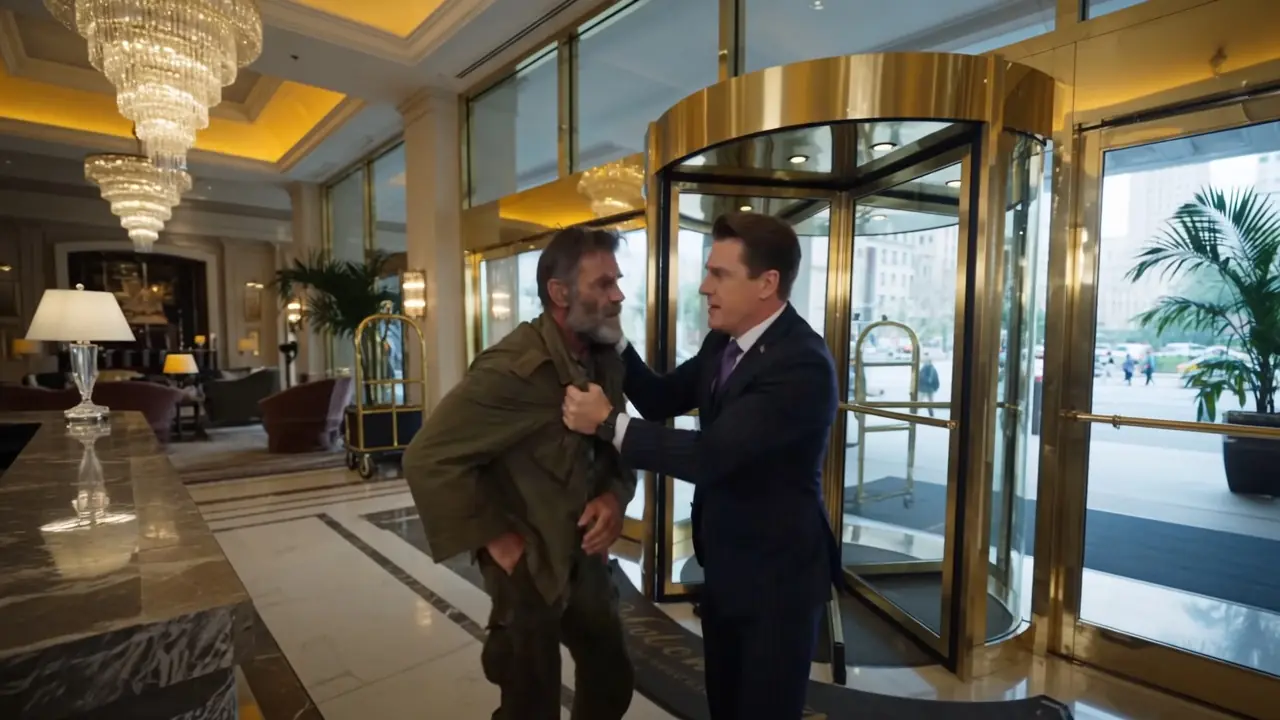
Victor crossed the marble floor with a tight smile that did not reach his eyes. “Sir,” he said, stopping in front of Robert. “This seating area is reserved for hotel guests.” Robert looked up gently. “I understand. I only need to sit for a moment.”
Victor’s nostrils flared slightly. “Are you staying with us?” Robert shook his head. “No.” The answer was honest, and honesty gave Victor all the permission he needed to be cruel.
“Then you need to leave,” Victor said. Robert placed both hands on his knees and tried to stand, but the movement was slow. “I will,” he said quietly. “May I have a glass of water first?” Victor’s expression hardened as if the request itself had stained the room.
“This is not a shelter,” Victor said. His voice was low at first, but loud enough for the front desk staff to hear. “We have guests paying eight hundred dollars a night. They should not have to walk past someone sleeping in the lobby.”
Robert looked at him carefully. “I was not sleeping.” Victor ignored that. “You’re creating discomfort.” A young front desk clerk lowered her eyes, pretending to type while listening to every word.
Robert reached into his coat again, intending to remove the photograph and perhaps explain why he had come. But Victor stepped closer, mistaking the movement for stubbornness. “Do not start pulling things out,” he snapped. “Just stand up and go.”
The photograph slipped halfway from Robert’s pocket. Victor saw only a dirty plastic sleeve and a trembling hand. “Whatever you’re selling, we’re not interested.” His tone sharpened, and several guests near the lobby café turned to watch. Robert’s face grew still.
“I am not selling anything,” he said. “I knew someone who belonged to this family.” Victor laughed once, cold and dismissive. “Of course you did.” He leaned closer, his smile cruel now. “Everyone who gets caught loitering suddenly knows someone important.”
Robert’s fingers tightened around his cap. “His name was Henry Sterling.” That name should have meant something in that lobby, but Victor only saw an old man trying to buy time. He stepped forward and grabbed the front of Robert’s torn coat, not hard enough to injure him, but hard enough to strip the room of silence.
“Listen to me,” Victor said, smiling through clenched teeth. “This hotel is for guests, not beggars in rags.” Robert’s eyes widened, not with fear, but with a pain deeper than fear. The same uniform cloth that had once carried honor was now being treated like garbage by a man who had never earned the right to touch it.
A uniformed security officer near the entrance noticed and started over. A Chicago police officer, already in the lobby speaking with the concierge about traffic control for the luncheon, turned as well. Victor seemed pleased by the attention because authority, in his mind, would make his cruelty look like policy. He released Robert’s collar and pointed toward the doors.
Robert remained standing, though his shoulders were slightly bent. “These rags carried more honor than your suit ever will,” he said softly. Victor’s face tightened. A few guests whispered at the sentence, sensing something beneath it that Victor did not.
“Honor does not pay for rooms,” Victor snapped. “And stories do not give you the right to sit wherever you want.” Robert lowered his gaze, his hand still inside his coat, touching the photograph. The security officer stopped a few feet away, uncertain.
Victor turned slightly toward the officer. “Please escort him out.” Robert lifted his head again. “I only asked for water.” Victor’s smile returned, thin and ugly. “If you don’t get out of here, I’ll call security to throw you out.”
The lobby went quiet. The front desk clerk’s fingers froze above her keyboard. The police officer looked from Victor to Robert, not stepping in yet, but watching closely now. Robert took one slow breath and removed the photograph from his pocket.
It slipped from his trembling hand before he could fully raise it. The small image fluttered down and landed faceup on the marble floor between them. Victor glanced at it with irritation, ready to kick it aside, but the police officer bent and picked it up before he could. The officer looked at the faded picture and paused.
The image showed young men in uniform, mud on their faces, trees behind them, and a wounded soldier being held up by another man. The officer studied the faces, then looked at Robert. Something in his expression changed from duty to respect.
Before anyone could ask a question, the elevator doors opened at the far end of the lobby. Evelyn Sterling stepped out with two assistants behind her, dressed in a cream business suit, her dark hair pulled back, her posture calm and commanding. At forty-six, she had run Sterling Hospitality for six years and carried her father’s legacy with a seriousness that made even senior executives stand straighter. She had come to inspect preparations for the investor luncheon, but one glance across the lobby stopped her cold.
She saw Victor standing over an old man in a torn coat. She saw the security officer holding a photograph. She saw the stiffness in the room, the embarrassed staff, the guests pretending not to stare. Evelyn walked forward without waiting for her assistants.
“What is happening here?” she asked. Victor turned quickly, forcing his face into a professional expression. “Ms. Sterling, I’m handling a lobby disturbance. This gentleman refuses to leave and has been making claims about knowing your family.”
Robert looked at her then. For a moment, Evelyn saw only an old man with tired eyes and a coat that had lived through hard weather. Then she saw the photograph in the officer’s hand. The officer handed it to her carefully.
Evelyn looked down. Her breath caught so sharply that one of her assistants reached toward her arm. In the photograph, she saw her father as a young man, not the silver-haired founder she remembered from boardrooms and charity dinners, but a frightened soldier with his face half-turned toward the camera. Beside him, holding him upright, was the same old man standing in the lobby now.
She knew that photograph. Not this exact copy, but the image. Her father had kept a similar one in his study, locked in a drawer beside letters he reread only when he thought the house was asleep. Evelyn remembered asking about it as a child. Henry Sterling had touched the picture with one finger and said, “That man carried me home.”
Her hand began to tremble. “Where did you get this?” she asked, though she already knew. Robert straightened as much as his body allowed. “Your father gave me a copy before we separated after the war.”
Victor’s smile faltered. “Ms. Sterling, he could have found that anywhere.” Evelyn did not look at him. Her eyes stayed on Robert’s face, moving from the gray beard to the tired eyes to the faint scar near his temple that matched the man in her father’s photograph. The years had changed him, but not enough.
“Your name?” she asked quietly. “Robert Hale,” he said. Evelyn’s lips parted. The name struck her harder than the photograph. Robert Hale was not just a story in her family; he was the missing name in every Thanksgiving toast her father made when he raised his glass and said, “To the man who gave me more years than I deserved.”
Evelyn’s eyes filled instantly. “My father talked about you until the day he died.” Robert closed his eyes for a second, absorbing the words. When he opened them, they were wet but steady. “Henry was a good man.”
The lobby held its breath. Victor shifted uneasily, aware now that the ground beneath him was changing. He tried to recover. “Ms. Sterling, I had no way of knowing who he was.” Evelyn finally turned toward him.
“That is not your excuse,” she said. “That is your confession.” Victor swallowed. “I was protecting the hotel’s image.” Evelyn’s expression hardened with a coldness that silenced even the guests near the café. “You grabbed an 81-year-old man by his coat and threatened to have him thrown out because he looked poor.”
Victor’s face reddened. “He was not a guest.” Evelyn stepped closer. “He was a human being.” The words hit the marble room like something final. Robert lowered his gaze, uncomfortable with the attention, but Evelyn was not finished.
She lifted the photograph. “This man saved my father’s life.” A low wave of whispers moved through the lobby. The front desk clerk covered her mouth. The security officer stood straighter, his expression full of regret.
Evelyn turned back to Victor. “My father came home because Robert Hale refused to leave him behind. My father built this company because he lived long enough to dream beyond survival. Every hotel under our name exists partly because this man had the courage to carry him when others thought it was too late.”
Victor tried to speak, but no words came out cleanly. “I... I didn’t know.” Evelyn’s voice rose, clear enough for the whole lobby. “You insulted my father’s hero. You’re fired.”
The sentence cut through the air. Victor stared at her, shocked. “Effective immediately?” Evelyn’s eyes narrowed. “Immediately.” She turned to the security officer. “Please collect Mr. Lang’s badge and escort him to the staff office to gather his personal items.”
Victor looked around, as if someone might defend him. Nobody did. The front desk staff looked away. The guests who had watched him humiliate Robert now watched him shrink inside his expensive suit. He removed his name badge slowly and placed it on the desk.
Robert spoke for the first time since Evelyn’s decision. “Ms. Sterling, I didn’t come here to cost a man his job.” Evelyn’s expression softened when she looked at him. “You didn’t. His choices did.”
Victor heard that and flinched. For once, he looked less angry than frightened, like a man realizing too late that polished shoes and a title were not the same as character. The security officer guided him away through a side hallway. The lobby remained silent until he disappeared.
Evelyn turned fully toward Robert. “Mr. Hale,” she said, her voice shaking now, “my father searched for you.” Robert’s face changed. “He did?” Evelyn nodded. “For years. The records were messy, addresses changed, letters came back. He thought you chose not to be found.”
Robert looked down at the photograph. “I moved around after I came home. I was not easy to find.” His hand trembled again, and Evelyn saw the exhaustion behind the dignity. She stepped closer but did not touch him without permission.
“He never forgot you,” she said. “He told me that if I ever met Robert Hale, I was to give him whatever help he needed before he had to ask.” Robert smiled faintly. “That sounds like Henry.”
Evelyn gestured toward the velvet chairs. “Please sit.” Robert hesitated. After what had happened, the simple invitation carried more weight than the chair itself. He lowered himself carefully, and this time the entire lobby seemed to make room for him.
Evelyn personally asked for water and coffee. When the front desk clerk hurried to bring them, she did so with tears in her eyes. “I’m sorry, sir,” the young woman said quietly. Robert looked up at her and nodded. “You did not speak against me, but you also did not speak for me.”
The clerk’s face crumpled slightly. “I know.” Robert accepted the glass of water. “Then remember how that felt.” She nodded, unable to answer.
Evelyn sat across from him, still holding the photograph. “What brought you here today?” Robert looked toward the glass doors, where the cold morning waited outside. “The clinic was not open yet. I needed to sit. Then I wanted to see if Henry’s promise still had any place in the world.”
Evelyn looked pained. “What promise?” Robert’s smile was small and sad. “He said any lobby carrying the Sterling name would always have a chair for me.” Evelyn lowered her head. For a moment, the CEO disappeared, and only a daughter remained.
When she lifted her face again, her voice was firm. “Then this hotel failed my father today.” Robert looked at her. “One man failed. Maybe others simply forgot.” Evelyn nodded slowly, as if accepting the difference but not using it to escape responsibility.
She asked him about the photograph, and Robert told her only enough. He spoke of fear, heat, confusion, and Henry’s voice fading as Robert dragged him toward safety. He did not describe the worst parts. He had learned that some memories did not become lighter just because other people heard them.
Evelyn listened with both hands around the photograph. She had grown up hearing her father’s version, but Robert’s version was quieter and somehow more powerful. He did not make himself the hero. He spoke as if helping Henry had been the only possible choice.
“Your father kept apologizing because he thought he was slowing me down,” Robert said. “I told him to save his breath for home.” Evelyn laughed through tears. “He used to say that to me when I complained during long walks.” Robert smiled, and for the first time that morning, some of the years lifted from his face.
The police officer approached respectfully. “Mr. Hale, I’m sorry I didn’t step in faster.” Robert studied him. “You were watching.” The officer nodded, ashamed. “I should have acted sooner.” Robert took a sip of water. “Next time, don’t wait for permission to notice wrong.”
The officer accepted the words without defense. Evelyn watched the exchange and understood something important: Robert was not bitter because he was weak. He was measured because he had carried too much to waste strength on shouting. That made Victor’s cruelty feel even uglier in hindsight.
Within an hour, Evelyn canceled the investor luncheon’s opening presentation and replaced it with a staff meeting. Department heads, front desk employees, security, housekeeping supervisors, and restaurant managers gathered in the ballroom, confused and nervous. Robert did not want to attend, but Evelyn asked if she could tell his story. He agreed only after making her promise not to turn him into a spectacle.
She stood at the front of the room holding the photograph. “This is Robert Hale,” she said. “He entered our lobby this morning cold, tired, and needing water.” The room stayed completely still. “He was judged by his clothes before anyone asked his name.”
Then she told them who he was. She told them what he had done for her father, and what that meant for the Sterling family. She did not raise her voice when she explained that Victor Lang had been terminated, but the message was unmistakable.
“This hotel does not have prestige because marble shines,” Evelyn said. “It has prestige only if the people inside it know how to honor human dignity.” Staff members lowered their eyes. Some had heard rumors already, but hearing the CEO say it made the shame official.
New policy followed before the day ended. No guest, visitor, or person seeking help would be dismissed based on appearance. Front desk staff would call management before denying basic assistance to elderly visitors. Security would receive new training, and every Sterling property would display a simple line in staff areas: A person’s worth is not measured at the door.
Robert remained at the hotel that night, not in a corner chair, but in a suite Evelyn insisted he accept. He tried to refuse until she told him the room had been her father’s favorite whenever he visited Chicago. That changed something. He sat by the window that evening, looking out at the city lights, with the photograph resting on the table beside a fresh meal.
The next morning, Evelyn visited him before his clinic appointment. She brought a wooden box from her father’s private archive. Inside were letters, photographs, and one small note written in Henry Sterling’s hand. On it were the words: If Robert Hale is ever found, tell him my life was never mine alone after the day he saved it.
Robert read the note twice. His hand covered his mouth, and the room went quiet around him. Evelyn did not rush him. Some gratitude arrives too late to be simple, but it still matters.
“I thought he forgot,” Robert whispered. Evelyn shook her head. “He remembered you every year.” Robert closed his eyes. “Then maybe I carried that photograph for a reason.” Evelyn smiled through tears. “You carried part of my family home.”
News of Victor’s firing spread quickly through the hotel world, but Evelyn refused to let the story become gossip about one bad manager. She spoke publicly only once, saying that her company had been reminded of its duty by a man who deserved honor long before he entered their lobby. She did not reveal more than Robert allowed.
Victor wrote a formal apology two weeks later. Evelyn gave it to Robert without pressure. Robert read it, folded it, and placed it on the table. “Does it matter?” Evelyn asked.
“It matters if he becomes different,” Robert said. “Not if he becomes sorry for being caught.” Evelyn nodded, understanding the difference. Robert had a way of making truth sound simple enough that no one could hide from it.
Months later, Robert returned to the Sterling Grand, this time wearing a clean wool coat Evelyn had given him, though he still carried his old cap in his hand. The doorman greeted him by name, but Robert stopped him gently. “Greet the next man that way too,” he said. The doorman nodded, and from that day on, he did.
In the lobby, near the wall leading to the elevators, Evelyn placed a framed copy of the wartime photograph. Beneath it was a small brass plaque that read: Robert Hale, whose courage gave Henry Sterling a future. May this hotel never again confuse appearance with worth.
Robert stood before the plaque the first time he saw it and said nothing for a long while. He did not like attention, but this felt less like attention and more like correction. The story had been put back where it belonged. Not hidden in an old coat pocket, not dropped on a marble floor, but held where people could learn from it.
The lobby still shone. Guests still crossed the marble with expensive luggage, staff still moved quickly behind the desk, and the hotel still carried its polished reputation. But something had changed beneath the shine. The staff looked longer, listened sooner, and remembered that every worn coat might carry a history no uniform could outrank.
Robert had entered that hotel as a man in rags. Victor saw only embarrassment. Evelyn saw a photograph and remembered the life behind her family name.
And by the time Robert walked back out through the glass doors, the Sterling Grand had learned the truth Henry Sterling had known all along: honor does not always arrive polished. Sometimes it comes tired, cold, forgotten, and carrying a faded picture in a trembling hand.