It paid $9.25 an hour, and it was the only thing standing between a 17-year-old boy and the street. He gave it up in the space of one afternoon on his knees on a concrete floor for a man he'd never met. And what came riding into Amarillo because of it, nobody in that town saw coming. Amarillo, Texas. Out on the access road along Interstate 40, where the old Route 66 traffic used to run.
In the flat hard middle of the panhandle, where the wind comes down off the high plains with nothing between it and Canada to slow it. It was September, still summer hot by day. And the air out there tasted of dust and diesel and the burnt rubber smell that hangs permanently around a tire shop. The sky went on forever. The wind never stopped, a low steady push against everything.
Rattling the banner over the lube bay that said Fisk's Tire & Lube Fast Friendly Service. Ezra Colson was 17 and he'd been on his own since 15. He'd come out of a group home in Lubbock the way kids come out of those places with a duffel bag and a couple of phone numbers and no soft landing anywhere. And he drifted north to Amarillo because somebody said there was work. There was, barely.
He swept the bays and ran the front counter and rotated tires at Fisk's for nine and a quarter an hour. And he slept two blocks away in a storage unit he rented by the month on a camp pad between somebody's boxed up Christmas decorations and a dead treadmill, which was against the rules and which the manager knew about and used quietly as one more thing he had on the kid. It wasn't much of a home. It had no window and no heat and a metal door that boomed like a drum when the wind hit it, but it locked from the inside and it was his $90 a month of somewhere the world couldn't get at him while he slept. And after 2 years of shelters and doorways, that felt like a mansion.
People called him Bird, a name from the group home for the way he'd perch still and small on the edge of things and watch, taking the measure of a room before he ever stepped into it. Here were Bird's numbers. He cleared about $280 a week. The storage unit ran 90 a month. He had $140 saved in an envelope taped under the treadmill and a plan, vague and precious, to have enough by spring for the deposit on an actual room with an actual address, the kind of address you can put on a job application without lying.
The job was everything. The job was the storage unit and the food and the plan and the thin daily proof that he was a person who existed on somebody's payroll, a person the world had a line item for. Lose the job and the whole scaffold came down. No wages, no unit, no address, no plan, back to the street he'd clawed up off of at 15. And Bird knew it the way you know the one nail holding a loaded shelf.
So, he was careful. He was never late, not once. He never gave Randy Fisk a reason because a boy in his position could not afford to hand a man like Fisk a reason. And he understood that Fisk was the kind of man who collected them. He kept his head down and his count clean and his eyes on spring.
That was the whole of Bird Colson's life. Balanced on $9.25 an hour. On the Tuesday the bike pulled in then. A little after two on a Tuesday the reason found him anyway and it had nothing to do with anything he'd done. He heard the bike before he saw it.
The way you always do out on that access road. A big rolling rumble coming off the interstate ramp dropping down through the gears. A sound you feel in the roots of your teeth a full second before it resolves into an engine. It pulled into the lot. An old cream and chrome Electra Glide sun faded and loaded for the long haul.
Saddlebags packed and a bedroll lashed across the back. Written by a big man easing off it slow the way big man in their 60s do after 400 miles of panhandle wind. He was tall heavy set. Gray in the beard and his cut red Hells Angels across the top rocker and Texas across the bottom. The winged death's head between them.
The small diamond patch riding over the heart. He came in out of the wind rubbing his left arm and asking about a slow leak in his back tire. And Bird wrote up the ticket. The name on it was Rock. And the big man went to lower himself into the plastic chairs by the window to wait.
He never made it to the chairs. Bird was halfway back to the bay when he heard it behind him. A grunt a stagger and then the awful heavy sound of a big man going down all at once. No hands out. The way people fall when the lights go off inside them.
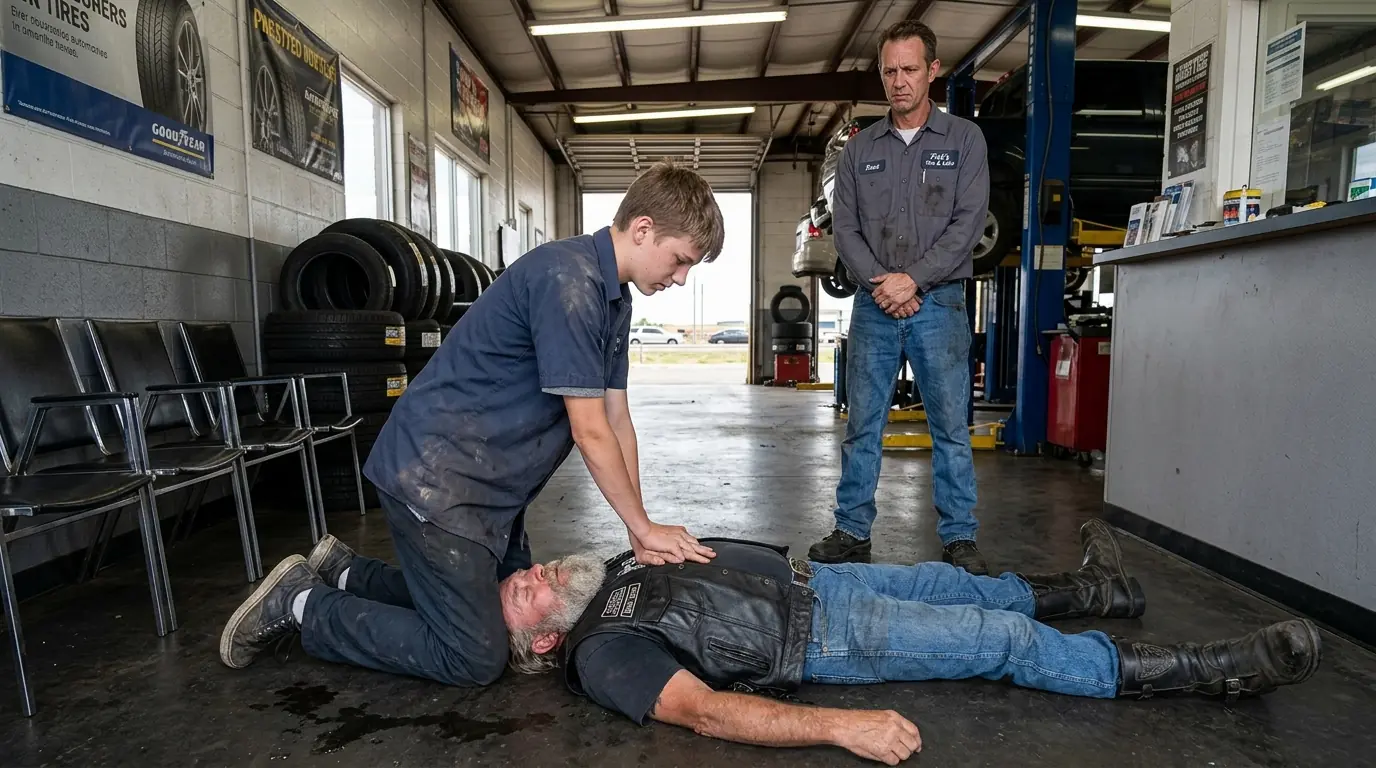
Del Rock hit the concrete face first and did not move. And by the time Bird got to him, the man's lips were going blue and his chest wasn't working and there was no pulse under Bird's shaking fingers at all cardiac arrest. Bird didn't know the words for it. He knew the shape of it because a nurse had drilled it into a room of bored group home kids one long afternoon two years back. Hands stacked, elbows locked.
Push to the beat of that old disco song and Bird had been the one in the back who paid attention. Because Bird always paid attention. Because paying attention was how a kid with no one stayed a step ahead of the next bad thing. He rolled the big man over, tore the shirt open, found the spot, stacked his hands on the wide steel chest, locked his elbows and pushed. He pushed hard the way she'd said, hard enough to crack, 100 beats a minute, counting under his breath.
The man's chest gave and came back under his palms. Bird pushed again and again. Sweat ran into his eyes and his shoulders started to burn inside the first minute because doing it right is nothing like the movies. It's brutal. It's your whole body.
Your knees grinding on concrete and your spine bowing over and your hands going numb. And Bird was a 140-lb kid driving his entire weight down into a 240-lb man over and over on a hot shop floor that smelled of oil and rubber. That was when Randy Fisk came out of the office. Fisk was a lean, sour man who ran his shop on thin margins and old grievances. And what he saw when he came around the counter was not a dying customer.