A homeless little girl finds a Hells Angels biker dumped like trash and her life changes forever. Some men spend their whole lives building something only to have it taken from them by the very people they trusted with their back and some men don't survive long enough to realize what happened. But this man did, barely. 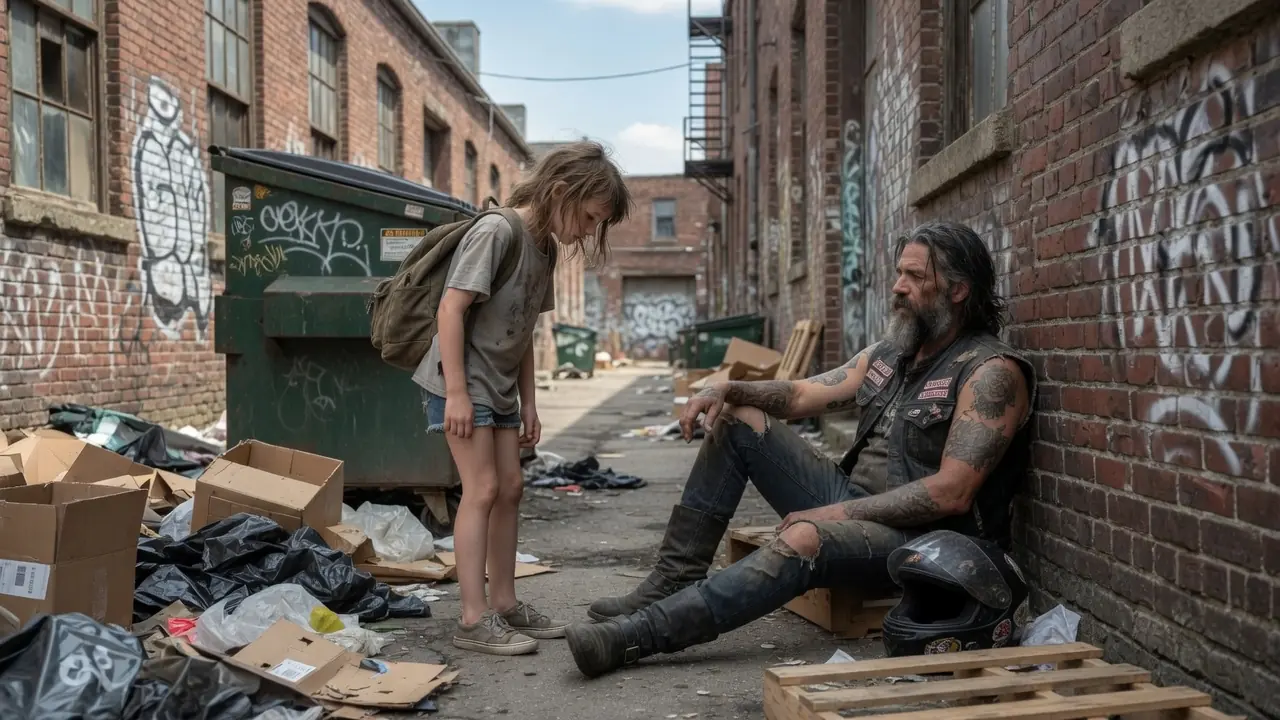
The landfill on the edge of the city didn't care who you were. It smelled the same whether you were a king or a beggar, hot rot, smoke, the sweet sickening decay of things that had been used up and thrown away. Eight-year-old Valerie Ballard knew that smell the way most kids know the smell of breakfast. It wasn't disgusting to her. It was just morning.
Her bare feet, toughened by years of cracked pavement and broken glass, moved carefully between the debris. She wasn't playing. She hadn't played in a long time. She was working because Grandma Rose's breathing had turned wet and wheezy the night before and the medicine wasn't free and the money didn't come from anywhere unless Valerie went out and found it herself.
She scanned the ground with practiced eyes. Old copper wire, a cracked phone, a piece of aluminum that might be worth something if she stripped it right. She almost missed him. Her foot caught on something that wasn't metal, wasn't plastic. It had weight to it, density, the stubborn resistance of a human body.
A skull wreathed in flames. And above it, three words stitched in red, Hells Angels Nomads. His face was turned to one side, jaw clenched even in unconsciousness, a deep gash running above his left temple. The blood had dried black in the heat. On his wrist, incongruously, almost insultingly, a heavy gold watch caught the afternoon sun and threw it back like a challenge.
Valerie stood frozen. Every instinct her eight years had given her said, "Run. Big man, biker, blood, danger, run." But then she heard it, a sound from somewhere deep in his chest. Low, guttural, a groan that didn't sound like a threat. It sounded like a man begging the darkness not to take him yet.
She crouched. Her hand trembled as she reached for his neck, pressing two small fingers to the pulse point the way she'd seen doctors do on the old TV her grandma kept by the window. There. Faint, but there. "Sir," she whispered. "Sir, you need to wake up. You can't stay here."
He didn't move. She looked around fast. The landfill had eyes in the late afternoon. Scavengers, older kids, men who saw that gold watch and would make a very different calculation than she was making right now. Night was maybe two hours away. After dark, this man was dead. Not from the head wound, from what would find him in it.
She dug into her backpack. Half a bottle of water, her only one saved for the hottest part of the day. She poured a careful trickle over his cracked lips. His eyelids moved, fluttered, then opened. Gray eyes. Pale as river stones, completely lost. "Where?" His voice came out broken, scraped raw. "Where the hell am I?"
"The landfill," Valerie said quietly with the calm of someone who understood that panic cost time they didn't have. "On the edge of the city, and you need to get up right now if you want to keep breathing." He tried to sit. The pain slammed him back down. He touched the side of his head, stared at the blood on his fingers like it belonged to someone else.
"I don't." He stopped. Something moved behind his eyes. Fear, real fear. "I don't remember anything. I don't know who I am. I don't know how I got here." Valerie studied him for a long second. The patches, the calloused hands, the jaw built for taking hits. This was not a man who scared easily, and right now he was terrified.
She made her decision. "It doesn't matter who you are," she said, pulling his arm with both hands. "What matters is we move now." Getting a 200-lb biker upright using an 8-year-old girl as the only support system is not something they teach you anywhere, but Valerie managed. He swayed, she braced. He leaned, she held, and they walked.
She guided him through hidden paths, trails she'd mapped over years of daily scavenging away from the main routes where the wrong people lingered. He moved in silence except for the labor of his breathing and the occasional grunt when his boot caught on something. She moved fast, scanning every shadow.
"What's your name?" he managed after a few minutes. "Valerie." "Thank you, Valerie," he said, and the way he said it, quiet, stripped of everything, told her more about him than any patch on his back ever could. She didn't answer. She kept her eyes on the path.
By the time they reached the landfill's edge, the city lights were beginning to blink on in the distance. He stopped for a moment, staring at his own hands, the tattoos, the scars, the watch, like they belonged to a stranger wearing his skin. "Do you think I'm dangerous?" he asked, and she could hear him dreading the answer.
Valerie looked up at him, at those gray, unguarded eyes. "Dangerous men don't look scared," she said simply. "You look terrified, so you're probably just in trouble." He had nothing to say to that. They kept walking. Neither of them knew in that moment that the road they were walking together was going to change both their lives completely. But that's the thing about the moments that matter most. You never see them coming.
Rose Ballard had survived things that would have broken most people. She'd buried a husband, raised a daughter alone, watched that daughter disappear and leave behind a granddaughter she was now raising on beans and willpower. She'd lived through winters with no heat and summers with no fans and years where the only thing standing between her family and nothing was her. She did not scare easily, but when that door opened and she saw what her granddaughter had dragged home, her hand went to her chest before she could stop it.
The warm light inside the house made the man look even worse than he had in the landfill. He filled the doorway. That was the first thing Rose noticed. A mountain of leather and ink and dried blood. One arm draped over the shoulder of an 8-year-old girl who was struggling and refusing to show it under his weight. His vest was shredded at the collar. The patches on it meant something. Rose was old, not ignorant. She knew what those patches meant.
"Grandma, it's me." Valerie's voice was calm in that infuriating way she had, the way that meant she'd already made up her mind and was simply informing the world. "I brought someone who needs help." Rose stood up from her chair slowly. Her joints protested every inch. She crossed the room and looked at the man the way a doctor looks at a patient, not with kindness first, but with assessment. Head wound. Real one, blood loss. The trembling in his legs wasn't weakness. It was the body burning its last reserves.
The man's eyes found hers. Gray eyes, still confused, still lost, but in them something else. Not aggression, not calculation, shame. He was ashamed to be seen like this. Rose had not expected that. "Who is this man?" she said, turning to Valerie, her voice carrying the full authority of a woman who had never once in her life been ignored. "And why is he in my house?"
"I found him in the landfill, Grandma. He was hurt and he doesn't remember anything. We couldn't leave him there to die." "We?" Rose repeated flatly. "There is no we in this decision, child. There is only you, and now there is this." The man spoke. His voice was rough, damaged, but steady. "Ma'am, I'm sorry. I didn't ask her to bring me here. If you want me to leave, I'll leave." He meant it. That was the thing. He actually tried to push himself upright away from Valerie's shoulder, ready to walk back out into the dark. His legs buckled immediately. Valerie caught him.
All 50-something pounds of her braced against his side, refusing to let him fall. Rose watched this, said nothing for five long seconds. Then she sighed, the deep, total sigh of a woman surrendering to something she already knew was inevitable. "Get him to the sofa," she said. "Don't let him bleed on the floor. I just cleaned it."
The sofa was small. He barely fit. He sat on the edge of it with his elbows on his knees and his head down while Rose moved to the stove, heating water without ceremony or warmth. Valerie hovered nearby, watching her grandmother with the careful attention of a child who knew when to speak and when to disappear.
Rose returned with a clean rag and a basin of hot water. She sat in front of the man and began cleaning the wound on his head, her movements efficient, practiced, carrying no tenderness and no cruelty. Just competence. He winced but didn't make a sound. "Those patches on your vest," Rose said without looking up. "You know what they mean?" "I know what they are," he said carefully. "I don't remember what they mean to me."
Rose worked in silence for a moment. "Hells Angels Nomads." "Men with no fixed chapter. Men who ride alone but answer to the brotherhood when called." She paused. "That's either very free or very dangerous. Sometimes both." He looked at her. "You know about that world?" "I know about every world," she said simply. "When you're poor, you learn to read people fast. Survival depends on it."
She pressed the cloth to the wound. He absorbed the pain without flinching. "The promises of men like you are worth nothing here, sir." Rose said quietly, not unkindly. "Rich or rough, it makes no difference in this house. But you look like a man with a very expensive problem." "Yes, ma'am." He said, "I think that's exactly what I am."
Dinner was three small plates of beans and handmade tortillas. Rose put the fullest plate in front of the stranger without comment. Valerie noticed. She always noticed everything. They ate in a silence that was surprisingly bearable. The man ate slowly at first, like someone reminding themselves how, and then with the quiet intensity of a person tasting food for the first time. Not because it was exceptional. Because he was hungry in a way that went deeper than his stomach.
Halfway through the meal, his fingers brushed the watch on his wrist. He turned it over. His thumb found a small button on the side, barely a raised edge in the metal. He pressed it without thinking. A soft voice filled the small room. Female, digital, but warm. "Recorded with care. For Jake, with all my love, Mary."
The name landed in his chest like a stone dropped into still water. Jake. He turned it over in his mind. Jake. It felt like trying on a coat that had been his once. Familiar in shape, strange in weight. Valerie had gone still across the table. "Is that your name, Jake?" "I think so." He said slowly. "And who's Mary?"
The question hung in the air. And the sensation that moved through him wasn't warmth. It wasn't longing. It was something darker, a coldness at the base of his spine that he couldn't explain and couldn't ignore. "I don't know." He said, "But something about that name doesn't feel right." Rose looked at him from across the table. Her eyes were steady, unreadable. "Sometimes the things that hurt us most are the things closest to us," she said. "Sleep on it. The truth has a way of finding you whether you look for it or not."
That night, after Rose had shown him the old blanket, clean, smelling of laundry soap, folded with a dignity that shamed him, and after Valerie had disappeared behind the curtain to her cot, Jake lay in the dark and stared at the ceiling. The house creaked around him. Wind moved against the metal roof. He touched the place where the watch sat on his wrist and thought about the voice, about Mary, about the cold feeling her name left behind.
He thought about the two women asleep a few feet away, one iron-spined and unafraid, one small and impossible and already more capable than most grown men he'd probably known. He didn't know who he was. He didn't know what he'd done or what had been done to him or who had left him for dead in that landfill like a broken thing past its use.
But he knew one thing with the absolute certainty of instinct, the only compass he had left. He would not let harm come to them. Whatever he had been before, whatever world he'd ridden through, whatever brotherhood he'd bled for, whatever enemies he'd made, that vow was the first solid thing he'd felt since opening his eyes in the garbage.
Outside, the moon moved across the landfill that had been his grave. Inside, three strangers slept under the same roof and the first fragile threads of something like family began to form in the dark. The days that followed were careful and quiet. Jake's memory returned in fragments, sharp and painful. Flashes of road, of brothers, of a life lived at high speed and low trust. Rose watched him carefully, but she saw no violence in him, only a man trying to remember how to be human.
Valerie followed him everywhere like a small shadow, asking questions that made him laugh and think at the same time. Rose taught him how to fix things around the house. Jake taught Valerie how to throw a punch that mattered. They ate together. They talked. They existed in the small space between survival and something gentler.
One evening Jake sat on the porch steps watching the sunset paint the landfill gold. Rose came out and sat beside him. "You remember enough yet?" she asked. "Enough to know I wasn't a good man," he said quietly. "Enough to know I hurt people who didn't deserve it." Rose nodded. She had expected as much. "The past doesn't own you unless you let it," she said. "You get to decide who you are now."
The decision came on a quiet afternoon when three men on motorcycles appeared at the edge of the landfill road. They wore the same patches as Jake's vest. They had come looking for their brother. Jake stood between them and the house, ready to protect what had become his without hesitation. The confrontation was brief. Words were exchanged. Recognition dawned. The men left without violence, carrying a message back to the club.
Jake chose to stay. He chose the small house, the old woman, the little girl who had saved him. He chose a different road. The club respected that choice. They left him to it. Years passed. Valerie grew tall and strong, carrying the lessons of kindness and courage into a world that needed both. Rose lived to see her great-grandchildren. Jake became the steady presence at the center of their family, a man who had been lost and found again through the simple act of one small hand reaching out in the garbage.
The landfill still smelled the same. The city still turned its back on the forgotten. But in that small house on the edge of everything, three people had built something unbreakable. A family born not from blood, but from the moment an 8-year-old girl refused to look away. Sometimes the greatest rescues begin with the smallest hands. And sometimes the fiercest brotherhood is the one you choose when the world throws you away.