The first time Graham Whitmore heard his daughter laugh after the accident, he was standing at the top of a staircase with a phone pressed against his ear, preparing to fire a man he had known for nineteen years. The laugh came through the open French doors at the rear of the house, so unexpected that Graham stopped speaking in the middle of a sentence. It was not the careful little sound Ella sometimes made to satisfy a nurse or reassure her father. It was a real laugh, surprised and wild, followed by another that rose above the fountain and carried all the way into the limestone hallway. Graham lowered his phone and walked toward the sound as if someone had called him by a name he had forgotten.
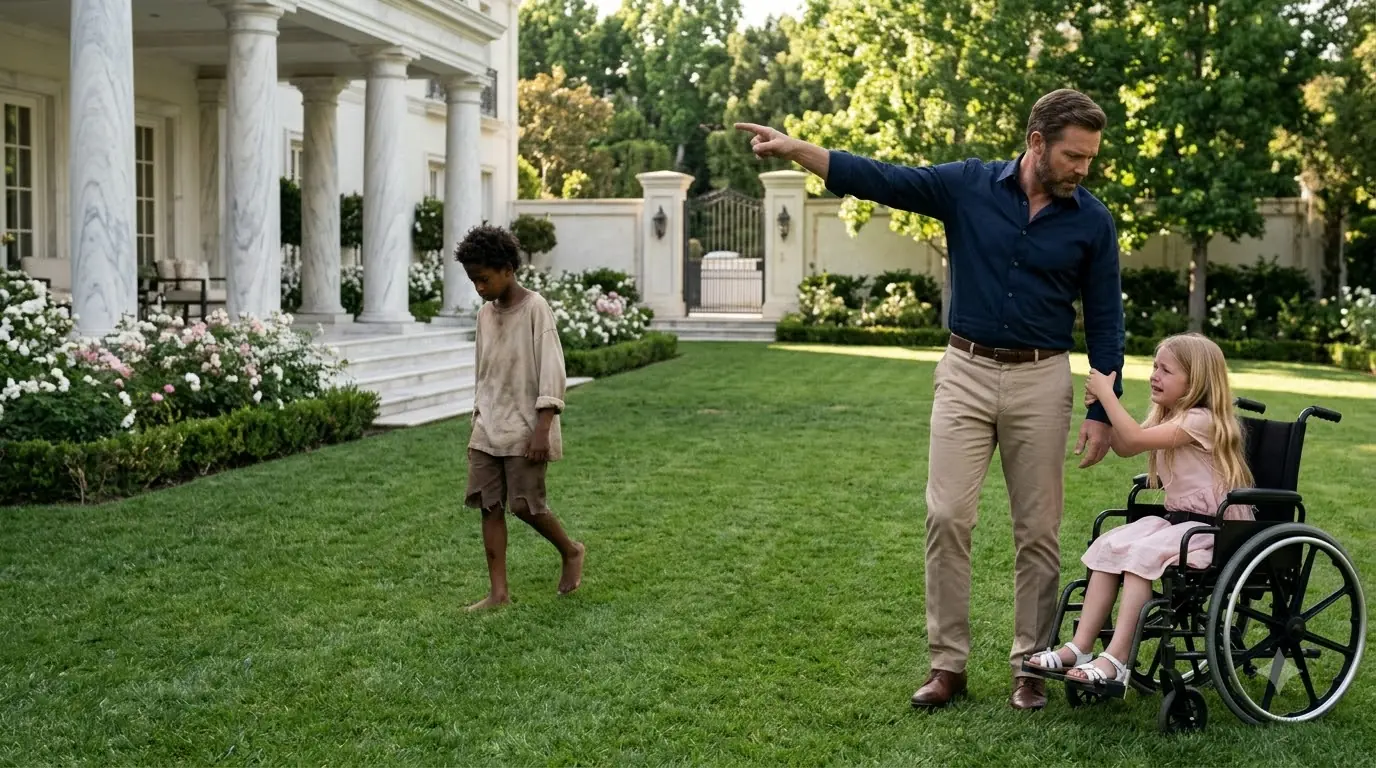
From the upper terrace of his Connecticut estate, he saw his nine-year-old daughter in her wheelchair beside the rose garden. Her hands were raised, and she was clapping hard enough to make the silver bracelet on her wrist jump. In front of her, a barefoot Black boy in a sweatshirt too large for his shoulders was performing what appeared to be a highly unsuccessful battle against his own feet. He lunged to one side, spun twice, stumbled deliberately, then snapped upright with the wounded dignity of a dancer who had just been betrayed by the ground. Ella laughed so hard she had to wipe her eyes. Graham gripped the terrace railing and forgot about the waiting phone call altogether.
A security guard emerged from the far walkway at a run. Graham opened his mouth to order the intruder removed, but Ella called out, "Again. Do the part with the invisible stairs." The boy made an elaborate bow, climbed three imaginary steps, discovered the fourth had vanished, and fell backward into the grass without letting his head touch the ground. Ella shrieked with delight. Graham could not remember the last time she had asked anyone to do something again. He held up one hand to stop the guard and watched until the boy noticed the movement above him and froze.
The property was called Ashbourne, though Graham had never liked the name. It stood on twelve landscaped acres outside Greenwich, behind iron gates, old stone walls, and a double row of maple trees that turned brilliant red every October. A century earlier it had belonged to a publishing family. Graham had purchased it after the sale of his logistics company made him rich enough to buy places he had once looked at from the other side of a fence. Now his holdings included freight terminals, commercial properties, and a transportation technology firm with offices in three states. Financial reporters called him a disciplined visionary. Employees used less flattering descriptions when they thought he was out of earshot.
Two years earlier, he had brought his wife, Caroline, and their daughter to Ashbourne because Caroline wanted a home where the windows opened and Ella could ride a bicycle without looking at traffic. They had laughed about the ridiculous length of the dining table and argued cheerfully over whether the west garden