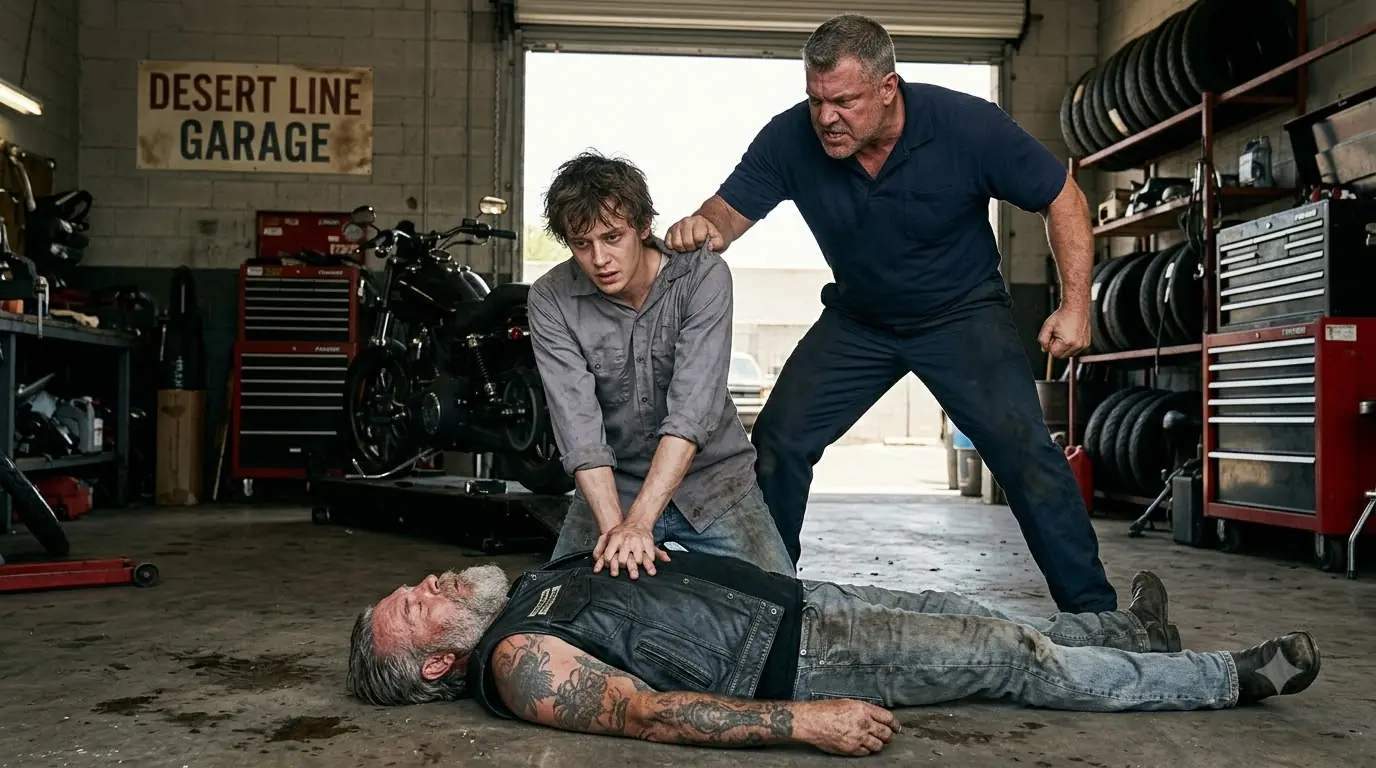
"Get back to work!" Marcus Bell screamed, grabbing Caleb's shoulder while Frank Dawson lay dying on the concrete. You're not a doctor. You're a nobody.
But Caleb shook him off. His hands were already bleeding from the pavement. His arms were already burning. And somewhere inside him, something had cracked open that could never be closed again.
He looked up at Marcus with eyes that had stopped being afraid. "Then fire me," he said, "but I'm not stopping. In Phoenix, Arizona, a homeless 20-year-old was about to make the most expensive decision of his life. The morning Caleb Whitmore almost let a man die began like every other morning with survival math. I woke at 5:47 a.m. in a motel room that smelled like mildew and old cigarettes, did the same calculation he'd been doing for 11 months and came up with the same number he always did.
Not enough, not enough saved, not enough time, not enough anything. The room cost him $38 a night. And after taxes and the $12 he put away each week toward the apartment deposit, he was slowly, painfully building toward, he had exactly $4.17 left over each day for food. That was his life. That was the entire architecture of his existence.
Built on numbers that barely held together on a job that could disappear the moment Marcus Bell decided it should. He splashed cold water on his face, looked at himself in the cracked motel mirror for exactly 3 seconds, then stopped. He'd learned early that looking too long didn't help anything. By 6:15, he was walking the mile and a half to Desert Line Garage because the bus cost $250, and that was money he didn't have. Phoenix in June didn't care.
The heat was already building even before 7:00 a.m., pressing down on the pavement, baking the air until it tasted like hot metal. Caleb pulled his cap lower, kept his head down, and walked. He'd been walking like that for years. Head down, quiet, invisible. That was how you survived when you had nothing and nobody.
Desert Line Garage sat on the eastern edge of a commercial strip where auto parts stores and fast food joints slowly gave way to warehouses and vacant lots. It was not a beautiful place. The parking lot was cracked asphalt with oil stains older than Caleb himself. Overhead lights inside flickered on a bad ballast that Marcus refused to replace, and the shop smelled permanently of grease, rubber, and something chemical that Caleb had never been able to identify. But it was his place.
In a life that had no anchors, this garage was the closest thing to solid ground he'd found. He pushed through the side door at 6:58 and went straight to the equipment locker. "You're late," he turned. Marcus Bell was already there standing near the front bay with his arms crossed and his mouth doing the particular thing it did when he was building towards something unpleasant. Marcus was 51, thick through the shoulders with the kind of face that had probably been good-looking once and had since soured into something harder.